


-
OCT 10, 2025

UNLOCKEDFederal judge partially grants Illinois temporary restraining order on deployment of National Guard
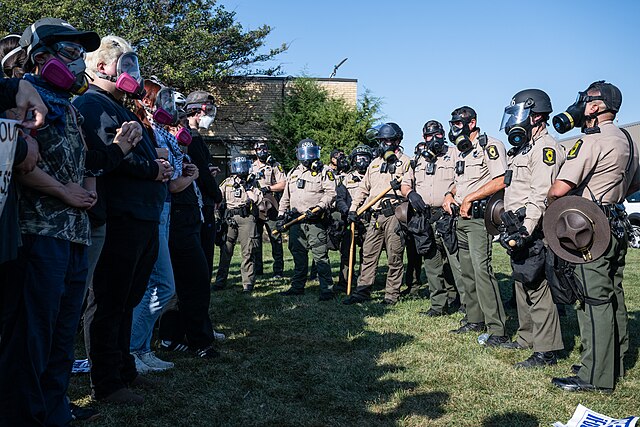
Protestors and Illinois State Police at a U.S. Immigration and Customs Enforcement facility in Broadview. [Paul Goyette/Creative Commons Attribution 4.0]
A federal judge partially granted Illinois’ request to temporarily block the deployment of National Guard troops Thursday.
The decision came with 500 guardsmen — 300 from the Illinois National Guard and 200 from the Texas National Guard — already deployed in the Chicago area.
The State of Illinois and City of Chicago sued the Trump administration Monday after President Donald Trump authorized the federalization of the National Guard over the weekend.
In their lawsuit, the state argued that the president’s federalization of the National Guard was not allowed under federal law, violated the constitution and would harm Illinois’ sovereignty.
Read more: Illinois sues Trump administration to stop deployment of Illinois, Texas National Guard in Chicago
The state asked for a temporary restraining order during a status hearing Monday. U.S. District Judge April Perry did not immediately grant the request, giving time for the federal government and herself to review the state’s filing.
Perry has been a district judge since November. She previously had been nominated to be the U.S. attorney for the Northern District of Illinois, but her nomination was blocked by then-Sen. JD Vance.
In a response filed late Wednesday night, the administration argued the deployments are necessary to protect federal property, particularly a U.S. Immigration and Customs Enforcement (ICE) facility in Broadview that has seen protests in recent weeks.
The administration said that while the National Guard deployment in Los Angeles saw troops deployed throughout the city, this deployment will specifically be around federal facilities.
Chief Judge Virginia Kendall released a statement ahead of oral arguments Thursday requesting the National Guard not be deployed at the federal courthouse in Chicago. A court filing Thursday said there were no plans to deploy the National Guard at the courthouse.
The administration argued the state had not proven that they were likely to be successful in their lawsuit. They argued the president was allowed to deploy the guard under federal law, which states that the guard can be federalized to combat rebellion or when the president is unable to enforce federal laws.
“The violent actions and threats by large numbers of protestors, directed at those enforcing of federal immigration laws and at federal property, constitute at least a danger of a rebellion against federal authority and significantly impede the ability of federal officials to enforce federal law,” the brief says.
The brief goes on to say that the National Guard would not be operating as law enforcement, something they are prohibited from doing.
A declaration included in the administration’s filing from U.S. Army Major General Niave Knell said the members of the Illinois National Guard were receiving training from 14 members of the federalized California Army National Guard. Members of the Texas National Guard began to protect the ICE facility in Broadview late Wednesday.
“By [Department of Defense] policy, the scope of the National Guard activities will be in response to requests for assistance from federal government agents and agencies only when they are related to protection of federal personnel performing official functions, as well as requests for protection duties such as protection of federal buildings,” Knell said in the brief. “The federalized National Guard will not be engaged in law enforcement activities.”
The temporary restraining order will remain in place until Oct. 23. A telephone hearing is scheduled for Oct. 22 to determine if it should be extended an additional two weeks.
The administration appealed the decision to the Seventh Circuit appellate court late Thursday night.


Trending


