


-
OCT 07, 2025

UNLOCKEDIllinois sues Trump administration to stop deployment of Illinois, Texas National Guard in Chicago
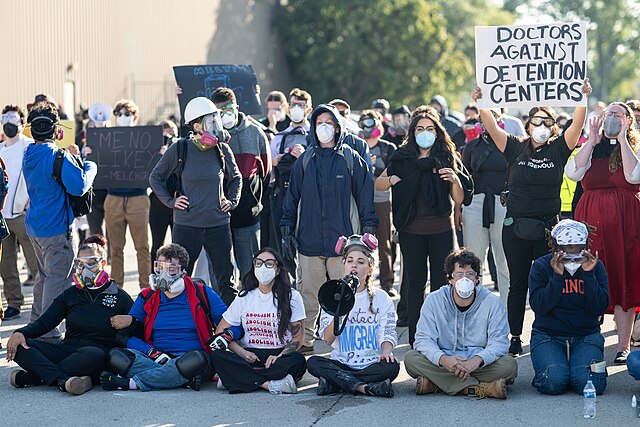
Protestors in Broadview on Sept. 26. [Paul Goyette/Creative Commons Attribution 4.0]
After more than a month of back-and-forth, the state has sued the Trump administration over orders to deploy federalized National Guard troops in Illinois.
This is the latest escalation in a standoff between President Donald Trump and Gov. JB Pritzker that dates back to Aug. 22 when Trump, shortly after deploying the National Guard in Washington, D.C. to combat crime, said Chicago would be next.
Pritzker, Attorney General Kwame Raoul and Chicago Mayor Brandon Johnson quickly rebuked the president’s comments, saying there wasn’t a need for federal troops in the city and any attempt to deploy them would be met with a lawsuit.
After more than a month, that lawsuit was filed in federal court Monday morning.
Pritzker said Sept. 30 that a memo had been sent to the Illinois National Guard requesting 100 troops to support U.S. Immigration and Customs Enforcement (ICE) agents amid ongoing raids in Chicago and surrounding suburbs. Pritzker said the memo mimicked one sent in Oregon, where the president made a similar attempt to deploy the National Guard.
That deployment has been blocked by a federal judge twice, once blocking the Oregon National Guard and once blocking the California National Guard.
In a statement released Saturday, Pritzker said he had been told by the administration that if he didn’t deploy the troops himself, the administration would federalize 300 members of the Illinois National Guard.
On Sunday, Pritzker said the Illinois National Guard had been notified that they would be joined by the Texas National Guard. Pritzker said, “400 members of the Texas National Guard” were being sent “for deployments to Illinois, Oregon and other locations within the United States.”
Pritzker is calling on Texas Gov. Greg Abbott, who confirmed via social media that he authorized the use of the Texas National Guard in other states, to rescind that approval.
“I have been very clear to Gov. Abbott, not the first time, but I have been very clear that he should withdraw his approval of the president calling up his Texas National Guard,” Pritzker said during a press conference Monday. “And again, Gov. Abbott should stay the hell out of Illinois’ business.”
The lawsuit, which was filed by the State of Illinois and the City of Chicago, details this string of events, along with comments made by Trump about Chicago dating back to 2013.
This follows weeks of protests at a Broadview ICE facility that have seen multiple arrests and the use of tear gas, pepper spray and rubber bullets. Department of Homeland Security (DHS) agents have received criticism for their treatment of protestors from Illinois elected officials, including Pritzker.
The lawsuit continues these criticisms, describing the protests as small, with fewer than 100 people at a time. It rejects that National Guard troops are needed to manage the protests and protect DHS agents.
“However, far from lawless riots, the Broadview protests have been small, primarily peaceful, and unfortunately escalated by DHS’s own conduct, seemingly for the goal of using them as a pretext for the Chicago troop deployment that was announced by Trump long ago,” the lawsuit says.
The lawsuit goes on to say that while local police cannot work with DHS on civil immigration matters under the Illinois Trust Act, Illinois State Police (ISP) had responded to three requests for support. Those three requests were for a protester possessing a firearm, traffic support and access to cameras at an ISP facility.
“Therefore, the limited protest activity also has not prevented the Trump administration from enforcing federal laws,” the lawsuit says.
The National Guard can only be deployed in three capacities: State Active Duty status, Title 32 status, and Title 10 status.
State Active Duty Status is invoked by the state governor, under which the National Guard is deployed under state law. Title 32 status is invoked when the National Guard is used by the federal government with the consent of the state’s governor.
Title 10 status is the federalization of the National Guard. This is the status that Trump has invoked in California, Oregon and Illinois. Under Title 10, the guard can be federalized when there is rebellion, insurrection or invasion.
The lawsuit argues that none of these three clauses are met in this case.
“There is no need or justification for a militarized response to anything going on in Chicago,” Raoul said Monday. “It is unfair to National Guardsmen, it is unfair to local law enforcement, and it is certainly unfair to the law-abiding citizens of Illinois who do not want to be subject to military occupation.”
The state and city also argue that the action harms Illinois’ sovereignty, takes National Guard troops away from other duties, such as disaster response, and could harm businesses by suppressing foot traffic.
They also argue the deployment violates the Posse Comitatus Act, which prohibits the use of military troops for law enforcement, except when authorized under the Constitution. The lawsuit argues this use does not fall within what’s allowed.
Finally, the state and city argue the order violates the Administrative Procedures Act and multiple Constitutional clauses, including the Tenth Amendment and separation of powers.
Defendants in the lawsuit include Trump, DHS,the Department of Defense (DOD) and the U.S. Army, as well as DHS Sec. Kristi Noem, DOD Sec. Pete Hegseth and U.S. Army Sec. Daniel Driscoll.
The state and city are seeking a temporary restraining order to prevent the deployment of troops. They are asking for the order to be ruled unlawful and for orders to the Illinois, Texas and any other state National Guards to be vacated. Finally, they’re asking for Hegseth and the DOD to be permanently instructed to not federalize any state National Guards in Illinois over the objection of the governor.
Attorneys from the state, city and federal government met Monday in court for a status hearing, during which Department of Justice Deputy Assistant Attorney General Eric Hamilton confirmed troops are on their way and are expected to begin performing their duties Tuesday at the earliest, as reported by the Chicago Sun-Times.
Oral arguments in the case are scheduled for Thursday.


