Springfield News
-
Hundreds of hopeful candidates lined the sidewalk and street in front of the Illinois State Board of Elections Monday morning in Springfield, angling for the chance to be listed first in their contested races on 2018 ballots. Those who missed their shot today will have until Dec. 4 to file their petitions.
From the 18th Congressional District, Brian Deters (D-Morton) filed to challenge incumbent U.S. Rep. Darin LaHood (R-Peoria) and his long-shot primary opponent Ray Rients (R-Benson). From the 13th Congressional District Betsy Dirksen Londrigan (D-Springfield) stood in line for a shot at Republican U.S. Rep. Rodney Davis’ safe seat.
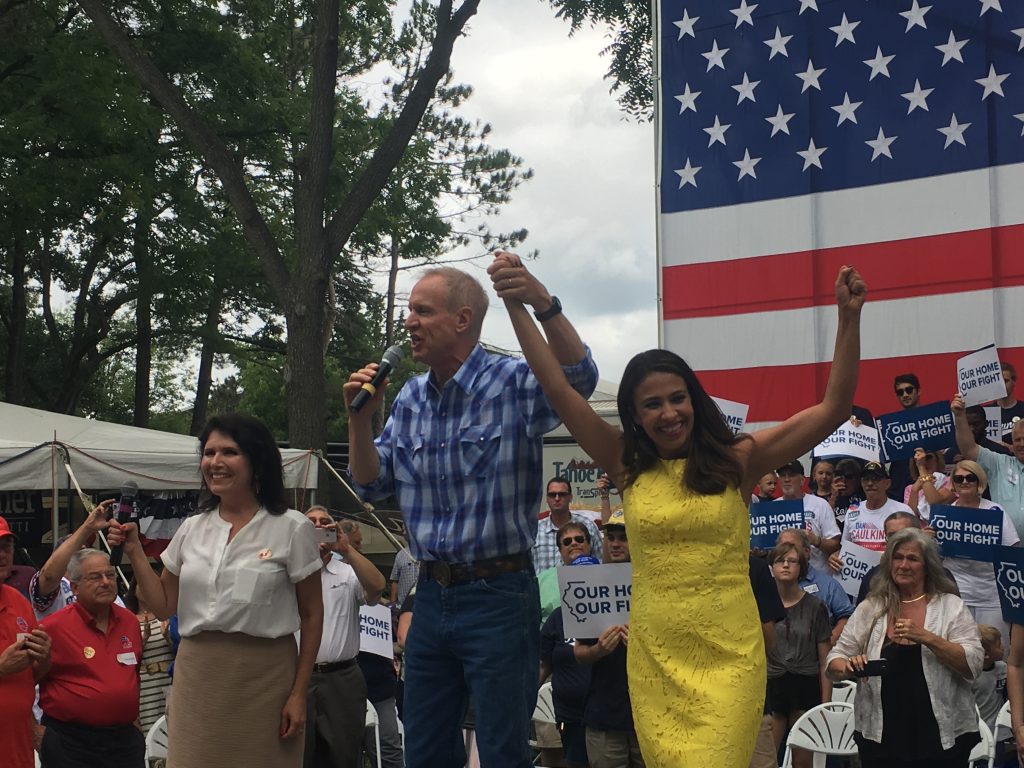
Candidates filing petitions for Attorney General yesterday included Chicago Democrat state Sen. Kwame Raoul (pictured left), former federal prosecutor Renato Mariotti (D-Chicago), state Rep. Scott Drury (D-Highwood), Highland Park Mayor Nancy Rotering, and former Gov. Pat Quinn. Sharon Fairley was absent, however. The only GOP candidate to file was Erika Harold (R-Urbana), who has received the endorsements from her party and Gov. Bruce Rauner.
Remarking on the biennial tradition, Raoul said “In other states, they have the option to either pay to get on the ballot or circulate petitions. I think the circulation of petitions is better because it actually forces you to speak to the voters. When I got here I had my folks at the front of the line, however I started at the back of the line talking to different first-timers who are filing because I think it’s an important experience for them and it’s an important reflection of what our democracy is and should be."
Mariotti, however, was eager to get moving.
"I think it’s fine but I wish, instead of spending so much energy here in line, we could spend that energy doing some good for people," he said. Mariotti was eager to see movement in the Attorney General's office as well, advocating for a stronger advocacy role in the office. "I don't want us to be limping into these things. I want us to be on the leadership and forefront of these things and I want us to be more aggressive taking on the Trump administration and the Rauner administration."
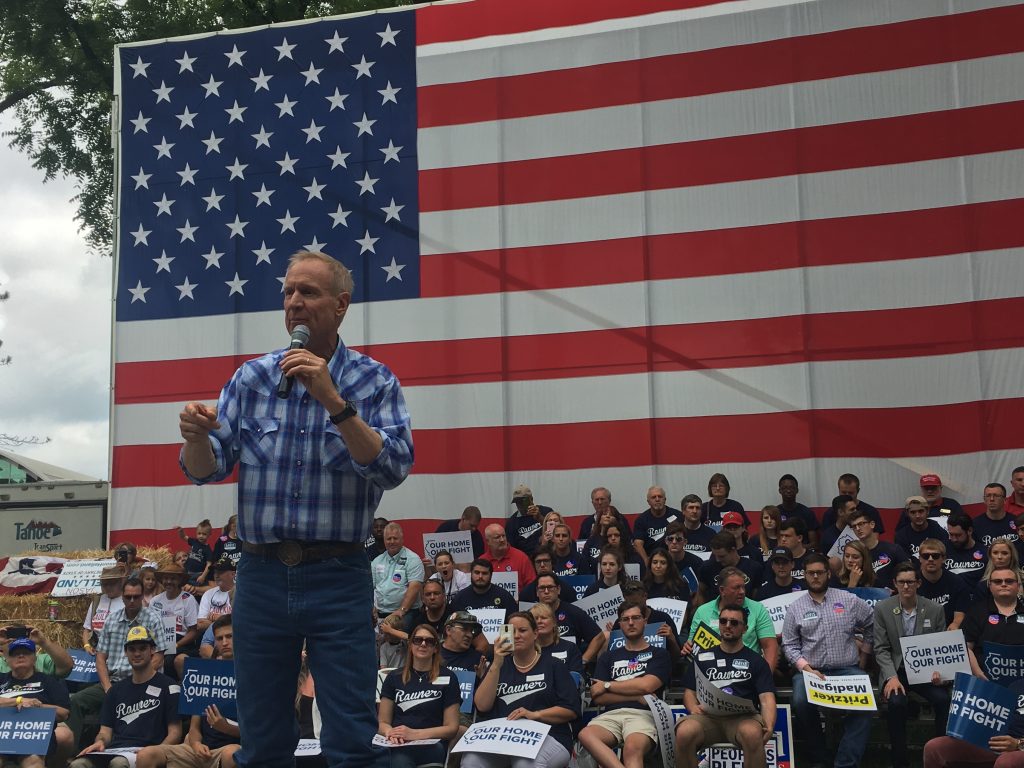
Campaign staffers for Gov. Bruce Rauner and Lt. Gov. Evelyn Sanguinetti filed on behalf of the absent duo, but primary challenger and state Rep. Jeanne Ives (R-Wheaton) held off, announcing she would be filing more than 13,000 petitions later this week.
Democratic gubernatorial candidates were spotted in line including Chicago Democrat J.B. Pritzker (pictured right), state Sens. Daniel Biss (D-Skokie) and Latesa Wallace (D-Rockford), and Democrat Ra Joy, running mate of the absent Chris Kennedy.
“We weren’t interested in camping out overnight but we wanted to make sure we were here by 8:00 a.m.," said Biss, "to make sure we were filing our petitions at 8:00 a.m. to make sure we had the lottery shot to be at the top of the ballot. But also to respect the hundred of volunteers across the state who worked in the rain and the cold and the sleet to get these signatures.”
Biss said this Illinois political tradition carries significance for him during his first filing at the new Springfield location. “This is about all of us standing together in one place at one time. It’s not a Facebook message, it’s not a virtual town hall. It’s actual people standing together and exercising a civic right.”
Candidates for the state Senate filing Monday also included incumbent Sen. Andy Manar (D-Bunker Hill) and his Christian County GOP Chair opponent Seth McMillan (R-Taylorville). In the 50th Senate District, incumbent Sen. Sam McCann (R-Plainview) was notably absent but his primary challenger Steve McClure (R-Springfield) filed.
Illinois House candidates filled the lines also, shoving boxes of paper petitions along the pavement. House GOP Leader Jim Durkin filed petitions today, although his opponent did not. Several candidates for the House’s 25th District crowded the sidewalk, along with Republicans from Springfield, former restaurateur Mike Murphy in the House’s 99th District seat and incumbent Rep. Tim Butler in the Hosue’s 87th. Incumbent Rep. C.D. Davidsmeyer (R-Jacksonville) also filed petitions to keep his seat in the 100th District.
Follow The Daily Line Springfield for continued coverage and updates on candidate filings through the week. -
- 10:00 a.m. - Five House and Senate committees will hold a joint subject matter hearing on SB316 and HB2353, the twin bills containing the Cannabis Regulation and Taxation Act. Senate committees to appear include Appropriations I, and Commerce and Economic Development. The three House committees slated to appear: Appropriations-Public Safety Committee, Economic Opportunity Committee, and the Committee on Tourism, Hospitality & Craft Industries. The body will convene in room C-600 of the Bilandic Building in Chicago. SB316 is currently in the Senate Assignments Committee, while HB2553 remains in House Rules. Lawmakers are not expected to vote on either bill at this time.
- A report from The Daily Beast revealed the largest PAC-funder for accused sexual assailant and Senate candidate Roy Moore (R-Alabama) is Illinois businessman Richard Uihlein, a prominent funder of the Illinois Policy Institute and of Illinois GOP candidates. The “mogul and his wife donated a combined $26.4 million to federal campaigns, party organs, super PACs, and interest groups during the 2016 election cycle, according to FEC data.”
- 11:30 a.m. - Gov. Bruce Rauner and Lt. Gov Evelyn Sanguinetti will be in Chicago this morning for a campaign stop, but to cover it members of the press will be required to present credentials which may include a driver’s license. The pair will join State Police Director Schmitz, and U.S. Customs and Border Protection (CBP) to discuss enhanced international mail screening procedures to combat the opioid epidemic at the Chicago International Service Center, 11600 W. Irving Park Road. A note included in the governor’s press release says “Media must check-in before 11 a.m. Credentialed media only. To expedite identification process, email [email protected] with names and a copy of driver’s license.”
- A new attempt at the Equal Pay Act has started picking up co-sponsors in the House. HB4163, from Rep. Anna Moeller (D-Elgin) “prohibits an employer from: (i) screening job applicants based on their wage or salary history, (ii) requiring that an applicant's prior wages satisfy minimum or maximum criteria, and (iii) requesting or requiring as a condition of being interviewed or as a condition of continuing to be considered for an offer of employment that an applicant disclose prior wages or salary. Prohibits an employer from seeking the salary, including benefits or other compensation or salary history, of a job applicant from any current or former employer, with some exceptions. Limits defenses. Provides for penalties and injunctive relief.”
- SB867, from Sen. Thomas Cullerton (D-Villa Park) was finally sent to the governor’s desk yesterday. The bill reduces filing fees for LLCs “to match the fees for similar documents in the fee schedule for corporations.” The measure becomes effective on the governor’s signature.
- Rep. Art Turner (D-Chicago) filed HB4173 which “provides that a committed person who is at least 50 years of age and who has served at least 25 consecutive years of imprisonment in a Department of Corrections institution or facility may petition the Department for participation in the Pathway to Community Program.” Participants would have to complete a Department of Corrections “restorative justice program” before being considered for the Pathway to Community Program, which it authorizes the DoC to administer with some discretion.
- In a press release from her office yesterday, Attorney General Lisa Madigan “condemned Federal Communications Commission (FCC) Chairman Ajit Pai’s plan to roll back existing net neutrality rules that prohibit internet service providers (ISPs) from discriminating among consumers and content providers. Madigan argues the rollback will result in consumers losing internet freedom to visit and obtain content from any site of their choice without interference...In July, Madigan led a coalition of 14 attorneys general in submitting comments to the FCC in opposition to the proposed rollback of critical net neutrality protections.”
-
Monday, November 27
8:00 a.m. - Doors open at the State Board of Elections as state candidates and their surrogates line up for a shot at the top of the ballot. The board is located in the Town and Country Shopping Center in Springfield, 2329 S MacArthur Blvd.
1:00 p.m. - The Business Enterprise Program Council’s Certification Subcommittee will meet in room 4-404 of the Thompson Center in Chicago. The public is also invited to join the meeting via teleconference by dialing (888) 494-4032, and using access number 2587213722. The body is expected to hold an appeal hearing for D.C. Excavation Services of Springfield. Agenda.
Tuesday, November 28
10:00 a.m. - Five House and Senate committees will hold a joint subject matter hearing on SB316 and HB2353, the twin bills containing the Cannabis Regulation and Taxation Act. Senate committees to appear include Appropriations I, and Commerce and Economic Development. The three House committees slated to appear: Appropriations-Public Safety Committee, Economic Opportunity Committee, and the Committee on Tourism, Hospitality & Craft Industries. The body will convene in room C-600 of the Bilandic Building in Chicago. SB316 is currently in the Senate Assignments Committee, while HB2553 remains in House Rules. Lawmakers are not expected to vote on either bill at this time.
10:00 a.m. - The Illinois Racing Board will meet in room 9-040 of the Thompson Center in Chicago. The group will consider renewal requests from six licensees in the state. The body recently announced its annual $750,000 charity program funding grant for non-profit organizations that provide health and wellness services to persons working or residing on the backstretch of Illinois’ pari-mutuel race tracks. The deadline to apply for the grant is Dec. 4. Grant application and description. Agenda.
2:00 p.m. - The Institutional Review Board of the Department of Children and Family Services is scheduled to meet in suite -100, the Southwest Conference Room, of the Thompson Center in Chicago. The meeting will also be open to the public via teleconference by dialing (888) 806-4788, and using access code 9447161737#. The group’s chosen topic is anyone’s guess: No agenda or meeting minutes have been posted on the board’s official website since June of this year. Contact Chair Janet Ahern at (312) 633-3415 for more information.
3:00 p.m. - The Working Group Regarding Treatment and Coverage of Substance Abuse Disorders and Mental Illness will meet in both Chicago and Springfield at the state’s Department of Public Health Offices. In Springfield, the public can attend in Conference Room, 535 W. Jefferson Street. In Chicago, the meeting will be held on the 35th floor conference room at 69 W. Washington Street.
Wednesday, November 29
8:00 a.m. - 4:00 p.m. - The Illinois Chamber of Commerce will hold its fourth annual New Laws Forum in conjunction with the Illinois State Council’s Society for Human Resource Management. The all-day event will be held at the Hilton Lisle, 3003 Corporate West Drive, in Lisle, Illinois 60532. Government and legislative updates will start at 1:00 p.m. Panelists include: Sen. Mike Connelly (R-Wheaton), Sen. Heather Steans (D-Chicago), and Rep. Mark Batinick (R-Plainfield). Program.
1:00 p.m. - 5:00 p.m. - The state’s Fire Advisory Commission will meet at the Springfield office of the State Fire Marshal, 1035 Stevenson Drive, in the auditorium. The commission will handle an intergovernmental agency agreement, and discuss their preliminary legislative and regulatory agendas. Agenda.
Thursday, November 30
1:00 p.m. - The House Appropriations-Human Services Committee will meet in C-600 of the Bilandic Building in Chicago for a subject matter hearing on Illinois Health and Family Services’ $12.5 million no-bid contract with consulting firm McKinsey and Company. The McKinsey contract is part of Gov. Bruce Rauner’s recent Medicaid overhaul deal worth $63 billion, the largest vendor contract in the state’s history. The body is not expected to vote on any legislation at this time.
Friday, December 1
9:00 a.m. - The Illinois Community College Board will meet at the Harry L. Crisp II Community College Center in Springfield. The group has not yet posted an agenda for the meeting. For more information, the board can be reached in their Springfield offices at (217) 785-0123.
09:30 a.m. - The Affordable Housing Trust Fund Advisory Commission of the Illinois Housing Development Authority will meet in the IHDA Board Room on the 11th floor at 111 E. Wacker Dr., in Chicago. No agenda has yet been made public.
The Eastern Illinois Economic Development Authority is scheduled to meet at the EIEDA Office, 1817 South Neil Street, Suite 100, in Champaign. The board has posted neither a time, nor agenda for the upcoming meeting but Executive Director Andrew Hamilton can be reached for more information at (217) 359-6261, (866) 325-7525, or via email at [email protected]. -
The State Board of Elections voted down a motion Monday to withdraw Illinois from participation in the controversial Interstate Voter Registration Crosscheck Program. The 4-4 split fell along party lines, with nay votes from Republicans who opposed to the move to leave.
[ Nay votes: Andrew Carruthers, Ian Linnabary, Katherine O’Brien, William Cadigan. Aye votes: William McGuffage, Charles Scholz, Casandra Watson, John R. Keith. ]
-
Appointments to the Senate's sexual harassment task force are followed by federal endorsements for state House candidates this weekend. Meanwhile, Illinois economic health is listed second-worst by a well-known organization.
- The State Board of Elections will convene at 9:00 a.m. in Springfield today to take up a vote on the controversial interstate Crosscheck program and to hold a mandatory public hearing on automatic voter registration.
- Congressman Luis Gutierrez (D-IL) on Saturday endorsed progressive Democrat and community advocate Delia Ramirez to be the next representative of the 4th House District. In a Friday release, Ramirez wrote that she “was drafted this spring by residents of the 4th House District to run for the open seat being vacated by path-breaking state Rep. Cynthia Soto, who is retiring.”
- Senate Republican Leader Bill Brady (R-Bloomington) announced additional appointments to the Senate Task Force on Sexual Discrimination and Harassment Awareness and Prevention. The two advocate appointments are Ahlam Jbara of the Illinois Coalition for Immigrant and Refugee Rights, Dr. Kathleen Robbins of Equality Illinois. Brady also appointed five members of the public. They are: Maria Rodriguez, Former Mayor of Long Grove; Maureen Maffei, Attorney; Julie Proscia, Attorney; Anita Rodriguez, assistant state’s attorney of Adams County. In a Friday release, Brady said: “In making these appointments, it is important to bring both diversity and an outside perspective to how best address this important issue in the public and private sectors.”
- Yikes. In his weekly newsletter, Sen. Kyle McCarter (R-Vandalia) mentions a study from Pew Charitable Trusts on states’ economic health. Illinois is ranked second worst. It reads: “New Jersey had the largest deficit, with aggregate revenue able to cover only 92.2 percent of aggregate expenses, followed by Illinois (94.2 percent). They were the only two states with aggregate shortfalls exceeding 5 percent of total expenses, and the only ones with annual deficits in each of the 15 years.”
- McCarter links the poor Pew score to another study on the loss of skilled labor across the states. From Georgetown University Center on Education and the Workforce, the study is worth a glance: “Illinois was among five states that suffered the most significant blue-collar job losses during the period from 1991 through 2015. The Georgetown University study was actually about the number and availability of good paying jobs for those people with less than a bachelor’s degree. While nearly half of the 50 states added jobs in this sector, Illinois, New York, Pennsylvania, California, and Ohio suffered the most blue-collar job losses.”
- From the press release box we learn: “Attorney General Lisa Madigan, along with 15 other attorneys general, filed a new amicus brief opposing the administration’s third travel ban. The amicus brief, filed in support of the plaintiffs in IRAP v. Trump, urges the U.S. Court of Appeals for the Fourth Circuit to affirm the nationwide preliminary injunction against the third travel ban issued by a Maryland district court. The district court’s injunction prevents the administration from implementing the third ban against individuals from six predominantly Muslim countries who have a bona fide relationship with a person or entity in the United States.”
-
After hearing an alarming presentation on the widespread vulnerability of Illinois voters’ personal data, a joint House and Senate committee had searing criticism for the State Board of Elections. The board’s sole Chicago-based representative provided answers for the panel regarding the Interstate Voter Registration Crosscheck Program. What lawmakers may not have realized, however, is that their pointed remarks were directed toward an agency already on their side of the issue.
Crosscheck has been at the center of a national voter data crisis. And in Illinois on Wednesday, the two committees were made aware of the depth of the systems mismanagement. Shawn Davis, professor of information technology and management at Illinois Institute of Technology, demonstrated how he was able to obtain crucial Crosscheck encryption keys for millions of Illinois voters via an improperly redacted FOIA request.
Davis also illustrated for the committees how a lack of Crosscheck file integrity checks mean state data uploads could be phished for. “They could also trick a state into uploading files to just a fake Arkansas FTP server,” he said.
Regarding individual voter rolls, Davis said attackers “could add names. They could potentially disqualify more voters and influence the program. They could potentially subtract names to allow more duplicate votes which would influence the program. There are no checks in place to see if that happened.”
Davis is just one of the 600-plus members of the public with committee witness slips in their names, who have been fighting for the state’s withdrawal from Crosscheck and for greater investment on voter data security.
The non-partisan State Board of Elections is anticipated to take a vote relating to the use of Crosscheck during their coming Monday meeting during. Illinois election officials say they'll review security questions raised about a multi-state voter registration database.
Rep. Will Guzzardi (D-Chicago) drew applause from the room when he called for the board to take immediate action.
“For months now it’s been very obvious that millions of Illinois personal data is at risk because of our participation in this program,” he said. “A good number of us feel very strongly that the board ought to get us out of Crosscheck as quickly as possible and if it’s going be discussed at this meeting next Monday, I encourage that “
SBE members may be a step ahead of Guzzardi. Members have a long record of preference for the panel’s desired voter data verification network, the Electronic Registration Information Center (ERIC).
"I don't think there's any argument that ERIC is a superior system," said SBE’s Assistant Executive Director Bernadette Matthews.
According to Matthews, the crux is in Crosscheck’s lower cost and exponentially larger user base, a factor SBE has to consider in order to comply with statutory requirements. While caught in the dilemma, SBE technology staff have continued to build a case for the state’s investment in ERIC. Since 2015, the board has been required by law to participate in the expensive proprietary network via SB172 while receiving insufficient state funds to pay their way. Consortium membership costs $83,000 per year plus a $25,000 one-time charge, and further one-off fees.
While Crosscheck security failures became more evident nationally, SBE board members saw solutions in ERIC, which they noted “previously provided an anonymizer program, which is a form of security that the data runs through right before it is sent to ERIC. In addition, the driver’s license number and source key were encrypted as another double security feature.”
As data protection advocates grew louder in state government, SBE echoed those calls for greater investment in voter security. In a Sept.19 meeting, SBE again called on subsidized funding for a better voting data system.
“Insofar as voter list maintenance is concerned, Illinois is a participant in both the Interstate Crosscheck and ERIC programs. Our experience in both indicates that the more robust data-matching done by ERIC gives much more accurate results, with far fewer false positive results and very sound data security. We would recommend that ERIC membership be encouraged, or even monetarily subsidized, for all states,” reads the report.
Hearing Matthews’ agreement with the panel preference Wednesday, Rep. Ann Williams (D-Chicago) asked the question on the minds of many members: What’s stopping Crosscheck-using states from securing their data?
The short answer is the money, time, and inter-state coordination. There’s also the matter of how tightly the dual systems are tangled in many states, including Illinois.
Rep. Mike Fortner (R-West Chicago) laid it out clearly at the meeting when he confirmed that since the state is a member of both Crosscheck and ERIC, it gets match lists from both of those systems. And in both cases the board will combine the results, then sort them by election jurisdiction, before sending the results to the corresponding election authorities in each area. But despite the partisan rhetoric which has come to dominate the topic of Crosscheck, Fortner advised the same caution as Democratic lawmakers.
“It strikes me that when we talk about how anyone can be automatically removed (from voter rolls), it seems like it would invite a federal lawsuit,” he said.
The tangle of two systems is only the most recent chapter of SBE’s voter data story. An October 2015 board report illustrates how intertwined the agency’s work has become with others since SB172’s passage. Sections detail additional cross-training and presentations from SBE technology staff to implement a myriad of programs with at least seven other executive agencies most with their own unique data management systems. As ERIC evolved into a more secure product, that entanglement increased.
In June of this year, SBE member Kyle Thomas “reported that the ERIC membership is now being used to perform the National Change of Address (NCAO) updates. He indicated the next step was take the information for the cross-state movers, merge it with the interstate cross-check system.”
Even individual system improvements and introductions became linked to the other systems. By August of 2017, Thomas was discussing “the (Illinois Voter Registration System database) program and said the polling place lookup feature on the website was updated to allow individuals who are not registered to vote to find their polling place so they may register to vote during grace period on election-day. Staff is also configuring IVRS to reflect not only the interstate cross-check data, but also the cross-state mover information from the agency’s membership in ERIC.”
Illinois isn’t the only state locked into a difficult marriage of data practices, but others have left Crosscheck.
“The reasons why some states left Crosscheck is because of the concerns that have been raised about Crosscheck’s insecurity and accuracy,” Matthews told lawmakers Wednesday. But another “reason why some states are not yet in ERIC has to do with the funding.”
SBE faced brutal cuts through state’s budget impasse, with telling moments highlighted in a July 2015 report, in which SBE Legislative Liaison Cris Cray “said that the agency budget was vetoed and was not included in the bill for a one-month budget. The Executive Director noted that the agency is in a state of uncertainty and he was not sure if paychecks would be issued on July 15. He felt things were O.K. on the operational side of things and said staff will continue to work in the absence of a budget.”
Even then, SBE’s Kyle Thomas saw the impact on the agency from SB172 and “noted that it was an unfunded mandate and the major change was expansion of the Paperless Online Voter Application (POVA). In addition, the bill required the SBE to participate in the ERIC.”
This made Illinois the first state to include information from state agencies other than just those responsible for voter registration. The report said “the contracts for the contractual employees that have been assisting with the project were in place prior to the end of the fiscal year,” but “election authorities were also in need of hardware and software to support the updated POVA system and they could seek reimbursement through the next IVRS State Grant, depending on FY16 funding.”
As the complicated interlocking systems aged, the SBE suffered heavy financial burdens. A record of the board’s June 2017 meeting paints a picture of an executive agency struggling to keep up with growing IT needs but without a growing IT budget.
“We do note that the voting systems used throughout the state are mostly those purchased more than a decade ago with considerable federal funding assistance through HAVA grants. Those old voting systems are at, or beyond, their usual lifespans, and will need replacement in the very near future,” reads an August 2017 board report. “The latest (2015) standards for voting systems include a number of security upgrades. It would be a tremendous (and much needed) help to all of the state and local election administrators if another round of HAVA funding would be made available to replace the old voting systems with new, more secure technology.”
For all the furor from lawmakers over the Board of Elections’ data security protocols, the agency couldn’t even pay for their anti-virus software.
“The McAfee antivirus license expires on September 4, 2017. Mr. Turner was unsure if the vendor would even provide a bid since the agency has been in payment arrears for two years. If the license is not renewed, Mr. Turner said it is possible that the agency will have to disconnect from the internet to prevent virus and malware infiltration,” reads an August report.
In fact, the very system which lawmakers on Wednesday demanded the board use, is the one lawmakers couldn’t pay for.
From the same August record: “Kyle Thomas reported that the ERIC Board voted to grant the agency an extension for payment to June 30.”
At their Aug. 22 meeting, board support for Automatic Voter Registration legislation appeared strong, but the body was closely monitoring the movement of budget bills for any signs of assistance. The 11-member agency was also stretched on personnel. They were asked to assist in gathering jurisdictional cyber-attack information for state Sen. Michael Hastings (D-Tinley Park) and U.S. Sen. Dick Durbin (D-IL) while SBE Executive Director Steve Sandvoss was being called to testify in front of the U.S. Senate Intelligence Committee to provide information on the state’s 2016 Distributed Denial of Service attack and the SBE’s current prevention efforts.
SBE Legislative Liaison Cray also relayed to the board her experience attempting to secure the required funding to implement AVR which, if carried alone, the board once estimated could cost as much as $940,000.
“She also was informed by the House Democrats that an appropriation hearing has not been set and was unsure if one would be scheduled. Discussion ensued regarding (AVR bill) SB250 and its impacts on the agency,” it reads.
Since then, new inter-agency labor sharing agreements have arisen which would significantly drive down those estimated costs. But according to SBE board members and the secretary of state’s office, even now, no appropriations bill exists for the necessary AVR work.
Matthews, however, did not flag when she spoke to The Daily Line. “It’s a question of resources which determines how just how long takes,” she said “but whatever the mandate, we always get it done.”
She also said the board has recently regained its footing, since the passage of the state budget. Matthews said the agency recently made new arrangements with and cleared its debts to ERIC, McAfee, and other vendors with the arrival of the first payments from the comptroller's office.
It was in the wake of this recovery that she faced the ire the House and Senate Committees who, finally awake to the state’s data vulnerability, are ready to see a quick departure from a dangerous system which may yet require a lengthy separation.
“It has been demonstrated that Crosscheck is being used, even though it may not have originated this way as a very partisan tool and I think it’s irresponsible for the State Board of Elections to be complicit in allowing the removal of voters in other states with our data,” said Rep. Carol Ammons (D-Champaign). “We are complicit in the denial of voting rights for people in other states, and its demonstrable...And yet the State Board of Elections has not responded to the demonstrated fact.”
Noting a recent move by Idaho’s state legislature which is currently weighing legislation for the state’s formal removal from Crosscheck, Ammons concluded: “We may have to do the same thing if the State Board of Elections continues to refuse to.”