


-
NOV 04, 2025

UNLOCKEDCounty assessor faces questions about legislative agenda, mitigating tax bill headaches during budget hearing
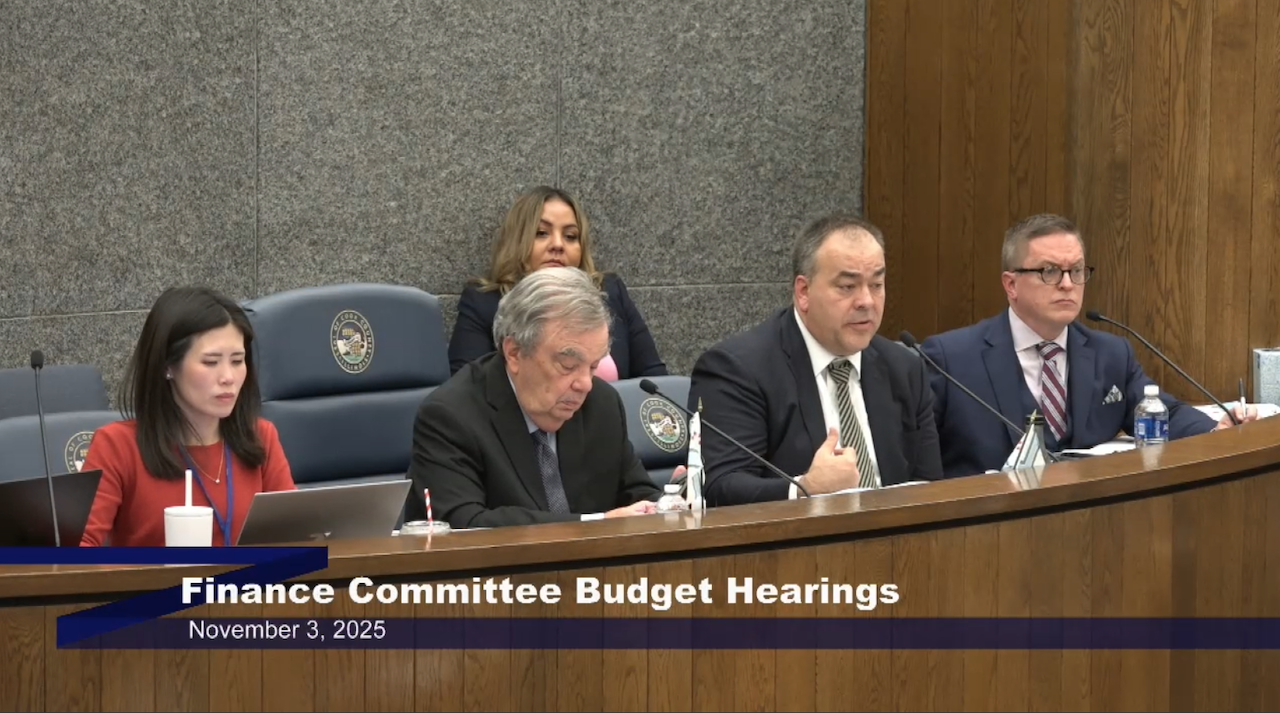
Cook County Assessor Fritz Kaegi, second from right, and Chief of Staff Scott Smith, right, address the County Finance Committee for a budget hearing on Nov. 3, 2025. [Livestream]
The Cook County Assessor’s Office on Monday presented to the County Finance Committee on its proposed 2026 budget, fielding questions about tax bill delays, sticker shock, improvements in assessment accuracy and legislative reforms to provide relief.
The hearing came as the mailing out of second installment property tax bills has been delayed by months due to technology issues with a county vendor, Tyler Technologies, which is something Cook County Treasurer Maria Pappas, whose office mails out bills, discussed last week.
Next year, the assessor’s office is proposed to have a $42.9 million budget, which would be a 6.3 percent increase from 2025.
Assessor Fritz Kaegi said in opening remarks the office’s hiring time — about 60 days — is far quicker than it was several years ago. It filled 68 vacancies this fiscal year, putting the office on track to have just six by the end of 2025. As a result, the assessor’s office cut overtime by 50 percent, saving approximately $750,000 this year. Under the proposed budget, the assessor’s office would gain eight new budgeted positions next year in its valuations division.
Kaegi also highlighted multiple positive outcomes from his office’s work, including the passage of state legislation last week that will raise the income threshold for the “senior freeze” property tax break for Tax Year 2026 and a University of Chicago study that concluded the assessor’s office had “dramatically reduced” regressivity of residential assessments and brought residential properties within 10 percent of their correct tax share “for the first time in years.”
“Before, owners of the most expensive homes paid less in taxes because their properties were assessed below market value,” Kaegi said in opening remarks to the finance committee. “We’ve corrected this injustice. By making fairness the cornerstone of our work, we have saved the owners of low- and middle-priced homes $1.9 billion in property taxes in the past six years.”
In Cook County, under the Low-Income Senior Freeze Exemption, homeowners that are 65 years or older and who make $65,000 annually or less save money on their property tax bills under the program through a freeze in their home’s equalized assessed value. Seniors must apply annually for the exemption. Last week, the General Assembly passed a bill raising the income threshold to $75,000 or less in statewide.
Comm. Bridget Degnen (D-12) asked about other statewide legislation Kaegi’s office would pursue in 2026.
Kaegi said auto-renewal of the senior freeze is something his office is advocating for, calling it a “common sense” reform.
“It’s a great imposition for seniors anyway to have them go through this process every year when the Illinois Department of Revenue has everyone’s income information,” Kaegi said.
It would save the more than 100,000 Cook County seniors in the program “from this annual chore” and prevent people from falling off the freeze unintentionally, the assessor said.
Kaegi also said he would continue to fight for a property tax circuit breaker bill to pass. One proposal was introduced earlier this year but has failed to pass the General Assembly.
Related: Assessor-backed property tax circuit breaker legislation among bills to stall this session
“The feedback that we’ve gotten on this is to create a structure that could be implemented statewide,” Kaegi said. “What we’ve heard from the leaders is that [we] don’t want to make this a Cook County-only program.”
While the circuit breaker bill would have applied to all counties, a spokesperson told The Daily Line the feedback the office got was that the structure of the proposal should be changed to make it more feasible to administer in all counties. The assessor said his office would continue to tweak the proposal and bring back a new version by the spring legislative session.
Degnen asked if the assessor’s office would still be well-equipped to advance its agenda in Springfield while poised to lose one of its budgeted intergovernmental affairs and policy team positions next year. But Chief of Staff Scott Smith said the position that is proposed to be axed has been a vacant position for a while and is more research-oriented.
“We feel pretty confident in our policy team to get things done,” Smith said.
Comm. Bridget Gainer (D-10) touched on tax bill spikes experienced by households across the county and mentioned that 30,000 households had applied for relief through the county’s $15 million Homeowner Relief Fund, a fund she helped spearhead the creation of.
Gainer said while some households didn’t qualify for the program based on their incomes, they still experienced significant year-over-year spikes and implored Kaegi to take a message to Springfield that the issue of sticker shock is far more widespread than the parameters of the relief program are able to address.
“It happens everywhere,” Kaegi said in agreement. “It's a good reminder that homeowners out there are struggling.”
Kaegi reiterated that the situation is a reminder of how important a circuit breaker is, noting that every single state representative district in the county contained at least 1,000 homeowners who saw year-over-year bill spikes of at least 25 percent, the office discovered in examining its own data.
Comm. Maggie Trevor (D-9) asked whether ongoing second installment property tax bill delays could be solved by the county assessor’s office putting its assessment data into the old county mainframe.
One of the reasons for the delay in bills has been errors with Tyler Technologies iasWorld, a system that other county offices involved in property tax administration, such as the treasurer’s and county clerk’s offices, have been transitioning to. Errors in the bills include incorrect data, amounts billed, and duplicates, Pappas said last week.
The county assessor’s office transitioned its online system to iasWorld in 2021 but continued to upload assessment data to the old county mainframe, where other offices could access it, until last year, Kaegi said.
Smith said Trevor’s hypothetical wasn’t feasible because it would be time-consuming and expensive.
“It would have been irresponsible to use the mainframe after we had collectively said we were not going to,” Smith said. “It would have further delayed the Tyler project. We would just be back here again next year.”
The chief of staff also said it ultimately wouldn’t save much more time, as he indicated the delays were close to being resolved, and the full transition is close to being complete.
Comm. Tara Stamps (D-1) asked what the office was doing to prevent gentrification and ensure fair assessments in predominantly Black communities.
Kaegi said that the University of Chicago study’s conclusions showed the progress the office was making in this regard. He said the office has reduced a pattern of “Robin Hood in reverse” in which homeowners whose homes were valued under $50,000 tended to be overassessed, a phenomenon Kaegi noted disproportionately affected predominantly Black communities.


