


Chicago News
-
A measure that would prohibit the sale of pot in Chicago until July 1 in order to ensure that firms owned by people who were hurt by drug laws can profit from the sale of cannabis advanced Tuesday on a 10-9 vote, setting up a final vote on Wednesday that pits the City Council’s Black Caucus against Mayor Lori Lightfoot.
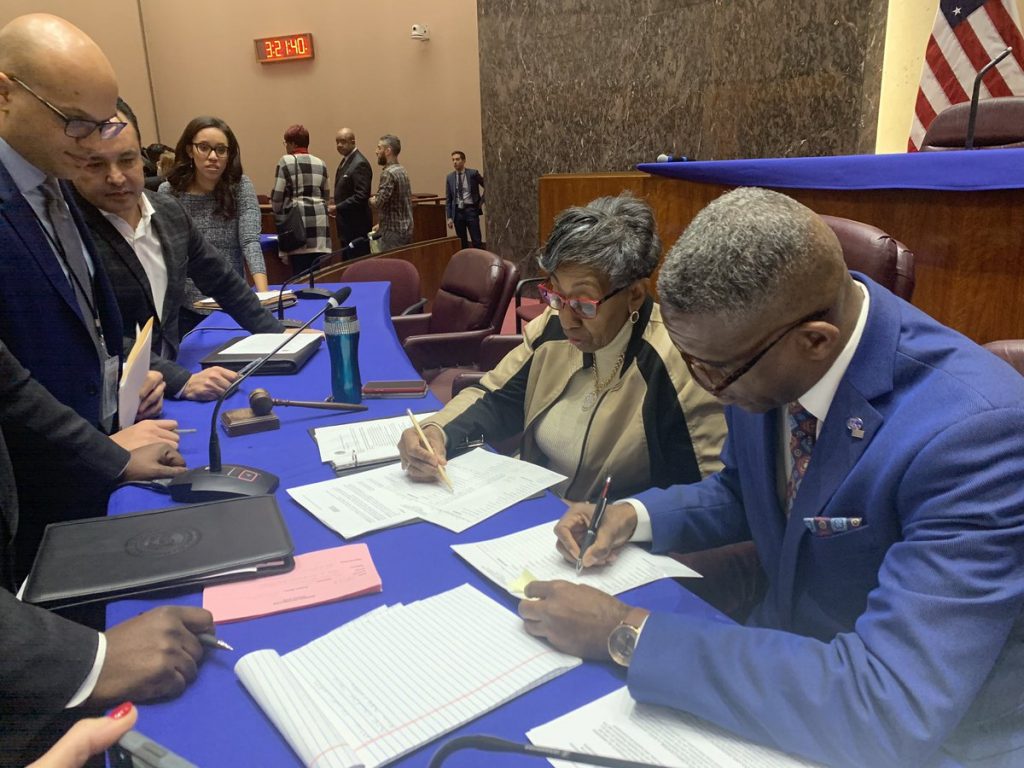 Ald. Carrie Austin (34), left, and Ald. David Moore (17), tally up the 10-9 vote to advance a six-month ban on the sale of marijuana in Chicago. [Heather Cherone/The Daily Line]
-
The final full City Council meeting of 2019 promises to showcase a truly rare occurrence: a knock-down, drag-out floor fight with no clear projected winner.
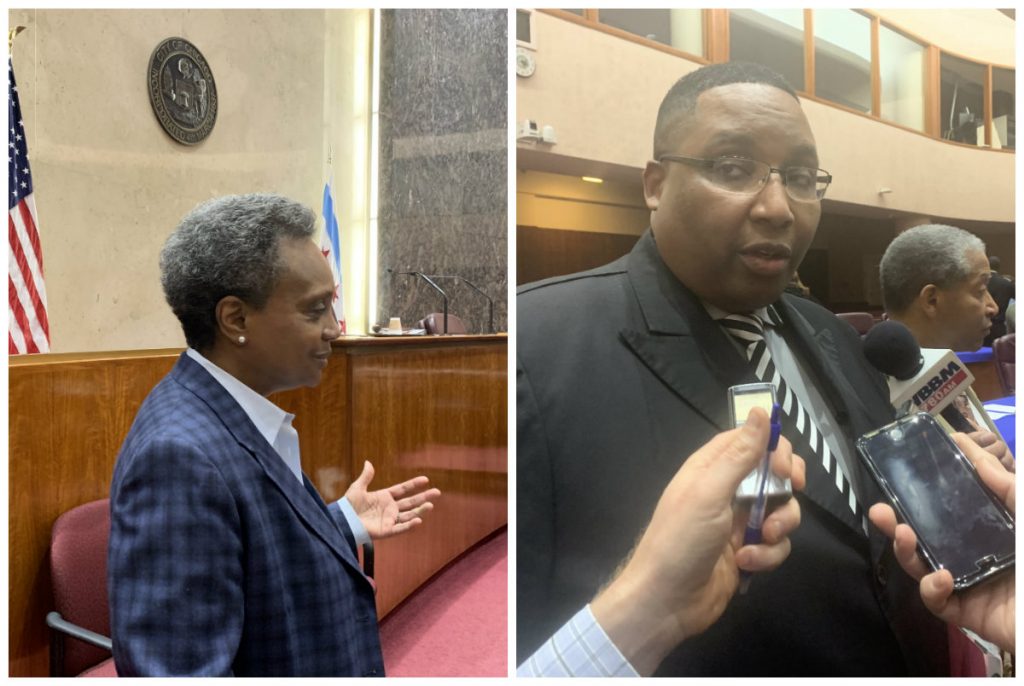 Mayor Lori Lightfoot, left, and Black Caucus Chair Ald. Jason Ervin (28). [Heather Cherone/The Daily Line]
Ten aldermen defied Mayor Lori Lightfoot Tuesday and sent a measure that would prohibit the sale of pot in Chicago until July 1 in order to ensure that firms owned by people who were hurt by drug laws can profit from the sale of cannabis.
That vote sets up a rare showdown between Chicago’s mayor and Chicago’s aldermen, who have more often served as a rubber stamp than an independent legislative body with its own set of priorities.
Related: Aldermen advance six-month ban on weed sales because lack of Black dispensary owners
If the measure passes over the mayor’s objections, that could trigger the first mayoral veto since 2006 — and perhaps triggered a full-scale rebellion by those already angered by the mayor’s decision to create a website — chicagobudgetvotes.com — to blast aldermen who voted against her 2020 spending plan.
At the same time, aldermen are braced for Lightfoot to renew her effort after the holidays to roll back aldermanic prerogative by attempting to rewrite the city’s zoning code — and perhaps looking for an opportunity to remind the mayor that a majority of the City Council makes laws for the city.
Related: At 6-month mark, Lightfoot’s effort to scale back aldermanic prerogative a work in progress
Ervin’s measure is not the only marijuana-related proposal on the agenda for the City Council meeting set to start at 10 a.m. Wednesday.
Aldermen will also weigh (O2019-8484) which would allow cannabis company Cresco Labs to relocate its MedMar dispensary from a 900-square-foot office at 3812 N. Clark St. to the 5,000-square-foot former home of the bar John Barleycorn at 3524 N. Clark St.
Related: ‘Give the brothers a piece:’ Aldermen narrowly OK dispensary amid criticism over lack of Black owners
That proposal advanced on a 7-5 vote Dec. 10 after an hour-long debate also centered on whether proposals from firms owned by Black and Latino entrepreneurs should be allowed to advance.
On firmer ground is another attempt by Lightfoot to push through another ethics reform measure designed to fulfill her central campaign promise to clean up city government and root out corruption.
Aldermen are set to advance a measure that would ban them from working as lobbyists to press other elected officials on city-related matters.
The measure (O2019-8541), which has 31 co-sponsors, is set for a final vote despite several aldermen saying they were concerned it would open the city up to litigation. They also said it was unnecessary, even amid the federal investigations swirling around City Hall and the State Capitol.
The ban was prompted by the arrest of former State Rep. Luis Arroyo (D-Chicago) in October on charges that he allegedly offered to bribe a state senator by paying him $2,500 a month in exchange for the senator’s support on legislation that would benefit a client he was working for at the city level. But that state senator was wearing a wire for the FBI.
Related: ‘The feds are all around us:’ Ban on aldermen working as lobbyists advances despite concerns
In addition, the proposed city ordinance bans elected officials who represent other jurisdictions from lobbying city officials or city agencies.
The ordinance carves out an exemption for elected officials who are also lawyers representing clients who have asked Chicago officials or agencies for an official action and are required to register as a lobbyist under state or local laws.
Aldermen on Wednesday are set give final approval to a number of items:- O2019-9121 — A measure authored by Ald. Matt O’Shea (19) that would allow aldermen to use their aldermanic office budgets to host document shredding and electronic recycling events.
- O2019-9252 — A measure authored by Ald. Raymond Lopez (15) that would allow aldermen to use their expense accounts — which will grow by $25,000 in 2020 — to publish “an annual calendar regarding citywide and ward specific information, events and holidays.”
- Twenty-three budgets for Special Service Areas across the city, including the approximately $300,000 budget for the Six Corners Special Service Area (O2019-7765), which was the source of controversy after Ald. Jim Gardiner (45) said he would vote against the budget unless the organization’s bylaws were changed.
- Eighteen appointments to the boards of Special Service Areas across the city.
- O2019-8545; O2019-8548; O2019-8556 — Three property tax breaks for commercial developments in the 14th, 21st and 11th wards.
- O2019-9126 — A measure authored by Ald. Tom Tunney (44) that will allow the plaza outside Wrigley Field to operate through March 29 as negotiations over a long-term agreement continue.
- O2019-9127; O2019-9128 — Two measures to ban home-sharing services in the 26th and 15th precincts of the 13th Ward.
- O2019-8528 — A measure authored by Ald. Silvana Tabares (23 )to ban home-sharing services in the 35th precinct of the 23rd Ward.
- Seven measures regarding the sale of packaged liquor.
- O2019-6853 — A proposal by the Chicago Housing Authority to build an 80-unit addition to the Chicago Housing Authority’s Edith Spurlock Apartments at 2604-2742 N. Sheffield Ave. in the 43rd Ward.
- O2019-8478 — A proposal by Marquis Capital to build a four-story mixed-use building with six residential units and ground-floor commercial space at 1057-59 W. Taylor St. in the 25th Ward.
- O2019-7963 — A proposal by Joseph Perillo to build a 131-stall parking garage at 6301 N. Western Ave. in the 50th Ward.
- O2019-4103 — A proposal by Thomas McCauley to build a six-story mixed-use building with 35 residential units and ground-floor commercial space at 3347 N. Southport Ave. in the 44th Ward.
- O2019-8476 — A proposal by Culver’s franchisee Justin Obreicht to build an 18-unit mixed-use building at 3500-02 N. Clark St. in the 44th Ward.
- O2019-7967 — Permission to allow the Ivy Hotel to install a retractable structure to enclose its existing rooftop terrace. The expansion triggers the city’s density bonus program, requiring a $101,500 payment into the Neighborhood Opportunity Fund.
- O2019-9258; O2019-9255; O2019-9256; O2019-9257 — Four measures that would terminate four tax-increment financing districts early.
- Or2019-513 — A payment of $1.3 million to settle a lawsuit filed by the family of 18-year-old Tevin Jones-Rogers, who was killed in a crash during a 2017 police pursuit.
- Or2019-512 — A payment of $1.2 million to settle a lawsuit filed by the family of 24-year-old Heriberto Godinez, who died in police custody in July 2015.
- Or2019-511 — A payment of $850,000 to settle a lawsuit that alleges Shaquille Gillespie was charged with a crime to cover up the fact that police officers used excessive force while arresting him in a West Side alley in March 2013.
- Or2019-514 — A payment of $175,000 to settle a lawsuit brought by Gertrude Matanky, who was crossing La Salle Drive at Lake Street in a crosswalk outside City Hall when she was struck by a car driven by Chicago Police Officer Phillip Flannagan while he was on duty.
- O2019-8005 — A measure to extend the Music Box Foundation’s $1 lease of a former South Shore fire station at 6843 S. Harper Ave. to allow its community center to remain open until 2026.
- O2019-8017 — A measure to spend $100,000 from the Central Park Tax Increment Financing District to purchase property to expand a park at 724-726 N. Kedzie Ave. in the 27th Ward
- Eleven sales of city property.
-
-
Ald. Jason Ervin (28) will get another chance to advance a proposal that would prohibit the sale of pot in Chicago until July 1 in order to ensure that firms owned by people who were hurt by drug laws can profit from the sale of cannabis. Meanwhile, elections officials are working to update their rolls as the primary approaches.
-
A burgeoning Cook County agency dedicated to transforming neglected properties into new homes is set to accelerate its operations next year, even as it faces an impending probe of its buyers and persistent criticism from county Treasurer Maria Pappas.
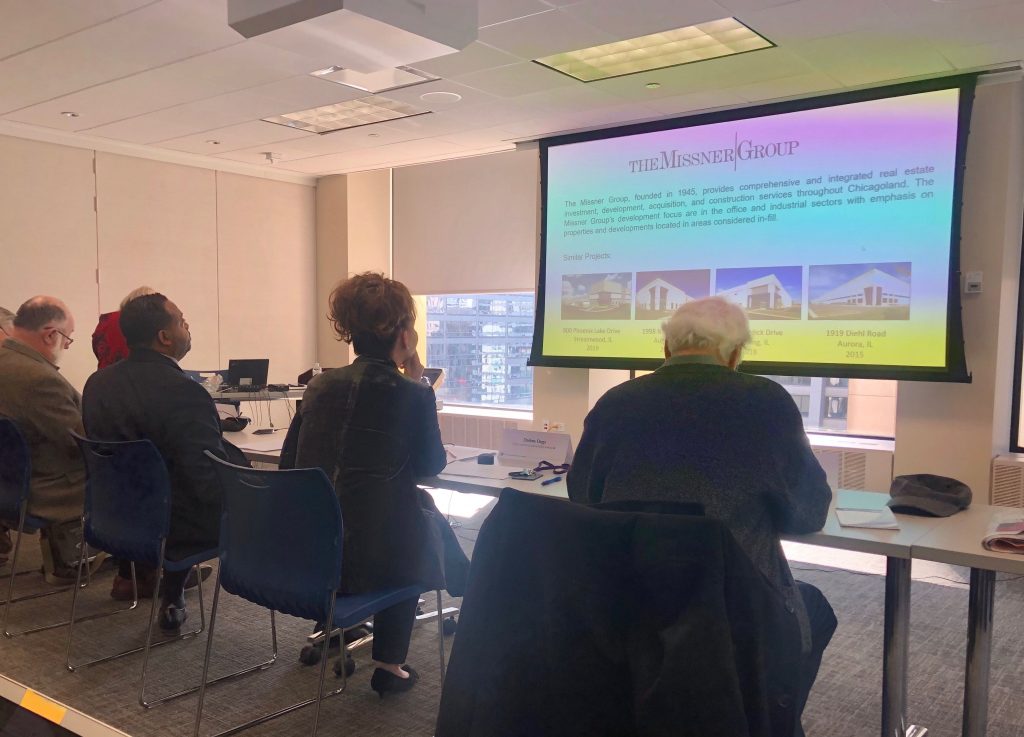 The Cook County Land Bank's Transactions Committee considers a proposal to buy a property in Franklin Park in November. [Alex Nitkin/The Daily Line]
-
DEC 13, 2019

UNLOCKEDBy Yana Kunichoff, Chalkbeat Chicago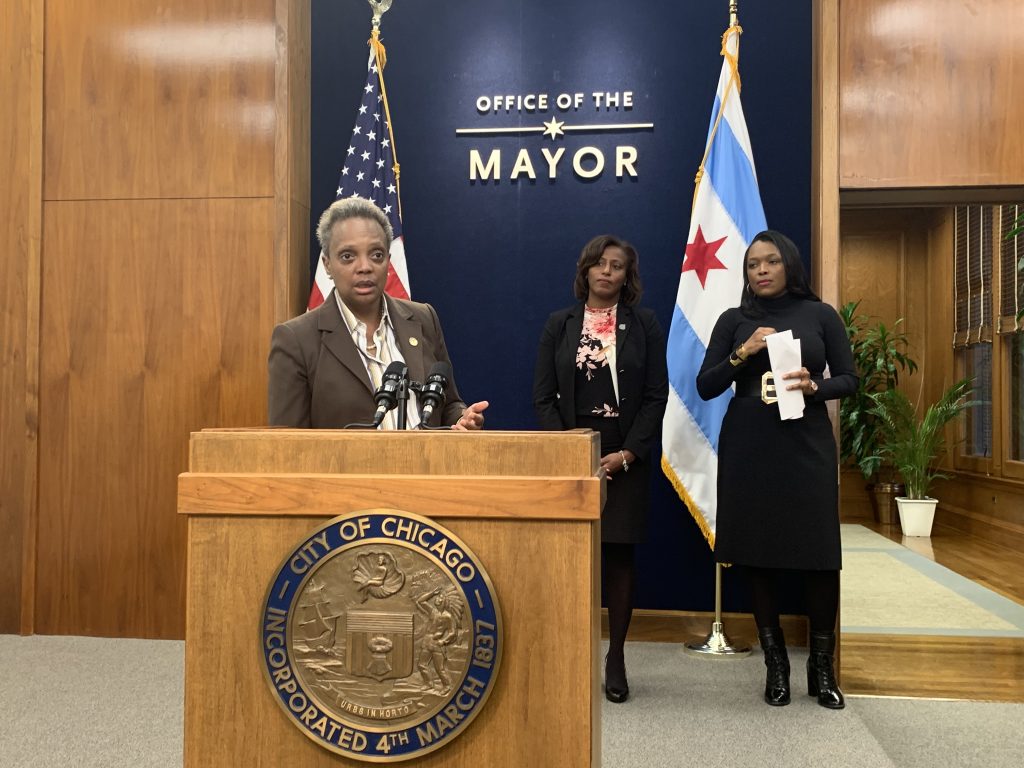 Mayor Lori Lightfoot and her two top schools officials CEO Janice Jackson and Chief Education Officer LaTanya McDade field questions from the news media. [Heather Cherone/The Daily Line]
Mayor Lori Lightfoot is making moves to reexamine the way Chicago budgets its billions for schools, starting with a new working group tasked with leading the charge.
The working group, which will gather information from the community engagement sessions and then propose recommendations, includes several formidable players in Chicago education policy, though in some cases the members are rarely on the same side of the table.
Members of the city’s appointed school board and its teachers union are on the committee. Find the full membership below.
The plan, announced by Chicago Public Schools on Thursday, builds on a key promise from candidate Lori Lightfoot to revisit school funding and consult the public about how to do that.
Chicago’s weighted school funding formula has come under fire for unequally distributing resources between schools that advocates argue need more resources, as well as pushing schools who are losing students into a funding loss spiral that makes it difficult to recover.
Related: Change could be imminent in how Chicago approaches spending low-income students
Any proposed changes yielded from the working group proposals and community engagement process wouldn’t come in all at once, the district said. Potential changes would be implemented over a multi-part timeline.
In a shift in recent practice, the school board is also leading committees around critical issues of diversifying the teacher pipeline and early childhood education. The first meeting about workforce diversity is next week.
Along with district network chiefs, board members and members of mayoral committees, the group includes leadership of local charter networks and teachers union researchers.
Here is who’s on the list:- Sendhil Revuluri, vice president, Chicago Board of Education
- Elizabeth Todd-Breland, member, Chicago Board of Education
- Carlos Azcoitia, former CPS principal and board member, and professor emeritus National Lewis University
- Krystal Burns, parent representative and member of the Harold Washington Elementary School Local School Council
- Bogdana Chkoumbova, chief schools officer, Chicago Public Schools
- Maureen Delgado, principal, Clinton Elementary School
- Vanessa Espinoza, parent representative and member of the Gunsaulus Elementary School LSC
- Rachel Garza Resnick, retired CPS administrator
- Kurt Hilgendorf, Chicago Teachers Union
- Pavlyn Jankov, Chicago Teachers Union
- Josh Long, principal, Southside Occupational High School
- Sybil Madison, deputy mayor for education, City of Chicago
- Matt McCabe, chief of staff and public affairs, Noble Network of Charter Schools
- Cameron Mock, chief of staff and senior fiscal adviser to the deputy governor
- Candace Moore, chief equity officer, City of Chicago
- Robin Steans, president, Advance Illinois
- Maurice Swinney, chief equity officer, Chicago Public Schools
- Ricardo Trujillo, deputy chief of Network 5, Chicago Public Schools
- Two students from the CPS Student Voice and Activism Council
- One teacher representative from the Teacher Advisory Council
The district plans to get feedback from the public through a series of meetings starting in late January. Here’s the full list of community meetings, which kick off Jan. 29, 2020:- Wednesday, Jan. 29, 6 p.m. – 8 p.m. at Amundsen High School, 5110 N. Damen Ave.
- Thursday, Jan. 30, 6 p.m. – 8 p.m. at Michele Clark High School, 5101 W. Harrison St.
- Saturday, Feb. 1, 11 a.m. – 1 p.m. at Corliss High School, 821 E. 103rd St.
- Wednesday, Feb. 5, 6 p.m. – 8 p.m. at Hammond Elementary, 2819 W. 21st Pl.
- Thursday, Feb. 6, 6 p.m. – 8 p.m. at Dyett High School, 555 E. 51st St.
- Saturday, Feb. 8, 11 a.m. – 1 p.m. at Roberto Clemente High School, 1147 N. Western Ave.
-
DEC 13, 2019

-
The city’s flagship affordable housing policy has failed, and the Development for All ordinance is the solution, a parade of affordable housing advocates told members of the City Council on Wednesday.
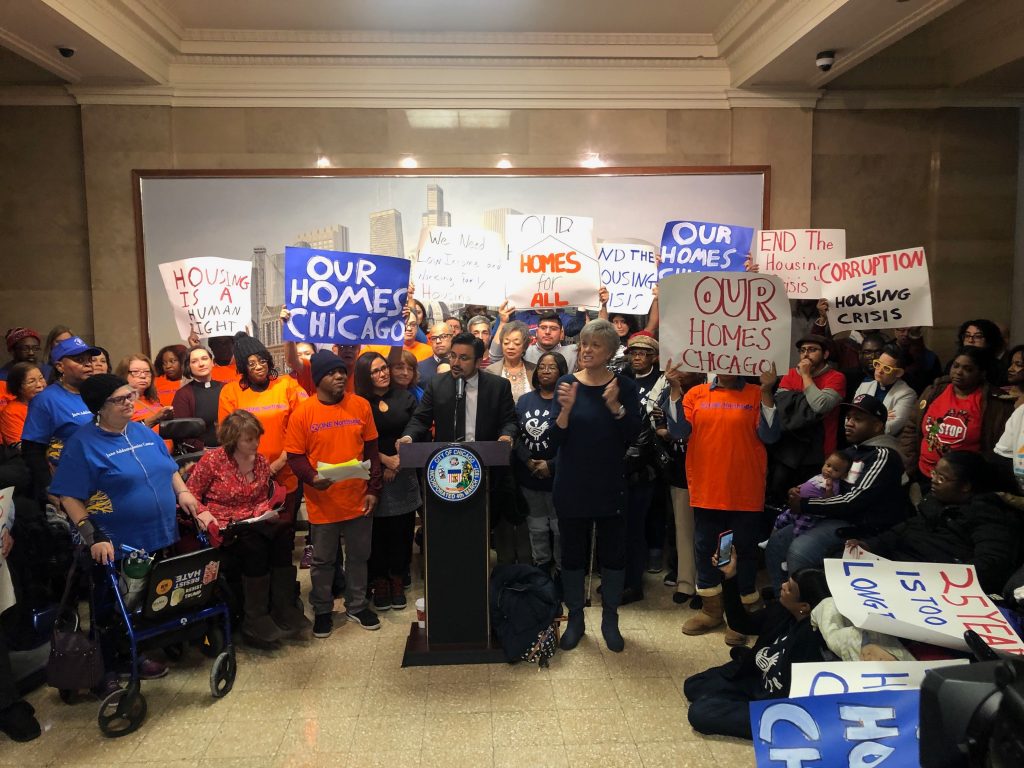 Ald. Byron Sigcho-Lopez (25) said the poor results of the city's affordable housing rules “staggering.” [Alex Nitkin/The Daily Line]
-
DEC 12, 2019
Cook County Assessor Fritz Kaegi sought to soothe the nerves of real estate investors on Wednesday by peeling back the curtain on the multi-agency process by which property owners’ tax bills are calculated.
 Cook County Assessor Fritz Kaegi and Chief Valuations Officer Donald Meyer explained how property tax assessments are changing. [Alex Nitkin/The Daily Line]
-
-
DEC 11, 2019
A group of aldermen on Tuesday nearly thwarted a cannabis company’s proposal to upgrade its Wrigleyville dispensary, blasting a warning shot against white weed purveyors who do not bring on diverse partners and further chipping away at the unwritten rule of aldermanic prerogative.
-
DEC 11, 2019
UNLOCKEDBy Yana Kunichoff, Chalkbeat Chicago Chicago Mayor Lori Lightfoot sits with students on the first day of school at Salazar Elementary Bilingual Center. [Yana Kunichoff / Chalkbeat Chicago]
Sullivan High School in Rogers Park has been nicknamed “Refugee High” for its student body. Often students come in speaking little English and sometimes far below grade level, while many students, both newcomers and others, suffer from the mental and emotional wounds of violence, perilous journeys, and family separation.
But with a budget that gives Sullivan roughly the same amount per student as it does for a student at Whitney Young Magnet High, a large selective-enrollment high school where fewer students live below the poverty level and parents are more involved in school fundraising, Principal Chad Adams has found himself facing what feels like an impossible choice: pay for a trauma counselor or a literacy coach, but not both.
This year, Adams chose a counselor.
“I think about all the trauma my kids see,” Adams said. “Their trauma may be more impactful to their learning. But it’s a complex jigsaw puzzle.”
Schools with more students who face learning challenges, language barriers, or other difficulties need more resources to educate them. But for six years Chicago Public Schools has budgeted the same per-pupil amount for schools, regardless of students' needs and background.
Granted, the district does give additional sums to campuses based on their count of students living in poverty or requiring special education. But the dollars often fail to cover the cost of hiring counselors and specialists.
Advocates with differing politics have assailed that budget uniformity.
As a candidate, Mayor Lori Lightfoot promised to revamp school funding and to consult the public about how to do that. Now she appears ready to fulfill her promise.
After bringing increased transparency to school board meetings and boosting staffing for high-needs schools when pressed by teachers contract negotiations, Lightfoot will start the long and complicated process of tackling one of the most technical items on her education agenda.
According to her office, by the 2021-22 school year, Chicago could shift how it hands out funds to schools. But the mayor hasn’t provided details on when, how, or who will lead the charge, which promises to be a Herculean undertaking. School officials have said an announcement is imminent. They also promised an “engagement process” related to next school year’s budget, and details on soliciting public opinion.
As to whether an initiative would be led by City Hall or the school district, a city spokeswoman said in a statement that “Mayor Lightfoot and CEO [Janice] Jackson have both made it clear that promoting greater equity in our schools is a top priority, and both the City Hall and CPS teams are focused on this effort.” This project is the third story in the Lens on Lightfoot series, a collaboration of seven Chicago newsrooms examining the first year of Mayor Lori Lightfoot's administration. Partners are Chalkbeat Chicago, the Better Government Association, Block Club Chicago, The Chicago Reporter, The Daily Line, La Raza and The TRiiBE. It is managed by the Institute for Nonprofit News.
How school budgets work is wonky, but they get at the heart of questions about priorities, values and investments. In a recent poll of 2,500 Chicagoans developed by a coalition of community organizations including Grassroots Collaborative and Chicago United for Equity, the second most-suggested need was to adopt a more equitable school funding formula, after increased staffing of nurses and social workers.
State funding and local property tax proceeds, along with some federal funding targeted at poor students and special education students, provide the core base for public education. The state doles out money based on some student needs, but for the most part doesn't dictate how school districts spend the bulk of its dollars.
Chicago then distributes operating funds to the 632 district-run and charter schools it funds. This year, the total operating budget is $6.32 billion, with just over half going to individual schools.
Under a five-year-old formula, about 60% of a typical school’s district grant is based on how many students it has. In fiscal year 2020, that was an average of nearly $4,500 per student. Those funds pay for a school’s core instructional needs.
The district also pays additional sums for special education students and for programs like after-school activities. Schools also receive additional dollars for low-income students and for English language learners.
Sometimes the district will award supplemental grants. Last school year it held an application process that granted $32 million to neighborhood schools for popular academic programs, in order to help recruit more students. A similar competition has been announced for this school year.
How Chicago funds schools is in line with many other urban districts around the country, said Marguerite Roza, director of the Edunomics Lab research center at Georgetown University.
And while Roza said she understands community interest in considering different funding models, she warns that without additional funding into a new system, a new model may not make huge changes. “The district doesn’t get any more money if it moves to another budgeting model,” she said, adding that, at the same funding level, directing more money to schools with higher needs would mean less for others.
Critics say Chicago’s current way of budgeting locks schools into a downward spiral. As schools lose enrollment, they get less money, which then dooms non-core classes and extracurricular programs, which further erodes enrollment, in turn shrinking the budget even more. A September report from Roosevelt University found that the schools with the smallest budgets were concentrated in black neighborhoods that had seen precipitous population declines, contributing to racial inequality across the district.
Chicago last overhauled its funding structure in 2013, moving from a budget that allocated teacher positions at each school based on enrollment quotas, to student-based budgeting. That move gave principals more autonomy to decide how to use the per-pupil funding they received, calculated according to the number of students they had during the 20th school day of the year.
But critics said budgeting by student count doesn’t address schools’ reality.
The district has promised to consider school funding as a key part of the mayor’s five-year investment in schools, announced this summer. And the district’s new equity framework, released last month, names “resource equity” as one of its four pillars. The teachers union contract, approved in November, also includes a side letter promising the district will review school funding.
Since Lightfoot took office, a band of unlikely allies, including education reform organizations, parent groups, and the teachers union, have pressed her to overhaul school funding, to promote educational equity and bring more dollars into schools.
Some groups have been sharing ideas.
Ralph Martire from the Center for Tax and Budget Accountability, a policy research group, suggests the district scrap its current budgeting formula and instead follow the state’s “evidence-based” approach, which allocates more money to certain needy populations like homeless students, refugees, and students facing other challenging life circumstances affecting learning.
The education reform group Kids First has developed an “equity index” budgeting tool, which weighs the incidence of trauma and violence and the concentration of single-parent households in communities.
The Chicago Teachers Union has also been pushing for a more nuanced funding formula that considers student and community need. The union won a side letter in its recent contract agreement that promised the district would review school funding.
Chicagoans may get a sense of what’s on the table from the equity framework published in November by Chicago Public Schools’ year-old Office of Equity.
The framework, drafted by the district’s equity chief, Maurice Swinney, says it’s unfair to assume students from different backgrounds and facing a variety of challenges have the same needs. That will “maintain the status quo of unequal achievement,” it says, and it suggests progressive spending patterns and schools sharing resources as possible solutions.
“Tools coming soon in 2020,” the framework says.
Will Chicago redistribute current dollars or seek new funds to distribute based on student need?
That may depend on whether the district can find more dollars. During her campaign, the mayor promoted such lifelines as redistributing tax-increment financing (tax proceeds intended to finance city development projects) and boosting the district’s credit rating to secure better rates on borrowing — but in her first budget as mayor, she directed tax surplus funds only to plug spending holes in the new contract with the union. If Gov. J.B. Pritzker’s graduated income tax rate passes, it could produce more revenue and offer more financial stability for Chicago schools.
Alternately, the district could divvy up its financial pie differently — but that could drain funds from schools with fewer high-need students, a move that could set off a political firestorm at schools with more politically savvy parents, whose influence makes this option unlikely.
Effective reform requires deft political maneuvering. School funding may be an important need, but the topic is complicated and dry, even for people in the know. Lightfoot will face a challenge in both laying out the rationale and logic of a new way of budgeting and, from groups long pushing for a change, the blowback if they feel it doesn’t impact their school communities.
How the district handles budget talks with residents could affect plans.
Jianan Shi, executive director of parent group Raise Your Hand for Illinois Public Education, said, “that conversation should be centered around communities most affected: underenrolled schools, schools with a history of change, and not just a closing but any kind of school action,” such as merging campuses or redrawing attendance boundaries.
At least another full school year likely remains before a new budget system is fully in place.
At Sullivan High School, that means another year of struggling to balance the needs of a diverse student body within the school budget. Adams, the principal, is hopeful for a change.
“This is where equity could come in — you are going to have to really listen to the community needs.”


