


-
OCT 17, 2025

UNLOCKEDMayor unveils $16.6B budget that revives head tax and imposes social media tax while eliminating grocery tax
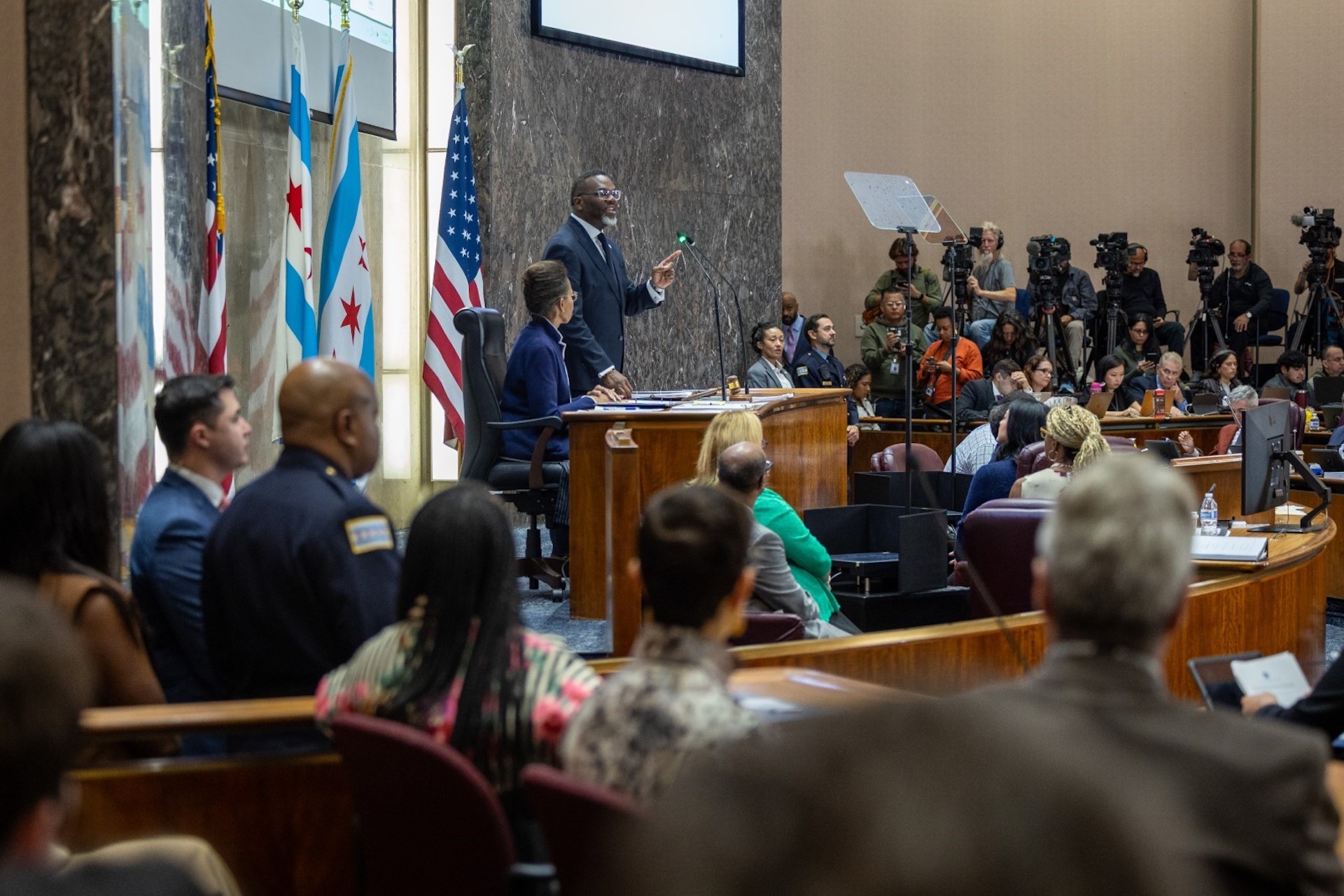
Mayor Brandon Johnson delivers his 2026 budget address during a City Council meeting on Oct. 16, 2025. [Mayor's Office]
Mayor Brandon Johnson on Thursday unveiled a slightly reduced $16.6 billion proposed budget for 2026 on Thursday that makes some cuts and asks for hundreds of millions from new and increased taxes and fees on the wealthy.
The mayor won’t seek a property tax hike for the third year in a row, but he will seek to revive Chicago’s old “head tax” in order to finance a litany of community safety programs. He will also ask to impose a new tax on social media companies to fund mental health services, including free clinics for residents and the city’s Crisis Assistance and Response Engagement (CARE) program. Additionally, in a reversal, the mayor will no longer seek to replace the 1 percent state-collected tax on groceries that expires at the end of the year.
The budget proposal represents a $547.9 million, or 3.2 percent, decrease compared to the adopted 2025 budget.
Johnson proposes to close an estimated $1.189 billion budget gap with $411.2 million in cuts to expenditures and $799.8 million in revenue increases, including a more than $1 billion declared tax increment financing (TIF) surplus — the largest in the city’s history. About half of that surplus would go to Chicago Public Schools, which hopes to use those funds to shore up its own finances, and the city would receive $157.6 million. The Chicago Park District, Cook County and City Colleges of Chicago would also receive some of the proceeds.
The mayor is proposing to bring back the corporate employer expense tax, which was abolished in 2014 and, at its height, charged companies with more than 50 employees $4 per employee each month. Qualifying employees either worked entirely or most of their time in Chicago.
The new proposed tax, dubbed a “Community Safety Surcharge,” would tax employers with more than 100 Chicago-based employees $21 per month per employee, and the proceeds would entirely go to a new Community Safety Fund that would fund services such as youth intervention and employment programs, first responder mental health support, community violence intervention programming, support for victims of gender-based violence and staffing for the Mayor’s Office of Community Safety.
While the tax would not apply to 97 percent of city businesses, the mayor’s budget office estimates the new tax would bring in $100 million in its first year.
It’s just one of the ways the mayor said his third budget fulfills his promise to make the rich pay their fair share and make large corporations “put a little more skin in the game.”
“Our budget proposal asks the large corporations and the ultra-wealthy to chip in a little bit more so that working families are not burdened with higher property taxes or grocery taxes or garbage fees,” the mayor said in his address.
The City Council Progressive Caucus told reporters after Johnson’s address that they were pleased with the presence of progressive revenue solutions in the budget.
Ald. Maria Hadden (49), co-chair of the caucus, said the group was “heartened” by the mayor’s commitment to continue funding public safety, mental health, public health and housing and shelter services at a time when federal dollars are in flux.
“These [investments] are the things that we hear our constituents ask for every day,” Hadden said. “This is what we fight for. So, seeing that these investments and these important services appear to be preserved in this budget is something that we are also encouraged by.”
With the Trump administration eliminating grant dollars and cutting other funds, “cities have to find new solutions to how we fund our essential services,” Hadden said. She said that large corporations can afford to pay more, as they will benefit from federal tax cuts.
Ald. Brian Hopkins (2) voiced strong opposition to the mayor’s thesis.
“This is a socialist budget,” Hopkins said. “This entire budget and the set of priorities is driven by a socialist economic model at a time when we still have capitalism — that still exists. They haven't succeeded in killing it yet.”
The mayor said during his address that he couldn’t imagine a better public investment for big business than making the city safer, which he added would encourage more people to move to Chicago and expand the tax base.
“Instead of asking Woodlawn and Englewood and Uptown to pay more, we are asking Google, Amazon and Meta to put more skin in the game,” Johnson also said. “Instead of asking seniors living on fixed incomes in Austin and South Shore to sacrifice, we are asking big business to chip in a little more.”
But Ald. Brendan Reilly (42), who helped lead the charge to repeal the head tax in 2012, said its resurrection would disincentivize job growth.
“I think it's a bit cynical, tying this massive head tax to public safety,” Reilly told reporters. “It seems like a false choice and suggesting that this is only going to fall on massive corporations when it hits any employer that has 100 employees or more — that touches a lot of family-owned and locally owned restaurants as well.”
The mayor also is seeking to increase the personal property lease transaction tax, which is effectively a cloud computing tax on companies like Salesforce and Amazon, to bring in an extra $333.2 million a year and hike the boat mooring tax to bring in an extra $4.1 million a year, with variable rates based on the size of the boat and whether the owner lives in the city.
He will also seek to impose new taxes on hemp and online sports wagering to bring in $10 million and $26.2 million next year, respectively, and change the tax on rideshare services and expand the downtown rideshare surcharge to bring in an extra $65.4 million next year. The budget plan would change the rideshare tax from $1.13 per vehicle per ride to a 10.25 percent tax, and expand the area covered by the $1.50 downtown surcharge.
The rideshare and hemp tax revenue estimates are based on April 1 and July 1 start dates, respectively.
Ald. Pat Dowell (3), the chair of the finance committee, said she wanted more details on who exactly will be impacted by the proposed head tax and the other taxes, and she said she was worried that the city continues to forgo annual inflation-based hikes to its property tax levy.
The mayor’s budget is also proposing the country’s first per-user tax on large social media companies. The Social Media Amusement and Responsibility Tax (SMART) would tax companies like Meta, TikTok, YouTube and X 50 cents for every user over 100,000 users. Budget officials estimated the tax would raise $31 million in its first year.
Revenue from the SMART tax would allow the city to create a dedicated funding stream to open free, city-run mental health clinics and continue operating CARE teams, which would move from the city’s American Rescue Plan Act fund to the corporate fund.
The tax is being proposed in direct response to the “growing body of research on the negative mental health impacts of social media usage, particularly on young people,” according to a news release from the mayor’s office.
“For far too long, we have allowed social media companies to collect our data and sell it for profit,” the mayor said. “They’ve implemented more and more aggressive strategies to get Chicagoans addicted to their apps. As a result, we’ve seen significantly higher trends of depression, anxiety, and mental illness, especially in our young people.”
Johnson went so far as to pitch the SMART tax as another version of a so-called “sin tax.”
“Just like we tax other addictive vices that are bad for our health like nicotine and tobacco, it is far past time we treat social media companies the same way,” the mayor said.
But Ald. Scott Waguespack (32) said he was concerned the proposed tax may not even be legal and could “incur a lawsuit overnight” based on previous U.S. Supreme Court decisions.
Additionally, the mayor’s budget is no longer seeking to pass a replacement grocery tax, which would have brought in about $80 million next year if the council had approved it by Oct. 1. If approved before January, the tax would generate half of that next year, and about $80 million annually going forward.
Instead, the mayor will let the state-collected tax expire at the end of the year. The tax charges residents one cent for every dollar spent on groceries, and while Johnson said less than a month ago that he still intended to pursue a replacement tax, his budget director told reporters Wednesday that Johnson reversed course because he intends to fulfill a promise that he said President Donald Trump couldn’t keep — lowering the cost of goods.
“There was a promise to lower grocery prices when this new administration came into office,” Budget Director Annette Guzman said. “That has not happened. In fact, the opposite has happened. Grocery prices are still going up, and we have just seen a budget at the federal level that reduces [food stamp] benefits.”
Dowell said she had been okay with keeping the grocery tax, since Chicagoans are already used to paying it.
The proposed expenditure reductions would come from operational and personnel savings, such as $50 million in savings from a yearlong hiring freeze, and a lower advanced pension payment of $120.2 million. The hiring freeze would exempt revenue-generating, public safety, elections, information technology, mental health, litigation savings and legislative positions.
A 2023 executive order directed $697.6 million in assigned fund balance to be used for advanced pension payments from 2024 to 2026, but the Lightfoot administration made the first payment early in 2023. According to budget officials, the assigned fund balance was fully expended this fiscal year, and that allows the city to lower its advanced pension payment next year.
When asked if the city was worried about a credit downgrade from a lower advanced payment, Chief Financial Officer Jill Jaworski said the city is still showing a commitment to make advanced pension payments, even if it is less.
“In the context of all of the budget-balancing measures that were made, we felt [it] was very important to continue to make the advance payment, but we also made the decision that there are other priorities that we needed to fund as well,” Jaworski said.


