


-
SEP 10, 2025

UNLOCKEDCouncil kicks off mid-year budget hearings, asks finance leaders for status of Ernst and Young report
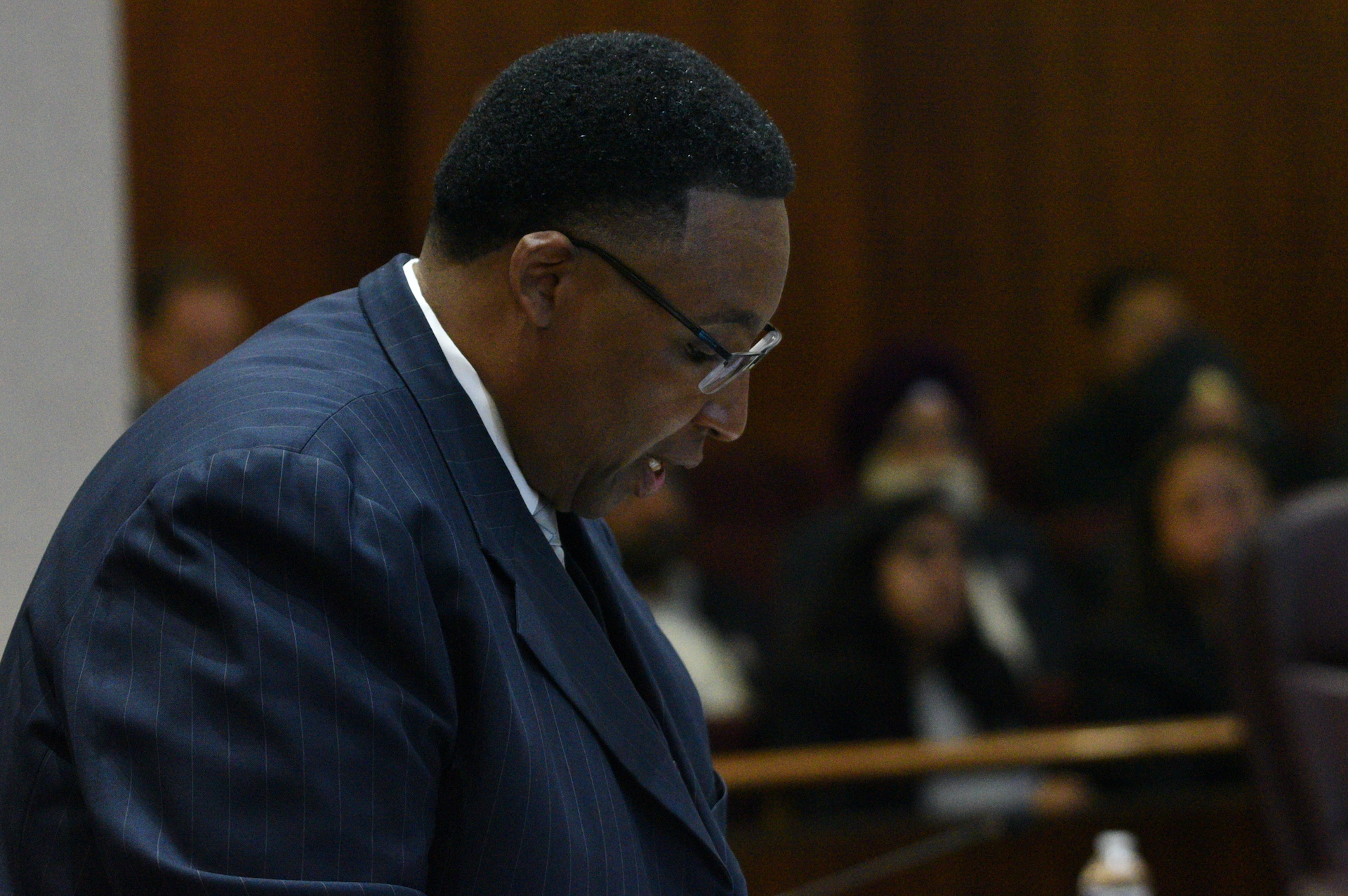
Ald. Jason Ervin (28), the budget committee chair, is pictured at a City Council meeting in April 2024. [Don Vincent/The Daily Line]
As the city stares down a projected $1.1 billion budget gap in 2026 and a projected end-of-year deficit, the City Council Committee on Budget and Government Operations on Tuesday kicked off a two-week period of mid-year budget hearings, during which alderpeople will get the chance to ask the city’s finance leaders and department heads about how the city’s actual spending and revenue compares to what was projected at the outset of the year.
The hearings are taking place a little over a month after the Chicago Office of Budget and Management (OBM) released its inaugural mid-year budget report to the council and the public.
The OBM report showed that revenue collection was 4.9 percent higher than budgeted as of May 31, driven by a 12.7 percent increase in utility tax revenue compared to what was budgeted, transaction tax revenue coming in 17.4 percent above budget projections and the city’s share of individual income taxes coming in 25 percent above budget. Those figures offset a 37.4 percent decline in allocations of state Personal Property Replacement Tax (PPRT) revenue from what was expected.
OBM also reported the city has controlled costs to save $39 million year-over-year on contractual services and $6.4 million in commodities and materials expenditures in the first five months of the year. The city also spent 22 percent less on overtime costs when compared to the same period last year.
The city’s July monthly revenue report showed the city had collected $2.57 billion in revenue this year, which was 5.2 percent or $127.5 million above the $2.4 billion that was expected. The taxes that were increased in the 2025 budget have also all come in strong, Guzman said.
Although the mid-year and July reports showed that revenue collection was stronger than budgeted and spending was down from projections, the city is still projecting to end the year $146 million in the red for myriad reasons, including the lack of certainty of a $175 million pension fund reimbursement from Chicago Public Schools, lower-than-expected PPRT revenue and the lack of available prior year fund balance and other one-time reserves.
Budget Director Annette Guzman said both reports highlight that local revenues have tended to be stronger compared to state-controlled revenues.
“The mid-year and July revenue reports demonstrate that we are exceeding budget expectations for locally controlled revenues, even as state-controlled revenues continue to trend downward,” Guzman said. “Yet our 2026 forecast makes clear that we face urgent structural challenges, challenges that must be faced together and through collaboration with the community and the executive and legislative branches.”
For instance, Chief Financial Officer Jill Jaworski said that the reliance on Chicago Public Schools (CPS) to cover its share of the Municipal Employees’ Annuity and Benefit Fund (MEABF) is an issue that needs to be addressed, especially when the district failed to meet its obligation under an intergovernmental agreement to make the $175 million payment last year and did not commit to the payment this year.
“In less than two years, the CPS Board of Education will be fully independent from City Council and the mayor. For the city to bear a cost that we have limited influence over is not the balanced approach that we need,” Jaworski said. “It is also not consistent with the financial and operational disentanglement that the state, city and CPS had been diligently working towards.”
Ald. Brendan Reilly (42) agreed and asked Jaworski if there was a legislative solution that would allow the city and school district to resolve the dispute.
“We've seen a whole lot of political football played this year with pension contributions and who should be making them, whether that's CPS or whether that's the city,” Reilly said.
Jaworski said that the only way to require CPS to make the payment beyond the intergovernmental agreement would be state legislation. While she said it’s “a topic of significant internal discussion,” she couldn’t say if the administration would push for changes during the upcoming fall veto session.
Ald. Bennett Lawson (44) asked about the reported 11.6 percent drop in local sales tax revenue recorded through the end of May. Chicago sales tax revenue came in $2.5 million under what was budgeted for that time period.
Guzman said during the first quarter of 2025, “our consumer spending has actually been pretty robust. So the declines that you're seeing have more to do with things that have happened at the state level that have shifted how things are accounted for under either sales tax or use tax.”
Several alderpeople also asked about when the council would receive a benchmarking report comparing the city’s budget against other cities that consultant Ernst and Young was paid $3.1 million by the city to prepare. The report is also expected to include revenue- and expenditure-side options for balancing the budget.
Guzman told Ald. Samantha Nugent (39) during the hearing the budget office was “still meeting with departments to finalize the assumptions and findings” from the report before it’s released later this month. The budget director committed to the report being released to the council before Oct. 15 — the day of the mayor’s budget address — at the latest.
“What we are producing for City Council, and frankly, to the mayor who commissioned the work, are a bunch of options and benchmarking,” Guzman said. “So, what we are producing and [what] will be made available to City Council will be the final options that we believe are — after talking to our own departments who have to do this work — practical for the city of Chicago.”
Reilly said the council should be able to see the original, raw draft of the report and not just a final version.
Guzman said the process that the Ernst and Young report was going through wasn’t unlike what other reports from her office go through. She told Reilly that reports issued by her department often go through “many iterations,” as they undergo standard fact-checking and “filtering.”
“We're spending a lot of money for Ernst and Young's professional expert opinion, and the risk here of having it filtered is that perhaps some very good ideas that don't necessarily match with this administration's wishes may be excluded from what is presented to us, the members of this body, who are being asked to partner with the administration in balancing a very difficult budget this year,” Reilly said. “And so I just want to make sure that there's nothing left on the cutting room floor that we don't get to see ourselves.”
The mid-year report showed that through the end of May, the city had spent 23 percent of its $13.7 billion in planned expenditures. Ald. Raymond Lopez (15) asked about the trend, seeking to figure out if the city could anticipate spending a fifth less than its projected budget this year or if spending would speed up in some fashion.
Guzman said that point-in-time figure reflected a common trend for the city budget and for other governments as well. Along with the deliberate decrease in contracting spending, Guzman said expenditures can be lower from January through May because they’re mostly colder months, meaning certain departments aren’t as busy as they are during warmer months, lowering overtime costs.
Hearings will also take place on Wednesday and Thursday beginning at 9:30 a.m., with Wednesday’s hearings including the Chicago Fire Department, Office of Emergency Management and Communications and Office of Public Safety Administration. Thursday’s hearings will feature the Department of Business Affairs and Consumer Protection, Department of Planning and Development, Department of Housing and Department of Cultural Affairs and Special Events. Hearings are also slated for Sept. 16, 17 and 18.


