


-
JUL 28, 2025

UNLOCKEDTrump administration Lawsuit challenging Illinois’ sanctuary policies dismissed as unconstitutional
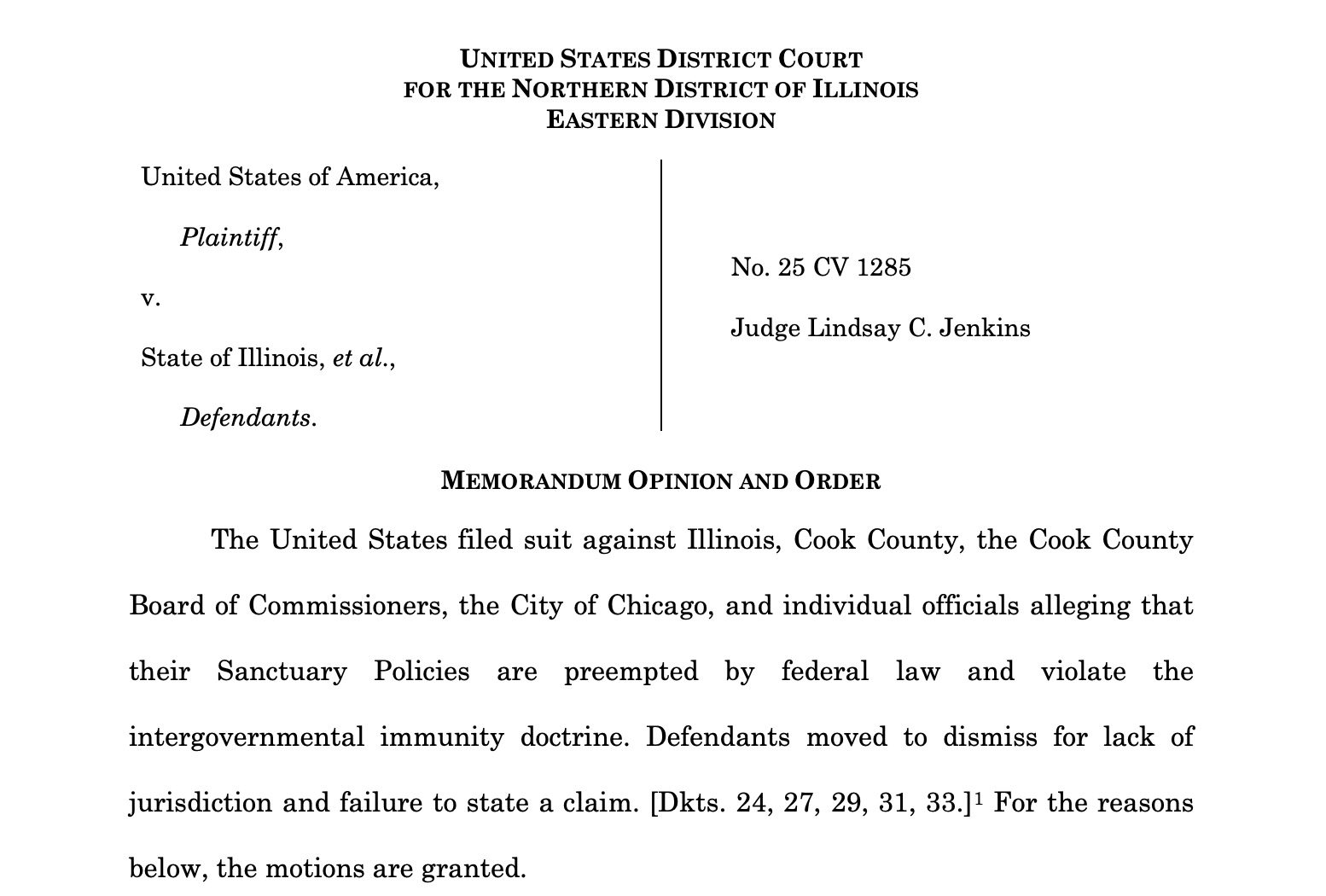
The Trump administration’s lawsuit against Illinois, Chicago and Cook County has been tossed by a federal judge — but the door is open for an appeal.
U.S. District Court Judge Lindsey Jenkins' decision Friday granted a request from the defendants to dismiss the lawsuit without a trial.
The Department of Justice (DOJ) sued in February over sanctuary laws in the state, specifically naming the Illinois Way Forward Act, the Illinois TRUST Act, Chicago’s Welcoming City ordinance and Cook County’s “Policy for Responding to ICE Detainers.”
The various policies state local law enforcement cannot stop, arrest, search, detain or continue to detain a person solely based on their immigration status. Local law enforcement is also prohibited from working with U.S. Immigration and Customs Enforcement (ICE) on civil immigration matters. That includes releasing a person into ICE custody, sharing information with ICE and permitting ICE to use facilities or equipment.
Sanctuary policies do not prohibit ICE officers from enforcing federal immigration laws in Illinois.
An exception exists when there is a criminal warrant, in which local law enforcement may work with ICE to apprehend the suspect.
Read more: What are the Illinois ‘sanctuary’ policies the Trump administration is looking to invalidate?
The DOJ lawsuit argued these policies violate the Supremacy Clause, which states that federal law preempts state law, and interferes with federal immigration enforcement.
Jenkins wrote that the state’s policies to not participate in civil immigration enforcement are protected under the constitution.
“Because the Tenth Amendment protects defendants’ sanctuary policies, those policies cannot be found to discriminate against or regulate the federal government,” she wrote.
She said forcing the state to participate under the guise of interference would circumvent the constitution.
Along with the State of Illinois, City of Chicago and Cook County, the lawsuit named Gov. JB Pritzker, Chicago Mayor Brandon Johnson, Cook County President Toni Preckwinkle, the Cook County Board of Commissioners, Chicago Police Supt. Larry Snelling and Cook County Sheriff Thomas Dart.
Jenkins wrote that the claims against individuals, including all members of the Board of Commissioners, were dismissed because the DOJ was seeking a pause in the sanctuary policies, which would apply to the governing entities themselves, not the individuals.
Jenkins said the Department of Justice did have standing to sue the State of Illinois, City of Chicago and Cook County. Lawyers for Cook County argued that the DOJ failed to demonstrate future injury to the federal government caused by policies that would warrant them to be overruled. Jenkins disagreed.
Still, with the administration’s complaint ruled unconstitutional, the lawsuit as a whole was dismissed without prejudice. This gives the DOJ an opportunity to amend their lawsuit. If they do not do so, the case will be dismissed with prejudice, meaning it cannot be filed again.
In a statement, Attorney General Kwame Raoul said he was “pleased” by the decision.
“Illinois’ TRUST Act acknowledges that civil immigration enforcement is the responsibility of the federal government, and that state and local law enforcement resources are most appropriately utilized protecting the communities in which they serve,” he said. “I will continue to defend the constitutionality of the TRUST Act against the Trump administration’s cruel and draconian immigration activities.”


Trending


