• Gov. JB Pritzker celebrates while signing the Reproductive Health Act into law, while State Rep. Kelly Cassidy, D-Chicago, cheers. [Governor's office]
    Gov. JB Pritzker signed the Reproductive Health Act into law Wednesday, touting the measure as “a giant step forward for women’s health.”

    The new law makes Illinois one of most progressive states in the nation when it comes to abortion. It repeals of the state’s 1975 abortion law, removes criminal penalties for doctors who perform abortions and throws out restrictions on the procedure later in pregnancy.

    It also marks the second time in recent years that Illinois lawmakers have expanded abortion rights. In 2017, former Gov. Bruce Rauner signed a bill that will ensure abortion remains legal in Illinois even if Roe v. Wade is overturned by the U.S. Supreme Court, and allowed the use of taxpayer funds for abortion care.

    But even with the Reproductive Health Act, SB 25, now law, it isn’t the last abortion-related fight on the horizon.

    Shortly before the governor signed at the Chicago Cultural Center Wednesday morning, Personal PAC Board President Melissa Widen said the next step for reproductive rights activists is the repeal of Illinois’ 1995 Parental Notice of Abortion Act

    “Now I look forward to working with the governor and our pro-choice leaders in the Senate and the House to pass the next important bill, and that’s to repeal the dangerous parental notice of abortion law,” Widen said.

    Related: Dems to push for repeal criminalization of abortion doctors, parental notice laws

    Both the RHA and the bill to repeal the parental notice law were introduced around the same time in February, after having been included in recommendations from gubernatorial transition committee reports early in Pritzker’s term. But both bills faced roadblocks in March, when House Democratic leadership shelved the bills, sending them to a subcommittee to die a quiet death.

    Related: Dem lawmakers vow to hold Pritzker to his promise to expand, protect reproductive rights

    But in the wake of the passage and signing of abortion bans and so-called “heartbeat bills” that aim to curtail abortion access in states like Alabama, Georgia, Missouri, Kentucky and Tennessee this spring, newly elected Democratic women, many of whom campaigned for the General Assembly on a platform that included abortion rights, pushed for the RHA.

    Related: Advocates frustrated as push to expand, protect reproductive rights stalls

    Toward the end of session, House Democrats held a lengthy caucus meeting, after which RHA sponsor State Rep. Kelly Cassidy (D-Chicago) confirmed to reporters that the brick was coming off her bill. The Sunday before the end of spring legislative session, bill language for the RHA was finally attached to a vehicle bill, and after a marathon hearing and two emotional debates in the last week of session, the bill passed both chambers.

    Cassidy told The Daily Line that the plan had been to move the RHA first, and then to move the bill repealing the Parental Notice of Abortion Act. But she said the most simple explanation was that lawmakers “ran out of time.” Though the repeal of the parental notice law could have been rolled into a larger RHA bill, Cassidy said not doing so was a conscious choice.

    “That was a strategic decision made with the coalition,” Cassidy said. “The RHA contains firewall provisions, if you will, because it was fundamentally about codifying status quo by and large, we felt it was cleaner to do this and then [the parental notice repeal bill].”

    State Rep. Chris Welch (D-Hillside), who sponsored the House version of the repeal bill, HB 2467, also told The Daily Line that focusing on the RHA this year was about the time crunch lawmakers faced.

    “As you know we ran into problems; [the two bills] got buried in committee,” Welch said. “As we were running out of time, we wanted to focus on the RHA because of everything that was going around across the country.”

    But Welch said he’ll continue to push for the repeal of the parental notice law, possibly as soon as the Fall Veto Session, which begins during the last week of October.

    The Parental Notice of Abortion Act requires minors seeking abortions to notify and get permission from a parent or guardian. If a minor fears retribution from her parents, she can seek a bypass order from a judge. Though the law was passed in 1995, it was blocked by courts for 18 years after its passage, until a 2013 Illinois Supreme Court decision allowed its implementation.

    ACLU Illinois spokesman Ed Yohnka told The Daily Line that in the time since the law has actually been enforced in Illinois, the ACLU has handled more than 400 cases for young women looking to bypass the parental notification by getting a judge’s signoff.

    Of those 400 cases, most have been handled in Cook County, as there’s no requirement under the Parental Notice of Abortion Act that a minor seek a judge’s permission in either the county she resides or even in the county she is seeking an abortion. Both the anonymity that the Cook County judicial system offers, especially for young women from rural or even suburban areas of the state, plus a relatively efficient system that’s been developed for bypass hearings, has made it ideal, Yohnka said.

    Judges typically move on these cases quickly, and it’s rare for a judge to deny a minor her petition for bypass, Yohnka said. Even so, he said the law’s continued existence puts young women at risk.

    “We still are committed to working with the sponsors to move the repeal of the parental notice law,” Yohnka said. “It’s still dangerous, it still harms families. We cannot force parental involvement and we cannot force parental communication.”

    The RHA could face a lawsuit, most likely from the Chicago-based Thomas More Society, where former State Rep. Peter Breen (R-Lombard) serves as vice president and senior counsel. Breen, who was present Wednesday at the cultural center for a protest against the signing of the RHA, told The Daily Line that his review of the RHA is ongoing.

    But he also said his “first priority is to defend parental notice against potential legal challenges.”

    Related: Rauner’s approval of HB40 — which will keep abortion legal in Illinois even if Roe v. Wade is overturned — resurfaces in governor’s race
  • State Rep. Nathan Reitz, top, voted for the bill his father, former State Rep. Dan Reitz lobbied for. [Hannah Meisel/The Daily Line; Submitted]
    When State Rep. Nathan Reitz (D-Steeleville) was sworn into the Illinois House last month, negotiations for an omnibus gaming expansion bill were well on their way in Springfield — a bill that would ultimately include six new licenses for areas in the state that have long clamored for their own casinos.

    Helping make the pipedream for a casino in Southern Illinois a reality this spring session was Dan Reitz, a former legislator, current lobbyist and the state representative’s father.

    The younger Reitz voted for the bill.

  • Some state employees will be paid out of a fund that accepts both public and private dollars under a change to state law included in the budget implementation bill passed by the General Assembly during overtime session last weekend and signed by Gov. JB Pritzker last week.

  • Illinois Comptroller Susana Mendoza [City Club of Chicago]
    Comptroller Susana Mendoza stayed out of sight this spring after finishing fifth in the race for the mayor in February. After the loss, Mendoza went back to work in Springfield, since she won a full four-year term in November — about a week before she announced her bid for mayor. During her first term as comptroller, Mendoza was a constant critic of Republican Gov, Bruce Rauner and Republicans as the state’s budget impasse wore on for two years. Since her loss in February, Mendoza says she’s been visiting safety net hospitals and healthcare providers around the state that have been impacted by high rates of denials from Medicaid Managed Care organizations — a cause Mendoza has been fighting since she entered office. At the height of the 736-day budget impasse, the state’s backlog of bills reached nearly $17 billion. As of Wednesday, that number is down to $6.15 billion — including $520 million worth of healthcare bills paid Tuesday. The Daily Line spoke with Mendoza Wednesday for a lengthy interview, part one of which ran in Thursday’s newsletter.

  • Illinois Comptroller Susana Mendoza [City Club of Chicago]
    Comptroller Susana Mendoza stayed out of sight this spring after finishing fifth in the race for the mayor in February. After the loss, Mendoza went back to work in Springfield, since she won a full four-year term in November — about a week before she announced her bid for mayor. During her first term as comptroller, Mendoza was a constant critic of Republican Gov, Bruce Rauner and Republicans as the state’s budget impasse wore on for two years. Since her loss in February, Mendoza says she’s been visiting safety net hospitals and healthcare providers around the state that have been impacted by high rates of denials from Medicaid Managed Care organizations — a cause Mendoza has been fighting since she entered office. At the height of the 736-day budget impasse, the state’s backlog of bills reached nearly $17 billion. As of Wednesday, that number is down to $6.15 billion — including $520 million worth of healthcare bills paid Tuesday. The Daily Line spoke with Mendoza Wednesday for a lengthy interview, part two of which will run in Friday’s newsletter.

  • Gov. JB Pritzker celebrates the signing of the budget. [Governor's Office]
    Rookie Gov. JB Pritzker on Wednesday signed bills approving the state’s operating budget and revenues, along with the rates for a graduated income tax, should voters approve the tax on the November 2020 ballot.

  • Illinois Department of Revenue Director David Harris. [Submitted]
    Illinois Department of Revenue Director David Harris was one of the small group of Republican legislators who defied former Gov. Bruce Rauner in the summer of 2017 when he not only voted for a tax hike to end a two-year budget impasse, but also voted to overturn the Republican governor’s veto on the increase in income taxes. While he and many others announced their immediate retirements after that vote or their decisions to not seek re-election, Gov. JB Pritzker announced Harris would serve as the director IDOR soon after his November win over Rauner. The Daily Line spoke with Harris on Tuesday two days after the legislature wrapped up its business for the spring session, which resulted in the legalization of recreational marijuana, a $40.1 billion budget, a $44.5 billion six-year capital plan and a host of new taxes and fees in exchange for the creation of a bevy of new tax incentives for businesses.

  • article-image
     A man plays a video slot machine in a lounge at Huck’s, a truck stop in Mt. Vernon, Illinois. Under Illinois’ new gambling expansion, bars, restaurants, fraternal organizations and gambling parlors will be allowed to have six machines, up from five. Trucks stops will be permitted to hold 10 machines. (Whitney Curtis, special to ProPublica Illinois)

    An 816-page bill introduced and passed by the General Assembly over the weekend will, if fully realized, transform Illinois into the gambling capital of the Midwest.

    The legislation legalizes sports gambling; sanctions six new casinos, including one in Chicago; increases the number of video gambling machines as well as the maximum bet; and transforms the state’s horse racing tracks into “racinos” by permitting casino operations at the state’s three existing tracks while allowing two more to open.

  • “They said it couldn’t be done,” Gov. JB Pritzker said. [Hannah Meisel/The Daily Line]
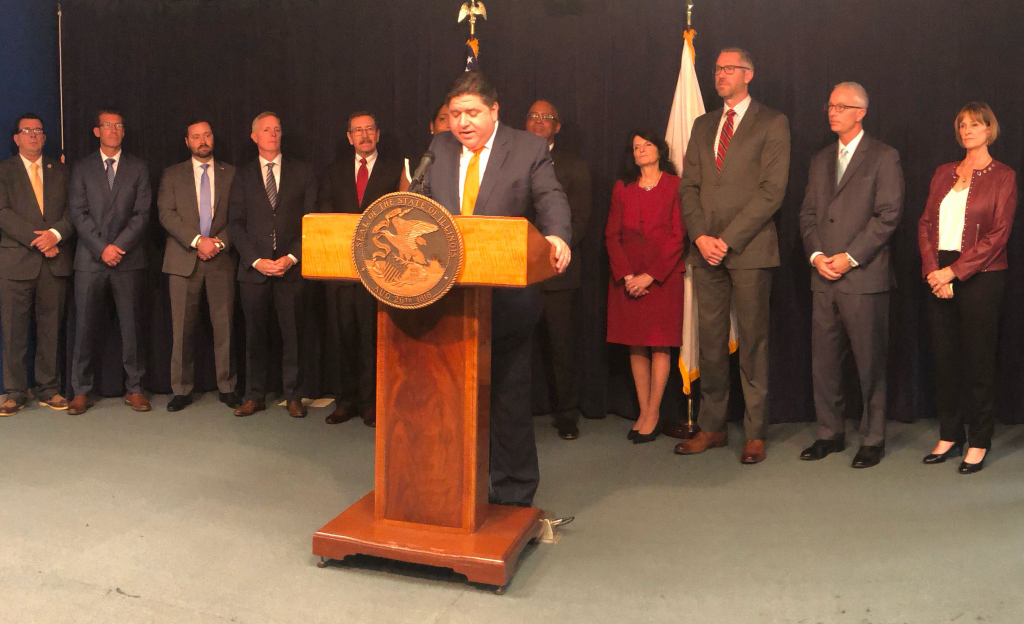
    Shortly after the Senate adjourned for the spring early Sunday evening, aides decked out Gov. JB Pritzker’s office with giant multi-colored signs touting their accomplishments: legalizing marijuana, putting the question of a graduated income tax on the November 2020 ballot, a $15 minimum wage and passing the Reproductive Health Act.

    But when Pritzker and other Democratic senators filed into the room to talk to reporters, he was accompanied by GOP senators as well as including Senate Minority Leader Bill Brady (R-Bloomington).

  • The Illinois State Capitol. [Hannah Meisel/The Daily Line]
    After an hours-long break in legislative floor action Friday afternoon and evening, the Illinois House passed an operating budget worth $40.1 billion — nearly $1.5 billion larger than the budget Gov. JB Pritzker proposed in February.