-
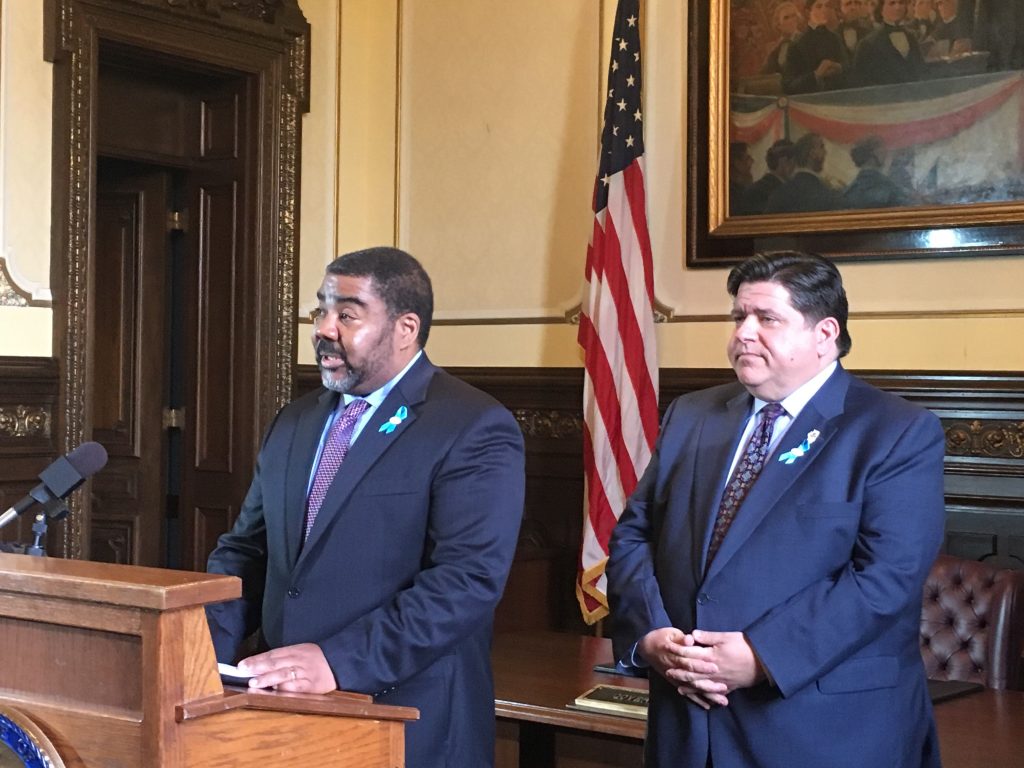
A game of political musical chairs will continue to churn with the selection of former State Rep. Rob Martwick (D-Chicago) to replace newly minted Cook County Judge John Mulroe in the Illinois Senate.
Cook County Judge John Mulroe, left, swears Robert Martwick into The Illinois Senate. [Robert Martwick]
-
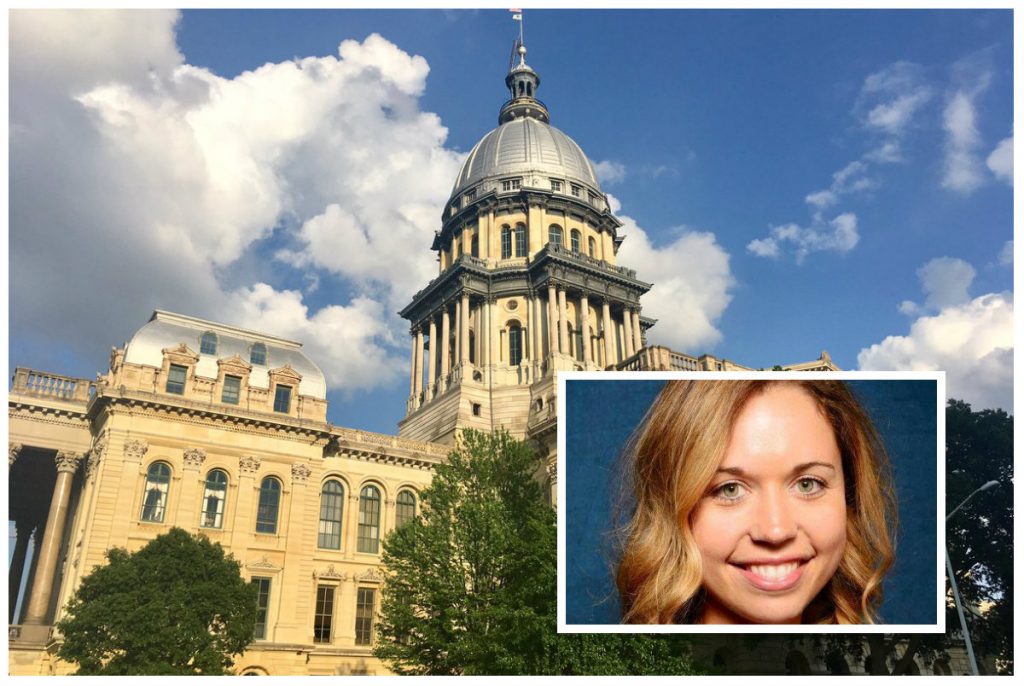
State Rep. Kelly Cassidy (D-Chicago) in her district office on Wednesday.
It would be reductionist to say that State Rep. Kelly Cassidy (D-Chicago) has had a big spring. But between being the lead House sponsor of both the bill to legalize recreational marijuana — making Illinois the first state to do so through the legislative process — and one that rewrites Illinois’ abortion law, the fifth-term Democrat has been at the center of attention.
[audio mp3="http://thedailyline.net/wp-content/uploads/2019/06/2019-06-28-Kelly-Cassidy-pod-session-Mixdown-final.mp3">[/audio]Podcast: Play in new window | Download
Subscribe: Apple Podcasts | Android | RSS
“It was otherworldly,” Cassidy told The Daily Line on Wednesday in her district office in Chicago’s Edgewater neighborhood. “It was happening outside my body. Another day, another three-hour debate.”
The last week of the General Assembly’s spring legislative session included many lengthy floor debates on legislation ranging from Cassidy’s two signature bills, to a change in firearm identification cards for gun owners, to a measure that will allow the question of a constitutional amendment for a graduated income tax on the November 2020 ballot.
By the time the House reached an overtime agreement on a package of budget, revenue, gaming and infrastructure bills late on Friday and Saturday, lawmakers kept saying how remarkable it was that those issues were so non-controversial in comparison.
Cassidy said it was a strange phenomenon that so much going on in the Capitol during the waning days of session seemed to come back to her and her cosponsors’ work on those two blockbuster bills.
“I was out in downtown Springfield and somebody turned to me and said, ‘So, how you feeling?” Cassidy recalled of a weekend in late May. “I smiled and said, ‘Yeah I’m great…also, I’m fully aware that this entire town’s mood hinges on my mood right now, so do you think I’d tell you differently?’”
For those moments, Cassidy says she hearkens back to the advice of Dave Sullivan, a former Republican senator and current statehouse lobbyist.
“He has a phrase that he uses that has become a bit of a mantra for me: ‘Watch the rollercoaster, don’t ride it,’” Cassidy said. “That’s a really important principle to keep in mind in May, because if you get on the rollercoaster, you’re not driving it.”
Marijuana legalization
Cassidy has been quick to correct the perception that legalizing marijuana in Illinois magically came together this spring. She emphasizes that it’s been six years of work on the part of herself, State Sen. Heather Steans (D-Chicago), Marijuana Policy Project senior legislative counsel Chris Lindsey, other stakeholders and in the last couple of years in particular, co-sponsors and chief negotiators State Sen. Toi Hutchinson (D-Olympia Fields) and State Rep. Jehan Gordon-Booth (D-Peoria).
Related: ‘Hell of a start:’ Here’s how expungement will work under the marijuana legalization bill
But despite all the groundwork laid before the spring, Cassidy said many of the specifics around criminal justice and equity were still up in the air. There was a big shared Google Doc filled with “open questions,” and “raw material.”
“What we knew in all our travels and all of our discussions around the country was that [legalization] hadn’t been done comprehensively anywhere,” Cassidy said. “Lots of states had tried one or two things… Presuming that the lack of inclusion and equity in this industry is based on a singular cause I think was the fatal flaw to every program.”
Cassidy said she and other negotiators knew that social equity had to be at the center of the bill, or risk seeing it fail. She said some places, like the Hood Incubator in Oakland, California, had done what she was hoping to do in Illinois, but on a smaller scale than any statewide initiative. The Hood Incubator is a business accelerator for entrepreneurs from under-represented populations in the marijuana industry. Negotiators consulted with leaders from the group, and even had them meet with members of the Black Caucus.
Related: Republicans back cannabis bill after governor agrees to use pardon power
Not everyone was confident that 2019 was the year to legalize marijuana. Cassidy said she too had heard the constant rumors that the bill was falling apart, but said she had to block it out.
“There were certainly moments where I was worried, and there were certainly marriage equality flashback moments,” Cassidy said of the 2013 bill that legalized same sex marriage in Illinois. “At its most basic, politicians evolve more slowly than humans do. There was huge public support for equal marriage back when we were working on it, and yet it was a slog to get to that 60 votes. Similarly here, it took a lot more wrangling than the public perception is.”
Related: Labor hopes to make inroads in recreational pot industry
Reproductive Health Act
When Gov. JB Pritzker signed the Reproductive Health Act into law earlier this month, he touted the measure as “a giant step forward for women’s health.”
The new law makes Illinois one of most progressive states in the nation when it comes to abortion. It repeals of the state’s 1975 abortion law, removes criminal penalties for doctors who perform abortions and throws out restrictions on the procedure later in pregnancy.
Related: Dems to push for repeal criminalization of abortion doctors, parental notice laws
But the RHA almost went nowhere this spring. Both the it and a bill to repeal the state’s Parental Notice of Abortion Act were introduced around the same time in February, after having been included in recommendations from gubernatorial transition committee reports early in Pritzker’s term. But both faced roadblocks in March, when House Democratic leadership sent them to a subcommittee to die a quiet death.
Related: Dem lawmakers vow to hold Pritzker to his promise to expand, protect reproductive rights
But in the wake of the passage and signing of abortion bans and so-called “heartbeat bills” that aim to curtail abortion access in states like Alabama, Georgia, Missouri, Kentucky and Tennessee this spring, newly elected Democratic women, many of whom campaigned for the General Assembly on a platform that included abortion rights, pushed for the RHA.
Related: Advocates frustrated as push to expand, protect reproductive rights stalls
Cassidy credits those House Democratic freshmen women for driving the bill, even when she thought it was dead.
“It was frustrating and it was clear at that point that there wasn’t really understanding of the importance of this and the urgency around it,” Cassidy said of talks with Democratic leadership in mid-session. “And efforts to share that sense of urgency were not well-received. So there were points — that was definitely one that I thought, ‘Okay, this one’s going to have to come back. There’s just nothing I can do to make this move.’”
She also credited the Illinois Handmaids — a group of women who showed up to the Capitol on a consistent basis dressed in the red cloaks and white bonnets of the women in Margaret Atwood’s The Handmaid’s Tale, which is now a popular television series of the same name on Hulu.
“There’s a discipline to what they did that frankly, really blows my mind,” Cassidy said. “Because they did it for a long time. And it did make a difference, it did get people asking…that helped to create the Capitol-wide conversation of, ‘This isn’t really going away.’”
Related: Abortion rights bill signed, but what happened to the effort to repeal parental notification law?
Cassidy said the freshmen women of the House used House Speaker Mike Madigan’s (D-Chicago) own political ethos to push for the bill he has buried, noting that the new lawmakers had run on being pro-choice in November and won seats that had long been held by Republicans in the suburbs.
“When you come in, especially for folks who are seen as targets: you have to be responsive to your district, you have to be responsive to the things that you said you were going to do when you ran,” Cassidy said. “That’s the advice we all get. Be true to your campaign promises…You can’t really argue with that point.”
Cassidy said she respected the way the House Republicans had handled the lengthy debate on the bill, ceding all their time to State Rep. Avery Bourne (R-Raymond), a third-term lawmaker who is pregnant with her first child.
“I’m really proud of us,” Cassidy said. “I think that as a state we showed how this can be discussed maturely and with respect. I think that using me and Avery — we are emblematic of our positions. I’m the poster child for my side, and she’s the poster child for her side and we can do this without getting ugly with each other and we can do this without it getting hyperbolic. So I think it showed us at our very best.”
Progressivism, Madigan, Mayor Lightfoot
Cassidy, who was first appointed to the House in mid-May of 2011, has seen an evolution of progressivism in both Illinois and throughout the country. Even though she’s a founding member of the House Progressive Caucus, she said that hasn’t changed her approach to legislating.
“I’ve always been someone that works across the aisle,” Cassidy said. “There certainly were periods during the last eight years where that was more challenging. But honestly until this year, I had never had a bill that didn’t have a bipartisan roll call. The RHA broke my record, which is a bummer.”
This spring stands in stark contrast to last May, when Cassidy publicly accused Madigan and his then-chief of staff Tim Mapes of using political force to get her fired from her part-time job with Cook County Sheriff Tom Dart’s office. Cassidy claimed it was retaliation for calling for an independent investigation into the speaker's handling of sexual harassment claims made against his political organization. In February of last year, campaign worker Alaina Hampton went public with accusations of sexual harassment against Madigan foot soldier Kevin Quinn.
Mapes was pushed out last June after House Democratic staffer Sherri Garrett accused him of harassment, and was replaced by Jessica Basham. Cassidy complimented Basham for jumping into the job, and said she approves of the changes the speaker has made in his office, but said there is “more ground to cover before it’s a better workplace for everybody.”
“I met with him in early January just like every member did, talked about my expectations for the session, talked about my desire to move forward, not look back,” Cassidy said of Madigan. “He shared that desire, and so we did…the reality is, without the support of leadership, you can’t pull off all that stuff.”
Cassidy is also close with new Chicago Mayor Lori Lightfoot, who must cope with a massive budget shortfall, chronically underfunded pensions, a tragic number of shootings and gang violence and many other issues.
“My biggest advice to her and the administration after they took over is make sure that there is a more direct engagement with us as partners, and in particular the city caucus,” Cassidy said. “Because I think in the Emanuel administration, it certainly was something that was a frustration with members…the city would not really directly engage but then accuse Springfield of failing to help. All that’s going to do is alienate people that could be helpful to you.”
And if all else fails, adopt a puppy.
Cassidy and her spouse, Candace Gingrich, had committed to adopting a mastiff puppy in mid-Spring from a friend whose dog was pregnant with a litter. They picked him up shortly after session ended, and promptly named him Jack Straw Herer — Jack Straw for a Grateful Dead song, and Jack Herer, after the marijuana rights activist also known as the “Emperor of Hemp.”
Photos and videos of Jack, now 11 weeks, were motivation to get through the end of session, Cassidy said.
“When things got hard, I’d text my friend and be like, ‘Puppy pics, stat!’” Cassidy joked. “I’m going to go to my happy place for a minute, I’ve got a puppy coming. Get this done…and I knew if I didn’t get it done, I wouldn’t get the puppy.” -
One year ago, former Gov. Bruce Rauner stood on the steps of the U.S. Supreme Court to declare victory in a battle he started just a few weeks after taking office in 2015. After a years-long battle through the court system, the nation’s high court ruled that so-called “fair share” union fees paid by non-card carrying workers were unconstitutional.
Gov. Bruce Rauner addresses media on the steps of the U.S. Supreme Court on June 28, 2018, after the high court ruled in his favor in Janus v. AFSCME. [@GovRauner/Twitter]
-
Comptroller Susana Mendoza — who spent most of her first term in office blasting former Gov. Bruce Rauner — was in familiar territory Wednesday, blaming mismanagement during the Republican’s tenure for delaying the state’s Certified Annual Financial Report on the 2018 fiscal year.
-
Both the state of Illinois and certain local governments will get a boost in revenues from online sales transactions under changes in the state’s tax code, provided for by a year-old U.S. Supreme Court decision.
-
Thousands of home health care workers who had been granted raises in the 2018 budget approved by lawmakers approved despite the veto of former Gov. Bruce Rauner will finally get $30.7 million in back pay this week, Comptroller Susana Mendoza’s office said Monday.
-
Lovers of fizzy water who got their LaCroix fix at Walgreens only to be incorrectly hit with the Chicago’s bottled water tax — which does not apply to sparkling water and seltzer — can not sue the drug store for fraud, the Illinois Supreme Court ruled.
A DNAinfo investigation found Walgreens erroneously taxed sparkling water. [DNAinfo Chicago]
The Illinois Supreme Court ruled 6-1 to reject a class action suit brought by Destin McIntosh, who filed suit after he bought sparkling water from a Chicago Walgreens store only to find he had paid Chicago’s five-cent per bottle tax, which should have applied only to plain, bottled water.
The taxing error was first reported by DNAinfo Chicago, which is now Block Club Chicago.
Walgreens corrected the error after the news reports.
The decision authored by Supreme Court Justice P. Scott Neville found Walgreens acted in good faith because officials believed the tax was required, did not attempt to hide the charge from customers and paid the tax to the city.
Chief Justice Lloyd A. Karmeier, and justices Rita B. Garman, Robert R. Thomas, Anne Burke and Mary Jane Theis concurred.
Read the full decision here.
However, dissenting Justice Thomas L. Kilbride said the ruling could establish a precedent that could thwart future consumer fraud claims by relying on the so-called “voluntary payment doctrine.”
That doctrine prevents litigants from recovering payments that were not coerced and if the charge was disclosed.
The suit was originally dismissed by a Cook County judge, but revived by an appeals court. Attorneys for Walgreens appealed that decision to revive the lawsuit. -
Organized labor helped push the bill to legalize recreational marijuana across the finish line in the closing days of the spring legislative session last month, but unions’ involvement in the marijuana industry is likely only just budding.
Unions like the International Union of Operating Engineers Local 399 and Teamsters Joint Council 25 could also represent workers supporting the infrastructure of the recreational marijuana industry. [Twitter/@jake____lewis]
-
Chicago and the rest of Illinois have lost population in recent years, partly because of a lack of economic and housing opportunities for black residents and, broadly, the loss of manufacturing jobs. [The Pew Charitable Trusts]
It’s known here as The Exodus.
People are leaving Illinois in droves. Republicans blame the state’s high taxes and its unfunded pension liability, which tops $130 billion. Democrats believe it’s the state’s lack of investment in education and infrastructure. -
The Spring legislative session may have ended without so much as a hearing on a bill that would allow nurse anesthetists to administer anesthesia without a physician’s direct supervision, but that hasn’t stopped a full-blown coalition from forming against the bill as insurance for possible action during veto session or even next year.
Meetings & Agendas- Chicago
- Springfield