


Chicago News
-
-
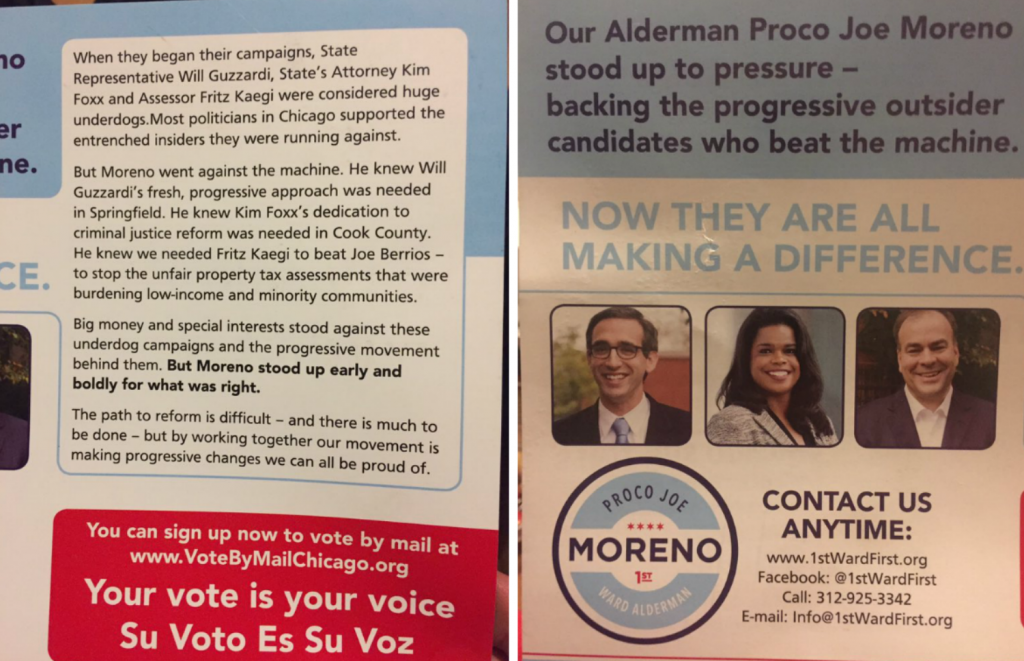 The mailer sent by Ald. Proco Joe Moreno (1).
Ald. Proco Joe Moreno (1), who is under investigation for filing a false police report after the car he said was stolen was found in the possession of a former girlfriend who said the alderman lent her the car, is now himself being accused of taking something without permission.
Moreno’s latest mailer features the pictures of state Rep. Will Guzzardi, Cook County State's Attorney Kim Foxx and Assessor Fritz Kaegi — three of the area’s best-known and most successful progressive politicians.
“Our Alderman Proco Joe Moreno stood up to pressure – backing the progressive outsider candidates who beat the machine,” the mailer reads. “He knew Will Guzzardi's fresh, progressive approach was needed in Springfield. He knew Kim Foxx's dedication to criminal justice reform was needed in Cook County. He knew we needed Fritz Kaegi to beat Joe Berrios — to stop the unfair property tax assessments that were burdening low-income and minority communities.”
Guzzardi took to social media to rebuke Moreno for making it appear as though Guzzardi endorsed him.
"The alderman did not receive, nor did he request, my consent to appear in this mailer,” Guzzardi wrote. “And while the statement made in the piece is factually correct — he did support my campaign in 2014 — I believe the mailer makes a misleading implication. I have not endorsed Alderman Moreno's re-election campaign. I have been increasingly troubled in recent years by both his personal and his professional conduct. I urge voters in the First Ward not to confuse my appearance in Moreno's literature with my support for his candidacy."
Robert Foley, a spokesperson for Foxx, said Moreno did not seek the state attorney’s permission to use her picture on his mailer.
“State’s Attorney Foxx has not endorsed Alderman Moreno for re-election or any other elected official this cycle,” he said.
“Fritz has not made an endorsement in the 1st Ward race. Any assertion otherwise would be inaccurate,” Kaegi spokesperson Joanna Klonsky said.
Kaegi gave Ald. Moreno permission to include on his mailer that the alderman had endorsed Kaegi in his run against Berrios, Klonsky said, but the two did not discuss using a photo.
Moreno did not immediately respond to a request for comment.
Daniel La Spata, who is vying to unseat Moreno in the 1st Ward contest on Feb. 26 election, noted that Moreno has been in the news this week for less than positive reasons.
“It’s shameful that he’s trying to mislead 1st Ward voters and distract from his record of selling out our ward by engaging in the machine-style politics that have held this city back,” La Spata said. “But he’s not fooling anyone.”
Earlier this week, mayoral candidate Susana Mendoza said she would not attend a Feb. 20 fundraiser for Moreno — although the alderman’s advertisements for the event said it would feature Mendoza as the “honored guest.”
This isn’t the first time a popular candidate has cried foul about others cashing in on their popularity or progressive bona fides. In the 2018 midterms, then-Commissioner Jesus “Chuy” Garcia’s picture or name appeared on campaign literature for several candidates he had not endorsed.
Garcia, who supported Alma Anaya in that race, demanded that candidate Angie Sandoval stop, and told reporters she intended to mislead voters. Despite Garcia’s objection, Sandoval used Garcia’s name on her palm card in the 7th District race.
Moreno told WGN-TV he reported his Audi stolen because of a “misunderstanding” between him and the woman, whom he used to date. Although the woman spent the night in jail after being charged with a misdemeanor, police have dropped all charges against her.
Send all of the walk pieces, mailers, palm cards or texts you get to us. Our DMs are open @thedailylinechi on Twitter and at [email protected]. -
-
A coalition of progressive groups backed by two of the city’s largest unions laid out a road map for the next mayor and City Council to follow, and urged whoever is elected to make a clean break from policies backed by outgoing Mayor Rahm Emanuel and his predecessor Mayor Richard M. Daley.
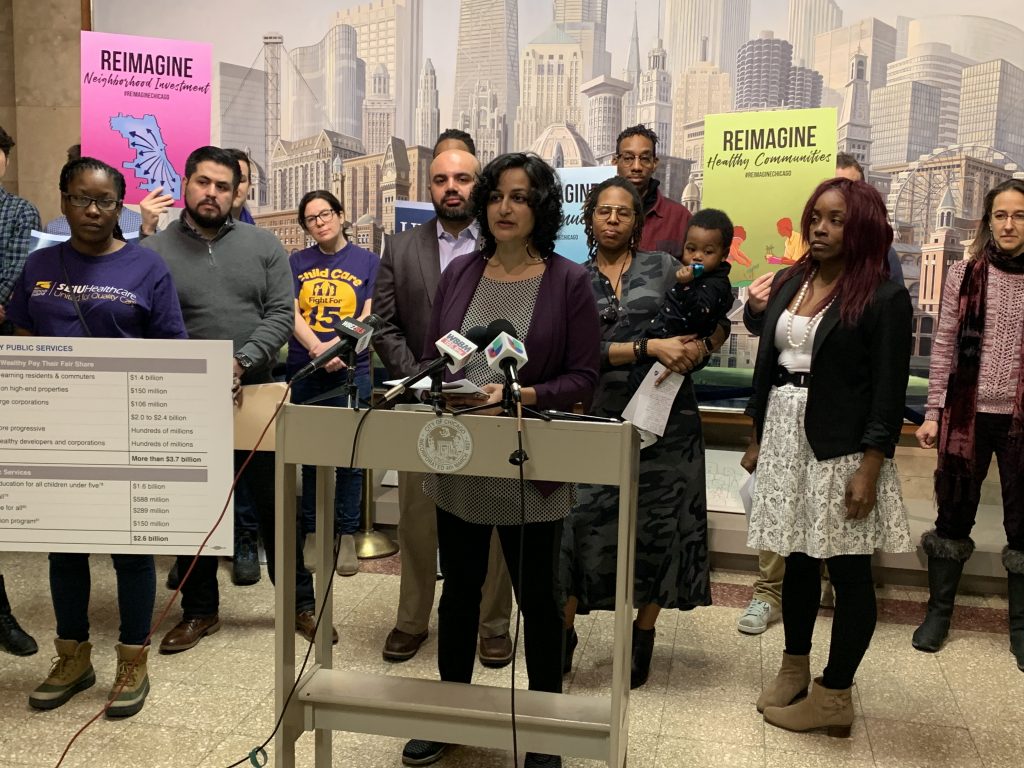 Amisha Patel, of the Grassroots Collaborative, unveils the budget plan. [Heather Cherone/The Daily Line]
-
-
The 2019 race for Chicago mayor has zigged and zagged half a dozen times before Lori Lightfoot’s eyes.
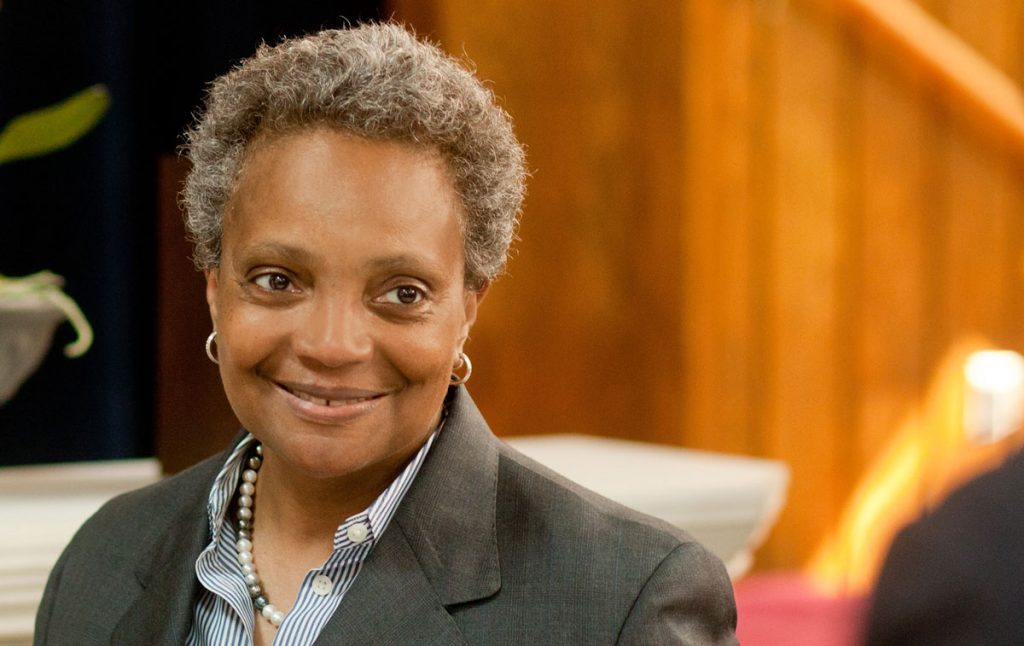 Mayoral candidate Lori Lightfoot [Submitted]
The former federal prosecutor, Police Board president and head of the Police Accountability Task Force formed in the wake of the release of the Laquan McDonald video expected to be facing off against the man who twice appointed her to office, Mayor Rahm Emanuel.
A former partner in the law firm of Mayer Brown, Lightfoot said she decided to run after concluded she was uniquely equipped to take Emanuel on. She would also make history in the meantime as Chicago’s first black, female LGBTQ mayoral candidate.
Little did anyone know Emanuel would drop out, opening up the race to roughly a dozen more candidates.
The race zigged with the attempted extortion charge against Ald. Ed Burke (14), zagged with the news that Ald. Danny Solis (25) had wired up after his own federal troubles, and only became more complicated with each new revelation of each frontrunner’s history with what Burke and Solis represented of the “broken Chicago machine,” as Lightfoot put it in her first television ad.
Related: Police Board Prez On CPD Consent Decree, Mayor’s ‘Blackbox’ DOJ Negotiations
Despite the extremely crowded field, Lightfoot’s comparatively poor showing in the polls, Bill Daley and Gery Chico’s millions, Cook County Board President Toni Preckwinkle’s robust union support, and Comptroller Susana Mendoza’s ability to command the race’s spotlight, Lightfoot said she will benefit from the ethics scandal, even as the winds of change continue to blow.
“Frankly, I think it positions me well as a former prosecutor, as somebody who has convicted a corrupt alderman, and frankly as someone who has been talking about the necessity of good government for a long time, way before the recent events. We put out our good government proposal back in August. We’ve been talking about those issues for a while,” she said on The Daily Line’s Aldercast.
[audio mp3="http://thedailyline.net/wp-content/uploads/2019/02/Lightfoot-aldercast-02-08-19_final.mp3">[/audio]
Podcast: Play in new window | Download Subscribe: Apple Podcasts | Android | RSS
Five takeaways from her interview:
Proposed cuts: Infrastructure Trust, Clerk, Treasurer – Lightfoot estimates she could save $15 million to $30 million by consolidating the administrative functions and investment advisors for the city’s pension funds. She also proposed eliminating the offices of the clerk and treasurer. Their work can be handled by other agencies.
Both are “a relic of the Mayor Richard J. Daley era to give blacks and Latinos a citywide office so they wouldn’t dare challenge him for mayor,” Lightfoot said.
She also proposed combining the city and county’s election boards and infrastructure and would bust the Chicago Infrastructure Trust.
Emanuel’s push to fast track the new police and fire academy — set to be considered by the Plan Commission this month — was “a rush job to get a win for the Chicago Infrastructure Trust.
“I don’t think it’s served any purpose whatsoever,” she said of the trust.
Police contract priorities — Lightfoot has been a frequent critic of the current Fraternal Order of Police leadership, including its resistance to the consent decree reforms. Many reforms must still be negotiated as part the police union’s next contract.
“I don’t worry about my standing with rank and file, because I know a lot of rank and file officers,” Lightfoot said when asked if she feared she’d start at a disadvantage in negotiations.
“I think that they recognize that what I’ve been fighting for is to make a better and stronger police department and not to vilify them... I do not believe that the FOP leadership is truly representative of the rank and file officers, and frankly, particularly officers of color,” Lightfoot said. “I just don’t think that they speak for them.”
Lightfoot said she would demand a provision in the contract to preserve disciplinary files in order to hold officers repeatedly involved in misconduct accountable and to help officers “who have lost their way” get back on track, Lightfoot said, adding that she would also allow anonymous misconduct complaints and expand the ability of the Civilian Office of Police Accountability and the public safety inspector general to track officers and units to identify patterns of misconduct.
Take the Department of Housing and run with it — Affordable housing development should move from the Department of Planning and Development to the mayor’s new proposed Housing Department, Lightfoot said.
“I’ve heard this from very frustrated community development organizations, that the city doesn’t lead, the city’s not involved in deals on the front end, they don’t have the perspective of how do we get to yes,” Lightfoot said. “There’s so much bureaucracy and red tape that it’s very discouraging for these community based developers to be able to get something done.”
The city’s current Affordable Housing Requirements Ordinance is “not working,” Lightfoot said, adding that the city should require a higher percentage of on-site units and force developers to build off-site units closer to the new development site.
Part of the problem is the unspoken dominance of aldermanic prerogative, Lightfoot said.
“We’re down 120,000 units, which is probably a conservative number… you can’t get there when you’ve got 50 different bosses making 50 different decisions,” Lightfoot said, adding that she will issue an executive order to tell department heads and licensing bodies “this thing doesn’t exist anymore” and take away alderman’s unilateral veto power.
How Chicago was different from what she expected — A small town Massillon, Ohio, native, Lightfoot said she moved to attend the University of Chicago law school because the city was always “this kind of mystical place in my mind, having grown up looking at Ebony and Jet magazine and seeing a life for black folks that was very very different than my own. I grew up in a working class family, we struggled a lot financially, but I’d see unfolded in these magazines is people living what seemed like a glamorous life, so it felt like a place there was opportunity.”
Chicago was not what she expected, Lightfoot said.
There is “definitely greatness to the city, without question, but there are a lot of challenges… levels of poverty that shouldn’t exist anywhere, but certainly shouldn’t exist in a city like this that has so many resources, so much wealth. It’s been very very interesting for me to explore the city from a different perspective,” Lightfoot said.
There were problems during the Daley years, but Emanuel made them worse — During Mayor Richard M. Daley’s administration, Lightfoot spent time at the Chicago Police Department’s Office of Professional Standards, Office of Emergency Management and Communications and the Department of Procurement Services during major crises, including the Hired Truck scandal.
“I remember once, being in a meeting with Rich Daley where I said ‘Look, [former U.S. Attorney] Pat Fitzgerald is going to announce an indictment of somebody whose a city employee, you ought to be standing right there with him. You ought to be sending a very clear, unequivocal message that you’re not going to tolerate misconduct, and certainly not any that tips over into criminal conduct.’ He looked at me like I was absolutely crazy, and everybody in the room was like, running for cover because it’s no secret that he had an incredibly explosive temper. But that told me a lot about him and the time.”
Lightfoot said she left the administration after receiving calls about complaining “sacred cow” donors while she was at Procurement Services. Mayor Rahm Emanuel exacerbated the city’s “give to get” culture by allowing “people like [Ald. Ed] Burke, like Danny Solis, and others, to amass even more power than they had before,” she said. -
The Chicago Public Schools got good news from a ratings agency, but storm clouds loom on the horizon. Meanwhile, a coalition of progressive groups are set to release a spending plan for the next mayor that would overhaul the city’s priorities and a mayoral task force charged with studying a proposal for a universal basic income will report its findings.
-
FEB 07, 2019

 Lori Lightfoot, one of the first candidates to join the mayoral race, became the latest candidate to hit the television airwaves just three short weeks before Election Day. In addition, candidate Amara Enyia announced the creation of a new “Black and Brown coalition” by endorsing three aldermanic candidates.
-
Chicago’s three candidates in the wide-open race for Chicago treasurer want the office charged with managing the city’s $8 billion investment portfolio as well as five retirement funds to play a more prominent role as the city grapples with a looming pension crisis.
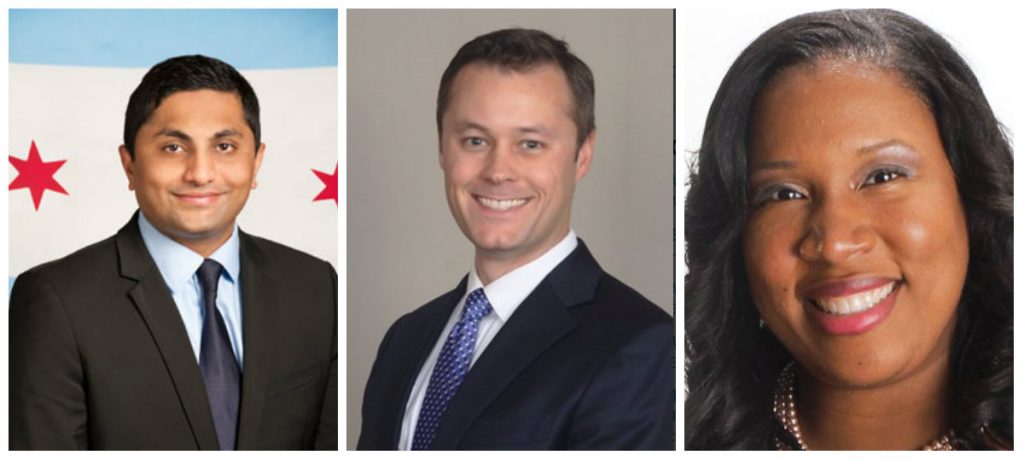 Ameya Pawar, Peter Gariepy, Melissa-Conyears-Ervin [Submitted]
[audio mp3="http://thedailyline.net/wp-content/uploads/2019/02/Treasurer-aldercast_mixdown_01.mp3">[/audio]Podcast: Play in new window | Download Subscribe: Apple Podcasts | Android | RSS
City Treasurer Kurt Summers, who flirted with a run for mayor before announcing that he would not seek another term, has not endorsed any of his potential successors.
Summers, a former chief of staff to Cook County Board President Toni Preckwinkle who is running for Chicago mayor, championed a $100 million investment fund in an effort to breathe new life into the South and West sides of Chicago and help fight crime and blight with affordable loans between $100,000 and $1 million — but the fund has yet to make its first investment despite being approved by the Chicago City Council in October 2016.
Ameya Pawar, who served two terms as 47th Ward alderman, said the treasurer should be an “aggressive advocate” for social change by using city dollars to pay off residents’ student loans, smooth the legalization and banking of marijuana, and push corporations to better represent workers. Pawar has been endorsed by U.S. Reps. Mike Quigley and Jan Schakowsky, SEIU Local 1 and St. Sabina pastor the Rev. Michael Pfleger.
Pawar, who ran unsuccessfully for the Democratic nomination for Illinois governor in March, has $212,000 in cash on hand, according to the Illinois Sunshine database.
Peter Gariepy, an accountant who tried unsuccessfully to unseat Cook County Treasurer Maria Pappas in the March Democratic primary, describes himself as the “grounded one” to hold down the fort during “an unprecedented time of financial challenge for the City of Chicago.” Gariepy has the backing of Ald. Scott Waguespack (32). Ald. Proco Joe Moreno (1) and Ald. John Arena (45) served on his exploratory committee.
Gariepy has $49,000 in cash on hand, according to Illinois Sunshine.
Melissa Conyears-Ervin (D-Chicago), elected in 2016 to represent a West Side district in the Illinois House, has the support of the Chicago Teachers Union, the Chicago Federation of Labor as well as Secretary of State Jesse White, U.S. Rep. Danny Davis, and more than two dozen incumbent aldermen.
Conyears-Ervin is married to 28th Ward Ald. Jason Ervin, who is running for re-election. The 28th Ward Democratic Organization, which is controlled by Ervin, gave Conyears-Ervin’s treasurer campaign $5,000 on Feb. 1, on top of $56,000 in in-kind donations in December, according to reports filed with the Illinois State Board of Elections. Conyears-Ervin has more than $255,000 in cash on hand, according to Illinois Sunshine.
Conyears-Ervin said the treasurer should serve as “an independent financial watchdog” to serve everyone across the city, and has proposed taking over the auditing functions now performed by the Council Office of Financial Analysis and the city’s sister agencies.
Pawar’s proposal to create a public bank has dominated much of the conversation around the race. Under his proposal, the bank would be limited to “refinancing student loans, funding affordable housing and banking cannabis.”
Both Gariepy and Conyears-Ervin point out such a proposal would require state approval. Several other cities and states are considering the creation of public banks, and it is part of mayoral candidate Amara Enyia’s platform.
Conyears-Ervin said she supports pursuing a public bank, she said her first step would be to discuss it with state Treasurer Michael Frerichs’ office “to make certain it is a benefit and not a financial burden to taxpayers.”
The cost to capitalize such a bank, which Gariepy pegs between $3 billion and $4 billion, could put taxpayers’ priorities at risk and invite corruption.
“As the city’s finances become more and more strained, I think the propensity for wrongdoing increases exponentially, and there’s a very good reason why no one else has created them,” Gariepy said. “If you find the money to create it, you find the political will in Springfield, you now have a bank whose deposits are solely guaranteed by the tax revenue of Chicago, and it’s run by elected officials, so you would have political appointees deciding the risk appetite for that bank. Who’s going to get loans? Who’s not going to get loans?” he asked.
Pawar waved off Gariepy’s concerns, and said the bank would be governed by a non-political board. He noted Gariepy worked as an accountant on Pawar’s gubernatorial campaign.
“He sounds like a cynical incumbent fending off upstarts who are trying to go big on public policy... it’s odd for a newcomer to politics to stake out that position,” Pawar said. “We have to go big on some of these issues. I’m not running to be a bookkeeper.”
Financial missteps spurred by activism will cost taxpayers in the long run, Gariepy said, noting repeatedly that the city’s pension bill is set to jump 31 percent in 2020, and officials have yet to propose a way to cover that expense.
“If you make bad investments, if you purchase bad debt, if you do things that are aligned with political goals rather than financial goals that also are in accordance with our principles, you’re putting the taxpayers on the hook,” Gariepy said. “So that’s why it’s important that this office, to the greatest extent possible, is not being used as some political stepping stone, because major damage can be done to the affordability and the solvency of the city.”
Pawar said using the treasurer’s office to achieve policy goals will be his highest priority.
He said it’s been difficult to offer bold proposals while corruption swirls around City Hall, eroding public trust. But he suggested the office can do much bigger things, including partnering with other municipalities to weaponize portfolios for social good.
“Imagine if the treasurer organized with the state treasurer, organized with other cities and said, you know, there’s a big opiate crisis,” Pawar said. “We are going to go after big pharma and we’re going to short you. We’re going to short your stocks. Or we’re going to divest from you, or we’re going to divest with funds that have major investments in big pharma unless of course you do something about the opiate crisis.”
Summers warned in a recent City Club speech that if city leaders set up a public bank, they will also have to be prepared to foreclose on homes or put a lien on a student’s assets.
Gariepy, a Detroit-area native, received his accounting and taxation degrees from Fordham University and a civil engineering degree from Northwestern. He worked at Amtrak on planning and real estate, and now works at BKD LLP, a national CPA and advisory firm.
Gariepy complimented Summers’ work as well as his predecessor, Stephanie Neely, saying he’d be in favor of “tightening screws rather than burning down, rebuilding the house.”
The treasurer’s office should adopt environmental social governance standards and take advantage of newly designated federal opportunity zones to promote development in under-invested neighborhoods, Gariepy said, adding that he wanted to explore replicating New York City’s AFL-CIO housing investment trust, which has used union labor to build approximately to 35,000 affordable units.
Conyears-Ervin earned a master’s in business administration from Roosevelt University and a bachelor’s degree in finance from Eastern Illinois University. Conyears-Ervin worked for close to 15 years as a manager for Allstate Insurance’s claims customer experience and catastrophe teams.
“CPAs, they tell you the story of what happened, finance folks make things happen,” Conyears-Ervin said.
Under her control, she said the treasurer’s office would perform analyses of the city’s pension funds, Chicago Public Schools and the city’s sister agencies.
Approximately half of the members of the Chicago City Council have endorsed Conyears-Ervin. She said she will operate independently of her husband, the current vice chair of City Council’s Budget Committee.
“Anyone that knows me know that I am independent,” Conyears-Ervin said. “I am an independent thinker. I was a leader before I met my husband. He was a leader before he met me.”
The Chicago treasurer has been held by an African American since 1999, when former Treasurer Miriam Santos resigned in disgrace as part of a corruption scandal.
Conyears-Ervin’s campaign has emphasized that she will be the first West Side resident to be treasurer.
Pawar, the first Asian American elected to City Council, has represented a ward that is about 90 percent white for eight years after defeating former Ald. Eugene Schulter's hand-picked replacement, who had the backing of the Chicago machine.
“I don’t look at it as change,” Pawar said. I don’t see that not having a black treasurer and having an Indian treasurer is change.”
“It’s enormously important that those who serve Chicago in elected office look like the population of Chicago. Our current mayoral field is extremely diverse, City Clerk [Anna] Valencia is currently unopposed, and I think there’s a very high likelihood that the next mayor of Chicago is a woman of color. And so times are changing,” Gariepy said.
All minority representation is good, Pawar said.
“I don’t like the crabs in the barrel mentality, we end up hurting one another… if we allow that narrative to persist.”
Update: This post was updated on Feb. 7, 2019 to reflect that Gariepy currently works at BKD LLP, a national CPA and advisory firm, and not Vora Certified Public Accountants. -
FEB 06, 2019
-
The city’s Community Development Commission endorsed plans Tuesday for a $700 million subsidy for a development between the South Loop and Chinatown along the Chicago River, despite calls from City Council hopefuls to delay in light of the corruption scandal swirling around City Hall.
 A rendering of The 78. [Related Midwest]
-
The monthly meetings of the Community Development Commission are usually sleepy affairs that feature nothing more exciting than members appointed by Mayor Rahm Emanuel approving new tax increment financing districts and city owned property sales already blessed by Emanuel.
 A rendering of the proposed park in the The 78. [Related Midwest]
-
FEB 05, 2019
U.S. Rep. Mike Quigley toured a training for judges preparing for the Feb. 26 municipal elections, and said the 14-year-old machines set to be used on Election Day should be replaced as soon as possible. Meanwhile, candidates scrambled to line-up big-name endorsements as new new television ads hit the airwaves.
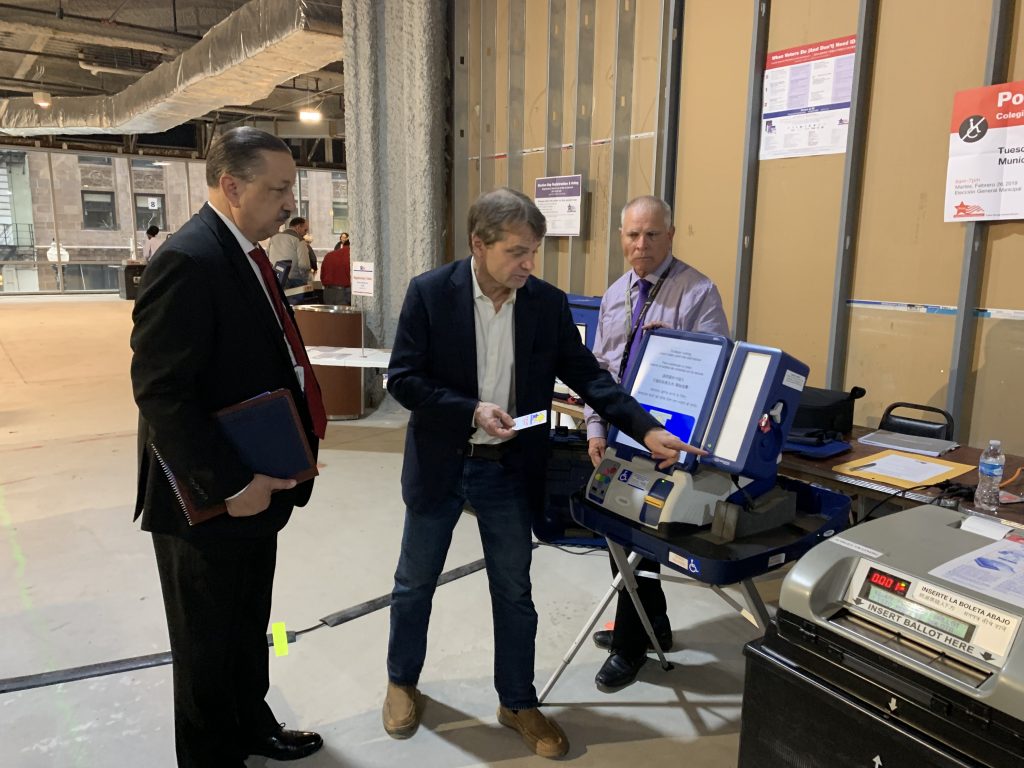 Chicago Board of Election Commissioners Executive Director Lance Gough, left, and U.S. Rep. Mike Quigley examine a voting machine. [Heather Cherone/The Daily Line]
-
Cook County Board President Toni Preckwinkle convened a 23-member anti-harassment working group to review and enhance “our policies and practices regarding the prevention and prohibition of harassment in the workplace” in the wake of her termination of her chief of staff John Keller after allegations of “inappropriate behavior” with a woman.


