


Chicago News
-
MAY 16, 2019

UNLOCKED
ProPublica Illinois reporter Mick Dumke looks at the state’s political issues and personalities in this occasional column.The Chicago City Council’s Transportation Committee has an annual budget of more than $467,000 to cover expenses related to its work on legislation and government oversight.
But little of that work was on display during the committee’s March 6 meeting.
“Fairly quick agenda this morning,” the committee chair, Ald. Anthony Beale, said at the start. He and the six other aldermen then ran through its 70-page agenda in about 23 minutes, approving dozens of ordinances that dealt with hyperlocal administrative matters such as signs, awnings, light fixtures or sidewalk cafes for particular addresses.
That was typical for Beale’s committee. While it rarely does in-depth legislative work, the committee and its budget have been far more valuable for Beale as perks.
Beale, alderman of the far South Side 9th Ward, has used committee funds to hire employees — eight were on the payroll as of December — though he acknowledged they don’t spend all their time on committee work. He’s spent Transportation Committee money on his own transportation, including payments on a Chevy Tahoe SUV and thousands of dollars in parking expenses. And committee funds have gone toward furniture for his City Hall office, including a bourbon cherry wardrobe cabinet, according to records obtained under the Freedom of Information Act.
The Transportation Committee isn’t an outlier.
At great cost to taxpayers, the City Council’s 16 legislative committees are the heart of a favor-trading system that’s enabled mayors to rule like monarchs distributing favors to loyalists. At the same time, the committees have failed to provide even basic oversight of city government.
Many meet infrequently, and when they do, they frequently rubber-stamp agendas in a matter of minutes — often without a quorum of half the members. The budgets for the committees added up to $5.8 million in 2018, but the amount each committee receives is not tied to the volume of legislation it reviews or the regularity of its meetings.
Instead, funding appears more closely aligned with tradition and the clout of the chairs.
Chicago aldermen have also made it almost impossible for the public to see what they’re up to. Committee meeting schedules are posted online and meetings are open to the public, but they’re not broadcast, recorded or transcribed — unless a chair makes arrangements.
The topper: The council has passed laws to make sure committee operations are kept from any oversight. In 2016, aldermen voted 25-23 to kill a proposal to allow the city’s inspector general to investigate and audit the council. Aldermen then passed a substitute ordinance that explicitly blocked the inspector general from looking into many council functions, including committee spending.
Mayor-elect Lori Lightfoot, who will be sworn in with aldermen on Monday, has called for changing the law so the inspector general can audit the council and its committees. She and key aldermen continue to negotiate over who will lead the committees. As current chairs maneuver to hold onto power, reformers say it’s time for significant changes.
City Inspector General Joe Ferguson said Lightfoot and the new council face an urgent need to open the books and bring accountability “with respect to budgets, expenditures, staffing and operations at both the whole Council and Committee levels.”
“Government cannot fully escape corruption, mismanagement and waste without accountability,” Ferguson wrote in a statement responding to ProPublica Illinois’ findings. “That applies as equally to a legislative body as it does an executive, and even more so in Chicago, with its history of a weak, compliant City Council most noted for a decades-long trail of corruption. At this moment in the City’s history, both the public and the incoming Mayor desperately need a productively engaged City Council that fully inhabits its legislative oversight responsibility.”
In most legislative bodies, members pick their own leaders and committee chairs. The Chicago City Council’s rules say that’s what aldermen should do as well. For decades, though, the mayor has picked council committee chairs. It’s no secret at City Hall that only aldermen who support the mayor’s initiatives are rewarded with the posts, though they often claim otherwise.
As Ald. Walter Burnett Jr. tells it, he was shocked when, in 2007, former Mayor Richard M. Daley offered to make him chair of the Special Events Committee. Burnett had never led a committee before. And he had been pushing an affordable housing plan that was more aggressive than the mayor wanted.
“I thought there might be a hit out on me,” Burnett joked. Instead, Daley came up with a watered-down affordable housing plan. After Burnett signed on, “the next thing I knew, I got a committee.”
Despite their back-and-forth over affordable housing, Burnett had supported almost all of Daley’s agenda, including the mayor’s plan to demolish dozens of public-housing buildings and replace them with mixed-income developments.
In 2011, Rahm Emanuel campaigned for mayor on a promise to rid City Hall of corruption. He even suggested he might replace Ed Burke, the dean of the City Council, as chair of the Finance Committee, the council’s most powerful. Once in office, Emanuel eliminated three other council committees and shaved funding for others.
But soon after, the city’s annual budgets — proposed by the mayor and approved by aldermen — began boosting the money available to committees again. By 2017, the council committees were spending more than when Emanuel became mayor.
Emanuel also let council insiders stay on as committee chairs — including, most notably, Burke — so he could count on their help advancing his agenda. Some loyalists got promotions. In 2013, for example, Emanuel shifted Burnett to the Traffic Committee, which had an annual budget of about $215,000, a bump from the $155,000 he had to spend as Special Events Committee chair. The Traffic Committee budget has since grown to about $249,000.
Emanuel’s chosen committee chairs have proven to be reliable supporters. Two of the current chairs sided with the mayor on 93% of divided council roll call votes from 2017 to 2018 — and those are the most independent voting records of any of the committee leaders. Burnett and five others voted with Emanuel 100% of the time, according to a study by political scientists at the University of Illinois at Chicago.
The committees are valuable because of a simple fact: Like most public officials, every alderman would like more staff and money to work with.
For years, the city’s annual budget — approximately $10.7 billion for 2019 — has allocated funds for each alderman to hire three aides. Most aldermen say that’s not enough to manage their daily barrage of constituent service requests, let alone to prepare for their jobs as legislators.
Aldermen have a limited number of options for adding staff. They can try to cut office expenses and spend more money on employees. They can also use campaign funds to hire more people, the approach taken by Brendan Reilly of the downtown 42nd Ward.
That’s not easy for most aldermen, especially those who struggle to raise money.
Chairing a committee offers another possibility. Committee staff members are exempt from city rules meant to prevent political hiring and firing, which means the chairs can fill the jobs any way they want, for any reason.
Tom Tunney, the current chair of the Special Events Committee, said he needs extra help to keep up with constituent needs in his busy ward, the 44th, based on the North Side’s Lakeview neighborhood.
He acknowledged that most of the legislation his committee oversees — concerning festivals, cultural events and other matters connected to the arts — comes from the mayor’s office and the Department of Cultural Affairs and Special Events. The committee had three employees as of December, but since they only spend about a week each month preparing for committee meetings, Tunney also assigns them to help with issues in his ward.
“Do they just work on committee stuff? No,” Tunney said.
Tunney conceded it’s not fair that committee chairs essentially get more help to take care of their wards. But he’s also skeptical of proposals that would require committee employees to limit their work to committee matters, because he doesn’t think they would have enough to do.
“I wouldn’t agree with that because practically; I want my people working all the time, given my workaholic nature,” he said.
Last month, Tunney said he would like to be considered for Finance Committee chair after the new council is sworn in on Monday, and other committee chairs are lining up behind him.
Burnett said he, too, counts on committee staff to help with ward matters. At the end of 2018, he had eight employees on the Traffic Committee payroll.
“It helps you with your ward, especially if you’ve got a ward like mine,” said Burnett, whose 27th Ward includes parts of the near North and West sides that have boomed with development over the last two decades. “I get everything from yuppies worried about permit parking to people [dealing with] sewage. It’s never ending. … So the extra staff people help, and they do dual roles. Everybody works on the ward and everybody works on the committee, too.”
Burnett said his committee employees put in a lot of work to prepare for the committee’s meetings. But that wasn’t evident when it convened on March 6.
Several minutes after the meeting was scheduled to start, the chairman’s seat was still empty. So were most of the seats around them. Only four of the committee’s 16 members had shown up.
Finally, an aide to Burnett got a call on his cellphone and waved Marty Quinn over. Quinn, alderman of the 13th Ward on the Southwest Side, appeared taken aback for a moment. Then he understood: Burnett wasn’t going to show. Quinn was going to have to lead the meeting.
Under City Council rules, at least half of the members of a committee need to be present for a quorum. But neither Quinn nor the other three aldermen noted that they were four short. Quinn gaveled the meeting to order and moved to pass the first 19 proposed ordinances on the committee’s 12-page agenda.
“All those in favor?”
“Aye!” the other three aldermen said in unison.
“In the opinion of the chair, the ayes have it,” Quinn said.
As is usually the case with the Traffic Committee, each of those ordinances concerned parking restrictions, loading zones or traffic signs for single addresses or streets. And if the local alderman has approved, the committee signs off.
In a series of rapid-fire motions and choruses of “aye,” Quinn and his three colleagues ran through the next 10 pages of ordinances with no discussion or break in their rhythm.
All told, the meeting took less than three and a half minutes.
The public has no ready way to see how many people are hired by the committees or what they do. Annual city budgets allocate money for committee staff. But only the budget for the Finance Committee specifies the number or titles of committee employees, giving the other committee chairs the power to use those funds as they see fit.
At the end of 2018, council committees had a total of 133 employees, according to city payroll records. That’s 108 more than were listed in the city budget approved by aldermen and released to the public. Most of the employees are listed in payroll records as “legislative aide.”
The Finance Committee has long had the largest committee budget, as well as the broadest jurisdiction, including city bonds, taxes, legal settlements and privatization deals. It also housed the city’s workers’ compensation program. In January, Burke, its longtime chairman, was charged in federal court with attempted extortion; Burke has denied any wrongdoing. Emanuel then had Burke deposed as finance chair and moved the workers’ comp program to the city comptroller’s office.
For years, the Finance Committee’s accounting was even more opaque than other committees’. According to the city budget, the Finance Committee had a 2018 budget of $2.3 million, which included the salaries of 25 employees. But expense records show that Burke had access to far more money and workers. Burke kept between 61 and 78 people on the payroll at different points in the year, costing a total of about $3.4 million in worker pay. Employees listed as full time were paid salaries ranging from about $21,000 a year for a legislative aide to $171,000 for the chief administrative officer of the workers’ comp program.
Following the Finance Committee money gets tricky fast. In addition to money allocated for the committee, Burke also paid workers out of funds he controlled in other city departments. One employee was paid out of the budget for the Fire Department’s workers’ compensation costs; others were covered out of allocations for “investigation costs” buried deep within the budget.
At least four employees were paid from multiple funds during the course of the year.
Last December, the Finance Committee transferred $862,000 from its reported expenditures to the balance sheets of other city departments. The end-of-the-year accounting maneuver came after Burke’s staff said some employees assigned to the committee should have been paid out of funds available for the workers’ compensation program. The spending records don’t show what the employees’ duties were.
The complicated money flow — and lack of oversight — put Burke in the enviable position of being able to dispense favors and largesse to other aldermen. For years, he essentially loaned employees to other aldermen who needed help, as WTTW reported in March. On occasion, the Finance Committee paid expenses for other aldermen, such as when it reimbursed 40th Ward Alderman Pat O’Connor about $2,900 total for travel to conferences of the National League of Cities in Nashville in 2015 and Kansas City the next year. O’Connor did not respond to a request for comment.
From 2015 to 2018, the Finance Committee also paid more than $46,000 to cellphone provider Verizon Wireless. Invoices don’t provide details about the account or why the bills were so high.
Burke didn’t respond to requests for comment.
As chair of the Committee on Committees, Rules and Ethics, 8th Ward Alderman Michelle Harris oversees council procedures and has the power to decide which legislation is assigned to which committees, or to hold up legislation altogether.
“I do everything I can to be aboveboard and be transparent because I am the rules chair, but every now and then it doesn’t work out that way,” Harris said in an interview.
In April 2018, $8,820 in committee funds went to pay a South Side company to print and mail an 8th Ward newsletter, according to a copy of the invoice obtained from the city under the Freedom of Information Act.
Harris said the mailing was focused on city services and wasn’t political, but she conceded it should have come out of her ward account. She blamed the error on a new employee and promised to “have her re-trained.” Harris also wondered why city finance officials didn’t catch the mistake.
“What I’m further concerned about is that it wasn’t flagged anywhere along the process,” she said.
Between 2015 and 2018, Harris paid $82,000 in Rules Committee funds to The Salient Group, a downtown firm, for what was described in a February 2018 invoice as “PR Consulting.”
Harris said Salient’s president has attended committee meetings and helped Harris respond to news coverage about her role as chair, such as criticism that she has buried legislation when it was opposed by Emanuel and his allies.
“I’ve gotten torn up on by some people, so I’ve had to come up with a strategy about how to deal with those issues,” Harris said. Asked if all of the PR work was connected to the committee, she said, “You are 10,000% correct.”
Loading...
Beale, chair of the Transportation Committee, also dipped into committee funds for public relations.
Beale became the committee’s leader after a slow, steady climb up the City Hall ladder. In 2007, Daley picked Beale to lead the council’s Landmarks Committee. Its previous chair, Arenda Troutman, had been charged in federal court with taking a bribe and then lost her reelection bid.
Three years later, Daley moved Beale to the helm of the Police and Fire Committee, which had a larger budget. When Emanuel was elected mayor in 2011, he shifted Beale to chair the Transportation Committee.
The new post was another boost for Beale. The Transportation Committee has an annual budget more than twice as large as his old committee’s. And most of its work consists of rubber-stamping hyperlocal administrative ordinances. Between 2015 and 2018, 99% of the ordinances introduced to the committee were passed, records show, typically without discussion or debate.
In addition to putting eight employees on the payroll, Beale used committee funds to pay $15,000 in 2015 and 2016 to the public relations firm MK Communications for “professional services,” including “project strategy, planning and management, media, writing and editing,” according to invoices.
Another $13,000 went to Rightsize Facility, an office furniture company, for items that included a bourbon cherry wardrobe cabinet delivered to City Hall, records show.
Beale also used committee funds to pay for a car and parking costs. More than $9,000 went to GM Financial Leasing for a 2015 Chevy Tahoe SUV, records show. Another $11,000 covered parking expenses.
Pointing to the committee’s 70-page agenda after its March meeting, Beale said all his committee staff positions are needed.
“That’s a lot of work, man,” he said.
But Beale said those employees don’t limit their work to committee matters.
“I mean, people call downtown for a city service, of course they’re going to serve the people,” Beale said. “I’m not going to tell a [committee] staff person, ‘This is an aldermanic call, someone calling to have a street light put on,’ and transfer that call. You take care of that city service. You’re still doing a service to the public.”
Marilyn Katz, the president of MK Communications, said her firm works on a range of issues with Beale. They include matters before the committee, such as taxi regulations, as well as ward issues such as housing and the opening of a Whole Foods store. She said she couldn’t comment on the committee expenditures but would ask Beale.
The alderman didn’t respond to that or other requests for comment about committee spending.
In recent weeks, Beale has been among the council chairs lining up support from colleagues to hold onto their committee posts. They’ve also been working to block 32nd Ward Alderman Scott Waguespack, a Lightfoot ally and head of the council’s Progressive Caucus, from becoming the next chair of the Finance Committee.
Perhaps the highest cost of the current committee system is the hardest to measure: the failure of the City Council to provide oversight of city government and, when necessary, serve as a check on mayoral power.
More than a dozen people were reportedly shot over the first weekend of April — a number that’s not unusual in Chicago as the weather warms up. But the city’s ongoing struggles with gun violence were not mentioned during the April 8 meeting of the Committee on Public Safety. Just one item was on the agenda: an ordinance that would temporarily allow helicopters to land near McCormick Place so they could be exhibited during the upcoming convention of the International Association of Chiefs of Police.
The committee rarely holds discussions of crime trends or policing strategies. That’s been true even within the last year, as aldermen have drafted and introduced proposals to create community oversight of the police department. After one proposal sat in the committee for two years, aldermen shot it down last fall. The committee chair, Alderman Ariel Reboyras, of the 30th Ward, hasn’t held votes on other proposals.
Last October, 20 aldermen signed a letter asking Reboyras for a hearing on a report from the office of the city inspector general that found police officers assigned to city schools lacked proper training, standards and accountability. Reboyras hasn’t called that hearing either.
From 2015 through 2018, 12 of the 25 ordinances approved by the committee concerned donations of used fire trucks and other vehicles to nonprofit groups or towns in Mexico, Puerto Rico or Argentina. The committee also considered 25 mayoral appointments to city boards. It approved all but one.
Only six of the committee’s 19 aldermen were present for its April 8 meeting, well below the 10 needed for a quorum. Once again, no aldermen asked for a quorum vote, so the meeting continued.
The committee members had just two questions about the helicopter-landing proposal. Had it been done before? Yes, a police sergeant told them — in 2011 and 2015, when the police chiefs last held their conference in Chicago.
Reboyras, the chair, asked the other question: “Where was the previous conference held?”
Orlando, the sergeant told him.
With that, the committee voted unanimously to approve the ordinance. The meeting lasted about five and a half minutes.
As of the end of last year, the committee had two employees, records show. But Reboyras didn’t want to talk after the April meeting about their responsibilities.
Asked if they spend all their time on committee work, he said, “What are you trying to get at?” Asked again if the committee staff do work in his ward, Reboyras said, “Yes, they do,” and walked off.
-
-
-
Mayor-elect Lori Lightfoot Tuesday identified all of the contributors to her transition organization Better Together Chicago, a non profit, weeks after facing criticism that she had been less than transparent since Election Day.
-
MAY 14, 2019
 Mayor-elect Lori Lightfoot will brief aldermen Tuesday on her plan to curtail aldermanic privilege, a key part of her campaign platform, while several aldermen-elect are set to join Ald. Carlos Ramirez-Rosa (35) to renew a push to give elected civilians oversight of the Chicago Police Department.
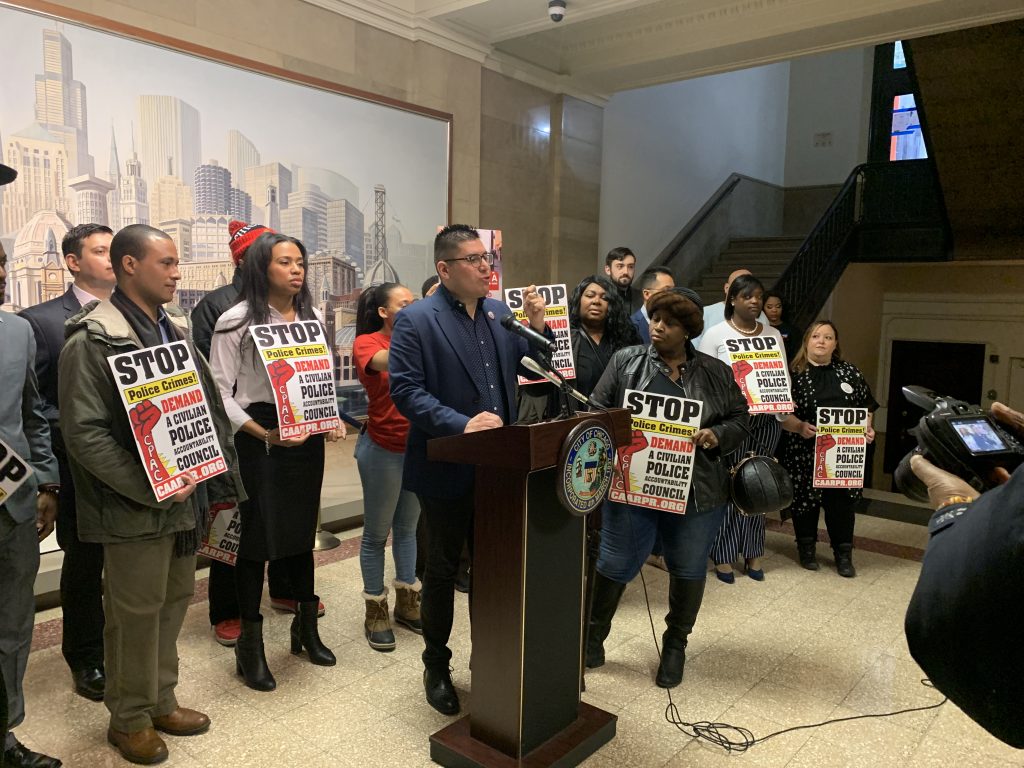 Ald. Carlos Ramirez-Rosa (35) rallied in support of civilian police oversight. [Heather Cherone/The Daily Line]
-
A half-dozen aldermen and aldermen-elect gathered Monday outside the James R. Thompson Center in Chicago to urge Senate President John Cullerton (D-Chicago) to allow a vote on a measure that would end mayoral control of Chicago’s schools.
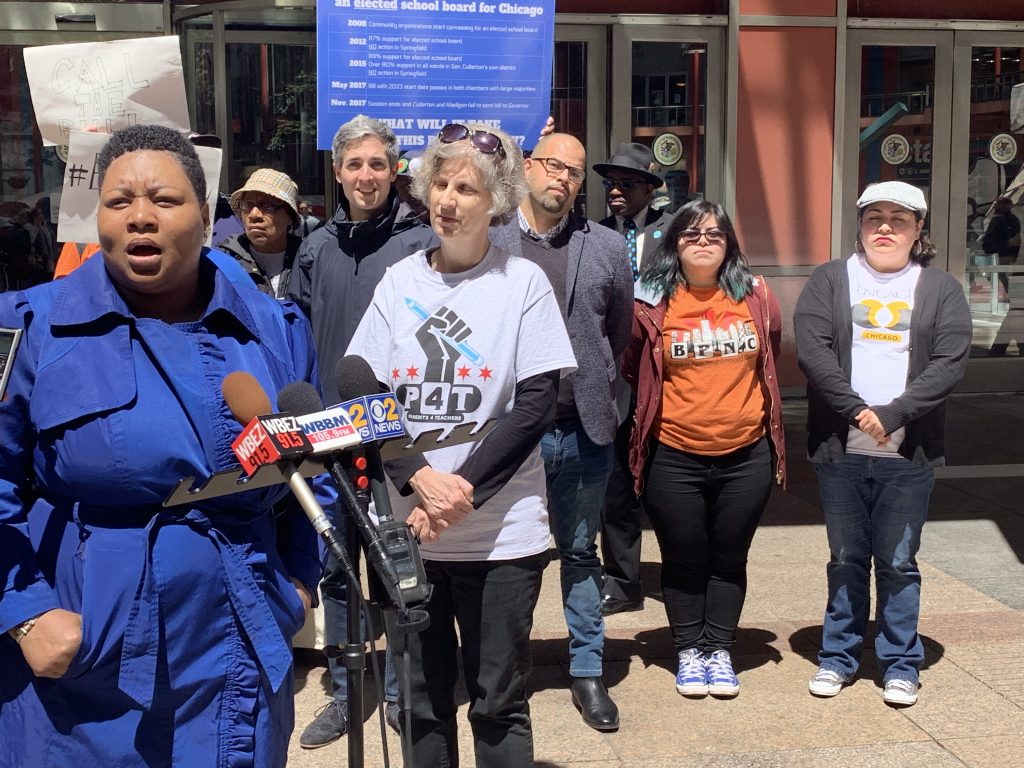 “The people have spoken. And people are tired of not being listened to," Ald.-elect Jeanette Taylor (20) said. [Heather Cherone/The Daily Line]
-
A measure that would permit Cook County to pay its pension debt with sales tax revenue and make a host of sweeping changes is working its way through the General Assembly, but some of the administration’s proposals are already facing pushback from Treasurer Maria Pappas and the Chicago Federation of Labor.
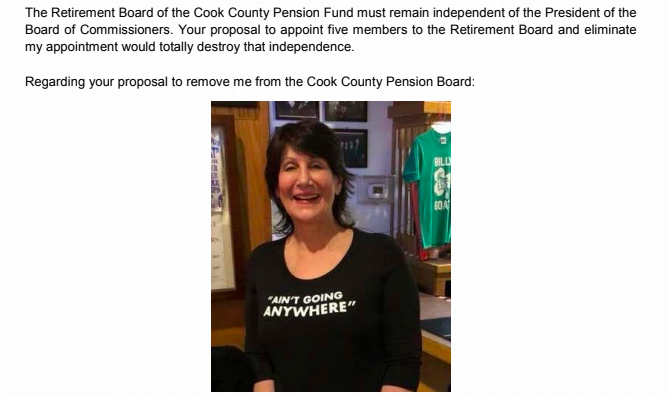 Treasurer Maria Pappas' letter to Cook County Board President Toni Preckwinkle. [Provided]
-
Chicago Police should scrap a plan to create a new gang database designed to correct the widespread and deep-seated problems identified in an audit by the city’s watchdog, the ACLU of Illinois urged Friday.
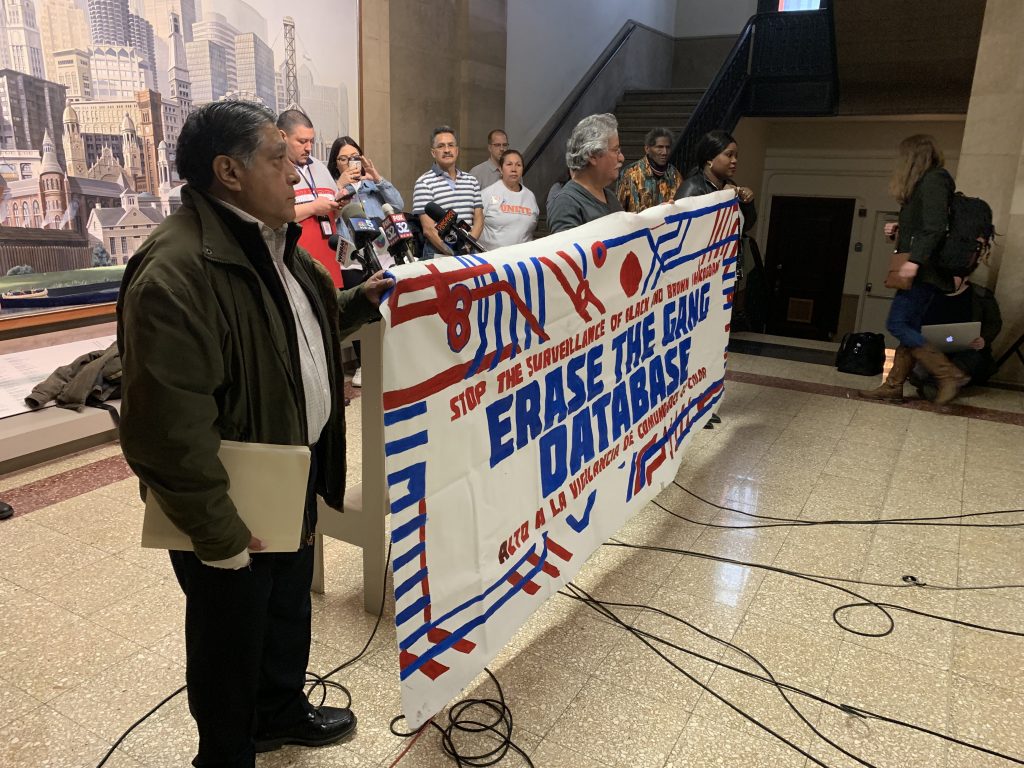 Members of the coalition said the database was "racist." [Heather Cherone/The Daily Line]
-
Chicagoans who want to weigh in on the Chicago Police Department’s plans for a new and improved gang database have until Saturday to have their say, while seniors who own small trucks and recreational vehicles would get a break on a city sticker under a plan that advanced Thursday.
-
Mayor-elect Lori Lightfoot is 10 days away from inauguration day, and has already begun preparing Chicago taxpayers for bad news.
 Amanda Kass, the associate director of the Government Finance Research Center at UIC’s College of Urban Planning. [Submitted]
Shortly after she was elected, Lightfoot said the city was facing a more “dire” budget gap than she expected and warned Thursday that the city faces a “much more substantial” pension challenge than the public has been led to believe.
Lightfoot’s first budget — generally introduced in October — will arrive on her new desk drenched in red ink: a roughly $250 million structural budget gap and a $276 million bill for the city’s pension funds.
With that in mind, The Daily Line invited one of Twitter’s most prolific pension watchdogs to come on the Aldercast podcast to discuss why journalists and politicos should not refer to it as a pension “crisis,” or expect Springfield to save the day and spare the city from making tough decisions.
Amanda Kass is the associate director of the Government Finance Research Center at UIC’s College of Urban Planning and Public Affairs. The Columbus, Ohio native with degrees in geography and international studies joined the Center for Tax and Budget Accountability in 2011 to research Illinois public pension systems.
“I actually had no idea what I was getting into at the time and I came in the summer of 2011, so it was kind of peak politics around Illinois’ pension systems,” Kass said. “It was right after the Tier II legislation had been signed into law and I had no clue what I was getting myself into at all.”
Technical difficulties prevented a broadcast-quality recording, so we’ve opted for a Q&A format, edited for length and clarity.
If you could go back to 2011 Amanda and 2011 legislators, what would you tell them?
I would tell 2011 Amanda don’t do anything differently, it’s going to be great. I think I would tell the legislators don’t bother passing any of these pension laws, because the Supreme Court’s just going to strike them down. I don’t think anybody would have listened to me. I think a lot of them knew that it was likely that legislation that they passed that cut benefits was going to get struck down by the state Supreme Court, but I think the politics of it was that they had to do something.
We’re just a couple weeks away from Lori Lightfoot’s swearing in — did you get the impression during the campaign that she understood the magnitude of Chicago’s budgetary and pension issues? There was a ton of talk during the campaign about corruption, Ed Burke, but not as much on pensions, not as much on budget.
If I take a step back and don’t think about her specifically, I think it would be difficult for any candidate to fully understand the finances of the city of Chicago. I don’t think the finances are that transparent or accessible to people working outside of City Hall. I think the pension issue and the kind of finances of the pension systems was well known. My sense was that her campaign staff and her understood this problem, but I don’t think anybody wanted to talk about it, right? Because they’re going to have to talk about, how are they going to raise revenue to make the pension contributions? Nobody who’s running for mayor is going to sit there and say hey, I’m going to raise your property taxes.
Give us a snapshot of where Chicago is pension-wise and budget-wise.
The pension systems, there’s four, one thing that people often don’t understand is that the City of Chicago itself is in charge of just four pension systems. There are other pension systems in Chicago and Cook County that impact Chicago residents, but they’re not in the purview of the city government. Those four systems, collectively, are about 30 percent funded, meaning that for every dollar of a pension liability there’s about $0.30 in the bank to pay that liability. The kind of financial condition of the systems ranges.
The first budget that Lori Lightfoot has, she’ll have to come up with $270 million to meet the ramp that we’re on.
That’s another important component — the four different pension systems, each of them has a five year ramp period. The city’s required contributions to the pension systems is a fixed dollar amount. This is a really bad idea, actually.
Why?
Because in theory, the way that you would want to have a government fund its pension systems is that the annual required payment would be a function of the unfunded liabilities, a plan to pay those down and the cost of benefits earned by the current employees in that year. So it would be determined each year by actuaries. Fixed dollar amounts are just that – they’re fixed dollar amounts. So if the unfunded liabilities increase or decrease, those fixed dollar amounts aren’t increasing or decreasing in tandem. So the city has these five year ramp periods, and then after those five year ramp periods is when it goes to funding the pension systems based on that calculation of paying down unfunded liabilities and the cost of benefits. So this means what the required contribution will have to be for the first budget year of Lori Lightfoot’s mayoralty is an estimate right now. Same for the Labor and Municipal.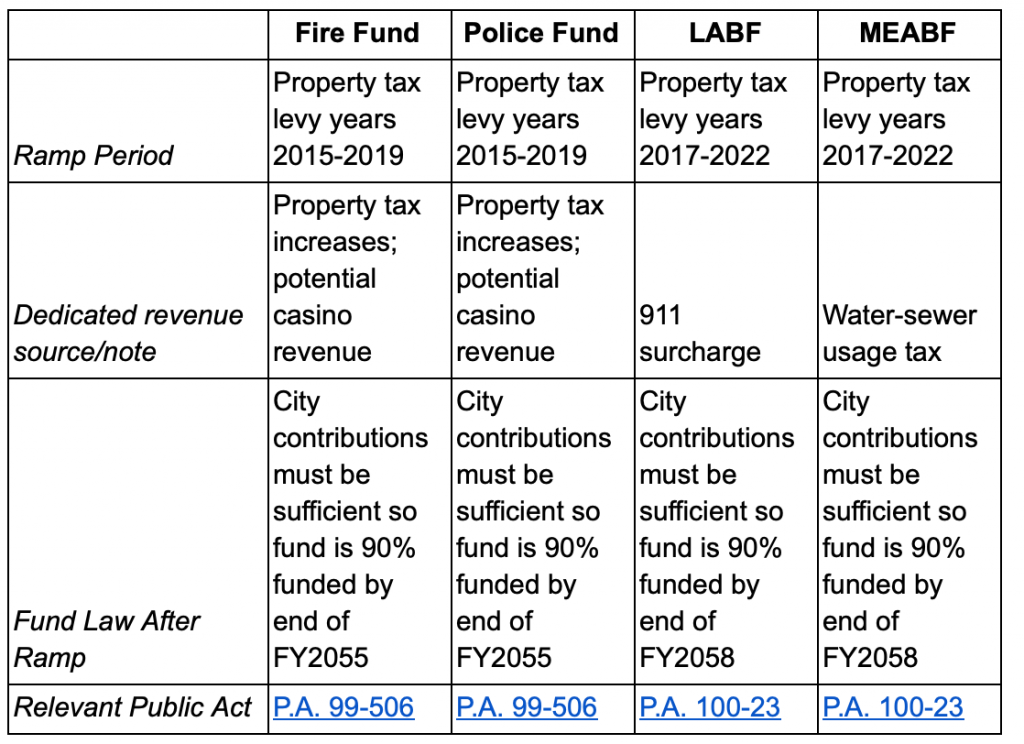
So ideally, every year some actuary would be coming back to the city saying, ‘Hey, here’s what you should actually be paying us to get to the level where we need to be.’ And we’re aiming for 90 percent funding?
Yep, for the four pension systems, the aim is 90 percent funded in different years. I think it’s 2055 for Police and Fire, 2058 for Labor and Municipal. The other important thing is the payment schedule to get to 90 percent is really backloaded. So in dollar amounts the city’s contributions are going to increase every year from now until 2055 or 2058.
Lori Lightfoot’s first budget, which would be prepared in September and passed before the fiscal year begins on January 1, calls for this big, seemingly big push up, this $270 million, and there’s another one in 2022, and it’s more than a billion over the first four years of her term?
One, I think the $270 million, we want to put that in context of the city’s budget. The city’s overall budget is about $10 billion. When we’re thinking about the city’s overall budget, $270 milion, even though that’s certainly a lot of money to me, is not insurmountable in a $10 billion budget. It is still something where they’re going to have to come up with the money to make the payment. The pension contributions are a more visible cost than other elements of the city’s budget. I think one question I’d like to get a better handle on is, what other aspects of the city’s budget are going to be increasing from year to year? And what’s the cost of those? And does the city have the revenue to make those payments?
<span data-mce-type="bookmark" style="display: inline-block; width: 0px; overflow: hidden; line-height: 0;" class="mce_SELRES_start">
Right. The first year projected gap for Lightfoot is also about $250 million. She said it was more dire than she originally anticipated because we’re going to have all these expected new costs – a new police contract a new fire contract, and because it already expired, there’s going to be some back pay involved. That’s another one of the big costs that she’s going to have to consider.
Yes, point at the data — again, these are current estimates — the city in 2017 contributed about $1 billion to its pension systems. Let’s just go out to 2025. The estimate right now is that the city will have to put in about $2.3 billion. So in less than ten years it increases by about a billion and a half.
That is a lot of money. We’re no longer looking at $270 million as a small percent of the city’s budget, we’re looking at more than a billion on top of dramatic, historic property tax hikes in addition to water and sewage fees and a new 911 surcharge.
Yes, it is a lot of money. I think we don’t project out revenue in the same way we do the required pension contributions. I think we’d want to say, if we can, project out all the other things that are a part of the city’s budget to get a real sense of what is actually the potential kind of gap that it’s going to be. The other component is the city underfunded its pension systems for decades, and so we weren’t recognizing the full cost of city operations for a really long time. Unfortunately, the taxes people were paying weren’t covering actual costs of the services they were using.
Walk us through a little bit of the history of how the city got away with underfunding its pensions for so long.
The city’s required contributions are actually dictated by state law. Until fairly recently, the state law basically said that the city’s contributions were a multiplier of what employees contributed. If a municipal employee put in a dollar to its pension system, the city maybe put in a dollar or $1.50. Those contributions were fixed multipliers, meaning that they didn’t change as unfunded liabilities changed, as the cost of benefits changed at all. So they’re completely divorced from the actual finances of the pension system. As you can imagine, this becomes a problem when unfunded liabilities arise and you have no way to contribute to pay down that unfunded liability. It is a problem that just snowballs and grows and grows and grows and grows. And then we have the recession, and it grows astronomically larger.
What are some misconceptions or 101 things we should review before we talk more about it?
I think that the challenge facing the city today is not a pension problem, I think it’s a budget problem. I think we should be talking about the issue in the context of the city’s overall budget and overall finances. Why do I think it’s not a pension problem? I think of a pension crisis as a situation in which the pension system is going to go insolvent, meaning that it is going to run out of assets and checks to retirees are going to get halted. That was the scenario that was facing the city’s pension systems until legislation was passed fairly recently that changed the city’s required contributions. So now there’s a funding plan for all four of the pension systems that will eventually, over many decades, restore the fiscal health of the pension systems. So now the challenge is how is the city going to come up with the revenue to make those required payments?
Isn’t that a crisis though? That the money isn’t readily there?
But the money’s not readily there for many other aspects of the city’s budget, right? The money’s not readily there, necessarily, to — pick whatever aspect of the budget is your interest. Is it an economic development initiative? Is it mental health? Is it public safety? Any aspect that is of interest in the city’s budget, the money’s not there. I don’t think it’s a crisis, because a crisis denotes something that’s acute and immediate. I don’t mean to say that they’re not a problem or a challenge, but I don’t think it’s an acute crisis in the same way that it would be if the pension systems had gone insolvent and the checks to retirees were literally halted.
We are moving closer to a couple potential revenue streams Chicago has wanted for a while. Some kind of gambling – maybe sports betting, maybe a casino, maybe video, poker, video gambling like we have in the suburbs – and also recreational marijuana. What are your concerns or your warnings for these new aldermen and this new mayor about either source of revenue?
I would really want to scrutinize any revenue estimate attached to any of these proposals. The other thing to know is that the revenue from a Chicago casino would already be dedicated to the police and fire pension systems. That’s not going to be revenue that the City Council and mayor can use for other areas of the budget. Casino money’s already spent.
What about marijuana?
The logistics of setting up recreational marijuana and then actually having the tax revenue comes in for it – there can be quite a long lag time between when a law is passed and when revenue actually starts being collected. For example, Cook County Board President Toni Preckwinkle passed the sugary soda tax, and I think from when the commissioners approved that to when revenue started getting collected was somewhere between six and nine months. That’s for a product that was already legal, on the market.
The other question is would the city be able to implement its own tax on recreational marijuana or would it be a state only tax? The state’s already facing its own financial challenges. If recreational marijuana is legalized and taxed at the state level, I think it’s an open question of is any revenue even going to filter down to the local governments.
What are other limitations this new mayor and the new City Council have in terms of raising revenue to pay for pensions? I think the one thing we always look at is property taxes, the one automatic thing the mayor and City Council can do to get revenue.
Raising the property tax levy is a political hurdle. Logistically, in terms of implementation, the property tax levy is the easiest target for the city, but I think the politics of it are complicated. We’ve got a new assessor who is implementing a new assessment system. It’s not totally clear yet how that’s going to impact people and businesses. Then you also have some areas of the city that are really hot real estate markets, so the values in those areas have already increased. That’s all still to be shaken out.
The city’s bound by home rule, so the city can only implement taxes that it’s authorized by state law to implement. The city, for example, can’t implement a city income tax because of the state constitutional provision. I’m going to be very unpopular, but I think the easiest thing for the City Council and the new mayor to do is to raise the property tax levy to make the 2020 payment.
We saw Mayor Emanuel attempt to do a rebate program that was not particularly popular. And the other issue is that people are generally okay with their taxes being raised if they feel like they’re getting something in return. These are just going straight to pensions rather than city services.
The property tax, there’s no good way around it, unfortunately residents have enjoyed services at a below-cost level for decades, and that kept their property taxes low, and unfortunately now revenue’s having to be raised to pay for unfunded liabilities. These are services people enjoyed and used in the past.
So we’ve been under-taxed for decades and now we’re playing catch up?
Yeah. I think if we think about the unfunded pension liability somewhat as a function of the full cost of city services not being realized, then yes.
So if it’s not a pension crisis would you describe it as a budget crisis?
I think the crisis word is just generally unhelpful in trying to craft thoughtful, robust public policy. I think labeling something as a budget crisis or a pension crisis creates a kind of frenetic energy of ‘Oh my gosh, we have to do something, we have to do anything, and we have to have done it yesterday, so we just need to do whatever.’ I think it leads to really bad pieces of legislation getting passed. I’d say there are budgetary challenges and problems, but I don’t think they’re insurmountable and I don’t think that they’re an immediate crisis.
I think it’s probably very boring, but to say let’s go steady, let’s be very careful, let’s do robust analysis, and to be honest and figure out what are we trying to fix, and what the scope of the problem is and how long it will be to dig itself out. The city’s financial challenges, underfunded pension systems, are long-term problems. The City Council, the new mayor are not going to be able to pass an ordinance tomorrow that’s going to at the snap of a finger turn everything around.
What role do you think TIF reform should play in this new Lightfoot administration? There’s a lot of attention on it because of the 78 and megadevelopments that might be benefiting from TIF to pay for infrastructure. What would you tell Lori Lightfoot about TIF?
Good luck.
Good luck because Chicago has such a massive program?
The politics around TIF are fairly heated. I’d say one, kind of good luck in trying to understand all the different TIF districts that are in Chicago. What are all the projects those TIFs are financing? How do some of these newer TIFs differ structurally from the already existing TIFs? And understanding the politics of TIF – why are different groups opposed to TIF? Is it financial reasons? Transparency? Are they just kind of opposed to it to be opposed to it?
You and Daniel Kay Hertz have written about it… if we got rid of a bunch of TIFs would we be able to solve our pension crisis– our budgetary issues?
Our short answer is mostly no. You can read our blog for the wonky details, but one of the complications is that TIF projects go to fund projects for Chicago Public Schools and the city’s infrastructure. One complication is some of these projects are for things that absent TIF, the city or Chicago Public Schools would still want or need to do. In that way it benefits CPS or the city.
What deserves a second look from this administration and these aldermen?
I think there could be two fronts on this. One could be — how is information on TIFs presented to the public? Are there ways to improve the transparency and clarity? One of the problems with public finance, often, is things are “transparent” because financial documents are put online or anybody can readily get those documents. But not everybody has been trained in public finance to understand what financial terms are. The information has to not just be transparent, meaning readily available, but made accessible to your everyday resident.
Two, looking at the actual projects and saying kind of structurally – is doing it via the TIF program the best way in terms of transparency in city operation? Why are we doing projects that are ostensibly needed infrastructure projects, why are we doing them via TIF? Could we do it a different way that would make it part of the city’s overall budget and give residents a better picture of the city’s overall activities?
What else would you like to see out of the new City Council?
To have a robust office to analyze legislation and come up with better fiscal notes for the general public.
You’ve been here for all of Mayor Rahm Emanuel’s tenure. The city is now facing up to the payments that it needs to make, at least Rahm Emanuel would say we’re through the choppiest waters, we’re on the path to sustainability, we’re in much better shape. Do you buy it? And is his legacy one of facing up to the challenges of our pension problem and our budget problem?
I think that’s complicated. I think I have the luxury of not having to think about the politics of everything and think about how do I get the majority of City Council to vote on something, how to get state lawmakers to pass something. So I should caveat my answer with that. With the pensions, I think yes and no. One of the problems is that changing the city’s funding laws for its pension systems wasn’t done during the first four years. Mayor Daley had commissioned a pension committee to look at that issue and they issued reports in 2010 that were pretty clear that look, the longer this issue festers, the more the problem’s going to grow and nothing was done immediately. I don’t put that all on Mayor Emanuel though, because during Daley’s administration they didn’t lobby to change the funding laws either. A problem with what got passed was they had these five year ramp periods. In the long run, the city would have been a lot better off if it had started properly funding the pension systems immediately, and not putting in these five year ramp periods.
So acting in 2012 rather than acting in ‘15 and ‘16?
Well even acting in ‘15 and ‘16, if they had just not put in these ramp periods and had said –– the financial hurdle between what the city had been contributing to the pension systems and what the city would have had to put in to the pension systems would have been much higher.
Do we know how much?
It would have been substantial. The Anderson Economic Group did a study on this about the overall impact of if the city hadn’t had these five year ramps. One question is, would it have been better if residents had taken one hit? If, fine, the increase would have been larger than what people have experienced thus far, but it was a one time hit, versus what’s been happening of a steady increase in property taxes, increases in the 9-1-1 charge, increase in the water and sewer rate charge and still a $270 million gap is going to have to be filled somehow.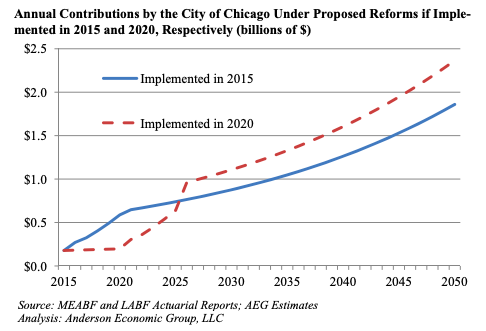
His justification is, “I couldn’t have done that so soon after the recession.” Is that fair?
I don’t know. The other component is that the city had kept its property tax levy fairly flat for decades.
So people might have been able to sustain the hit.
The question is, maybe it wouldn’t have been feasible for him to come into office right away and do it, so maybe it wasn’t feasible in 2012, but 2015, 2016? Again, my quibble is over having the five year, fixed-dollar amount ramps.
What overall grade would you give him on his pension legacy?
That’s confidential. -


