Chicago News
-
Cook County Commissioners narrowly approved a $16.4 million contract Thursday to order the latest model of tasers and body cameras for thousands of Cook County Sheriff’s deputies, despite protests from multiple commissioners who said the purchase had faced too little scrutiny.
-
Cook County commissioners heard dueling arguments on Wednesday over how far they should limit landlords’ ability to turn away potential tenants with criminal histories.
Tom Benedetto, legislative analyst with the Chicagoland Apartment Association, urges commissioners to give landlords more leeway in denying rental applications. [Alex Nitkin/The Daily Line]
-
Robert Murphy, the Democratic committeeperson for the 39th Ward announced Wednesday he will step down from his party post at the end of this week, ending his tenure just shy of one full term.
Robert Murphy, right, and Ram Villivalam celebrate in January when Villivalam took office as the first Asian American state senator. [Robert Murphy/Facebook]
-
One of the big three New York credit ratings agencies warned Tuesday that it would be watching to see how Mayor Lori Lightfoot and the City Council close the $838 million gap in the Chicago’s 2020 budget — and that decision will be “pivotal” in determining the city’s credit worthiness.
-
The $838 million budget gap facing Mayor Lori Lightfoot and her finance team as they work to craft a 2020 spending plan is just the tip of an iceberg of debt facing Chicago officials and residents.
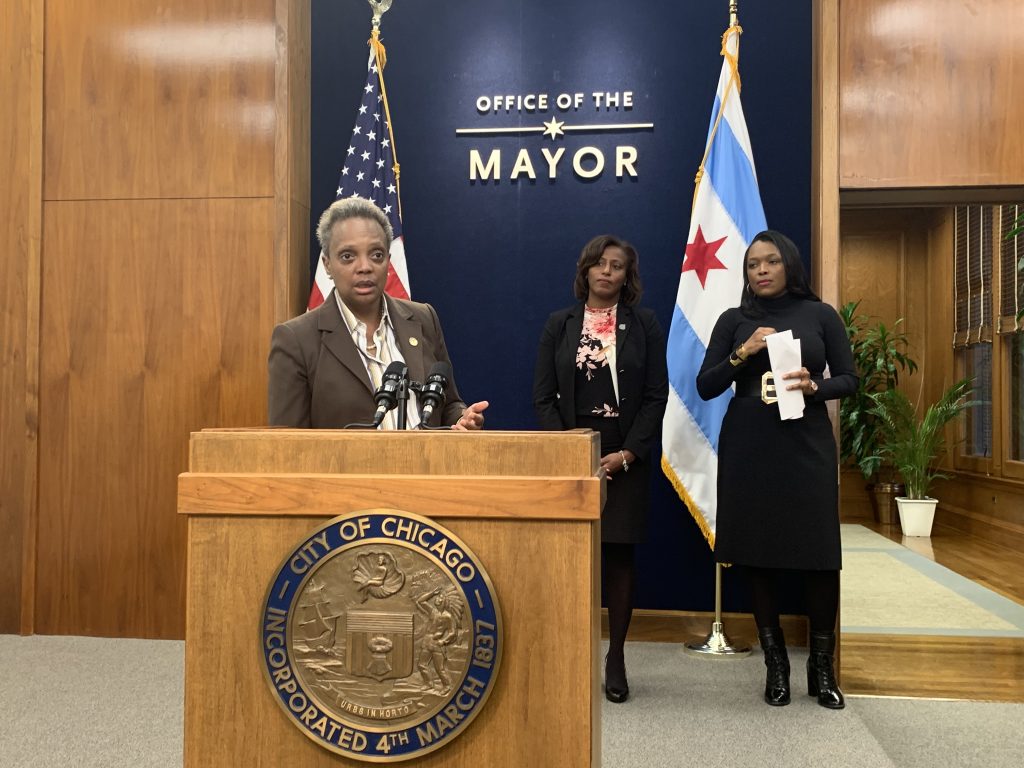
Mayor Lori Lightfoot addresses the city Thursday. [Hannah Alani/Block Club Chicago]
After Lightfoot stepped off the flag-festooned stage at the Harold Washington Library Center Thursday evening, her team released the city's annual budget forecast, which detailed the city’s dire financial condition not only for 2020, but also for 2021 and 2022.
Even if the country defies predictions that a recession is imminent and the economy experiences moderate revenue growth and the city is able to control expenditures, Lightfoot and the City Council face a projected deficit of $901.1 million in 2021 and $799 million in 2022 — and that’s in the best-case scenario, according to the forecast.
But if the economy slides into a recession, the city’s projected deficit will swell to $1.6 billion in 2021 and $1.74 billion in 2022, according to the forecast.
Even if the economy is much the same in the fall of 2021 and the fall of 2022 as it is right now, Chicago’s financial situation will worsen, and leaders are expected to face a $1.18 billion deficit in 2021 and $1.16 billion deficit in 2022, according to the forecast.
Lightfoot on Thursday said she would not “sugarcoat” the “enormous, systemic financial challenges we have struggled with for decades...and the even greater financial challenges we face going forward.”
That is why Lightfoot has emphasized the need for state lawmakers to approve major structural changes to the way the city meets its obligations — while putting the blame squarely on Mayor Rahm Emanuel, without mentioning him by name.
“We walked in to a staggeringly large budget deficit for next year,” Lightfoot said. “And what was worse, we were not left with a credible plan on how to fix this massive problem.”
In 2020, personnel costs are expected to rise by $296.3 million, even as the number of city employees dropped 8.75 percent since 2008 because of wage growth and increasing pension contributions, according to the forecast.
In addition, the city expects to have to pay $89.7 million more to resolve lawsuits, according to the budget forecast.
Pension pressure
Approximately a third of the city’s budget gap is due to the bill for the city’s pensions, which will jump 31 percent in 2020 due to a change in state law that ties payments to actuarial estimates.
The city owes its pension funds for police and fire retirees an additional $281.2 million in 2020, bringing the total due to those two funds to $1.1 billion, according to the forecast.
“I don’t see the provision of pensions or city workers as the problem,” Lightfoot said. “The key problem is the decades’ long failure to meet our pension obligations and fix the structural problems that have led to this crisis.”
The bill for the city’s pensions will only grow, Lightfoot warned.
“No matter what we do for this coming budget, Chicago will be on the hook for over half-a- billion in new pension obligations over the next three years,” Lightfoot said. “Dedicated city workers have fulfilled their careers with the agreement that they will retire with the dignity and the certainty pensions afford. Our obligations are not optional.”
However, Lightfoot called for “structural changes” to the way Illinois pays its pensions, without detailing what specific changes she favored.
In July, Gov. JB Pritzker suggested the consolidation of the state’s downstate police and fire pension funds could elicit higher rates of return on investments the funds make in the market, and a task force is studying the feasibility of consolidating the state’s downstate public safety pension funds.
Related: Pritzker floats unified investment pool as counter to Lightfoot pension plan, but analysis not rosy
In her speech, Lightfoot noted that “cities and towns in every corner of Illinois are grappling with rising pension costs.”
“Solving our shared pension problems will require the entire state to come together,” Lightfoot said.
Related: Downstate police and fire pension funds see jump in unfunded liabilities
While meeting with the Crain’s editorial board Friday, Lightfoot called the annual 3 percent cost-of-living increase in pension benefits for municipal and labor retirees “unsustainable,” as inflation hovers around 1 percent annually. Any change to that provision would require an amendment to the Illinois Constitution.
Such a proposal was floated by Emanuel before he left office, and was greeted with howls of outrage from labor groups — many of whom are now staunch supporters of Lightfoot. A spokesperson for the mayor issued a “clarifying” after the session to note that she opposes changing the constitution.
But without changes to the city’s pensions, Lightfoot said she would have no choice but to ask the City Council to approve a property tax hike — even as many aldermen still have political scars from the 2015 vote to increase property taxes by $543 million over four years to fund police and fire pensions.
“I want to avoid that measure as much as possible, but if we don’t get the structural changes that our pensions need...we will be presented with very hard and limited options,” Lightfoot said.
But pushing those changes through a General Assembly filled with lawmakers leary of voting for anything an opponent could cast as a bailout of Chicago will be no small task for the rookie mayor, who has never before held elected office and is still working to build relationships in Springfield.
“People in this state know — as I do — that I-80 is not a border,” Lightfoot said. “That there cannot be a ‘Chicago’ versus ‘The Rest of the State.’”
All of the specific revenue-generating proposals Lightfoot backed in her speech would require a new state law, including a push to make the city’s Real Estate Transfer Tax graduated — offering relief for those who sell homes for less than $500,000, while increasing the tax on the sale of more expensive properties.
That has already drawn fierce condemnation from advocates for homeless men and women in Chicago, who had been pushing to raise the transfer tax on homes worth more than $1 million and earmark those funds for additional services.
Lightfoot acknowledged those complaints in her speech, but did not offer specifics about her plans to boost help for the homeless.
“We are committed to addressing homelessness and housing instability, and putting real resources toward these problems,” Lightfoot said.
Lightfoot also backed efforts to impose a tax on those who commute into the Loop by car, as well as new fees on ride-hailing services like Lyft and Uber, without offering a specific proposal. A congestion fee would require a new state law to be implemented, while the City Council could hike ride-hailing taxes on its own.
“We are exploring revenue options to address rampant congestion that solves the problems of traffic, pollution and other issues, while simultaneously bringing in a fair source of funding,” Lightfoot said.
The mayor also vowed to “stand up a robust and healthy cannabis industry” after lawmakers passed a law legalizing the drug, set to take effect Jan. 1.
But Lightfoot will need help from lawmakers if Chicago is to finally get a casino that could offer “a structural solution to address long-term problems, not a one-time fix.”
But if that doesn’t happen, Lightfoot issued a pointed warning.
“We will be forced to make painful choices on finding other revenue sources — and we all know what those are, the sources we wish to desperately avoid,” Lightfoot said.
Related: Lightfoot: Chicago casino study proves I was right about problems with state gambling law
Lightfoot’s new strategy
In her speech, Lightfoot said she was focused on “laying the foundation for a strategy that shifts the focus to investing in our people, our neighborhoods, and not just in our central business district. We are working to create a real growth strategy that deals everyone in, regardless of neighborhood or zip code.”
That new strategy is key to solving the long-term financial challenges facing the city, Lightfoot said.
“Small businesses, and homeowners, individuals and community-based institutions must be part of this strategy,” Lightfoot said. “We must expand opportunity, expand our tax base and expand our population. We need to continue to give residents and businesses of all stripes reasons to stay, to come and to grow.”
Lightfoot said she would make decisions about tax hikes and new fees with two key principles in mind: the need to “relieve the financial burden on those least able to afford it” and to avoid “driving businesses out of Chicago.”
While Lightfoot’s roughly 25-minute speech was light on specific sources of new revenue, she vowed to make government operate more efficiently and effectively, promising taxpayers would see a return on efforts to reform the city’s workers’ compensation program and protect the city from costly lawsuits by developing a first-ever risk management program.
Lightfoot also vowed to replace high-interest debt and eliminate some short-term loans, while promising to crackdown on employee absenteeism, eliminate contracts with vendors that don’t hold up their end of the agreement and crackdown on unbudgeted overtime as well as excessive spending by the chairs of City Council committees.
Lightfoot is also hoping to restore Chicagoans’ faith in their city government — and ease the sting of certain tax hikes — by fulfilling her central campaign promise and root out corruption at City Hall, where several federal corruption investigations are churning behind the scenes. An initial package of ethics reforms passed 50-0 in July, with another proposal to expand public access to the results of investigations by the inspector general.
“These reforms that we have made are a critical component of showing you, not just saying it, but showing you we heard you and we will be better fiscal stewards of your hard earned tax dollars,” Lightfoot said.
Political risk to agenda
Lightfoot also used her speech to serve notice that she would not shelve her legislative agenda to focus on the massive budget gap.
As aldermen return from their August break, they will face a full docket of proposals from the mayor, including a push to change the way the city enforces its vehicle sticker laws spurred by reporting by ProPublica Illinois and WBEZ designed to bring relief to tens of thousands of mostly black, low-income motorists and lead to a reduction in bankruptcy filings.
Lightfoot also vowed to push through an ordinance hiking the city’s minimum wage to $15 an hour by 2021 — four years before the rest of the state — and end “water shut-offs for residents facing significant financial hardships.”
City officials have yet to detail what both proposals would cost the city.
“These initial steps are important to shore up individuals and families who aren’t just living paycheck to paycheck, but are constantly on the cusp of financial ruin,” Lightfoot said. “They need the ability to go to bed at night knowing that they can take care of themselves and their families. That Chicago has not abandoned them. Growth and financial wealth must include everyone.”
But Lightfoot may find herself caught between a rock and a hard place — determined to make good on the progressive proposals that she campaigned on while forced to spend the political capital she accumulated in her sweeping victory in April’s runoff.
Yes, some of our solutions will be hard,” Lightfoot said. “Yes, they may involve putting ourselves at risk. And if it means that I sacrifice myself politically, so be it in pursuit of the right thing.”
-
The campaign to hike the city’s minimum wage to $15 an hour by 2021 — four years before the rest of the state — got underway in earnest Friday, even as supporters said they feared the city’s looming massive budget deficit would torpedo the effort.
Flanked by several members of the City Council, Ald. Susan Sadlowski Garza (10) urges the crowd to call the mayor and their aldermen and urge them to support the plan to hike the minimum wage to $15 by 2021. [Heather Cherone/The Daily Line]
-
After the dust settled from the Cook County Democratic Party’s two-day internal melee to pick candidates for the Illinois Supreme Court and Cook County State’s Attorney, party leaders announced that they made history.
Attorney Jill Rose Quinn recorded a video in response to anti-transgender remarks by President Donald Trump and former State Rep. Jeanne Ives (R-Wheaton). [Courtesy Jill Rose Quinn]
During an impromptu press conference called to announced the results of the party slating session, State Sen. Don Harmon, who is also the Democratic committeeman for Oak Park Township, read 13 names off a handwritten list of candidates whom party members had voted as their picks to fill vacancies on the Cook County Circuit Court.
One of those candidates was Jill Rose Quinn, a 64-year-old family attorney from the city’s Northwest Side who would, if elected, become the first openly transgender judge ever to preside over a courtroom in Illinois. She is the first transgender candidate the party has ever endorsed.
While the power of a party endorsement is limited in higher-profile races, the volume and relative obscurity of circuit court judge candidates means that landing a spot on the Democratic ticket is crucial to their victory.
Quinn’s name made its way onto Harmon’s list after years of build-up and appeals from her family, local Democratic party officials and from Phyllis R. Frye, the nation’s first-ever transgender judge, who encouraged the Northwest Side attorney to run for office.
But Quinn said some of the credit also belongs to President Donald Trump, whose election angered her enough to lean into public life — and to State Rep. Jeanne Ives (R-Wheaton) whose inflammatory gubernatorial campaign ad mocking transgender people sharpened Quinn’s anger into a mission.
“You just don’t go stir up hatred like that, in a way that could inspire people to attack someone,” Quinn told The Daily Line. “I was so filled with anger — I thought we were past that.”
In response, Quinn recorded her own video, identifying herself as a “transgender citizen” and a candidate for judge in the county’s 10th subcircuit. She called Ives’ ad “disgraceful.”
“As a judge, I will do my best to resolve disputes among people by respecting them and treating them fairly,” Quinn said. “The duty of those elected to public office is to heal wounds, not to open them up and pour in salt.”
Quinn lost the election last year, then organized to run for a county-wide seat on the circuit court in 2020.
‘Quite a bit of adversity’
A Brooklyn native, Quinn got her first taste of public service after graduating college in the late 1970s, when she worked as a community organizer for the Volunteers in Service to America, a group that was later incorporated into the Americorps network of programs.
Quinn moved to Chicago in 1979 and spent a year helping administer free lunch programs for the U.S. Department of Agriculture before starting at the University of Illinois at Chicago’s John Marshall Law School.
After passing the bar, Quinn worked for a series of small suburban firms and juggled a wide variety of legal work, fitting her goal of becoming a “neighborhood lawyer,” she said. She handled everything from wills and bankruptcies to real estate and criminal law.
Attorneys she worked for “always had this attitude of, ‘I don’t know how to do this, so could you figure it out?’” Quinn said. The result was that she became well-practiced in more than a dozen legal fields.
By 1998, a year after Quinn founded her own jack-of-all-trades law firm in Edison Park, she knew she had to come to terms with the “internal battle” she had been facing since she was 4 years old, she said.
“I got to the point where I had a career, and a child, and I was making a good living, but I was still unhappy,” Quinn said. “And I knew that the source of it was that I was pretending to be a man.”
Some friends and clients left when she began to transition, but most stayed with her, she said. And she built out a new network of queer clients, helping gay caretakers gain power of attorney so they could make health care decisions for their ailing partners.
She also became a board member of the Lesbian and Gay Bar Association of Chicago, where she mentored younger LGBT attorneys, according to association President Moses Suarez.
“Her transition has put her through quite a bit of adversity...she’s talked about how changing her identity and appearing before a judge affected her business,” said Suarez, who is also a partner at the law firm Smith Amundsen. “She provides a lot of meaningful insight to our members, and she’s become a resource to everyone.”
‘A process most lawyers don’t know about’
Quinn never considered running for a judgeship until 2013, when she attended her first LGBT Bar Association convention and met Judge Frye of Houston and Judge Vicky Kolakowski of Northern California, then the only two openly transgender judges in the country’s history.
“Phyllis [Frye] said she was the first, Vicky was the second, and I should be the third,” Quinn said.
Judge Tracey Nadzieja of Arizona became the country’s third-ever transgender judge last year.
Quinn’s options in Cook County were to apply for an appointment as an associate judge, wait for the Illinois Supreme Court to appoint her to temporarily fill a vacancy, or launch a campaign for an elected position on the circuit court. She chose the third option, filing to run for one of two vacancies that had opened on the 10th subcircuit that covers the city’s Northwest Side.
In late 2017, after Quinn launched her campaign, Quinn introduced herself to Robert Murphy, the Democratic committeeperson for her home 39th Ward, and began attending party events.
But by that time, party leaders had already endorsed two other candidates, Colleen Daly and Stephanie D. Saltouros, to fill the vacancies.
“The way we select judges in Cook County is a process most lawyers don’t know about until they try to jump into a race,” Murphy said. “If you have broad support from the party, you’re going to be able to get your message out to voters, and your likelihood of success is going to be much higher.”
Quinn came in fourth place in her March primary race, earning just under 12 percent of the vote in a five-way race. Daly, the party's pick, won with more than 51 percent.
But by that time she had become a volunteer organizer with the party’s ward organization and had formed a friendship with 46th Ward Committeeperson Sean Tenner.
Quinn “was really impressive, and her story was a very strong one, so Sean and I were encouraging her to run county-wide” in 2020, Murphy said. “She bore down and got to work.”
Courting the party
The candidate called almost all of the 80 Democratic committeepeople and met with 55 of them, presenting her credentials to dozens of local party organizations in “parts of the city I had never been before,” Quinn said.
“I told them I was rated qualified by the Chicago Bar Association and that I was the first openly trans candidate to run in the state of Illinois,” Quinn said. “It made me realize how easy it is to get involved in politics — you just have to get off your butt and do it.”
By the time it fell upon the committeepeople to vote on a ticket last week, she no longer needed Murphy and Tenner to vouch for her, Tenner said.
“She did the hard work of going into every community and saying that she wasn’t just asking them to support her because she was trans,” the Uptown committeeman said. “She was asking them to support her because of her 36 years of legal experience and her impeccable reputation.”
Still, party leaders could not ignore the message inherent in sending a transgender judge to be a part of the county’s court system, Harmon said, who chaired the committee responsible for recommending circuit court endorsements.
Before the committee offered its list of recommended endorsements, members winnowed the list of more than 40 candidates by sweeping aside those who weren’t deemed qualified by the Chicago Bar Association, Harmon said. After that, the committee set about crafting the most diverse slate that they could, he added.
On top of building a ”judiciary that reflects the county and the litigants who appear before them,” the party’s goal is for judges to educate their colleagues so they can better understand people of all backgrounds, Harmon said.
“If all of my colleagues in the legislature were also boring white guys, I wouldn’t be able to expand my horizons much,” Harmon said, adding that it “reflects well” on the judiciary for the county’s transgender population to be represented in the county’s court system.
Quinn agreed, saying that she’s ready to be a “resource” for other judges to help them understand the experiences of transgender litigants, she said. But she hopes the example of her candidacy ripples out even further.
“There a lot of kids out there who are filled with despair, because they think there’s no life for them after high school,” Quinn said. “Now, they’ll be able to look up and say, ‘This lady practiced law, was a leading member of her community, and she became a Cook County judge.’” -
On April 10, City Council approved a 16-story, 168-unit high-rise at 1624 W. Division St. in Wicker Park against the wishes of neighborhood leaders. PROVIDED
A developer currently building a batch of million-dollar condos and town homes in Wicker Park has filed a lawsuit against the city this week after former 1st Ward Ald. Proco “Joe” Moreno discreetly approved a massive development nearby.
The lawsuit, filed by an entity of Vermilion Properties, alleges the city violated the Illinois Open Meetings Act as well as a six-month city zoning approval deadline when Moreno pushed through a zoning change on his way out of office for a high-rise at 1628 W. Division St. -
Indicted Ald. Ed Burke (14) abstained from 27 votes during the first six months of 2019 in order to comply with the city’s Ethics Ordinance — approximately half as frequently as he did during the same period in 2018, city records show.
Ald. Ed Burke (14) in his newly assigned seat in the City Council chambers. [A.D. Quig/The Daily Line]
-
A high school student from Northbrook, Illinois, whose mother considered giving up guardianship of her to qualify for financial aid, displays some of the college brochures she has received. (Max Herman for ProPublica Illinois)
Amid state and federal scrutiny as well as a public backlash, more than a half-dozen suburban Chicago families who had recently gone to court to give up guardianship of their college-bound teens to qualify for financial aid they wouldn’t otherwise receive are now quietly letting their cases lapse.
Though some families remain unapologetic about their use of a practice that had gone largely unnoticed until three weeks ago, they say the real issue is not that they tried to take advantage of a legal loophole but the exorbitant cost of higher education.
“A lot of families are afraid to say what they are thinking,” said one mother, whose son’s case closed last week when the family decided not to pursue it. “They have OK incomes. But having a good income does not make you able to pay for college. I would have to not drink or eat to pay for my two boys.”
She, like other parents, agreed to speak about their cases on the condition of anonymity.
One Northbrook mother said she had been mulling guardianship but feels it’s no longer an option.
“I said, ‘Is that off the table?’” she said she asked the college consultant at the center of the guardianship scandal. “She goes, ‘I don’t think … any judge in Illinois would sign off on anything.’”
Last month, ProPublica Illinois reported that almost four dozen families from affluent suburbs in Lake County had gone to court to turn over legal guardianship of their children to a relative or friend, typically a few months before the children turned 18. By doing so, the teens could then declare themselves financially independent and apply for need-based federal, state and university aid without their parents’ income being taken into account.
ProPublica Illinois has since identified about a dozen more families in McHenry, Cook and Will counties who filed similar guardianship petitions since 2017. Among them was the family of a 17-year-old who lived with his parents in suburban Long Grove. Four days after a Lake County judge denied their petition last month, they refiled the case, naming a different guardian, in neighboring McHenry County. The family said it was in their son’s best interest to “obtain independent student status in order to qualify for financial aid necessary for the minor to attend a state college” and, eventually, become a doctor, court records show.
But Judge Michael Chmiel, who had approved at least nine other guardianship petitions for college-bound students, questioned the move after learning the parents would continue to provide their son financial support.
“So it’s a charade?” he asked attorney Nina Neuber of the Kabbe Law Group in Naperville, which has handled about half of the 59 petitions identified by ProPublica Illinois from Chicago’s suburbs.
“No, your honor. It is not a charade,” Neuber replied, according to a transcript of the July 16 hearing.
But Chmiel remained skeptical.
“I’m challenged by this practice of a parent giving up parental rights for no reason other than an alleged attempt to qualify the kid somehow for financial aid, but yet the parent is still providing financial aid,” Chmiel said. “It doesn’t sound right to me. It just doesn’t.”
Other officials also have been troubled by the practice. The University of Illinois at Urbana-Champaign’s director of undergraduate admissions called the guardianships a “scam,” while federal and state officials have opened investigations. The U.S. Department of Education’s inspector general has recommended modifying the language on financial aid forms so students in guardianships who receive medical and financial support from their parents don’t qualify as independent.
State lawmakers held a hearing over the matter and discussed possible reforms, from changing the guardianship laws to new regulations for college consultants. The Wall Street Journal has also reported on this practice.
Families involved in the questionable guardianship cases live in some of the most affluent suburbs of Chicago, including Lake Forest, Libertyville and Deerfield. The parents work as lawyers, doctors, technology specialists, entrepreneurs, teachers and real estate agents.
It’s impossible to know if the families are struggling financially. Some live in homes worth more than half a million dollars, records show. A handful have declared bankruptcy in recent years.
Many appear to have been directed to guardianships by the same college consultant, Lora Georgieva. The Bulgarian immigrant has worked in the industry for close to a decade and, in 2013, launched her own firm, Destination College, state records show. Her website, which includes an image of a graduation cap with $100 bills spilling out of it, describes some of her services as “strategies to lower tuition expenses.”
In an interview this week, Georgieva said she has done nothing illegal or unethical but has worked hard to help middle-income families who find it a financial struggle to send their children to college.
She pushed back on the perception that her clients are all wealthy. In the interview and in a three-page statement, she said her clients earn between $35,000 and $180,000 a year, and some are still paying off their own student loans. Many of the families have more than one child they plan to send to college, she said; court records show that at least six of the families involved in the guardianships had filed petitions for siblings.
Two families said they paid Georgieva around $4,500 to $5,000 for her services. Several families, including one that had not gone through with a guardianship change, said they signed nondisclosure agreements. Georgieva said the agreement is meant to protect her unique process of helping students and their families find the right college, write admissions essays and explore financial strategies, including the guardianship option.
Not all of her clients pursue that option, she said, and “nobody was pressured into using it.” Georgieva said “some people, out of being desperate, they acknowledged the fact that they need it. Some people said, ‘We have enough money to pay for college, we don’t need that or don’t feel comfortable with it.’ It is up to the families to decide whether to do it.”
For now, Georgieva said, she will stop recommending guardianship petitions to her clients, although she has gotten phone calls from families interested in pursuing that strategy. “The news that broke, you guys opened the eyes of a lot of families of what they can do,” she said. “If legislators are not going to do this quickly to close that” loophole, then families in Illinois and elsewhere will pursue it.
However, she also urged broader reforms, including increasing the amount of the federal need-based Pell grant, currently up to $6,195, and lowering the age that children are considered financially independent from their parents, now at 24.
Before providing any of her clients with information about guardianships, Georgieva said she spoke with a representative from Federal Student Aid, an office of the U.S. Department of Education, and several lawyers who are her clients “who all confirmed this is a valid legal approach.” Department of Education officials said Tuesday they were unaware of any conversations with Georgieva about guardianship.
They said that the laws governing “dependency status were created to help students who legitimately need assistance to attend college” and that “those who break the rules should be held accountable.”
While federal financial aid isn’t limited, state need-based grants in Illinois are awarded on a first-come, first-served basis. Some 82,000 students qualified for the state funds last year but did not receive them because the money ran out.
Several families who spoke with ProPublica Illinois said guardianship was one of many strategies that Georgeiva presented them.
“It was introduced as a program that helps people like us. We weren’t looking at it as something unethical,” said one mother, who successfully petitioned to transfer guardianship of her daughter to a family friend last year.
She said she and her husband both work and “by no means do we live in a lavish home.”
Another parent, from a wealthy community in southwestern Lake County, said she hired Georgieva after interviewing several college consultants. “I did graduate from college, and so did my husband,” she said. “But the whole process changes every year. Why not get the best results? My kids are doing very good in school. I want them to do the best.”
She said Georgieva reviewed her son’s college application essays and recommended strategies to become a more attractive candidate, such as volunteer work.
The woman said she and her husband both work, earning more than $200,000 a year, to support their two teenage sons. The family is among those who have allowed their guardianship petition to lapse following the reports about the tactic.
“Why should the kids of people who work hard and are busy every day and have no time to see their kids, why are their kids being punished?” the Lake County mother asked. “They will have to take huge loans and not be able to pay.”
Both of her sons want to become doctors. The guardianship strategy may have helped them avoid hundreds of thousands of dollars in student loan debt, she said. That now seems inevitable.
“I don’t want to be discouraging them, but I’m looking at this and thinking, ‘I have to support them all of their life?’” she said.
She worries her sons will get “stuck doing something they don’t like,” perhaps attending community college and working in fast food if they can’t afford to become doctors.
“I thought they encouraged kids in school to do what they have a passion for,” she said. “Do we have to kill a passion in our kids?”
Another one of Georgieva’s clients, the Northbrook mother who worried guardianship was no longer an option, said “something resonated” when they met with the college consultant in the spring of 2018. The family had attended a number of free college planning sessions that focused on wealth management or gaining admission to elite universities. Nobody spoke as plainly as Georgieva about the high costs of college.
The family has struggled financially, said the woman, who spoke to ProPublica Illinois on Georgieva’s recommendation. She and her husband both lost their jobs, forcing them to go through their emergency fund. They borrowed money and tapped into their retirement and children’s college savings, she said.
Eventually, she found work. Then she said her husband suffered a stroke, requiring medical care around the clock. He remains in a nursing home. She said she sold their house and moved into a rental property with her two children. When she met Georgieva, her oldest son was enrolled in community college and her daughter was a high school sophomore.
Georgieva charged the family about $4,500 for her full package of services, letting them pay in installments. She helped the daughter identify what kind of career matched her interests, told her to focus on improving her ACT scores and encouraged her to take an academic enrichment program.
She assured the family there were ways to finance a higher education, including scholarships and loans. Then she mentioned the possibility of giving up guardianship, perhaps to the girl’s aunt, who had been supportive during the family’s difficulties. Her initial reaction was surprise. “I’m like, ‘Oh my God … I’m not emancipating my child,’” she recalled saying. “I had, like, a million questions.”
But as Georgieva explained how it worked, she warmed to the idea. If her daughter was considered financially independent, then her salary from her job in marketing — more than $100,000 a year, she said — wouldn’t be taken into account.
“Because of how the system is structured they’re telling me I make too much money,” she said. “But I don’t have $30,000, $40,000 or $50,000 sitting [around].”
Before they made a decision on whether to pursue guardianship, the scandal made national headlines. Their Plan A was off the table. Now they’re scrambling to figure out how they will pay for college.
ProPublica Illinois is an independent, nonprofit newsroom that produces investigative journalism with moral force. Sign up for The ProPublica Illinois newsletter for weekly updates.
-
Illinois Supreme Court Justin P. Scott Neville will face Appellate Court Judge Jesse Reyes and attorney Daniel Epstein in the March contest for a 10-year term on the state's highest court. [Submitted]
During the mid-century heyday of the Cook County Democratic Party, candidates considered a party endorsement the start of a countdown clock to their inauguration.
Those days are gone.
Contenders who were left off the party ticket in three high-profile races during slating last week’s slating event vowed Monday to see their campaigns through to March 17, when Cook County voters will pick a Democratic nominee in each contest.
Their campaigns will seek to exploit the party’s wounded reputation amid a sea of corruption scandals and hone in on the anti-establishment messages that swept Cook County Assessor Fritz Kaegi and then Mayor Lori Lightfoot into office. -
Four years ago, former Mayor Rahm Emanuel laid the foundation for the largest property tax hike in the city’s history by holding a series of forums across the city designed to give residents a chance to weigh in before he presented his proposed spending plan to aldermen.
Although Mayor Lori Lightfoot won an overwhelming victory in April by promising to undo much of Emanuel’s legacy, she will take a page directly from his playbook after delivering an address on the state of the city at 6 p.m. Aug. 29 at the Harold Washington Public Library.
-

Former Cook County Assessor Joe Berrios, right, and Retired Judge Gloria Chevere, who served as as a proxy for Ald. Roberto Maldonado (26), listen during Friday's slating meeting. [Alex Nitkin/The Daily Line]
Latino candidates were shut out of party endorsements in headline races at the end of Cook County Democrats’ two-day slating session Friday, leaving some members feeling like the county’s 1.3 million Hispanic residents got short shrift on the ballot.
The party’s 80 committeepeople voted on Friday to include three Latinos among 13 candidates who were endorsed to fill vacancies on the Cook County circuit court, and three additional Latinos were endorsed as alternates in case more judgeships open up before Election Day.