


Chicago News
-
The state’s largest Catholic health system announced Thursday it would give up a controversial $5.5 million city subsidy for its new Downtown headquarters.
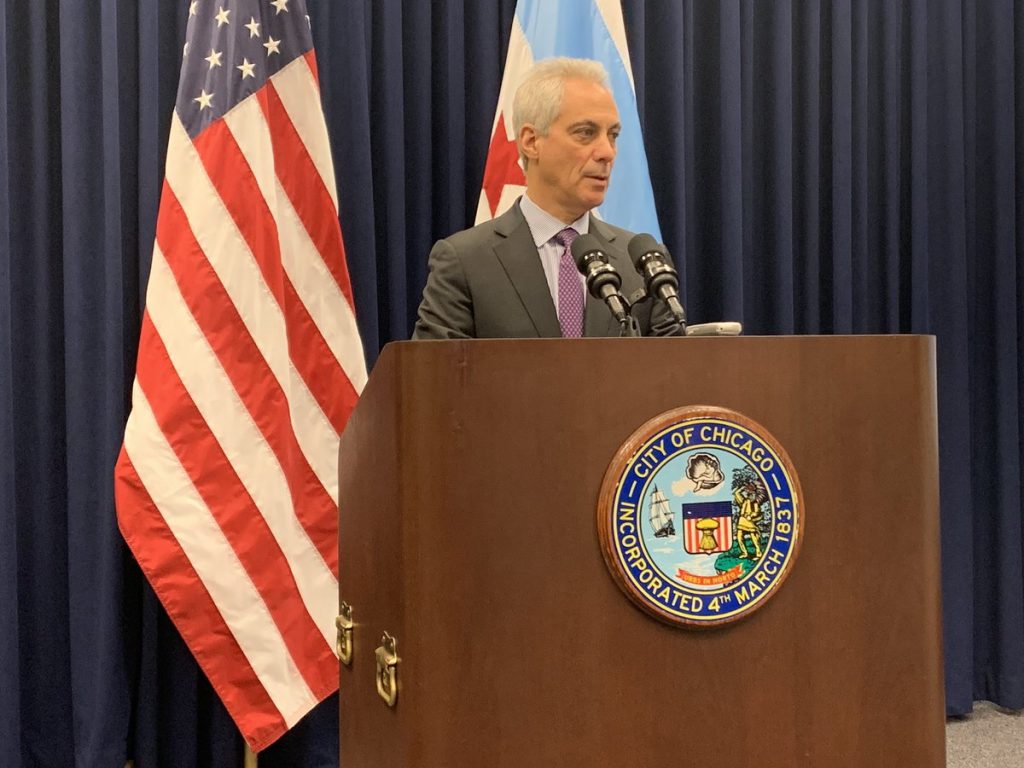 Mayor Rahm Emanuel pushed through a $5.5 million subsidy for Presence Health in January 2018. [Heather Cherone/The Daily Line]
The Chicago City Council voted 31-18 in January 2018 to spend $5.5 million in tax increment financing district funds to renovate Presence Health’s new headquarters at 200 S. Wacker Drive.
With Mayor Rahm Emanuel’s full-throated support, the subsidy was approved after a heated and emotional debate and over the objections of Ald. Brendan Reilly (42) and other aldermen who said it was improper for public funds to be used to help a health system that fails to provide what they called basic reproductive health services, including contraception and abortion, that conflict with Catholic doctrine.
AMITA Health purchased Presence Health last year, and CEO Mark A. Frey said a statement Thursday that the firm had “decided not to complete the paperwork required to finalize the Presence Health TIF agreement.”
Representatives of AMITA Health declined to answer questions about the decision, but said they would keep the firm’s headquarters Downtown.
“AMITA Health’s decision to relinquish the TIF allows the city to reallocate these funds toward other pressing priorities, and provides AMITA Health the necessary flexibility to make non-clinical staffing decisions at its Chicago headquarters,” Frey said.
It was not clear how accepting the TIF funds would have impacted AMITA Health’s staffing decisions.
Aldermen who supported the subsidy said it was necessary because Presence Health planned to open a cancer center on the West Side and neighborhood clinics in Calumet Heights, Belmont-Cragin, Avondale and West Town. TIFs are designed to improve blighted parts of the city.
Those clinics, in which Presence has invested $15 million, will operate as originally planned, even without the subsidy, Frey said.
The ACLU of Illinois, which opposed the subsidy, said public funds should not be used to discriminate against those seeking medical care.
“We welcome the news that Presence Health — now AMITA Health — will not be using taxpayer funding while it denies basic reproductive health care to women,” said Ameri Klafeta, a senior staff attorney for the ACLU.
Representatives for Emanuel and Reilly did not immediately respond to a request for comment from The Daily Line.
Frey’s statement made no mention of the fact that the Chicago Board of Ethics fined Ald. Ed Burke $2,000 earlier this month for exercising improper influence in the debate over the subsidy at a meeting of the Finance Committee.
The board determined that Burke, the chairman of the Finance Committee, violated Chicago’s Governmental Ethics Ordinance by “introducing witnesses, and answer[ing] procedural questions from his colleagues” during the Jan. 12 meeting of the committee, before announcing that he would recuse himself from the vote.
The Ethics Board voted 4-0 on April 26 “that this constituted participation,” even though Burke had informed ethics officials he intended to recuse from a matter involving Presence Health Care. His law firm represented Presence Health on unrelated matter within a year of the vote.
Klafter & Burke filed property tax appeals on behalf of one Presence Health property in 2016 and 2017, according to county property records first reported by WBEZ and the BGA.
The board fined Burke the maximum amount allowed under the ordinance. -
-
-
MAY 16, 2019

UNLOCKED
ProPublica Illinois reporter Mick Dumke looks at the state’s political issues and personalities in this occasional column.The Chicago City Council’s Transportation Committee has an annual budget of more than $467,000 to cover expenses related to its work on legislation and government oversight.
But little of that work was on display during the committee’s March 6 meeting.
“Fairly quick agenda this morning,” the committee chair, Ald. Anthony Beale, said at the start. He and the six other aldermen then ran through its 70-page agenda in about 23 minutes, approving dozens of ordinances that dealt with hyperlocal administrative matters such as signs, awnings, light fixtures or sidewalk cafes for particular addresses.
That was typical for Beale’s committee. While it rarely does in-depth legislative work, the committee and its budget have been far more valuable for Beale as perks.
Beale, alderman of the far South Side 9th Ward, has used committee funds to hire employees — eight were on the payroll as of December — though he acknowledged they don’t spend all their time on committee work. He’s spent Transportation Committee money on his own transportation, including payments on a Chevy Tahoe SUV and thousands of dollars in parking expenses. And committee funds have gone toward furniture for his City Hall office, including a bourbon cherry wardrobe cabinet, according to records obtained under the Freedom of Information Act.
The Transportation Committee isn’t an outlier.
At great cost to taxpayers, the City Council’s 16 legislative committees are the heart of a favor-trading system that’s enabled mayors to rule like monarchs distributing favors to loyalists. At the same time, the committees have failed to provide even basic oversight of city government.
Many meet infrequently, and when they do, they frequently rubber-stamp agendas in a matter of minutes — often without a quorum of half the members. The budgets for the committees added up to $5.8 million in 2018, but the amount each committee receives is not tied to the volume of legislation it reviews or the regularity of its meetings.
Instead, funding appears more closely aligned with tradition and the clout of the chairs.
Chicago aldermen have also made it almost impossible for the public to see what they’re up to. Committee meeting schedules are posted online and meetings are open to the public, but they’re not broadcast, recorded or transcribed — unless a chair makes arrangements.
The topper: The council has passed laws to make sure committee operations are kept from any oversight. In 2016, aldermen voted 25-23 to kill a proposal to allow the city’s inspector general to investigate and audit the council. Aldermen then passed a substitute ordinance that explicitly blocked the inspector general from looking into many council functions, including committee spending.
Mayor-elect Lori Lightfoot, who will be sworn in with aldermen on Monday, has called for changing the law so the inspector general can audit the council and its committees. She and key aldermen continue to negotiate over who will lead the committees. As current chairs maneuver to hold onto power, reformers say it’s time for significant changes.
City Inspector General Joe Ferguson said Lightfoot and the new council face an urgent need to open the books and bring accountability “with respect to budgets, expenditures, staffing and operations at both the whole Council and Committee levels.”
“Government cannot fully escape corruption, mismanagement and waste without accountability,” Ferguson wrote in a statement responding to ProPublica Illinois’ findings. “That applies as equally to a legislative body as it does an executive, and even more so in Chicago, with its history of a weak, compliant City Council most noted for a decades-long trail of corruption. At this moment in the City’s history, both the public and the incoming Mayor desperately need a productively engaged City Council that fully inhabits its legislative oversight responsibility.”
In most legislative bodies, members pick their own leaders and committee chairs. The Chicago City Council’s rules say that’s what aldermen should do as well. For decades, though, the mayor has picked council committee chairs. It’s no secret at City Hall that only aldermen who support the mayor’s initiatives are rewarded with the posts, though they often claim otherwise.
As Ald. Walter Burnett Jr. tells it, he was shocked when, in 2007, former Mayor Richard M. Daley offered to make him chair of the Special Events Committee. Burnett had never led a committee before. And he had been pushing an affordable housing plan that was more aggressive than the mayor wanted.
“I thought there might be a hit out on me,” Burnett joked. Instead, Daley came up with a watered-down affordable housing plan. After Burnett signed on, “the next thing I knew, I got a committee.”
Despite their back-and-forth over affordable housing, Burnett had supported almost all of Daley’s agenda, including the mayor’s plan to demolish dozens of public-housing buildings and replace them with mixed-income developments.
In 2011, Rahm Emanuel campaigned for mayor on a promise to rid City Hall of corruption. He even suggested he might replace Ed Burke, the dean of the City Council, as chair of the Finance Committee, the council’s most powerful. Once in office, Emanuel eliminated three other council committees and shaved funding for others.
But soon after, the city’s annual budgets — proposed by the mayor and approved by aldermen — began boosting the money available to committees again. By 2017, the council committees were spending more than when Emanuel became mayor.
Emanuel also let council insiders stay on as committee chairs — including, most notably, Burke — so he could count on their help advancing his agenda. Some loyalists got promotions. In 2013, for example, Emanuel shifted Burnett to the Traffic Committee, which had an annual budget of about $215,000, a bump from the $155,000 he had to spend as Special Events Committee chair. The Traffic Committee budget has since grown to about $249,000.
Emanuel’s chosen committee chairs have proven to be reliable supporters. Two of the current chairs sided with the mayor on 93% of divided council roll call votes from 2017 to 2018 — and those are the most independent voting records of any of the committee leaders. Burnett and five others voted with Emanuel 100% of the time, according to a study by political scientists at the University of Illinois at Chicago.
The committees are valuable because of a simple fact: Like most public officials, every alderman would like more staff and money to work with.
For years, the city’s annual budget — approximately $10.7 billion for 2019 — has allocated funds for each alderman to hire three aides. Most aldermen say that’s not enough to manage their daily barrage of constituent service requests, let alone to prepare for their jobs as legislators.
Aldermen have a limited number of options for adding staff. They can try to cut office expenses and spend more money on employees. They can also use campaign funds to hire more people, the approach taken by Brendan Reilly of the downtown 42nd Ward.
That’s not easy for most aldermen, especially those who struggle to raise money.
Chairing a committee offers another possibility. Committee staff members are exempt from city rules meant to prevent political hiring and firing, which means the chairs can fill the jobs any way they want, for any reason.
Tom Tunney, the current chair of the Special Events Committee, said he needs extra help to keep up with constituent needs in his busy ward, the 44th, based on the North Side’s Lakeview neighborhood.
He acknowledged that most of the legislation his committee oversees — concerning festivals, cultural events and other matters connected to the arts — comes from the mayor’s office and the Department of Cultural Affairs and Special Events. The committee had three employees as of December, but since they only spend about a week each month preparing for committee meetings, Tunney also assigns them to help with issues in his ward.
“Do they just work on committee stuff? No,” Tunney said.
Tunney conceded it’s not fair that committee chairs essentially get more help to take care of their wards. But he’s also skeptical of proposals that would require committee employees to limit their work to committee matters, because he doesn’t think they would have enough to do.
“I wouldn’t agree with that because practically; I want my people working all the time, given my workaholic nature,” he said.
Last month, Tunney said he would like to be considered for Finance Committee chair after the new council is sworn in on Monday, and other committee chairs are lining up behind him.
Burnett said he, too, counts on committee staff to help with ward matters. At the end of 2018, he had eight employees on the Traffic Committee payroll.
“It helps you with your ward, especially if you’ve got a ward like mine,” said Burnett, whose 27th Ward includes parts of the near North and West sides that have boomed with development over the last two decades. “I get everything from yuppies worried about permit parking to people [dealing with] sewage. It’s never ending. … So the extra staff people help, and they do dual roles. Everybody works on the ward and everybody works on the committee, too.”
Burnett said his committee employees put in a lot of work to prepare for the committee’s meetings. But that wasn’t evident when it convened on March 6.
Several minutes after the meeting was scheduled to start, the chairman’s seat was still empty. So were most of the seats around them. Only four of the committee’s 16 members had shown up.
Finally, an aide to Burnett got a call on his cellphone and waved Marty Quinn over. Quinn, alderman of the 13th Ward on the Southwest Side, appeared taken aback for a moment. Then he understood: Burnett wasn’t going to show. Quinn was going to have to lead the meeting.
Under City Council rules, at least half of the members of a committee need to be present for a quorum. But neither Quinn nor the other three aldermen noted that they were four short. Quinn gaveled the meeting to order and moved to pass the first 19 proposed ordinances on the committee’s 12-page agenda.
“All those in favor?”
“Aye!” the other three aldermen said in unison.
“In the opinion of the chair, the ayes have it,” Quinn said.
As is usually the case with the Traffic Committee, each of those ordinances concerned parking restrictions, loading zones or traffic signs for single addresses or streets. And if the local alderman has approved, the committee signs off.
In a series of rapid-fire motions and choruses of “aye,” Quinn and his three colleagues ran through the next 10 pages of ordinances with no discussion or break in their rhythm.
All told, the meeting took less than three and a half minutes.
The public has no ready way to see how many people are hired by the committees or what they do. Annual city budgets allocate money for committee staff. But only the budget for the Finance Committee specifies the number or titles of committee employees, giving the other committee chairs the power to use those funds as they see fit.
At the end of 2018, council committees had a total of 133 employees, according to city payroll records. That’s 108 more than were listed in the city budget approved by aldermen and released to the public. Most of the employees are listed in payroll records as “legislative aide.”
The Finance Committee has long had the largest committee budget, as well as the broadest jurisdiction, including city bonds, taxes, legal settlements and privatization deals. It also housed the city’s workers’ compensation program. In January, Burke, its longtime chairman, was charged in federal court with attempted extortion; Burke has denied any wrongdoing. Emanuel then had Burke deposed as finance chair and moved the workers’ comp program to the city comptroller’s office.
For years, the Finance Committee’s accounting was even more opaque than other committees’. According to the city budget, the Finance Committee had a 2018 budget of $2.3 million, which included the salaries of 25 employees. But expense records show that Burke had access to far more money and workers. Burke kept between 61 and 78 people on the payroll at different points in the year, costing a total of about $3.4 million in worker pay. Employees listed as full time were paid salaries ranging from about $21,000 a year for a legislative aide to $171,000 for the chief administrative officer of the workers’ comp program.
Following the Finance Committee money gets tricky fast. In addition to money allocated for the committee, Burke also paid workers out of funds he controlled in other city departments. One employee was paid out of the budget for the Fire Department’s workers’ compensation costs; others were covered out of allocations for “investigation costs” buried deep within the budget.
At least four employees were paid from multiple funds during the course of the year.
Last December, the Finance Committee transferred $862,000 from its reported expenditures to the balance sheets of other city departments. The end-of-the-year accounting maneuver came after Burke’s staff said some employees assigned to the committee should have been paid out of funds available for the workers’ compensation program. The spending records don’t show what the employees’ duties were.
The complicated money flow — and lack of oversight — put Burke in the enviable position of being able to dispense favors and largesse to other aldermen. For years, he essentially loaned employees to other aldermen who needed help, as WTTW reported in March. On occasion, the Finance Committee paid expenses for other aldermen, such as when it reimbursed 40th Ward Alderman Pat O’Connor about $2,900 total for travel to conferences of the National League of Cities in Nashville in 2015 and Kansas City the next year. O’Connor did not respond to a request for comment.
From 2015 to 2018, the Finance Committee also paid more than $46,000 to cellphone provider Verizon Wireless. Invoices don’t provide details about the account or why the bills were so high.
Burke didn’t respond to requests for comment.
As chair of the Committee on Committees, Rules and Ethics, 8th Ward Alderman Michelle Harris oversees council procedures and has the power to decide which legislation is assigned to which committees, or to hold up legislation altogether.
“I do everything I can to be aboveboard and be transparent because I am the rules chair, but every now and then it doesn’t work out that way,” Harris said in an interview.
In April 2018, $8,820 in committee funds went to pay a South Side company to print and mail an 8th Ward newsletter, according to a copy of the invoice obtained from the city under the Freedom of Information Act.
Harris said the mailing was focused on city services and wasn’t political, but she conceded it should have come out of her ward account. She blamed the error on a new employee and promised to “have her re-trained.” Harris also wondered why city finance officials didn’t catch the mistake.
“What I’m further concerned about is that it wasn’t flagged anywhere along the process,” she said.
Between 2015 and 2018, Harris paid $82,000 in Rules Committee funds to The Salient Group, a downtown firm, for what was described in a February 2018 invoice as “PR Consulting.”
Harris said Salient’s president has attended committee meetings and helped Harris respond to news coverage about her role as chair, such as criticism that she has buried legislation when it was opposed by Emanuel and his allies.
“I’ve gotten torn up on by some people, so I’ve had to come up with a strategy about how to deal with those issues,” Harris said. Asked if all of the PR work was connected to the committee, she said, “You are 10,000% correct.”
Loading...
Beale, chair of the Transportation Committee, also dipped into committee funds for public relations.
Beale became the committee’s leader after a slow, steady climb up the City Hall ladder. In 2007, Daley picked Beale to lead the council’s Landmarks Committee. Its previous chair, Arenda Troutman, had been charged in federal court with taking a bribe and then lost her reelection bid.
Three years later, Daley moved Beale to the helm of the Police and Fire Committee, which had a larger budget. When Emanuel was elected mayor in 2011, he shifted Beale to chair the Transportation Committee.
The new post was another boost for Beale. The Transportation Committee has an annual budget more than twice as large as his old committee’s. And most of its work consists of rubber-stamping hyperlocal administrative ordinances. Between 2015 and 2018, 99% of the ordinances introduced to the committee were passed, records show, typically without discussion or debate.
In addition to putting eight employees on the payroll, Beale used committee funds to pay $15,000 in 2015 and 2016 to the public relations firm MK Communications for “professional services,” including “project strategy, planning and management, media, writing and editing,” according to invoices.
Another $13,000 went to Rightsize Facility, an office furniture company, for items that included a bourbon cherry wardrobe cabinet delivered to City Hall, records show.
Beale also used committee funds to pay for a car and parking costs. More than $9,000 went to GM Financial Leasing for a 2015 Chevy Tahoe SUV, records show. Another $11,000 covered parking expenses.
Pointing to the committee’s 70-page agenda after its March meeting, Beale said all his committee staff positions are needed.
“That’s a lot of work, man,” he said.
But Beale said those employees don’t limit their work to committee matters.
“I mean, people call downtown for a city service, of course they’re going to serve the people,” Beale said. “I’m not going to tell a [committee] staff person, ‘This is an aldermanic call, someone calling to have a street light put on,’ and transfer that call. You take care of that city service. You’re still doing a service to the public.”
Marilyn Katz, the president of MK Communications, said her firm works on a range of issues with Beale. They include matters before the committee, such as taxi regulations, as well as ward issues such as housing and the opening of a Whole Foods store. She said she couldn’t comment on the committee expenditures but would ask Beale.
The alderman didn’t respond to that or other requests for comment about committee spending.
In recent weeks, Beale has been among the council chairs lining up support from colleagues to hold onto their committee posts. They’ve also been working to block 32nd Ward Alderman Scott Waguespack, a Lightfoot ally and head of the council’s Progressive Caucus, from becoming the next chair of the Finance Committee.
Perhaps the highest cost of the current committee system is the hardest to measure: the failure of the City Council to provide oversight of city government and, when necessary, serve as a check on mayoral power.
More than a dozen people were reportedly shot over the first weekend of April — a number that’s not unusual in Chicago as the weather warms up. But the city’s ongoing struggles with gun violence were not mentioned during the April 8 meeting of the Committee on Public Safety. Just one item was on the agenda: an ordinance that would temporarily allow helicopters to land near McCormick Place so they could be exhibited during the upcoming convention of the International Association of Chiefs of Police.
The committee rarely holds discussions of crime trends or policing strategies. That’s been true even within the last year, as aldermen have drafted and introduced proposals to create community oversight of the police department. After one proposal sat in the committee for two years, aldermen shot it down last fall. The committee chair, Alderman Ariel Reboyras, of the 30th Ward, hasn’t held votes on other proposals.
Last October, 20 aldermen signed a letter asking Reboyras for a hearing on a report from the office of the city inspector general that found police officers assigned to city schools lacked proper training, standards and accountability. Reboyras hasn’t called that hearing either.
From 2015 through 2018, 12 of the 25 ordinances approved by the committee concerned donations of used fire trucks and other vehicles to nonprofit groups or towns in Mexico, Puerto Rico or Argentina. The committee also considered 25 mayoral appointments to city boards. It approved all but one.
Only six of the committee’s 19 aldermen were present for its April 8 meeting, well below the 10 needed for a quorum. Once again, no aldermen asked for a quorum vote, so the meeting continued.
The committee members had just two questions about the helicopter-landing proposal. Had it been done before? Yes, a police sergeant told them — in 2011 and 2015, when the police chiefs last held their conference in Chicago.
Reboyras, the chair, asked the other question: “Where was the previous conference held?”
Orlando, the sergeant told him.
With that, the committee voted unanimously to approve the ordinance. The meeting lasted about five and a half minutes.
As of the end of last year, the committee had two employees, records show. But Reboyras didn’t want to talk after the April meeting about their responsibilities.
Asked if they spend all their time on committee work, he said, “What are you trying to get at?” Asked again if the committee staff do work in his ward, Reboyras said, “Yes, they do,” and walked off.
-
-
-
Mayor-elect Lori Lightfoot Tuesday identified all of the contributors to her transition organization Better Together Chicago, a non profit, weeks after facing criticism that she had been less than transparent since Election Day.
-
MAY 14, 2019
 Mayor-elect Lori Lightfoot will brief aldermen Tuesday on her plan to curtail aldermanic privilege, a key part of her campaign platform, while several aldermen-elect are set to join Ald. Carlos Ramirez-Rosa (35) to renew a push to give elected civilians oversight of the Chicago Police Department.
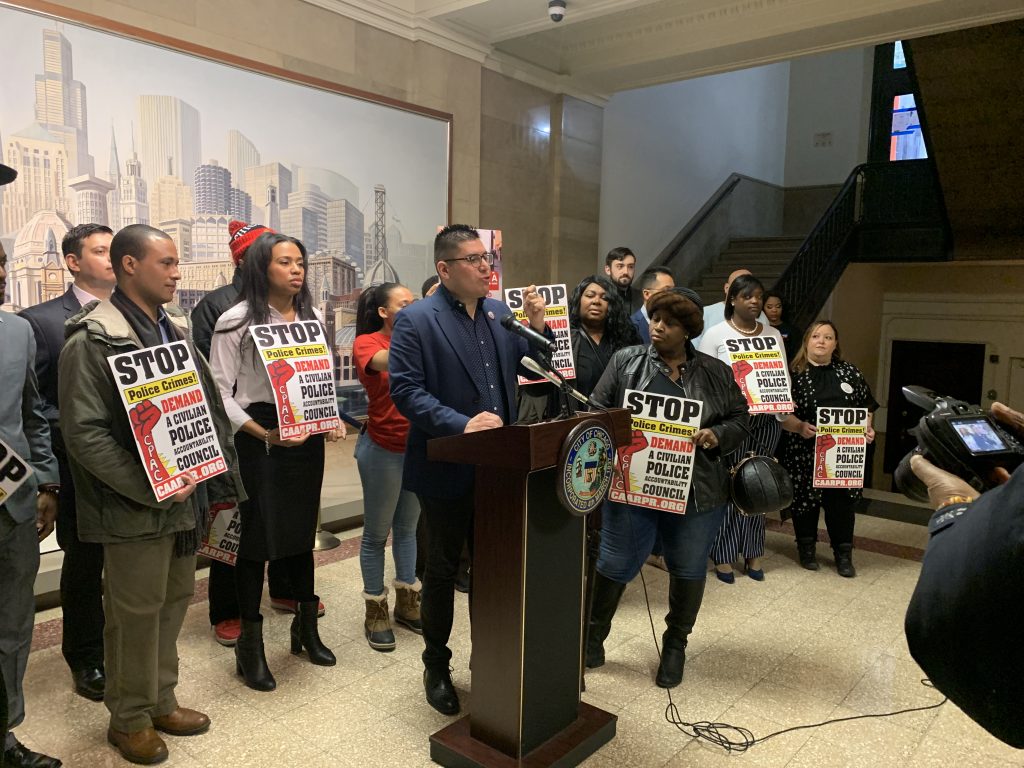 Ald. Carlos Ramirez-Rosa (35) rallied in support of civilian police oversight. [Heather Cherone/The Daily Line]
-
A measure that would permit Cook County to pay its pension debt with sales tax revenue and make a host of sweeping changes is working its way through the General Assembly, but some of the administration’s proposals are already facing pushback from Treasurer Maria Pappas and the Chicago Federation of Labor.
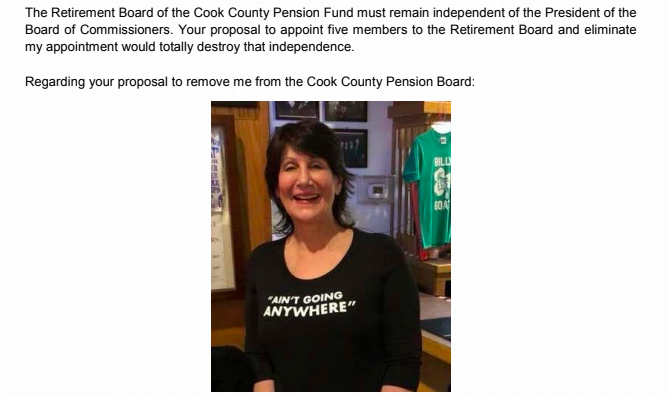 Treasurer Maria Pappas' letter to Cook County Board President Toni Preckwinkle. [Provided]
-
A half-dozen aldermen and aldermen-elect gathered Monday outside the James R. Thompson Center in Chicago to urge Senate President John Cullerton (D-Chicago) to allow a vote on a measure that would end mayoral control of Chicago’s schools.
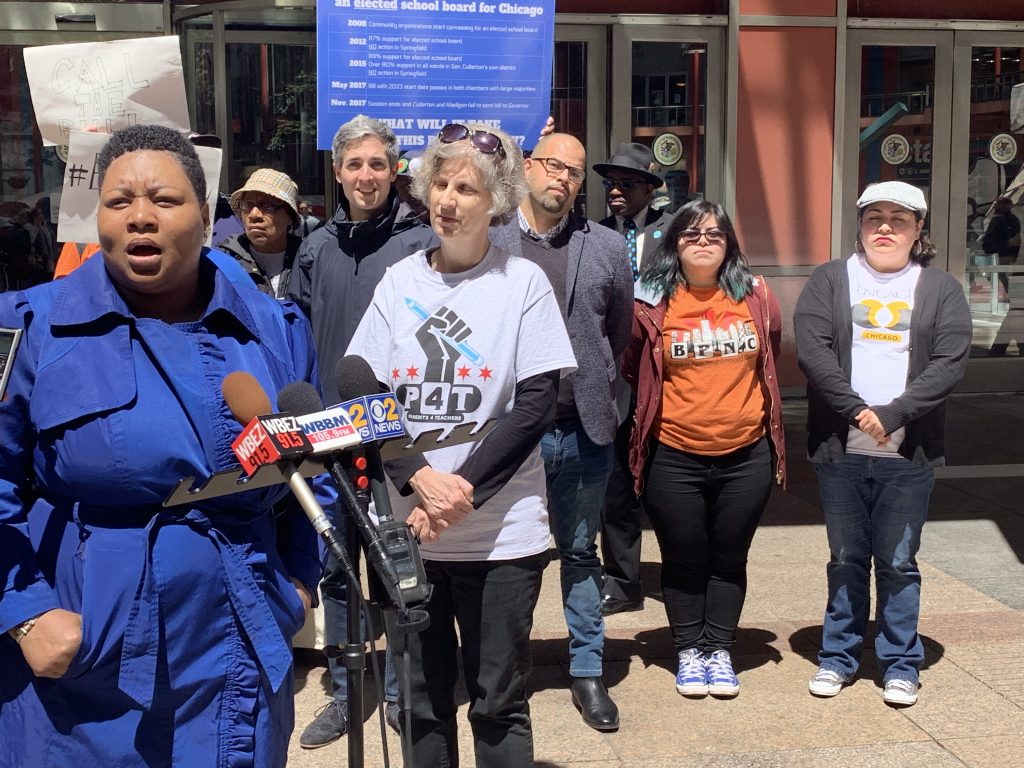 “The people have spoken. And people are tired of not being listened to," Ald.-elect Jeanette Taylor (20) said. [Heather Cherone/The Daily Line]


