


Chicago News
-
FEB 15, 2019

 With less than two weeks until Election Day, mayoral candidate Toni Preckwinkle unveiled her closing argument with a new television spot. Cook County Republican Party Chairman Sean Morrison tossed his support behind mayoral candidate Willie Wilson, while 1st Ward aldermanic challenger Daniel La Spata lost another endorsement because of a photo from his bachelor party that City Council Black Caucus Chairman Ald. Roderick Sawyer (6) said was “racist.”
-
FEB 15, 2019
UNLOCKED
Sarah-Ji Rhee, a local photographer, says that Ald. Joe Moore used her photo without permission. [Facebook/ Sarah Ji Rhee]
A local photographer and a Los Angeles-based photojournalist are accusing Ald. Joe Moore (49th) of using their photos on campaign mailers without permission — but Moore’s campaign contends they did nothing wrong.
On Friday, photographer Sarah-Ji Rhee accused Moore and his campaign of stealing her photo for a campaign mailer in a Rogers Park Facebook group. She called it the most “egregious violation of professional courtesy” she’s experienced as a photographer. -
FEB 14, 2019
-
When long time 23rd Ward Ald. Mike Zalewski announced in April that he planned to retire before his term was up — giving Mayor Rahm Emanuel a chance to appoint his replacement, and giving him or her a leg up in the race for a full term — Paulino Villarreal did not even apply.
 Private investigator Paulino Villarreal, left, and 23rd Ward Ald. Silvana Tabares. [A.D. Quig/The Daily Line; Submitted]
Even though his 2015 bid for alderman was cut short by heart problems, Paulino Villarreal told The Daily Line he was certain the selection process was “rigged” for then state Rep. Silvana Tabares, an ally of House Speaker Michael Madigan.
“It is a farce,” Villarreal said in May. “The deal has been cut.”
Villarreal was prescient — one of four people to apply, Tabares got the nod from Emanuel and was confirmed by the City Council unanimously.
Tabares is now running for a full term representing the Southwest Side ward that includes Midway Airport — and will go head to head against Villarreal after three other candidates were knocked from the ballot after their nominating petitions were challenged.
A licensed private investigator, Villarreal faces tough odds — he’s never had more than $1,000 on hand, compared to Tabares, who has close to $500,000 in her campaign’s bank account, according to the Illinois Sunshine database.
Tabares, who was born in Little Village raised by her mother in Brighton Park, has the backing of several large labor organizations, including the Chicago Teachers Union.
Villarreal, who grew up in Pilsen, moved to Bridgeport and ended up in Garfield Ridge, said he is running because of the “limited, limited, limited activities” for children outside of baseball in the spring and summer, a lack of small business development in the ward as well as crime.
But Villarreal said his main motivation in challenging Tabares’ bid for a full term is her close ties to Madigan — which he said is bad for the community.
“The ward is suffering,” Villarreal told The Daily Line from a donated ward office a few blocks from Tabares’. He played Tony Bennett and Frank Sinatra on the TV while his wife, Olimpia, sat a desk away. “People are afraid to vote against Madigan. This whole ward is basically city workers, state workers, county workers. And they have told me, they say. ‘Paul, we’re going to vote for you but we can’t put your yard sign up… because we know we’ll get repercussions at work for supporting you.’”
Tabares said she was proud of her connections to other elected officials.
“I want to be able to have a good working relationship with everybody in the ward, whether it’s our congressmen, our Cook County commissioners, our state legislators, I want to be able to work for them to make sure that the community benefits from that, because that’s how you get things accomplished and for your ward,” Tabares said.
While Villarreal’s campaign may not be flush with cash, Tabares is taking his challenge seriously.
Her campaign has flooded residents at least half a dozen mailers, including one slamming Villarreal for being in debt to the state of Illinois.
Villarreal said he is making payments and has a remaining debt of less than $30,000, which he said was incurred when his firm’s former accountant did not pay his company’s state taxes.
Tabares’ husband, Sean Murray, worked on her first campaign and was also been on the payroll of the Friends of Michael J Madigan and Democratic Majority committees during election years. Madigan is paying for Murray to work on Tabares’ campaign as well, according to records filed with the state board of elections.
“Has he donated? Yes, he’s donated. I’m one of the Democrats in Illinois House, he’s not only donated to my campaign but many others in the Democrats. I mean, we are Democrats, we both, as Democratic Party of Illinois, we both served,” Tabares said, explaining she and Madigan has both run for Democratic state central committeeman as well.
Tabares is named as a defendant in the "sham candidate" lawsuit brought by Jason Gonzales after the 2016 primary he ran against Madigan. Gonzales alleged Tabares told early voters at a polling place that Gonzales was a convicted felon.
Tabares said she could remain independent of Madigan while serving on City Council.
“Oh yeah, I vote — when I was a state Rep., I always voted my district,” Tabares said, laughing. “I always appreciated the feedback I got from residents, the calls, the emails, the walk-ins… that’s what I’m going to continue to do in City Council.”
Tabares served as the state representative for the 21st District in the Illinois for five and a half years.
She said fighting for more money for Chicago Public School funding and carrying a bill to “restore collective bargaining rights for teachers that were stripped away back in 1995” as her major accomplishments. That bill, HB1253, died at the end of the last session.
Tabares said she supports an elected school board.
Since taking office as alderman — replacing one of the last Polish aldermen to represent a ward with a growing Latino population — Tabares said she worked with neighboring Ald. Ed Burke (14) and Ald. Marty Quinn (13) to press the Chicago Department of Aviation to replace window insulation installed by the city to reduce jet noise that emit a foul odor.
Tabares says she backs a ban on outside employment for aldermen — one of many proposals to clean up City Hall in the wake of an ethics scandal that erupted after Burke was charged with attempted extortion. Burke has said he is innocent.
However, Villarreal said Tabares’ mailers suggest she owes her allegiance to the 13th Ward.
In mailers, Tabares is pictured outside three locations not in the 23rd Ward — Pticek & Son Bakery, which is just on the other side of the ward border at 55th Street; Hale Elementary and Kennedy High School, both less than two blocks outside of the 23rd Ward.
Another mailer from neighboring Ald. Marty Quinn (13), another Madigan ally, features a similar image as a Tabares mailer — a police officer walking a girl to school.
Tabares said she and Quinn are working with the city to crack down on the Rainbow Motel — known for selling hourly rates, “naps,” and its fantasy suites. Tabares said it attracts crime to the area.
Both Villarreal and Tabares agree the area needs more resources for officers.
“The 23rd Ward is home to a lot of police officers and teachers and city workers,” Tabares said. “And one of my biggest priorities is making sure that police have the resources they need to keep our neighborhoods safe.”
The alderman touted her efforts to install a security camera at a major intersection on Archer and support for more counseling and training for officers. She said she wants to assure residents she will protect them from shouldering a heavier property tax burden and wanted to help small businesses navigate City Hall.
Villarreal said he wants to attract a new hospital near the former site of Leclaire Courts, a new firehouse at the corner of Archer and Narragansett, add a community parking lot for those shopping on Archer Avenue, as well as providing flood relief and small businesses improvement funds to mom and pop shops between Cicero to Harlem.
“I want to turn this strip into the next downtown LaGrange area where it’s loaded with nothing but small mom and pop boutiques… I’m tired of them selling out to all these big businesses in our neighborhood,” he said.
Between March 2013 and June 2014, Alaina Hampton worked in Tabares’ office as part of her duties for for the Office of the Speaker.
Hampton filed a federal discrimination lawsuit in the spring of 2018 against Madigan and his political organizations, alleging she was prevented from moving up in the organization because she reported being sexually harassed by Kevin Quinn, the alderman’s brother. Kevin Quinn was fired. Madigan has denied retaliating against Hampton.
Tabares responded to a question about the alleged harassment of Hampton by talking about her efforts to “stand up” to former Gov. Bruce Rauner, a Republican, but declined to comment on how Quinn handled the situation.
“I think as a woman, in politics, whether you’re running for office or you’re in office, you have to be tough,” Tabares said. “And you have to stand up for yourself and for your ward, and that’s what I’m doing. That’s what I did down in Springfield, stood up to Bruce Rauner when he wanted to cut funding, and that’s what I’m going to continue to do for my ward, is stand up. Stand up for the ward and what’s important to them.”
Tabares said she would focus on the issues important to 23rd Ward voters rather than concerns about workplace sexual harassment in Illinois politics.
“The No. 1 issue I hear going door to door is public safety and education, and that’s what I’m going to fight for in the City Council is the needs for the residents, because that’s what I’m hearing at the door,” Tabares said.
Hampton said it was disappointing that Tabares did not stand with her when she reported the harassment.
“It's so important that women in politics stand up for one another, now more than ever,” Hampton said in a statement. “Ald. Tabares has had plenty of opportunities, including in this interview, to speak up and support me and other women who have been victims of sexual harassment in the organization we both came up in politics through. Instead, she has opted to stay silent. It's disappointing. We'll never see meaningful change in our Democratic Party institutions as long as women in leadership are tacitly or explicitly enabling sexual harassment in this way."
Both Villarreal and Tabares said they have reservations about the consent decree now in place over the operations of the Chicago Police Department to ensure officers no longer violate the civil rights of Chicagoans.
“Any changes that we make in the police department I strongly believe that we need to have the police officers at the table to make those changes, so that’s my stance on the consent decree,” Tabares said. “Because police officers put their lives on the line every day, and we need to make sure that they come home safe to their families.”
Villarreal said the consent decree inappropriately limits police powers.
“Unfortunately we have groups out there that are stating, well you know, all police are bad or hate the police or blue lives matter or black lives matter,” Villarreal said. “You know, no, let’s find the common ground in the middle where it’s all lives matter, everybody’s lives matter, let’s all work together… let’s get a big table and at that table let’s have everybody we can have there and sit down and everybody talk and work out their problems. It’s that simple.”
In a 2014 video from Villarreal’s campaign announcement, he said public safety would be his top priority as alderman. He told reporters he planned to suit up and patrol the streets himself with a gun and his aldermanic badge.
“The alderman is a peace officer when he’s sworn in,” Villarreal said in the video. “He has the right to detain someone. He has the right to arrest someone. He has a city radio in his vehicle. He carries a badge. He can carry a weapon. This alderman doesn’t do that. No alderman has done that. I plan on doing that. I plan on doing it five nights a week,” he said. “I’m going to go out and buy a bulletproof vest. I’m talking about, I’m going to be out there Wednesday, Thursday, Friday, Saturday, Sunday. There’s guns on the street and we’re going to get them.”
In mailers, Tabares’ camp photoshopped Villarreal’s face onto imagery from the movie “Paul Blart: Mall Cop.”
“The last thing we need is a guy running around with a gun and trying to make arrests while he’s living out his fantasy of being a cop. It’s dangerous and reckless,” the piece reads.
Villarreal said the ad’s imagery was an attempt to bully him for using a mobility scooter — walking is painful for him because of Osteoarthritis, he said. -
Mayoral candidate Paul Vallas became the latest contender to hit the airwaves, where he will be joined by some of the best-funded aldermanic candidates.
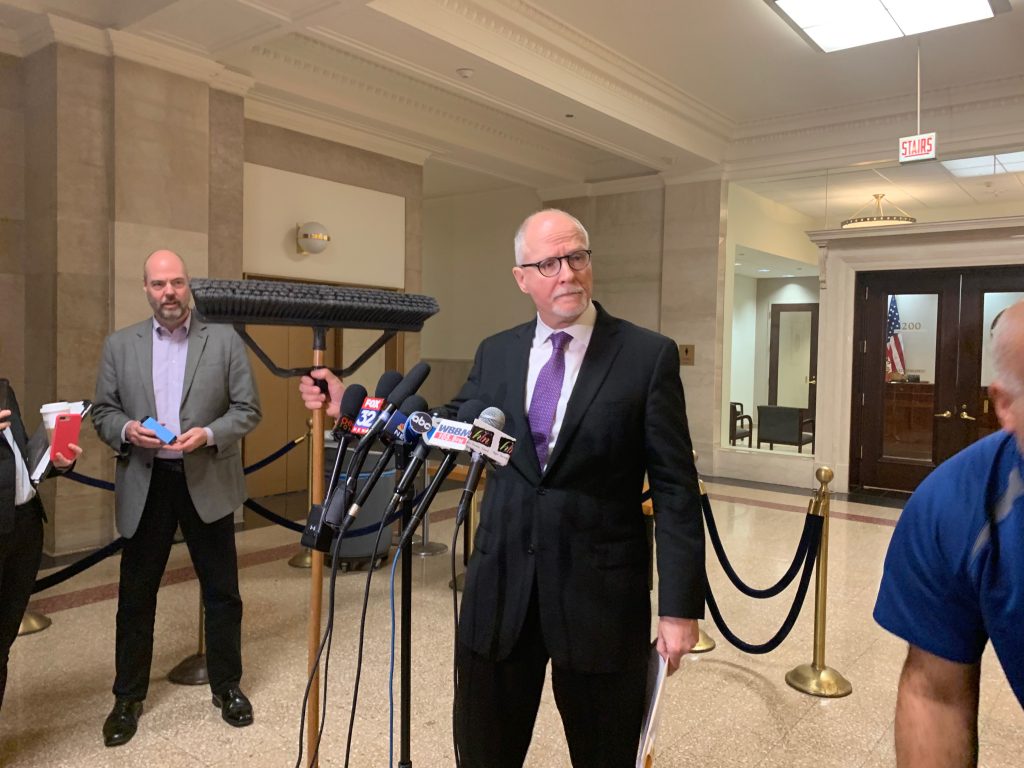 Mayoral candidate Paul Vallas brandishes a broom at his City Hall press conference. [Heather Cherone/The Daily Line]
-
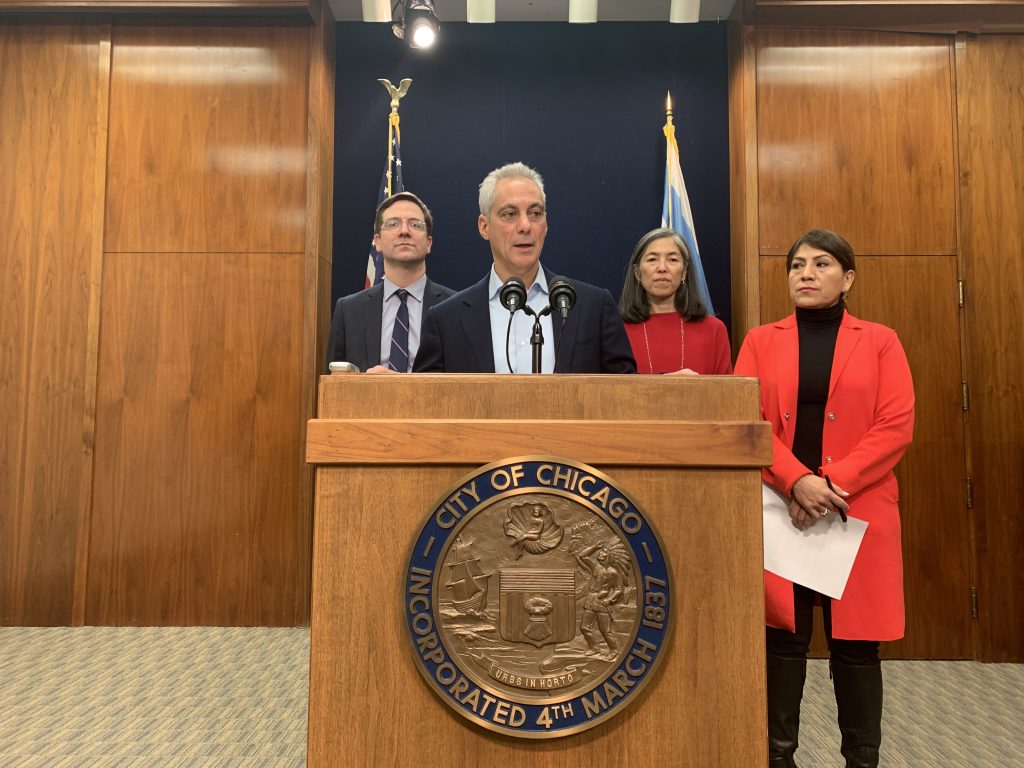 Mayor Rahm Emanuel on Tuesday urged state lawmakers to follow Chicago's lead and raise taxes on e-cigarettes. [Heather Cherone/The Daily Line]
Illinois lawmakers looking for ways to plug the state’s massive budget deficit should follow Chicago’s lead and hike taxes on e-cigarettes and liquid nicotine, Mayor Rahm Emanuel said Tuesday.
-
The closure of northbound Lake Shore Drive for nearly 24 hours after the discovery of cracked steel support beams on Monday should be a “wake up call” for everyone that Illinois — and Chicago — can no longer paper over its crumbling infrastructure, Mayor Rahm Emanuel said Tuesday.
 A crack in a steel beam shut down Lake Shore Drive for 24 hours from Monday into Tuesday. [Photo courtesy of Ald. Brian Hopkins (2)]
-
Daniel La Spata, who is running to unseat 1st Ward Ald. Proco Joe Moreno, apologized Tuesday for taking a photo wearing a banana costume while surrounded by smiling African American children and people wearing monkey masks in Millennium Park.
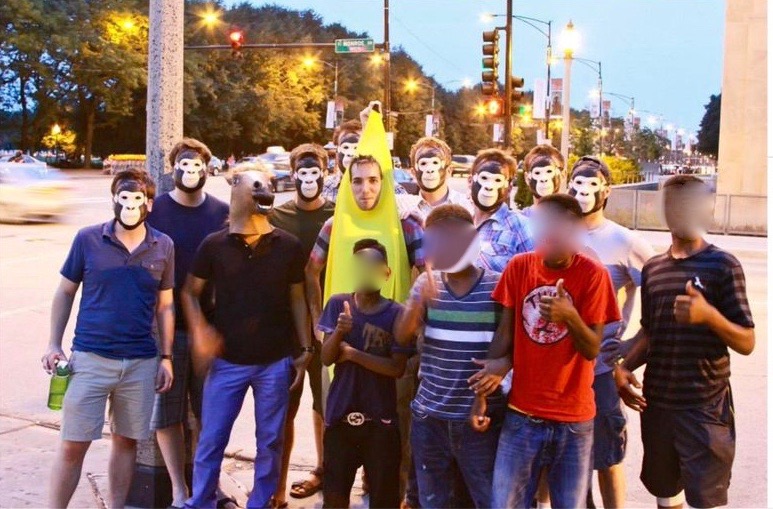 This photo taken during 1st Ward candidate Daniel La Spata's 2013 bachelor party has been deleted from his Facebook page. [Submitted]
“I apologize unequivocally for the photo," La Spata said in a statement. "The photograph and the costumes were not racially motivated, but I understand how it could be perceived."
The 2013 photo, which La Spata removed Tuesday from his Facebook page, was taken during his bachelor party, when his friends surprised him with a banana costume and chased him in Millennium Park while wearing monkey masks. Kids in the park asked to take a picture with the group, according to a statement from the campaign.
"This type of insensitivity and bigotry has no place anywhere," Moreno said in a tweet.
In a text message to The Daily Line, Moreno said had nothing to add to his tweet.
Black Caucus Chairman Ald. Roderick Sawyer (6) criticized the photo in a statement, as did Latino Caucus Chairman Ald. Gilbert Villegas (36).
“Whether it’s Ralph Northam in Virginia, or an aldermanic candidate here in Chicago, there should be no place in our politics for this kind of blatant racist imagery," Sawyer said. "I have no interest in having a colleague in the City Council who would participate in this sort of bigotry.”
Villegas said he had concerns about La Spata's behavior.
"Whether it’s elected officials from Virginia or the White House, hate has no home here and definitely not on the City Council," Villegas said in a tweet.
Sawyer is running for re-election, while Villegas is unopposed.
"As alderman, I will use my office to break down racial inequities in our ward and city, as I’ve done personally and professionally for the last 13 years,” La Spata said. -
-
-
Attorney General Kwame Raoul announced Monday he would challenge the nearly 7 year sentence imposed on former Chicago Police Officer Jason Van Dyke, alleging that Cook County Judge Vincent Gaughan improperly applied the law after the officer was convicted of murdering 17-year-old Laquan McDonald.
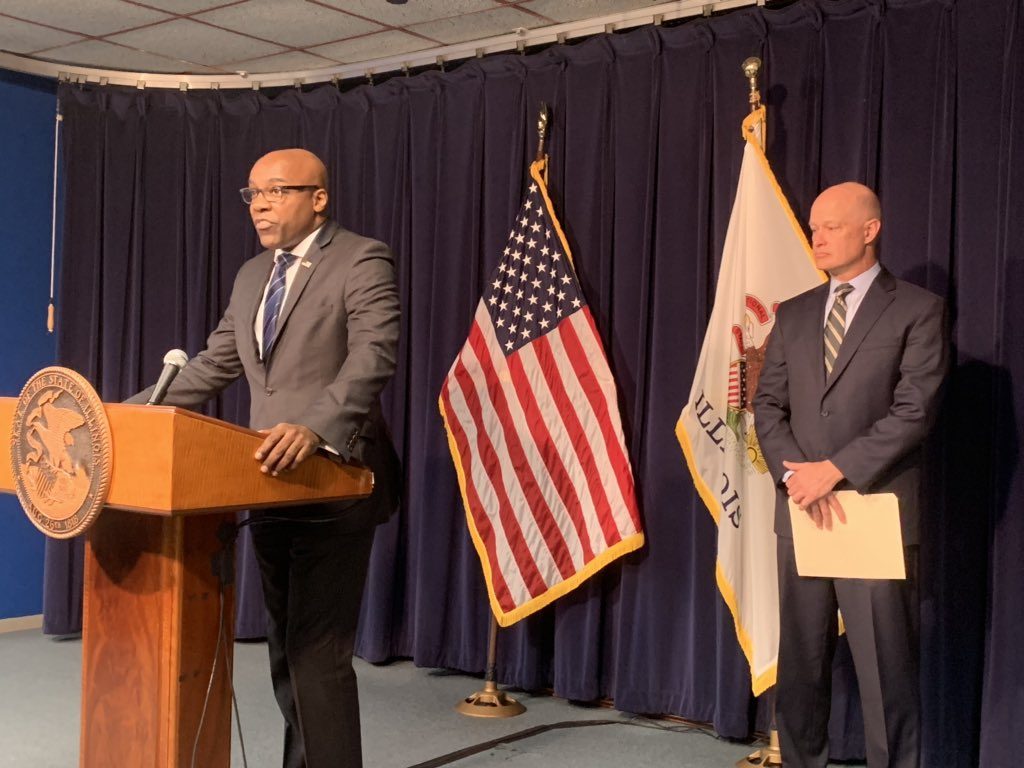 Flanked by special prosecutor Kane County State’s Attorney Joe McMahon, Illinois Attorney General Kwame Raoul announces that he will challenge former Chicago Police Officer Jason Van Dyke's nearly seven-year sentence for murdering Laquan McDonald. [Heather Cherone/The Daily Line]
Flanked by special prosecutor Kane County State’s Attorney Joe McMahon, Raoul said he took no position on whether Van Dyke’s sentence — which was widely criticized — was too lenient.
Instead, Raoul said he filed a writ of mandamus asking the Illinois Supreme Court to decide whether Gaughan property sentenced Van Dyke to 81 months in prison on the second-degree murder conviction rather than the 16 counts of aggravated battery with a firearm, one for each shot that hit McDonald.
Van Dyke should be resentenced, Raoul said, acknowledging that the decision to challenge a judge’s ruling on a matter of law was not an “everyday occurrence.”
“But neither is it uncommon,” Raoul said, adding that this action was the only way to challenge the “totally unauthorized sentence.”
The Supreme Court should order a new sentencing hearing for Van Dyke and instruct Gaughan “to follow precedent by imposing sentence on all 16 counts and then determine whether one or more sentences must be consecutive,” Raoul said.
McMahon said Van Dyke’s defense attorneys last week filed notice that they plan to appeal his conviction.
The second-degree murder count is a Class 1 felony, while the battery counts are considered Class X felonies, and could result in a longer prison sentence.
Raoul said his action was not prompted by political considerations.
“That’s nonsense,” Raoul said. “This is a question of law.”
However, Van Dyke's lawyers Darren O’Brien and Jennifer Blagg said in a written statement that Gaughan followed the law after hearing arguments from both sides.
"By requesting mandamus, they seek to turn the Illinois Supreme Court from a deliberative body into a political battleground," O'Brien and Blagg said. "The filing also opens up a Pandora’s box of legal issues that, in the long term, could result in grossly excessive, unjust sentences for defendants that follow in the wake of this request."
McMahon, who led the prosecution of Van Dyke, said he had spoke with McDonald’s family, who told him that they supported challenging Van Dyke’s sentence.
“While there are many who have opined on the appropriateness of the length of the sentence in this matter, I recognize that a trial judge’s discretion in sentencing is to be given great deference,” Raoul said. “However, it is in the interest of justice that we do all within our power to make sure that such exercise of discretion be applied consistent with the mandates of law no matter who the defendant and no matter who the victim in a particular case.”
However, there is no plan to launch a review of other, similar cases where the law may have been improperly applied, Raoul said.
McMahon said after the sentencing hearing he was “satisfied” with the sentence, but wants to ensure that the sentence is lawful after having had “an opportunity to step back and evaluate both the law and how the sentence was imposed.”
Raoul, a former state senator, introduced a measure in 2015 that would have required police officers to be licensed.
Read the complete filings here and here.
Mayoral candidates Toni Preckwinkle and Amara Enyia applauded Raoul's move.
"Laquan McDonald and our city's Black and Brown communities deserve real justice," Preckwinkle said.
Enyia praised Raoul and McMahon for "having the fortitude and moral compass to do the right thing."
"While today’s actions are a small step in finally achieving justice for Laquan McDonald and his family, it continues to spotlight our city's racial disparity with justice," Enyia said. -
-
-
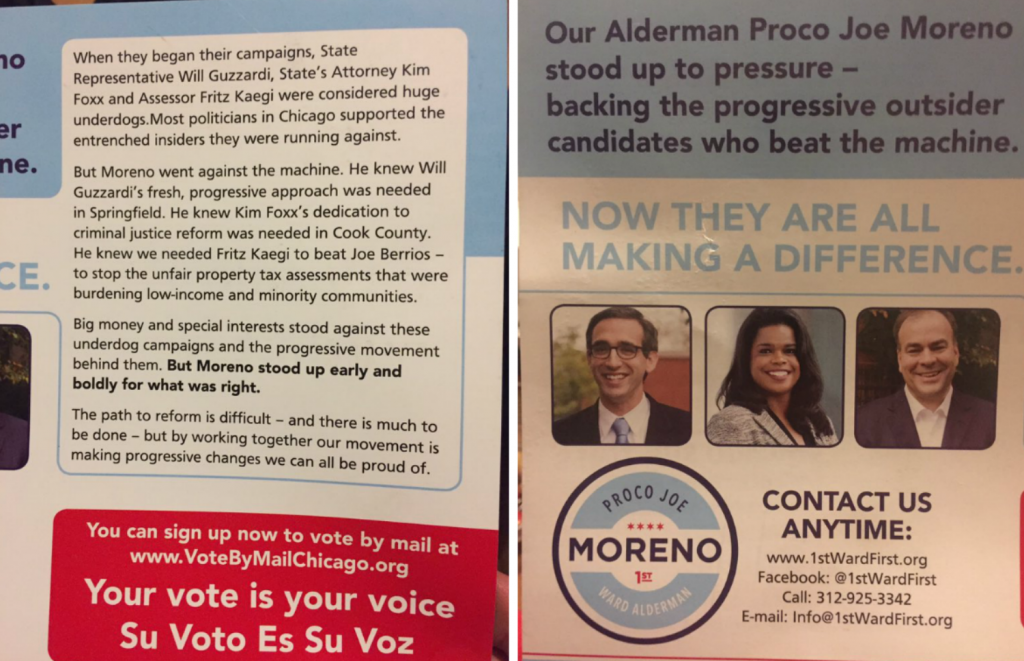 The mailer sent by Ald. Proco Joe Moreno (1).
Ald. Proco Joe Moreno (1), who is under investigation for filing a false police report after the car he said was stolen was found in the possession of a former girlfriend who said the alderman lent her the car, is now himself being accused of taking something without permission.
Moreno’s latest mailer features the pictures of state Rep. Will Guzzardi, Cook County State's Attorney Kim Foxx and Assessor Fritz Kaegi — three of the area’s best-known and most successful progressive politicians.
“Our Alderman Proco Joe Moreno stood up to pressure – backing the progressive outsider candidates who beat the machine,” the mailer reads. “He knew Will Guzzardi's fresh, progressive approach was needed in Springfield. He knew Kim Foxx's dedication to criminal justice reform was needed in Cook County. He knew we needed Fritz Kaegi to beat Joe Berrios — to stop the unfair property tax assessments that were burdening low-income and minority communities.”
Guzzardi took to social media to rebuke Moreno for making it appear as though Guzzardi endorsed him.
"The alderman did not receive, nor did he request, my consent to appear in this mailer,” Guzzardi wrote. “And while the statement made in the piece is factually correct — he did support my campaign in 2014 — I believe the mailer makes a misleading implication. I have not endorsed Alderman Moreno's re-election campaign. I have been increasingly troubled in recent years by both his personal and his professional conduct. I urge voters in the First Ward not to confuse my appearance in Moreno's literature with my support for his candidacy."
Robert Foley, a spokesperson for Foxx, said Moreno did not seek the state attorney’s permission to use her picture on his mailer.
“State’s Attorney Foxx has not endorsed Alderman Moreno for re-election or any other elected official this cycle,” he said.
“Fritz has not made an endorsement in the 1st Ward race. Any assertion otherwise would be inaccurate,” Kaegi spokesperson Joanna Klonsky said.
Kaegi gave Ald. Moreno permission to include on his mailer that the alderman had endorsed Kaegi in his run against Berrios, Klonsky said, but the two did not discuss using a photo.
Moreno did not immediately respond to a request for comment.
Daniel La Spata, who is vying to unseat Moreno in the 1st Ward contest on Feb. 26 election, noted that Moreno has been in the news this week for less than positive reasons.
“It’s shameful that he’s trying to mislead 1st Ward voters and distract from his record of selling out our ward by engaging in the machine-style politics that have held this city back,” La Spata said. “But he’s not fooling anyone.”
Earlier this week, mayoral candidate Susana Mendoza said she would not attend a Feb. 20 fundraiser for Moreno — although the alderman’s advertisements for the event said it would feature Mendoza as the “honored guest.”
This isn’t the first time a popular candidate has cried foul about others cashing in on their popularity or progressive bona fides. In the 2018 midterms, then-Commissioner Jesus “Chuy” Garcia’s picture or name appeared on campaign literature for several candidates he had not endorsed.
Garcia, who supported Alma Anaya in that race, demanded that candidate Angie Sandoval stop, and told reporters she intended to mislead voters. Despite Garcia’s objection, Sandoval used Garcia’s name on her palm card in the 7th District race.
Moreno told WGN-TV he reported his Audi stolen because of a “misunderstanding” between him and the woman, whom he used to date. Although the woman spent the night in jail after being charged with a misdemeanor, police have dropped all charges against her.
Send all of the walk pieces, mailers, palm cards or texts you get to us. Our DMs are open @thedailylinechi on Twitter and at [email protected].


