


-
MAR 26, 2026

UNLOCKEDMayor vetoes ordinance freezing annual tipped wage phase-out
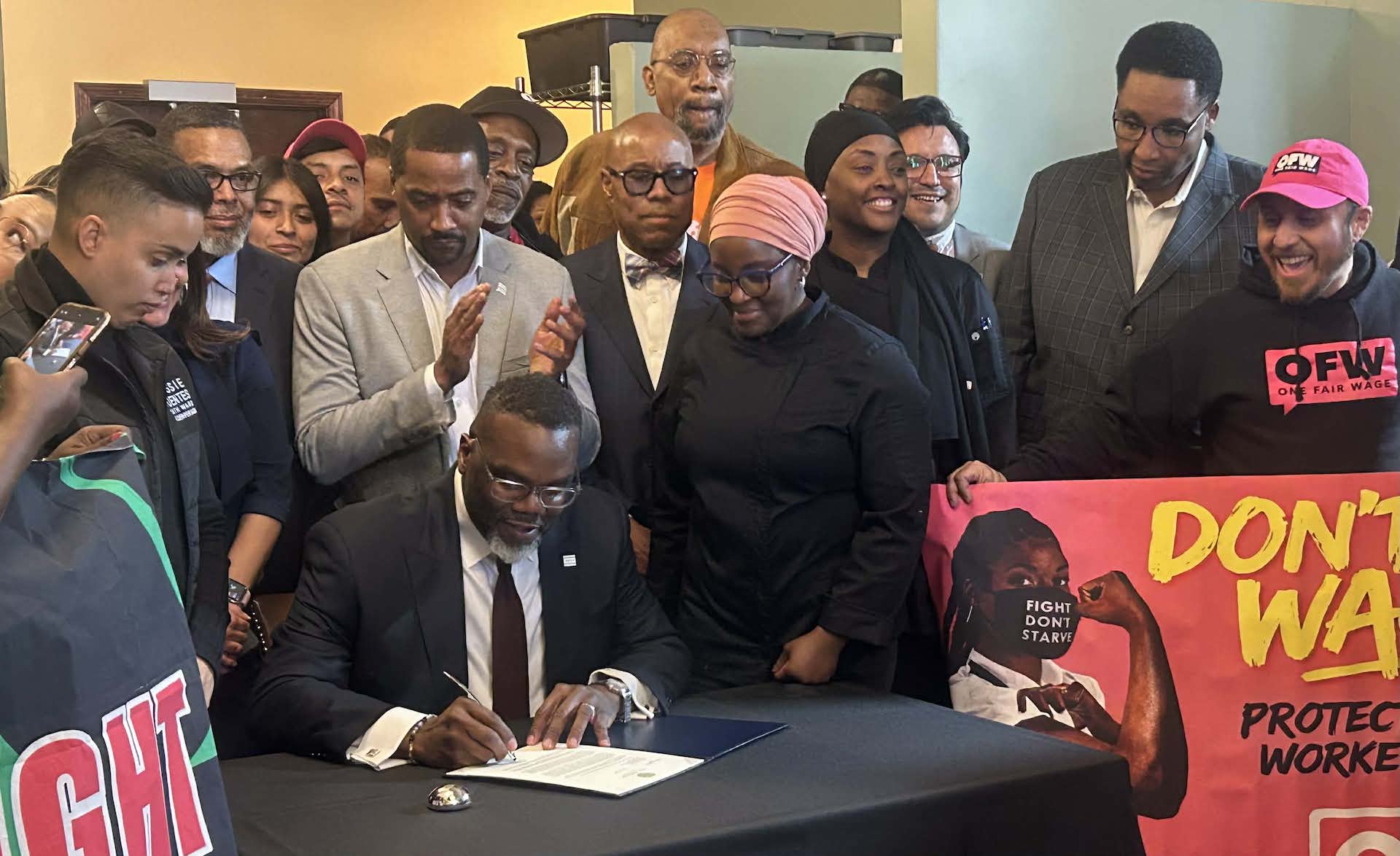
Mayor Brandon Johnson signs a veto of the ordinance freezing the elimination of the subminimum wage at Let's Eat to Live in West Woodlawn on March 25, 2026. [Michael McDevitt/The Daily Line]
The mayor issued the third veto of his term on Wednesday by quashing the ordinance freezing the phase-out of the city’s tipped wage, which was passed by the City Council last week.
Mayor Brandon Johnson signed the veto at the Black-owned restaurant Let’s Eat to Live in West Woodlawn, promising not to let the city to renege on what has been promised to tipped workers, a group which the mayor said is made up primarily by Black and brown women.
“We also have a responsibility to lead by example here in Chicago, showing that supporting local businesses and paying workers fair wages can go hand in hand,” the mayor said during a press conference ahead of the signing ceremony.
The council approved the ordinance (SO2025-0017549) freezing the five-year phase-out of the subminimum wage for tipped workers, such as bartenders and wait staff, by a 30-18 margin. The council will need 34 votes to overturn Johnson’s veto.
The mayor is seeking to protect one of his administration’s signature legislative victories, the One Fair Wage ordinance (SO2023-0002995) passed in October 2023, as well as demonstrate his bona fides as working people’s “fighter on the fifth floor,” as he put it Wednesday.
Under the One Fair Wage ordinance, the gap between the tipped wage and minimum wage is intended to shrink by eight percent every July until it becomes equal to Chicago’s minimum wage on July 1, 2028. That process began in 2024.
Last spring, Ald. Bennett Lawson (44) first introduced the ordinance to freeze the elimination of the tipped wage, citing job losses and business closures in the bar and restaurant industries. But the proposal got stuck in the Committee on Committees and Rules, so a statutory tipped wage increase went into effect last July.
Ald. Samantha Nugent (39) brought it back to the floor last Wednesday, with slight changes to account for the current tipped wage.
Related: Mayor to veto ordinance freezing tipped wage escalator
The ordinance approved by the council freezes the current tipped wage ratio at 76 percent of the city’s minimum wage. Currently, the tipped wage is $12.62 an hour compared to the $16.60 an hour minimum wage. The minimum wage, and the tipped wage, will continue to go up annually in accordance with inflation under city ordinance.
Johnson argued that if it would be unthinkable for the city to roll back pay raises it agreed to in one of its public union contracts, the freezing of the tipped wage retirement should be viewed similarly.
“It's especially tone-deaf and disturbing to see individuals attempt to do that in this moment,” Johnson said. “Families are struggling under the weight of rising costs — rent, groceries, childcare and wages have not kept up with these rising costs. At a time when people are fighting just to stay afloat, you had individuals who claim to stand up for working people as Democrats take money out of the pockets of working people.”
“We can talk about affordability, and it should not come at the cost of our workforce, the backbone of our city who make our businesses thrive, who contribute and make sure that we are the best hospitality city and the epicenter of culinary in this country,” Ald. Jessie Fuentes (26), the lead sponsor of the One Fair Wage ordinance, said at the press conference.
The mayor has touted more than 1,500 new retail food establishment licenses issued since July 2024 and an 83 percent renewal rate in 2025 to claim the Chicago restaurant industry is “thriving.” Still, that license class isn’t limited to restaurants and cafes but also includes grocery stores, convenience stores, catering businesses and other businesses where tipping is not typical.
“A veto of this legislation ignores what we’ve heard from workers and small businesses across Chicago,” Nugent said in a statement. “This industry is already under strain, and eliminating the tip credit without fully understanding the impacts risks fewer hours, fewer jobs, and added pressure on neighborhood restaurants. Freezing the tip credit was a responsible step to give us time to get this right for workers and employers alike.”
The state restaurant association has said their own data shows hundreds of restaurants closed last year, and it said employment in the restaurant industry remains below pre-pandemic levels. Additionally, they said the median tipped worker in Illinois makes $28 an hour.
“Today’s veto is completely misguided,” said Sam Toia, president and CEO of the Illinois Restaurant Association, in a statement. “It will eliminate jobs, reduce take-home pay for restaurant workers, and cause irreparable damage to the vibrant restaurant industry in each of Chicago’s 77 communities. We need to freeze the tip credit and give our restaurants and their employees a fighting chance.”
The council will have a chance to overturn the veto at its next regular meeting.
The state General Assembly is also considering a bill that would nullify Chicago and any other municipality's ability to phase out the tipped minimum wage. The measure was approved by a House committee Wednesday.


Trending


