


-
JUN 30, 2026

UNLOCKEDProtecting Renters Ordinance introduced to housing committee
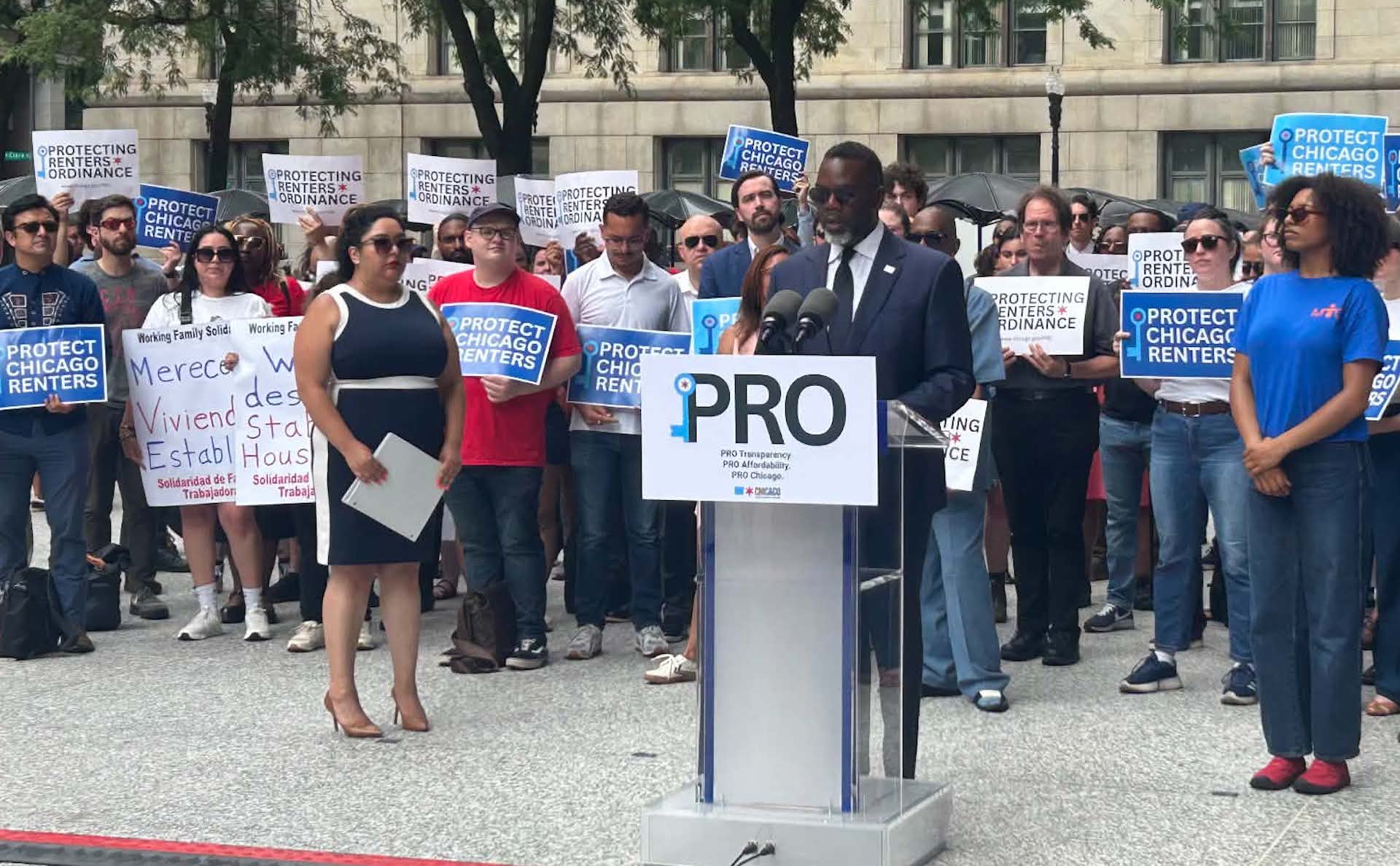
Mayor Brandon Johnson speaks about the PRO ordinance at a press conference in Daley Plaza on June 29, 2026. [Michael McDevitt/The Daily Line]
The City Council’s housing committee on Monday heard from all sides of the debate around a major piece of legislation from Mayor Brandon Johnson that would add new protections and financial relief for renters facing lease non-renewals and increase transparency around corporate apartment building ownership.
It would also seek to improve the city’s ability to hold bad landlords accountable and increase housing stability for tenants.
“For too long, Chicago has lagged behind other cities. Past administrations have kept organizers at arm’s length while declining to implement critical protections that have yielded results across the country,” Johnson said at a Monday morning press conference in Daley Plaza announcing the introduction of the legislation. “Needless to say, relief is long overdue.”
The Protecting Renters Ordinance (PRO) (O2026-0026554), which was directly introduced into the Committee on Housing and Real Estate ahead of the hearing, would serve as the first major overhaul of the Residential Landlord and Tenant Ordinance (RLTO) since it was enacted four decades ago and would respond to what advocates and the mayor’s office describe as a crisis of housing affordability in Chicago.
“Chicago’s rental market has changed significantly,” Johnson’s Chief of Policy Jung Yoon told the committee. “Growing numbers of out-of-state landlords target vulnerable communities. Eviction rates have surpassed pre-pandemic highs, and nonrefundable fees that would have been unthinkable just a few years ago are now common practice.”
The PRO ordinance would establish a formal Tenant Bill of Rights to more clearly spell out the existing rights afforded to renters, such as the right to organize a tenants union, right to make necessary repairs and deduct the cost from one’s rent and the right to withhold rent and terminate a lease in certain circumstances, as well as protections from illegal lockouts, discrimination, excessive noise and unsafe and unhealthy living conditions.
It also adds new flexibilities and rights for landlords, like instituting a 14-day cure window for potential violations and reforming security deposit requirements to no longer mandate they be kept in interest-bearing accounts.
The ordinance establishes a Bureau of Rental Housing Services under the Department of Housing that would centralize the functions of receiving and processing complaints against landlords, investigating alleged violations, issuing notices to remedy a violation and notices of violation and coordinating enforcement of the city’s rental laws.
It would also connect tenants with free legal advice and provide educational materials and compliance guides to tenants and landlords.
Housing Comm. Lissette Castañeda said it would lead to quicker dispute resolution that avoids needless time spent in court, which would benefit both landlords and tenants.
The bureau would also administer a citywide registry of rental units. The registry would provide transparency on the number of units being rented or available to rent citywide, the ownership of each building and each building’s history of code violations.
The registry would be funded through annual registration fees. Depending on the size of a building, property owners would be charged a $20-60 annual fee per rental unit. Certain properties would be exempt from the fees, including Chicago Low-Income Housing Trust Fund or Chicago Housing Authority-subsidized or owned properties, owner-occupied apartment buildings with six or fewer units and rentals owned and managed by nonprofits.
“I can see no negative consequences of the registry as proposed in the ordinance,” University of Chicago Associate Professor Philip Garboden, who specializes in housing policy, told the committee. “It is simply good governance that a city should maintain a database of rental property owners within its borders as it does for nearly all other small businesses.”
Garboden said that City Council and other elected officials are “often asked to make critical and high-stakes decisions related to rental housing policy” and “such decisions require basic information on the rental housing stock and its ownership. Without a rental registry, we are basically flying blind.”
The ordinance also limits the types of fees landlords may charge tenants. Application fees would be limited to $20. Acceptable fees would include pet fees, utility and internet pass-through costs and other pass-throughs for tenant-incurred costs for things like key replacement or the cost of “optional” services. Late fees and other lease-related penalties would still be allowed.
Ald. Daniel La Spata (1) said the optional services provision concerned him.
“I want to make sure that landlords don't turn items that are available to all into optional items,” La Spata said. “For example, if there’s a fitness center in your building, I don't want that becoming optional, or [if] there's a rooftop deck, that should not become optional.”
Donovan Harvey, director of housing for the mayor’s office, told La Spata that provision would only apply to services explicitly requested by tenants or amenities that a landlord charges for independent of the base rent.
“The intention of the section, as written, is to prevent situations where tenants are charged fees for amenities that they're not using and didn't ask for,” Harvey said. “So, if there is a mandatory $120 pool fee for a tenant that can't swim, it’s the position of this proposal that the tenant shouldn’t have to be paying for that.”
The governor signed legislation (HB3564) Friday that will impose $50 limits on application fees unless actual service costs are higher, ban almost a dozen “junk fees” charged by landlords and property management companies and require disclosure of any non-optional fees. It will go into effect in January.
But the legislation gave municipalities the ability to be stricter, and the city intends to take advantage not only through the $20 application fee cap but also by proposing a ban on move-in fees.
Castañeda said the city’s fee reform measures improve upon the state bill by accounting for landlords renaming fees to get around the ban by instead giving them a way to recoup actual costs.
The ordinance would make the city’s Right to Counsel pilot program, which has helped provide low-income and moderate-income Chicagoans with legal representation in eviction court cases since 2022, a permanent part of the city budget.
The pilot program is currently funded until the end of 2027. Castañeda said it has saved the city approximately $13.6 million since launch, easing “pressure on things like emergency rooms and on the homelessness system.”
Finally, the ordinance would incorporate the provisions of the Just Cause for Eviction Ordinance, under which a landlord would have to provide a reason for evicting someone or not renewing a lease. For lease nonrenewals that are not a tenant’s fault, landlords would have to pay the displaced tenants relocation assistance.
“Without Just Cause, tenants are unexpectedly displaced through no fault of their own,” said Tulsi McDaniels, an organizer with the Metropolitan Tenants Organization. “The consequences of this can be devastating, because the cost of living is so high, let alone with an unexpected move.”
If a tenant misses rent payments, violates lease terms, engages in criminal activity or misses their deadline to sign a lease renewal offer, the landlord would be able to recover the unit without paying relocation assistance.
For all other lawful reasons, landlords must pay those tenants to mitigate the cost of moving.
If the nonrenewal occurs due to the conversion of the building into condominiums; the unit’s demolition; the need to significantly repair the unit or building; the removal of the unit from the residential market or plans for either the owner or their relative to move into the unit, large landlords would have to provide assistance equal to five months’ rent or $5,000, whatever is greater. Landlords for owner-occupied two-to-six-flat buildings would have to provide the greater of $3,000 or three months’ rent.
If the nonrenewal occurs for any other lawful but unlisted no-fault reason, the large landlords would owe the greater of $10,000 or 10 months’ rent. Landlords for owner-occupied two-to-six-flat buildings would still owe just $3,000 or three months’ rent, whichever is greater.
But landlords would be allowed to provide displaced tenants with a comparable unit or a rent concession or credit for the remainder of the lease instead of the relocation payment, or a combination equal in value to what the ordinance requires.
The housing commissioner said the Just Cause provision aims to eliminate 10,000 annual displacements.
Yoon also noted that a previous draft that limited “unconscionable” rent hikes was found to be too confusing through feedback. That language was removed to ensure that Chicago did not run afoul of Illinois’ ban on rent control, she said.
Opponents, including some building owners and representatives from the property management industry, said the ordinance would cause the cost to build and provide housing to rise.
“This ordinance adopts policies commonly found in some of the nation's least affordable housing markets, including New York, San Francisco, Los Angeles and Washington, D.C.,” said Jon Kozlowski, government affairs director for the Chicagoland Apartment Association. “Cities that build see rents fall. Cities that overregulate see rents rise.”
Neighborhood Building Owners Alliance of Chicago President Michael Glasser said the thesis of the ordinance was wrong.
“You can't make housing more affordable by making it more expensive to provide housing,” Glasser said in a statement. “Over 100 new regulations will raise costs for owners and tenants alike.”
Ald. Anthony Quezada (35), who himself rents, said he didn’t see the ordinance as a threat to affordability.
“We need more affordable housing, but building housing and strengthening renters’ protections are not competing goals,” Quezada said. “They go hand in hand. If we want people to stay in our neighborhoods, raise their families here and put down roots, then we have to make sure that they have both housing options and basic protections.”
But some found the amount of input from housing providers insufficient.
“There's a lot of good things in this ordinance that I want to support,” said Ald. Gilbert Villegas (36), who chairs the council zoning committee. “But here we are once again where an ordinance is being drafted, and I'm hearing from housing providers that there wasn't enough engagement from their side.”
The ordinance was born out of the work of the city housing department’s Advisory Committee for Renting Right, which includes tenant advocacy, disability rights, housing justice and housing provider groups. Edwin Ortiz-Reyes, director of policy, planning and legislative affairs in the Department of Housing, said about a third of those on the advisory committee represented housing providers.
“This whole adversarial approach just really frustrates me,” Villegas said. “It's always you guys putting us in a position where it’s: ‘Are you with these guys or with that guy?’”
While Housing and Real Estate Chair Byron Sigcho-Lopez (25) said he thinks the hearing made it clear that some more discussion among alderpeople and stakeholders was needed, the housing committee will meet again July 8 and could vote on the ordinance.
Correction: This article was updated to clarify that application fees would be capped at $20, regardless of actual costs of credit and background checks.


Trending


