-
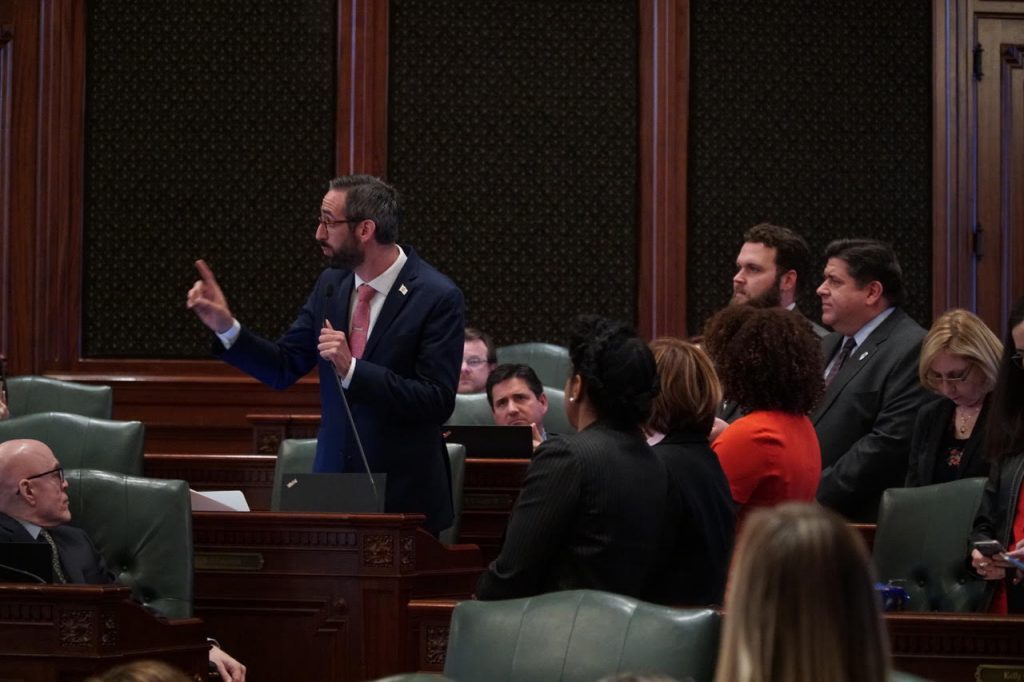
State Rep. Peter Breen (R-Lombard) and State Rep. Stephanie Kifowit (D-Oswego) on the House floor Tuesday.
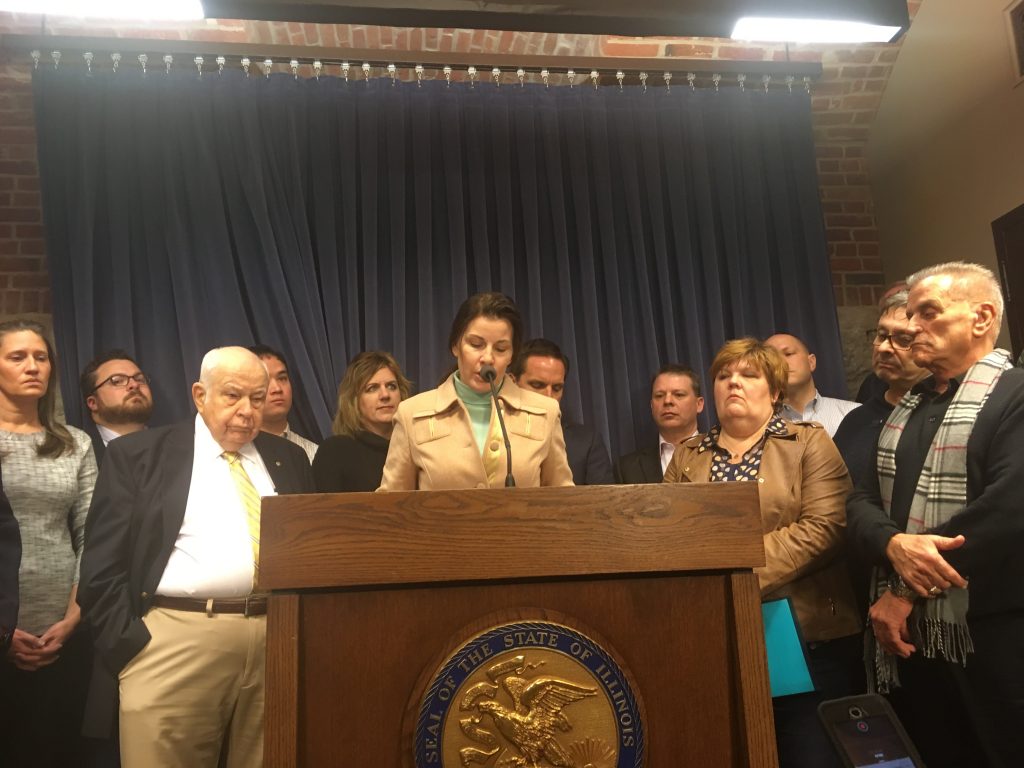
One day after a Democratic House member said she “would like to make” a Republican member “a broth of Legionella and pump it into the water system of [his] loved one so that they can be infected,” the House GOP on Wednesday used two obscure parliamentary rules to protest the comments.
-
The Illinois House on Tuesday overrode Gov. Bruce Rauner’s veto of a bill that lifted the caps on awards from the state’s court of claims from $100,000 to $2 million in a move designed to help the families of those who died from Legionnaires’ at the Quincy Veterans’ Home.
-
State Rep. Marty Moylan (D-Des Plaines) told Gov.-elect JB Pritzker Tuesday to slow down with his push to legalize recreational marijuana in Illinois, making him the first Democrat to publicly throw up a roadblock. Meanwhile, the Illinois Senate on Tuesday approved a bill that would allow for the dissolution by referendum of road districts in Lake and McHenry counties.
-
Moylan: marijuana won’t ‘solve all of Illinois’ problems’ — Lawmakers on both sides of the aisle say they’re eager to decriminalize marijuana with the support of pro-recreational pot Gov.-elect JB Pritzker, but the new governor won’t be able to count on everyone in his party. State Rep. Marty Moylan (D-Des Plaines) told The Daily Line that he’s far from the only Democrat who is opposed to the idea altogether — or against the fast track that Pritzker and other lawmakers have indicated they want to take to legalize marijuana. Moylan called for more studies on the issue, and in a statement Tuesday said the legislature should be “cautious” and that the state needs to “understand the repercussions our community will have to face.” The Democrat alleged that studies from Colorado show traffic accidents and homelessness have increased in the state since officials legalized pot in 2014. Moylan and said he is “worried that the benefits [of legalizing marijuana] will not outweigh the societal cost. Experts debate the validity and significance of those findings. On the campaign trail, Pritzker promised a boost in state revenues from legalizing the drug. A new Illinois Economic Policy Institute study estimated that decriminalizing the drug would create some 2,600 businesses and 24,000 jobs, plus tax revenue of $525 million annually, but other estimates are much lower. Moylan isn’t alone in opposing legalizing marijuana; House Republican Leader Jim Durkin (R-Western Springs) has also come out against it. Moylan on Tuesday said legalizing recreational marijuana “to generate more tax money is just irresponsible. Marijuana isn’t this miracle product that will solve all of Illinois’ problems; it is a drug that has consequences.”
- Local government consolidation bill OK’d — Democrats in the Illinois Senate on Tuesday pushed through a bill that would allow residents of Lake and McHenry counties to vote to dissolve road districts in an effort to bring down Illinois’ highest-in-the-nation units of local government. The bill, HB 4637, passed over Republicans’ objections that the bill might unfairly burden other municipalities after a district was dissolved. The measure passed the House with 80 votes in April, but didn’t get a hearing in a Senate committee until the first part of veto session earlier this month. Republicans on Tuesday criticized the bill as being short-sighted, questioning what would happen if residents voted to dismantle a road district that was in debt. But State Sen. Terry Link (D-Waukegan) said he promised to work with Republican opponents on a trailer bill to fix any shortcomings. Link told The Daily Line after the vote that he wasn’t sure how many road districts in Lake and McHenry counties were indebted versus ones with assets, but said that one local road district in Lake County only had six miles of roads, and employed “umpteen” people, which wastes tax money. “This is ridiculous the amounts of local government we have in this state,” Link said. “We’re only touching the tip of the iceberg with the amount we have. I’m tired of everybody talking about it and not doing something about it…this is a step forward and I think people want consolidation.”
-
Moylan: marijuana won’t ‘solve all of Illinois’ problems’ — Lawmakers on both sides of the aisle say they’re eager to decriminalize marijuana with the support of pro-recreational pot Gov.-elect JB Pritzker, but the new governor won’t be able to count on everyone in his party. State Rep. Marty Moylan (D-Des Plaines) told The Daily Line that he’s far from the only Democrat who is opposed to the idea altogether — or against the fast track that Pritzker and other lawmakers have indicated they want to take to legalize marijuana. Moylan called for more studies on the issue, and in a statement Tuesday said the legislature should be “cautious” and that the state needs to “understand the repercussions our community will have to face.” The Democrat alleged that studies from Colorado show traffic accidents and homelessness have increased in the state since officials legalized pot in 2014. Moylan and said he is “worried that the benefits [of legalizing marijuana] will not outweigh the societal cost. Experts debate the validity and significance of those findings. On the campaign trail, Pritzker promised a boost in state revenues from legalizing the drug. A new Illinois Economic Policy Institute study estimated that decriminalizing the drug would create some 2,600 businesses and 24,000 jobs, plus tax revenue of $525 million annually, but other estimates are much lower. Moylan isn’t alone in opposing legalizing marijuana; House Republican Leader Jim Durkin (R-Western Springs) has also come out against it. Moylan on Tuesday said legalizing recreational marijuana “to generate more tax money is just irresponsible. Marijuana isn’t this miracle product that will solve all of Illinois’ problems; it is a drug that has consequences.”
-
Gov.-elect JB Pritzker is set to announce yet another committee to advise him during his transition, while the early onslaught of winter won’t stall the end of construction projects, transportation agencies say.
-
The Seventh Circuit Court of Appeals Monday upheld the dismissal of the federal lawsuit State Sen. Sam McCann (C-Plainview) filed this spring after being denied resources from the Senate Republican caucus when he declared he was running for governor under the banner of the Conservative Party.
State Sen. Sam McCann (C-Plainview) addresses reporters after NBC 5's debate on Sept. 20, 2018. [Hannah Meisel/The Daily Line]
-
Gov.-Elect JB Pritzker and Attorney General-Elect Kwame Raoul’s transition teams and appointees are largely white and hail from the Chicago area, though there’s still room to grow for the two Democrats who have seven more weeks until they are sworn into office.
-
The Illinois Supreme Court Tuesday heard arguments in a case about whether a 14-year-old boy was “aggrieved” when Six Flags Great America took his fingerprints in 2014 without the consent of a parent — the first of a number cases filed against companies under Illinois’ Biometric Information Privacy Act to make it to the state’s highest court.
The "Superman" rollercoaster at Six Flags Great America. [Courtesy of Wikimedia Commons] -
Nov. 6 was a rough day for the Illinois Republican Party — the state GOP lost races up and down the ballot, including the all-important governor’s mansion and seats in both the General Assembly and in Congress.
Conservative talk radio host Dan Proft, Chicago Tribune columnist Kristen McQueary and former Illinois GOP Chairman Pat Brady sit for a panel at the City Club of Chicago on Monday, moderated by former Illinois House GOP Leader Tom Cross (R-Oswego). [Photo courtesy of @CityClubChicago]
In the two weeks since, there has been much hand-wringing, speculation and self-reflection on what the party did wrong, and how much can be chalked up to a “Blue Wave” that party officials and candidates couldn’t do much to avert. The autopsy continued Monday at the City Club of Chicago, where Republicans gathered to hear takes on the party’s past and future strategies, and what comes next for the Illinois GOP.
The panel, which was moderated by former Illinois House Minority Leader Tom Cross (R-Oswego), also included former Illinois GOP Chair Pat Brady, conservative talk radio host Dan Proft and Chicago Tribune columnist Kristen McQueary. Though the three represent various wings of the party, they agreed that the state GOP could begin its rebuild by exerting influence in a race much closer than the 2020 elections: the February Chicago mayoral race.
“Don’t you think we have an opportunity now in this mayoral race with everybody besides you and I not filing to run for Chicago mayor today?” Brady asked Proft. “If we got organized in Chicago and the organization is there and actually stayed together, we might have 8 or 9 percent is a big chunk of what’s going to win the mayoral race. I think it’s an opportunity to reassert ourselves in a real down time.”
Proft replied that it’s a “shame” that Republicans aren’t organized enough to mount a GOP candidate in the “wild west” mayoral race.
“Even if they couldn’t win a runoff, they could get to it,” Proft said. “Even if they couldn’t get to a runoff, they establish a beachhead in Chicago and start to change the conversation in this state. So it’s another failure of the Republican Party, if we’re being honest with ourselves, it’s a failure of the Republican Party to not be in a position to elevate somebody in this mayor’s race with this historic opportunity of this open seat.”
But Brady said the party can still make lemonade out of the situation, saying the lack of a candidate doesn’t equate to the lack of a voice, as there are still a constituency of Republican voters in the city of Chicago.
“These people need to come before the Republicans and say, ‘Hey, if you want our nine percent or whatever we can deliver, this is what we demand. A sugar tax is a bad idea. A 10 percent sales tax is a bad idea,’” Brady said.
Proft, who backed 22 far-right legislative candidates with money from his Liberty Principles PAC, only won a handful of those districts, where most of the candidates were also incumbents and relied more upon the party’s infrastructure than Proft money. Proft said Monday that he nearly stepped away from the election cycle back in August when he first saw polling evidence of a Blue Wave.
“I’ll tell you something i haven’t said publicly: I looked at these races…that my little group supported pre-Labor Day,” Proft said. “And the numbers I saw coming from suburban races — I had a conversation internally with our group: “should we sit this election out?” Because they were that bad.”
Proft didn’t end up pulling his support, but acknowledged he did not do particularly well on Election Day. However, Proft said he wasn’t about to change his methods.
McQueary said that when candidates are vetted by the Tribune’s Editorial Board, she looks for candidates “who are independent thinkers” and “aren’t looking to make friends” in Springfield.
But despite all three panelists’ agreement early on in the conversation that an opposition to longtime House Speaker Mike Madigan (D-Chicago) shouldn’t be the party’s only message, McQueary closed the conversation saying that the party doesn’t necessarily have to move to the center in order to win elections.
“If these two sides can constantly focus on what the real opposition is, and that should be the Democrats — look at what they’ve done to the state, you don’t need me to go through all the numbers,” McQueary said. “That should be the focus of every conversation that these two gentlemen have and party should have going forward.”
Brady broached the subject of President Donald Trump several times, receiving audible groans from the back of the room when he mentioned the drag Trump had on the party. He also mentioned GOP attorney general candidate Erika Harold as the future of the state’s Republican party, saying she was charismatic and young. Harold is also African American, which many in the Illinois Republican Party pointed to as an asset throughout the campaign.
Proft, on the other hand, decried “identity politics” as “anti-intellectual,” and said he refused to “play the game” of picking ideal candidates by characteristics, rather saying that the party needed to be more aggressive about its conservatism. -
In April 2014, then-gubernatorial candidate Bruce Rauner called a news conference in a Springfield warehouse, where he stood behind a 67,976-page petition containing 591,092 signatures to force an initiative putting term limits on Illinois elected officials.
Then-candidate Bruce Rauner tells reporters he believes term limits will eliminate corruption in Illinois, as he delivers a 67,976-page petition containing 591,092 signatures for the ballot initiative in a Springfield warehouse on April 30, 2014. [Hannah Meisel/The Daily Line] -
The leading sector in job growth during the past year in Illinois has been government, according to new figures out Thursday from the Illinois Department of Employment Security.
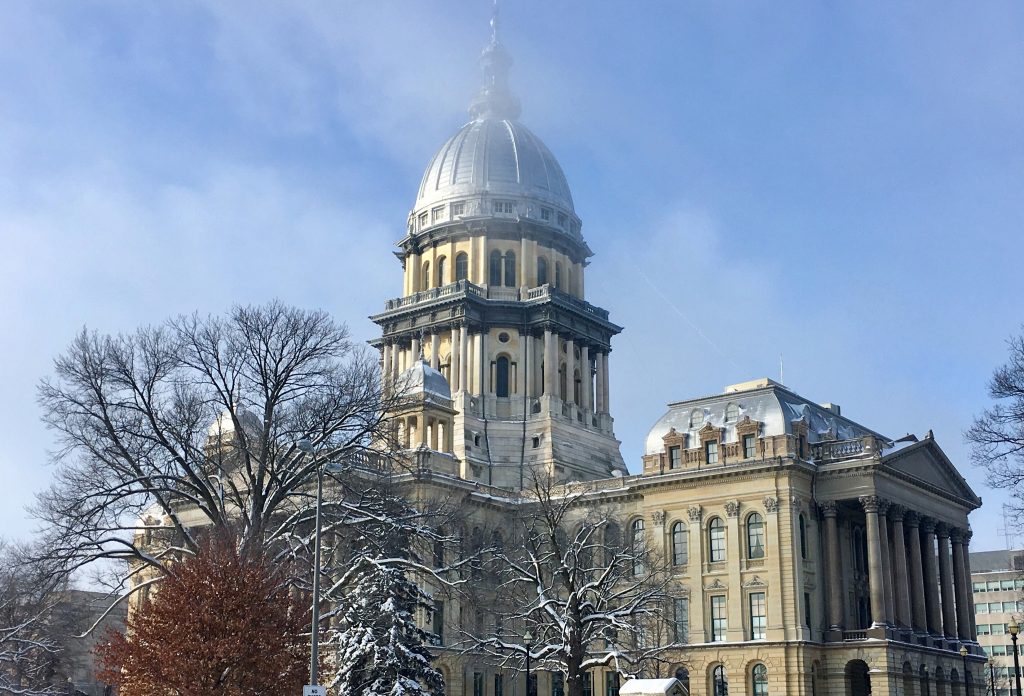
The Illinois State Capitol. [Hannah Meisel/The Daily Line]
Meetings & Agendas- Chicago
- Springfield