


Springfield News
-
“How did you get my number?”
Thousands of registered voters statewide have asked variations of that question of the campaign worker or volunteer at the other end of text message blasts in recent weeks — one of the latest strategies in voter persuasion and get-out-the-vote efforts that many Illinois campaigns have embraced this year. -
The Illinois Department of Corrections is still failing to provide adequate psychiatric care to mentally ill prisoners even after a 2016 settlement agreement mandated that state officials change their policies and speed up access to treatment, an Illinois federal judge ruled this week.
-
A group called the Cook County Democratic Women is giving Gov. Bruce Rauner its support instead of Democrat JB Pritzker after 10 current and former members of Pritzker’s campaign staff members alleged racial discrimination and mistreatment. Meanwhile, Rauner’s newest “voter report card” mailers caused at least one voter discomfort and annoyance.
-
After Gov. Bruce Rauner narrowly won the Republican primary in March, many wondered what the governor would do to win back the trust and votes of those who broke from party establishment and backed ultraconservative State Rep. Jeanne Ives (R-Wheaton).
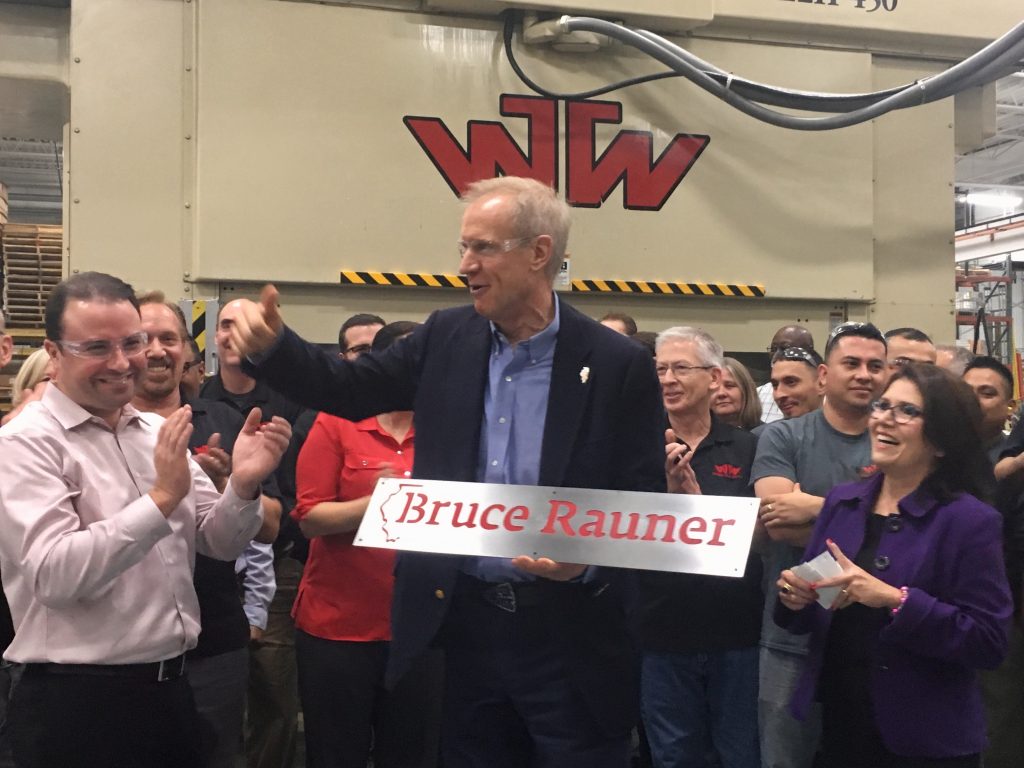 Gov. Bruce Rauner poses with employees at Wiegel Tool Works in Wood Dale on Tuesday as part of a whirlwind campaign tour in the waning days of the election cycle. [Hannah Meisel/The Daily Line]
 -
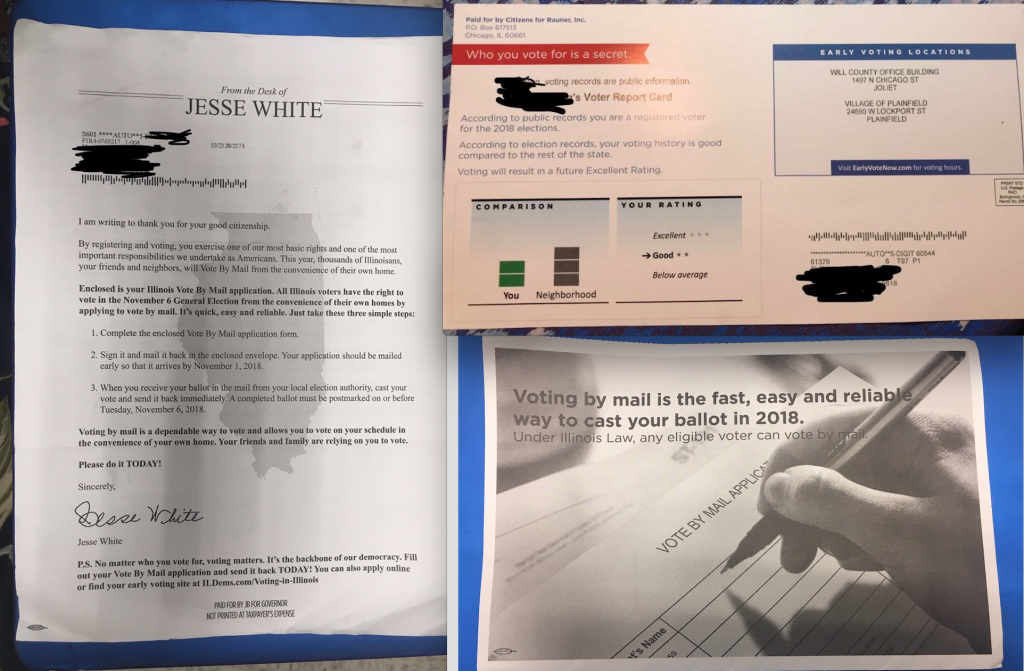 Three different voter contacts on early voting from the campaigns of both Democrat JB Pritzker and Gov. Bruce Rauner.
Likely Republican voters around the state looked into their mailboxes over the weekend to find mailers rating them on their past election participation as compared with others in their neighborhood.
A mailer sent to a registered Republican in Plainfield, obtained by The Daily Line, rates the voter’s participation record as “good” and advises that voting next week “will result in a future Excellent Rating.”
The mailer, paid for by Gov. Bruce Rauner’s campaign, also gives two suggestions for early voting locations and encourages the recipient to check EarlyVoteNow.com — which redirects to a section of the governor’s campaign website — to find voting hours at the recommended early polling places.
Rauner’s mailer is a toned-down version of so-called voter shaming mailers that have become more popular in recent years, including a mailer that went out in the days before the March primary sent to Chicago-area voters by the mystery group Illinois State Voter Project. Those mailers named voters’ neighbors and showed whether or not they had voted in the previous three elections in an attempt to pressure voters to get to the polls.
[gallery columns="2" size="full" ids="62206,62205">
Illinois State Board of Elections spokesman Matt Dietrich said the agency heard plenty from voters this spring who were unhappy with the mailers.
“We were inundated with calls about that in the week before the March 20 Primary,” Dietrich said. “It is a legitimate use [of voter data] but we can tell from the reaction that it does definitely get people’s ire up.”
The governor’s recent mailers only vaguely refer to a voter’s record as compared with his or her “neighborhood.”
Rauner campaign spokesman Alex Browning said the mailers went out to voters “statewide,” but declined to say how many were sent or how much the campaign spent on the effort.
One Kankakee-area voter took to Twitter to complain about his election participation rating. Jim Frogge, whose Twitter account identifies himself as a former teacher at Bishop McNamara Catholic High School tweeted Monday that the mailer was “clever,” but was disappointed in the conclusion.
“As I vote in EVERY election for which I am eligible, the cited data are either incorrect or the creators are lying,” Frogge tweeted. “Our governor needs to do better.”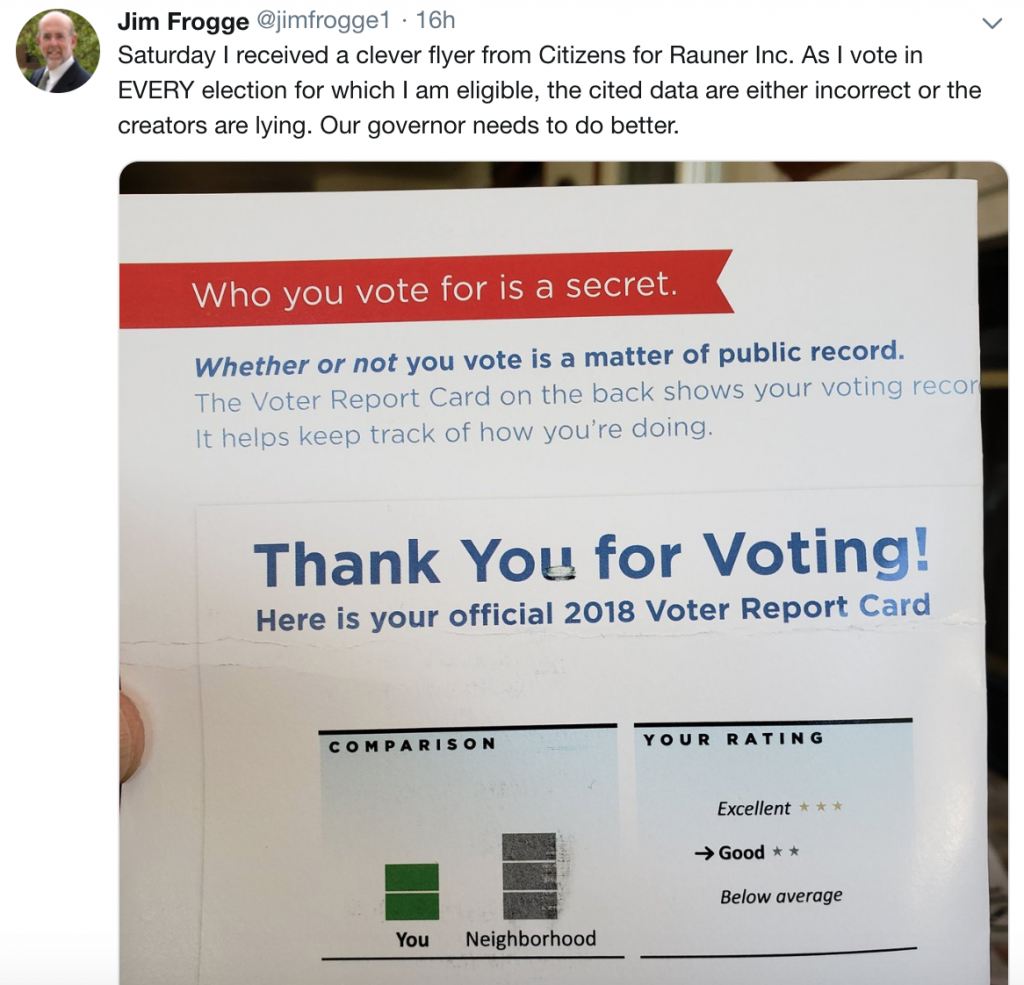 A Twitter user complains about Gov. Bruce Rauner's new mailer on Monday.
Frogge did not return messages left by The Daily Line Monday.
But Rauner’s mailers are only the latest efforts in this campaign season’s get-out-the-vote drive — a push marked this year by its focus on early voters.
Rauner’s challenger, Democrat JB Pritzker, made a show of casting his ballot a full 40 days before Election Day on Sept. 27, the first day polls were open for Illinois’ early voting period. Pritzker made his selections at the Chicago Board of Elections’ Loop Super Site — one of hundreds of early voting locations across the state.
Early voting requirements vary by the population served by a local election authority, according to the State Board of Elections.Pritzker’s campaign has promoted early voting on social media, producing two videos encouraging voters to cast their ballots early in the General Election, following up from a similar push before the Primary. The campaign is also sending voters to a website funded by the Democratic National Committee to find his or her early polling place.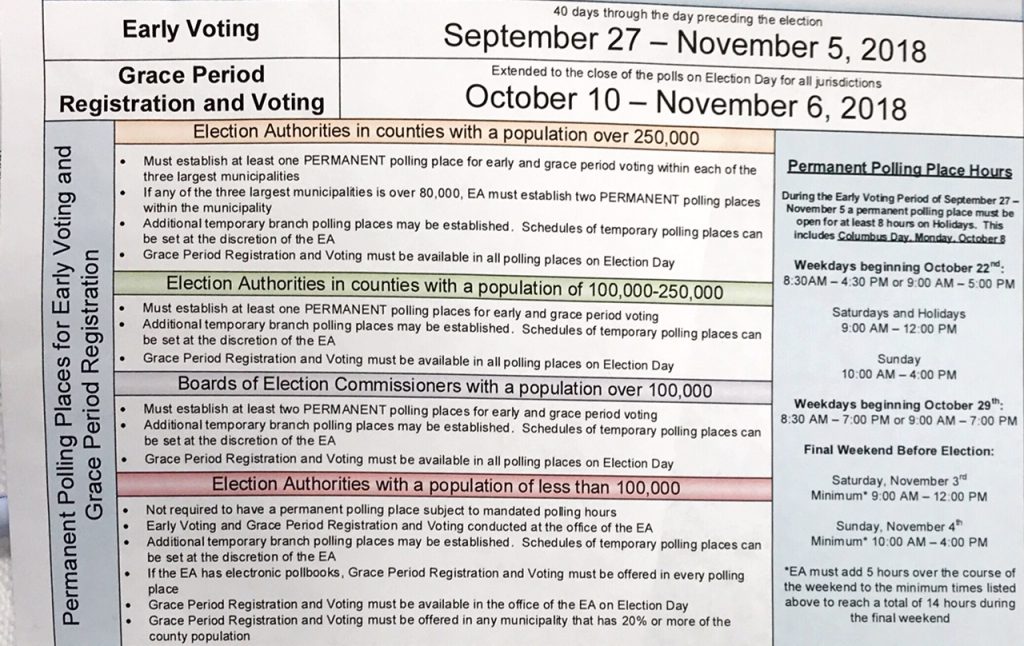 Early voting guidelines for local election authorities of varying sizes. [Courtesy of the State Board of Elections]
Rauner too has encouraged supporters via social media to vote early or cast their ballots by mail, but the effort hasn’t been as big as Pritzker’s. Observers noted that it’s not surprising that Rauner has let Pritzker take the lead on more nonpartisan informational get-out-the-vote efforts, as Pritzker is a member of the majority party in Illinois.
Illinois’ experiment with early voting began in 2006, and has now been expanded to more than five weeks’ worth of opportunities for early voting, both in person and by mail. The state’s more recent pilot programs for online, grace period and same-day voter registrations have also been made permanent, and campaigns are beginning to use the extra time to make more unique voter contacts.
In the weeks before Pritzker cast his ballot last month, his campaign had sent two rounds of vote-by-mail applications to 2.5 million likely voters around Illinois, the campaign said. Campaign finance records show the Pritzker campaign paid $1.2 million to Chicago-based firm The Strategy Group, Inc. for the first round of applications, which went out in early September, and spent an additional $1 million on the second round of mailings, which were sent later in the month.
[gallery size="full" ids="62209,62207,62208">
Rauner is not doing a vote-by-mail application drive this campaign cycle, breaking tradition from the last few general elections when the gubernatorial candidates from both parties had done so. Though Republicans had been pioneers in vote-by-mail applications in Illinois, The Daily Line was told, observers said Rauner’s calculations to use his resources elsewhere could be a shrewd move.
Though local election authorities don’t keep track of which vote-by-mail applications come in through specific channels like the Pritzker campaign, the campaign can still keep track via information provided by the U.S. Postal Service. The applications sent out to likely voters also had pre-paid return envelopes, which allows the Pritzker campaign to keep a running tally of how many vote-by-mail applications the Democrat has spurred.
The Pritzker campaign told The Daily Line on Monday that the latest numbers indicate 200,000 of the 450,000 vote-by-mail applications originated from Pritzker’s mailings.
The State Board of Elections’ total number of vote-by-mail applications differed Monday; the agency’s latest figures show 519,276 applications have been requested.
The first of Pritzker’s vote-by-mail applications came in an envelope bearing the name of Illinois Secretary of State Jesse White, but also clearly indicated it was paid for by the Pritzker campaign.
Inside, along with the vote-by-mail application, was a letter with instructions on how to fill out the application, signed by White with “From the Desk of Jesse White” at the top of the letter. The bottom of the letter clearly states the mailing was paid for by Pritzker’s campaign, and “not printed at taxpayer’s expense.”
Though Dietrich said the Board of Elections doesn’t cast any official judgment on get-out-the-vote efforts like this, as they’re perfectly legal, he did say the agency received “numerous calls” about the mailers.
“I can say, though, that used on the reaction we got, there are voters who were confused and some were a bit angry about it,” Dietrich said.
Pritzker deputy spokesman Jason Rubin told The Daily Line on Monday that the campaign enlisted White for the vote-by-mail application push as he is a “trusted leader.”
“JB and [lieutenant governor candidate] Juliana [Stratton] are running a statewide operation to get out the vote for Democrats up and down the ballot in this election,” Rubin said. “JB and Juliana are committed to protecting and expanding the right to vote and encouraging turnout and have invested in programs to ensure all Illinoisans can make their voices heard in this critical election.”
White’s spokesman for his governmental office, Dave Druker, said the office was advised about White’s name being used for Pritzker’s campaign in this capacity, but hadn’t received any calls from voters about it.
Elections officials told The Daily Line that the use of White’s name was far less egregious than a 2016 vote-by-mail application drive that used an altered state seal to attract voters’ attention.
Another change for 2018 is a tweak to state law that stipulates vote-by-mail applications must be labeled with a return address of a voter’s local election authority, not the campaign that originated the application.
Chicago Board of Elections spokesman Jim Allen said the new procedure has made the process run “more smoothly” than in past years, like in 2014 when both former Gov. Pat Quinn and then-candidate Rauner both had vote-by-mail application drives.
“This is much better than four years ago when both Rauner and Quinn were mailing them out and having them come back to themselves,” Allen said. “This is far better…what was happening was we were having delays [before the new law].”
The law was passed as part of an omnibus elections bill this spring, a year and a half after a Rock Island County clerk discovered 1,500 absentee ballot requests in a post office box that had gone unchecked until late October 2016. The post office box turned out to have been authorized by the Illinois Opportunity Project, an independent expenditure group founded by conservative radio host and donor Dan Proft.
Allen also acknowledged that Pritzker’s double vote-by-mail applications may have confused some voters, but said that anyone who sent in two applications for a mail-in ballot were immediately recognized by the system.
Voting by mail has become increasingly popular in recent years, and while Illinois’ laws on voting by mail place it in the middle of the pack on the issue, according to the National Vote at Home Institute, the state has made strides.
Gerry Langeler of the institute told The Daily Line on Monday that Illinois has made a “huge step up” from 2014, when approximately 40,000 voters — a little over half a percent of those registered — received a ballot in the mail. Langeler said Illinois is on track to have close to 7 percent of its voters cast a ballot by mail.
Related: Elections officials explore vote by mail programs to increase turnout, security
Some states like Washington, Oregon and Colorado have adopted laws that mandate each registered voter receives an absentee ballot in the mail. Some voters will opt to go to the polls instead, but Langeler said the option is becoming more and more popular. Nearly every county in Utah is now vote-by-mail focused, he said.
Langeler said one of the reasons he believes his organization’s data is predicting 42 million vote-by-mail ballots nationwide this year is the electorate’s growing demand for convenience in other areas of their lives.
“People who have busy lives are are figuring out it’s a whole lot easier to fill out ballot at kitchen table than [waiting for Election Day],” he said. “We increasingly don’t wait in lines. We shop online, we bank online, we buy concert tickets online.”
Langeler also acknowledged that factors like transportation and childcare also have played a role in pushing for vote-by-mail programs.
But national parties have also led the charge for early voting in states where it’s a possibility, whether by mail or in person, Langeler said, in part because of the “growing number of unaffiliated voters.” When parties can push for their own voters to cast ballots early, they have more time to focus on those undecided voters whose ballots they covet.
“Parties really want to make sure they’re getting their designated folks out because there’s this huge wildcard of unaffiliated voters and they don’t know [how they’ll vote],” Langeler said.
As of Monday, 382,910 Illinoisans have voted early in person, plus 211,354 more who have mailed in completed ballots, according to the State Board of Elections. According to ElectProject.org, a website maintained by University of Florida Associate Professor Michael McDonald, early votes cast in Illinois are now at 77 percent of the total number of early votes cast in 2014, with one week left to go until Election Day.
As for Rauner?
“He plans to vote on Election Day,” Browning said. -
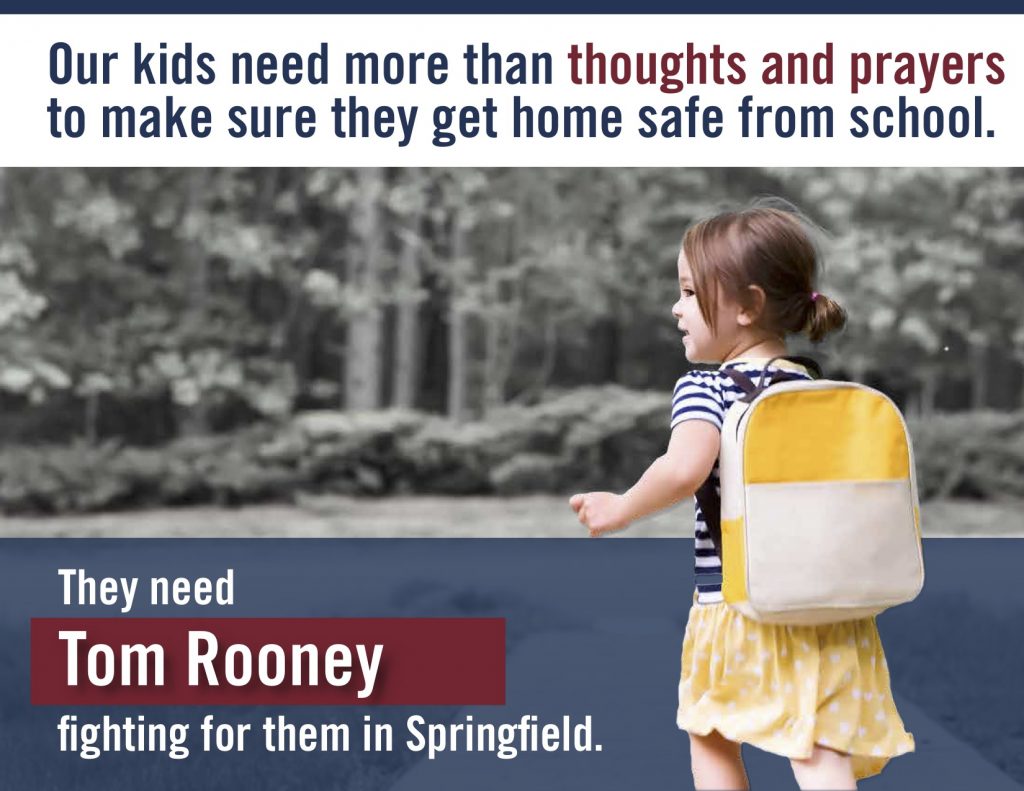 A mailer sent by the Gun Violence Prevention PAC sent on behalf of State Sen. Tom Rooney (R-Rolling Meadows).
Three suburban Republican senators facing touch re-election bids are getting help from the Gun Violence Prevention Political Action Committee during a year dominated by debates over gun policy and headlines about gun violence in Illinois and beyond.
Earlier this month, the Republican State Senate Campaign Committee contributed $38,000 to the Gun Violence Prevention Political Action Committee — the largest one-time contribution the organization known as GPAC has received in its nearly six-year history. According to campaign finance records, the Republican committee’s donation also makes it the fourth largest donor to the committee, coming in just behind three people directly involved with the founding and operations of GPAC.
With that $38,000, the committee sent out mailers on behalf of State Sens. Chris Nybo (R-Elmhurst), John Curran (R-Downers Grove) and Tom Rooney (R-Rolling Meadows), touting the three Republicans’ votes on gun legislation. Those three senators are locked in contentious races in the suburbs, where Republicans are worried about winning the votes of women.
Lawmakers this spring passed three pieces of gun legislation, including the Gun Dealer Licensing Act (SB 337), which Gov. Bruce Rauner has vowed to veto, though it has not yet been sent to his desk.
Rauner signed HB 2354 — legislation meant to raise a “red flag,” which gives courts the authority to use emergency civil restraining orders to take guns away from individuals that loved ones alerts law enforcement may be a danger to themselves or others. The governor also signed SB 3256, which allows for a 72-hour waiting period for handguns delivery is extended to all guns purchased in Illinois.
Nybo, Curran and Rooney voted yes on all three bills, while the trio largely supported iterations of two other proposals that did not end up passing through both chambers. The abandoned bills would have banned bump stocks and raised the legal age for buying an assault weapon in Illinois from 18 to 21.
GPAC Executive Director Kathleen Sances told The Daily Line on Friday that she “couldn’t be more pleased” that Republicans have stepped forward to support gun reform in Illinois, and said the organization was glad because this year was the “first time ever” that GOP incumbents had submitted answers to candidate questionnaires that GPAC had been putting out since 2014.
“We’ve always benefited from Democrats [supporting us] on the issue and now we’re getting backing and support form the Republican party,” Sances said. “I think this is a turning point for the movement in our state. we’re proud of it…we’ve been working very hard to educate voters in key legislative districts mostly in the suburbs.”
Reaching across the aisle is necessary on gun issues, especially because some Democrats are either gun control opponents or do not vote on the issue, Sances said.
“We can’t pass policy without bipartisan support and honestly…I know people try to make it a partisan issue but we represent victims and survivors,” Sances said. “People are dead, people are being shot every two hours.”
GPAC endorsed the three GOP senators in July, along with State Rep. Peter Breen (R-Lombard). The organization ultimately endorsed 75 lawmakers — the remaining 71 Democrats. Of the group, 43 are incumbents, while 32 are challengers. GPAC has also endorsed Democratic gubernatorial nominee JB Pritzker and attorney general nominee State Sen. Kwame Raoul (D-Chicago).
The organization spent nearly $59,000 on the three mailers on behalf of Nybo, Curran and Rooney, plus an additional $4,607 for a mailer on behalf of Democrat Daniel Didech, running for the 59th House District to succeed outgoing State Rep. Carol Sente (D-Vernon Hills). Sances said GPAC had done voter identification work in those four districts, which resulted in the mailers.
[gallery columns="4" type="slideshow" ids="62150,62149,62154,62153,62152,62151,62156,62155">
All four mailers feature positive language touting the the GOP senators’ votes on the gun legislation, but the mailers for Nybo and Didech also contain small sections attacking their opponents. Nybo’s mailer asks why Democrat Suzy Glowiak of Western Springs “won’t...tell the truth?”
“Suzy Glowiak said in her campaign video that Chris Nybo is backed by the NRA,” the mailer says. “Why is she lying? Fact: The NRA has given Chris Nybo an ‘F’ rating.”
The mailer for Didech, a Democrat from Buffalo Grove slams Republican Karen Feldman of Lincolnshire for “refus[ing] to answer questions about keeping our children safe from violence.”
“What is Karen Feldman hiding?” the mailer asks. “Who will she put first?”
Beyond those four mailers, which GPAC spent nearly $59,000 on, the organization also sent endorsement letters on behalf of Nybo, Curran, Rooney and Didech, in addition to Democrats State Rep. Michelle Mussman (D-Schaumburg) and State Sen. Julie Morrison (D-Deerfield).
Sances also said GPAC is now helping Rooney with social media messaging, and will do a “live phone” program ahead of Election Day for get-out-the-vote efforts. But Sances declined to say which districts the get out-the-vote effort would target.
GPAC’s focus on three Senate Republicans has left some Democratic strategists scratching their heads, one describing it as a strange “gamble.”
“They’re supporting those [GOP senators] over the pro-reform Democrats, despite the incumbents’ past votes against such measures,” one Democratic operative said. “These guys just started voting closer to their way this year…because it’s an election year perhaps? Why wouldn’t they support the women who they know will be with them through and through?”
Last week, Democratic House candidate Terra Costa Howard, who is challenging Breen, suggested her opponent’s votes on gun bills were disingenuous, but Breen defended his vote to the Daily Herald, saying the recent spate of gun bills were the first real opportunity he had to vote on legislation limiting access to guns.
Sances said GPAC’s endorsement guidelines dictate that the group supports incumbents who “submit 100% questionnaires and seek public public endorsement.” Rooney was the first Republican who attracted GPAC’s attention, Sances said, as he “was the first Republican to break from his party in April 2017” when he voted SB 1657, the first version of the Gun Dealer Licensing Act, which Rauner vetoed in March.
“Because of his bravery, it led to 12 Senate and House Republicans voting on the final version of [gun] dealer regulation,” Sances said. “I feel strongly he should not lose his job because of this vote.”
Sances also pointed to GPAC’s support of other candidates since the primary, including State Rep. Anthony DeLuca (D-Chicago Heights), State Rep. Natalie Manley (D-Joliet), State Rep. Elizabeth Hernandez (D-Cicero), State Rep. Kathleen Willis (D-Addison) and State Sen. Don Harmon (D-Oak Park) though those contributions have been small dollar amounts compared with the organization’s support for Nybo, Rooney and Curran. GPAC also contributed $10,000 to the Illinois House Victory Fund in April. Breen received $1,000 from the group a week after the primary election in March.
Earlier this year, a GPAC-commissioned a poll found that 65 percent of Illinois Republicans, 72 percent of voters in GOP-held districts and 71 percent of Illinois voters overall are in favor of licensing gun dealers, Sances said. The poll, which was conducted by a Republican polling firm and advised by a Democratic one, according to Sances, also found that 72 percent of suburban voters and 63 percent of gun owners favor the Gun Dealer Licensing Act.
Brian Burian, Executive Director of the Illinois Senate Republicans’ political organization, told The Daily Line on Sunday that GPAC’s endorsement of the RSSCC’s caucus members is fitting of their districts.
“Illinois is a diverse state and our members, whose districts are spread throughout, are representing their constituents an being endorsed for it,” Burian said.
GPAC gave $7,500 to both Rooney and Curran, and $2,500 to Nybo in August and September, along with a combined $25,000 in in-kind contributions for the trio. Those in-kind payments were made to Chicago-based communications firm The Sexton Group, which specializes in phone call and text message communications. State records show The Sexton Group’s clientele is by and large Democratic, including Pritzker, State Rep. Sam Yingling (D-Grayslake) and Chicago Mayor Rahm Emanuel.
On Friday, the Republican State Senate Campaign Committee contributed $40,000 to pro-gun group the Illinois State Rifle Association, which puts its three members supported by GPAC — Nybo, Curran and Rooney in the gun lobby’s crosshairs. The State Rifle Association has orchestrated action calls from its members to the government offices of Nybo, Curran and Rooney, putting them on the defensive about their votes in support of tougher gun control.
When asked about the donations, Curran told The Daily Line that he did not know about the senate committee’s recent contribution to ISRA, but is “glad to have GPAC’s support and endorsement.” -
The Illinois GOP’s fortunes changed when then-candidate Bruce Rauner entered the political scene five years ago — Rauner was a different kind of candidate: both a successful businessman with no government experience and a self-funder, which allowed the state’s Republican party to focus its fundraising efforts elsewhere.
[audio mp3="http://thedailyline.net/wp-content/uploads/2018/10/2018-10-26-Aldercast-Demmer-smaller-file-mixdown.mp3">[/audio]Podcast: Play in new window | Download
Subscribe: Apple Podcasts | Android | RSS
And in the time since Rauner was elected in 2014, Republicans have been able to reclaim power in state government, even breaking Democrats’ supermajority in the Illinois House in 2016. But a predicted Democratic “Blue Wave” threatens that progress, and has forced Illinois Republicans to grapple with both their identity and how best to remain a check on Democratic power in the state.
With credit ratings agencies breathing down Illinois’ neck threatening to downgrade state bonds to junk status last summer, 15 House Republicans finally broke ranks with Gov. Bruce Rauner, voting for a bill to increase the state’s income tax in order to end the 736-day budget impasse. After Rauner’s expected veto, 10 House Republicans ultimately approved the tax hike within a full budget package.
In the weeks and months that followed, a wave of more moderate Republicans with years in the legislature announced their resignations or retirements — though some Democrats also headed for the exits.
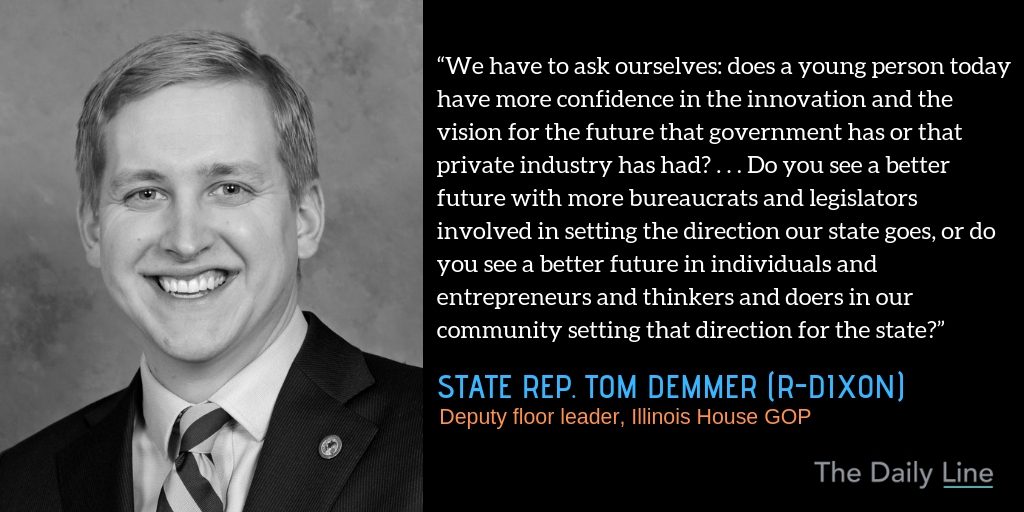
Springfield could look quite different come January if Democrat JB Pritzker prevails over Rauner. That could forcing Illinois Republicans to readjust to their new reality. One of those Republicans is State Rep. Tom Demmer (R-Dixon), who has served in the House since 2013. This summer, he was tapped to become the deputy floor leader within his caucus.
Demmer told The Daily Line he believes the key to expanding the Republican party’s umbrella in Illinois is reaching out to communities the state GOP may have written off as solid Democratic voters, especially Chicago.
“I think there’s a real opportunity for Republicans to make a bigger play in the city of Chicago,” Demmer said. “It’s a city that’s been under Democratic control for decades and Democrats traditionally win the lion’s share of votes in those areas in statewide elections and Congressional elections, but I think there is an opportunity for Republicans to talk about looking at some of the challenges facing the city of Chicago right now…there’s really one party that’s responsible for those decisions. When you look at the amount of debt that the city carries, the underfunding of pension obligations at the city level, when you look at some of the pressures that they see that are not dissimilar to the financial pressures the state sees, you say, ‘Well, who’s been running the city of Chicago for decades?’ Nearly unanimously, it’s Democrats.”
Play this show in a new window | Download this episode
Follow the show: Apple Podcasts | Android | RSS
Listen to past episodes from our archives
Other takeaways:- Identity crisis? — The nomination and eventual election of President Donald Trump in 2016 caused existing fault lines within the GOP to break into full-blown chasms, at least on a national level. Some of the dischord has trickled down into Illinois, which traditionally enjoys some measure of independence from national politics due to the strength and size of state government. But the near-win of ultraconservative State Rep. Jeanne Ives (R-Wheaton) over Gov. Bruce Rauner in the March primary also rocked the Illinois GOP. Does Demmer think the party is facing an identity crisis? “I think both parties have struggled with what their identity is,” Demmer said. But he also said rapid changes in public opinion has presented the GOP with opportunities to expand its identity. “Republicans have been very strong in the last several years on pushing for criminal justice reforms, areas that hadn’t been a priority for Republicans for several years,” Demmer said. “So as we start to embrace new thinking or new policy positions within the Republican party, that gives us the opportunity to talk to new people in a different way. I think in order to be successful, you start to bring some of those people into the fold and say, ‘We can be an ally and we can fight alongside you in accomplishing some of the things we both are pushing for.’”
- Rauner’s money — Though Democrat JB Pritzker’s millions have set campaign finance records in both Illinois and nationally, Gov. Bruce Rauner’s self-funding shocked Illinois when he first ran for governor. Rauner’s infusion of money to the Illinois Republican Party allowed the state GOP to achieve parity for spending in down ballot races, while not having to worry about supporting the top of the ticket. Whether Rauner loses on Nov. 6 or his self-imposed eight years in office run out after his second term in 2022, eventually, the Republican’s cash will stop propping up the party. But Demmer says the Illinois GOP has done enough to transform itself as an operation in order to keep achieving milestones even without the financial support of Rauner and his allies. “When you talk about fundraising, it’s never a good idea to put all your eggs in one basket,” he said. “But we’ve seen in addition to the resources that Gov. Rauner’s invested in the Illinois Republican Party, a lot of it’s in sort of developing some of the back-end systems, the data collection systems…all Republican candidates, no matter what level they’re at benefit from those kinds of investments. Reorganizing the party structure, getting more professionalism and more people involved in that, I think those are positive things that everybody benefits from. You can kind of build upon that, I think. It’s not necessarily that that goes away. The investments and gains that we’ve made, they don’t go away at the same time. Those are long-lasting investments.”
- The Madigan question — Gov. Bruce Rauner will leave a lasting impact on Illinois politics for many reasons, but calling public awareness to longtime House Speaker Mike Madigan through television advertisement and constant name-checking has changed the conversation about the 13th Ward boss, and even caused some members of his own party to put distance between themselves and him. Does Demmer consider it a “win” that Republicans have activated voters against Madigan? “I think it’s a win any time you can illustrate to people how state government actually works,” he said. “I’ve talked to colleagues in legislatures in other states across the country and they’re shocked. I mean, they’re absolutely shocked when we talk about the reality of how a bill becomes a law in Illinois. it looks nothing like Schoolhouse Rock. It looks nothing like what your civics book would have taught you. It really is a system that’s been designed to concentrate power into one person’s hands. The people of Illinois need to know that.” Asked if it’s fair to tie his Democratic colleagues to Madigan at every turn, or if it limits coalition-building across the aisle, Demmer said: “the question is when are Democrats going to stop tying themselves to him at every turn?” Demmer urged his Democratic colleagues to consider an alternate vote for House Speaker, or to balk at approving Madigan’s House rules because he alleges it stacks the deck “even against themselves.”
-
The Illinois Labor Relations Board was “clearly erroneous” when it sided with Gov. Bruce Rauner’s administration’s claim that it had reached impasse with AFSCME Council 31 when the parties were negotiating on a new contract, an Illinois appellate panel ruled Tuesday.
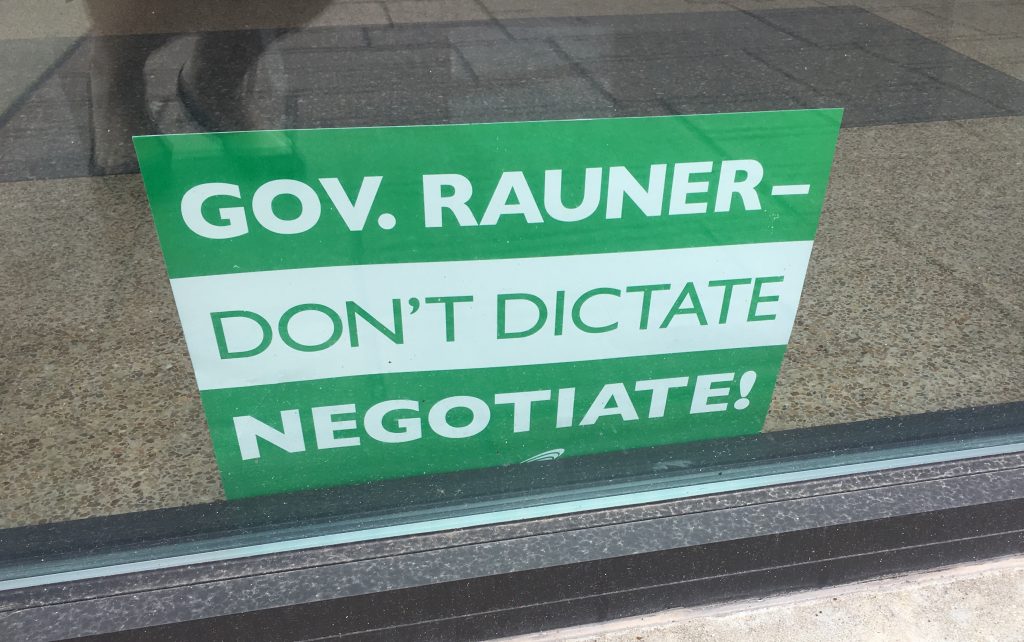 A sign urging Gov. Bruce Rauner to keep negotiating on a contract with AFSCME is displayed in the window of the union's Springfield office on February 23, 2017 — the same day the union authorized a strike, which never ended up happening. [Hannah Meisel/The Daily Line]
 -
The Illinois Supreme Court refused to rule on the constitutionality of de facto life sentences for teens last week, instead sending a criminal case that resulted in a 76-year prison sentence for an 18-year-old back for trial, without addressing whether the sentence violated the Illinois Constitution.


