


Springfield News
-
JUL 30, 2019

UNLOCKEDBy April Simpson of Stateline, an initiative of The Pew Charitable Trusts
Democrats started the year newly in control of six state governments. They used that power to quickly undo years of conservative policies.
Nevada decriminalized abortion, Maine expanded access to it and Illinois made it a “fundamental right.” New Mexico began requiring background checks for nearly all firearm sales. Colorado tightened oil and gas regulations and enacted a comprehensive sex education law. And New York granted collective bargaining rights to farmworkers and allowed residents living in the country illegally to get driver’s licenses.
Her state experienced a “historic, blockbuster session of progressive legislation,” said Lisa Parshall, an associate professor of political science at Daemon College in Amherst, New York, and a public policy fellow at the Rockefeller Institute of Government.
“I almost think of it as a pipeline that’s been clogged for a while by the Republican control of the Senate,” Parshall said. “It’s been a big term and really shows how elections have consequences.”
Democratic victories in last year’s midterm elections gave them six new “trifectas” — states where they hold the governor’s office and majorities in both legislative chambers. Their seizure of power in Colorado, Illinois, Maine, Nevada, New Mexico and New York gave them complete control of 14 state governments, the most they’ve had since 2014.
The Democratic victories also diversified state leadership. Nevada, with a fast-growing population that is majority-minority, now boasts the country’s first majority-female legislature. And in New York, two of the three top state elected officials are African Americans, and one of them, Senate Majority Leader Andrea Stewart-Cousins, is a woman.
Notably, every one of the new trifecta states enacted laws to expand voting. None went as far as New York, which approved a broad package including an expansion of early voting; pre-registration for 16- and 17-year-olds; portability of registration records; and consolidation of state and federal primary dates.
New York lawmakers also passed constitutional amendments to allow same-day registration and no-excuse absentee voting, but those measures will have to be passed again and ratified by voters.
Democratic gains in the midterms shattered four Republican trifectas — in Kansas, Michigan, New Hampshire and Wisconsin — and the GOP didn’t gain any new ones, leaving the party with a net loss of power.
But the GOP still maintains its overall advantage at the state level. Republicans have 22 trifectas of their own, and they continued to use that power to push their priorities, including on hot-button issues such as abortion, voting rights and guns.
Eight states with GOP trifectas approved new limits to abortion or banned it, pending the possible repeal of Roe v. Wade. Arizona, Florida, Indiana, Tennessee and Texas — all under complete Republican control — enacted new voting restrictions. And GOP-dominated states such as Kentucky and Oklahoma expanded gun rights laws.
Even in solid blue states, Republicans joined conservative Democrats to block some progressive measures. In New Mexico, for example, they quashed a bill that would have decriminalized abortion, and in Maine they derailed a “red flag” gun control measure that would have allowed relatives or police to petition for a court order to confiscate weapons from people deemed to be a risk to themselves or others. Instead, Democratic Gov. Janet Mills signed a bipartisan bill that requires people to temporarily surrender their weapons when a medical professional says they pose a threat.Republican Resistance
Democrats in Illinois, in control of the governor’s office for the first time since 2015, raised the minimum wage and legalized recreational marijuana.
But Christopher Mooney, a professor of state politics at the University of Illinois at Chicago, said those and other measures didn’t spark partisan warfare.
Both Democratic Gov. J.B. Pritzker and the Republican opposition were happy, Mooney said. “Pritzker got what he wanted and then some, and the Republicans came out of it pretty pleased.”
“Politics in Illinois is where you pour the concrete. It’s not really about dying for some ideological principle,” he said. “It’s about how you get business done and how you make the work happen.”
It was a different story in Colorado, where Republicans desperate to slow an avalanche of progressive legislation employed an effective delay tactic: They requested a reading of bills on the floor for all to hear.
It’s legal under the Colorado Constitution, thanks to an old law that was written when the legislative body included illiterate members. In a countermove, Democratic Senate President Leroy Garcia applied a 21st century twist: He used five computers to simultaneously read different parts of a 2,000-page bill at a rapid 650 words a minute, cutting the reading time to hours instead of days.
But Republicans charged that Garcia’s gambit was unconstitutional because the computer reading was unintelligible. A court agreed.
“We managed in the minority to remind the majority that the constitution does lay the foundation for a legislative process and that’s part of it,” said Republican Senate Minority Leader Chris Holbert.
Tempers wore thin, as they often do in citizen legislatures. Nevertheless, business carried on.
Colorado Democrats pushed through an oil and gas bill that gives municipalities more control over local drilling; a human sexuality education bill; and another measure requiring K-12 educators to include the contributions of minority groups in their curriculums. Those successes agitated Republicans and garnered wider media attention, said Robert Duffy, political science professor at Colorado State University.
“People ask, ‘How can they run such a far-left progressive agenda? Colorado isn’t that blue.’ And the reason is it doesn’t have to be,” Holbert said. “All the Democrats need is a one-vote majority in each chamber and governor’s seat to have 100 percent control.”
The Republican delay tactics did force Democrats to make hard decisions about which bills to prioritize and which ones to leave for the future.
“It also made it clear to the more liberal side of the party that we can’t get everything done quickly without an iterative and thoughtful process that brings our opponents along a little bit,” Senate Majority Leader Steve Fenberg said.
In fact, most of the legislation Colorado lawmakers approved was bipartisan: Seventy percent of the bills the Senate passed garnered the support of at least half of the Republicans, Duffy said. State funding for full-day kindergarten, which Democratic Gov. Jared Polis campaigned on, passed with bipartisan support.
“Partisanship will flare on certain issues, but for the majority of issues, both sides are working together,” House Majority Leader Alec Garnett said.
Nevertheless, angry Colorado conservatives are pushing for recall elections to remove Polis and two Democratic state senators. Earlier this year, they tried and failed to force a recall election of two Assembly members, one of whom resigned.
In Nevada, newly empowered Democrats also won some significant victories, including the restoration of voting rights for formerly incarcerated felons and a measure making it easier for people to seal court records tied to low-level marijuana convictions.
Nevada Democrats were hindered by a couple of high-profile scandals. Senate Majority Leader Kelvin Atkinson resigned in March after admitting to using campaign funds for personal use. Less than two weeks later, Assemblyman Mike Sprinkle stepped down amid sexual harassment allegations.
“The Democrats moved the state in a different direction, but not as radically as many conservatives thought would be the case,” said Eric Herzik, a political science professor at the University of Nevada, Reno.
But Republican Assemblyman Jim Wheeler, who stepped down as minority leader after the session, predicted that Democrats will “take the state drastically toward very liberal policies” if they maintain legislative control in 2020.
“Some of the policies that were defeated will come back in the next session if [voters] don’t give us, the Republicans, a chance to at least win the House,” Wheeler said.Democratic ‘Fractures’
In Maine, Democratic dominance exposed disagreements within the party.
John Bott, communications director for Maine’s House Republicans, criticized the Democrats for overseeing “the most extreme legislature probably in Maine history.”
“We’ve seen proposals that have never come up in the state of Maine before that are part of a national progressive agenda,” Bott said.
But Mills, the new governor, vetoed some progressive measures backed by lawmakers of her party, including two bills pushed by labor unions. One would have required binding arbitration for the salaries, pensions and insurance of public-sector employees, and the other would have allowed teachers to collectively bargain over lesson planning and preparation periods.
Mills also angered progressives by failing to fully restore cuts to municipal revenue sharing made under the previous Republican administration. And she kept a campaign promise to not raise taxes, despite calls from progressive think tanks and legislators to recoup losses from her predecessor’s tax cuts.
There also were some disagreements between the two chambers. The Maine Senate, for example, voted to join the National Popular Vote Interstate Compact, but the House balked. Twenty-one Democrats joined all 56 Republicans in opposing the measure, which several lawmakers called a “knee-jerk” reaction to the election of President Donald Trump, who lost the popular vote but won the Electoral College.
Democratic governors in Colorado, Nevada and New Mexico also vetoed bills approved by their Democratic-led legislatures.
Colorado’s Polis vetoed three bills that would have tightened or created new licensing requirements for certain professions, earning accolades from conservatives. Nevada Gov. Steve Sisolak vetoed a measure that would have entered his state into the National Popular Vote Interstate Compact. And New Mexico Gov. Michelle Lujan Grisham vetoed a bill that would have changed the state’s probation and parole rules, citing objections by the state attorney general and district attorneys.
“It’s easy to be united when you’re united against something,” said Robert Glover, associate professor of political science at the University of Maine in Orono. “When you have a trifecta, it exposes the fractures within the party.” -
JUL 26, 2019
UNLOCKED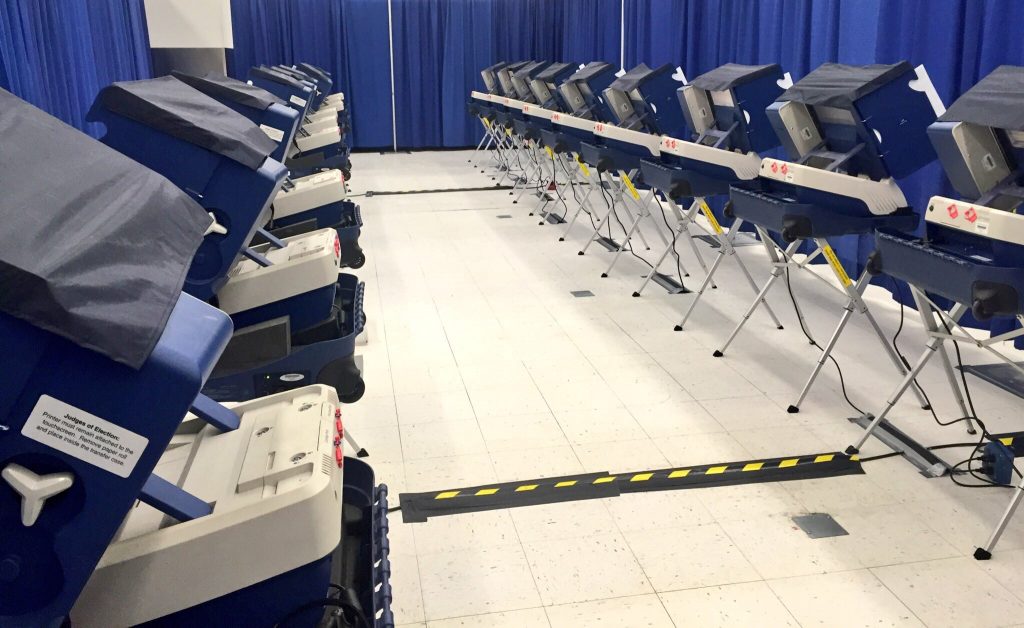
A polling place in March 2018. [A.D. Quig/The Daily Line]
Behind nearly every voter registration database, voting machine and county website that posts results on Election Day, there’s an election technology company that has developed those systems and equipment.
By targeting one of those private vendors, Russia, China or some other U.S. adversary could tamper with voter registration rolls, the ballot count or the publicly released results, potentially casting doubt on the legitimacy of the final tally. -
The Illinois Human Rights Commission earlier this month ruled in favor of a trans boy student who had been denied the use of the boys’ locker room at his suburban high school without the use of a privacy curtain, a finding that has the potential to reverse a judge’s ruling on another trans locker room case last year.
-
-
Estimates that a pension buyout program for members of the State Employees Retirement System would save the state $400 million touted by former Gov. Bruce Rauner’s administration were based on an actuarial review of an entirely different plan, according to an analysis by the Civic Federation.
The pension buyout plan approved as part of the budget for the 2019 fiscal year has so far only saved the state $20 million, as first reported by The Daily Line.
-
JUL 19, 2019
UNLOCKED Credit: Lydia Fu for ProPublica Illinois
ProPublica Illinois is an independent, nonprofit newsroom that produces investigative journalism with moral force. Sign up for our newsletter to get weekly updates written by our journalists.
Illinois lawmakers and advocates are calling on state child welfare officials to better comply with a federal court order to serve Spanish-speaking families, an issue they say has become more critical amid heightened fear among immigrants of interacting with government agencies.
The calls come in response to a ProPublica Illinois investigation last month that found that the Illinois Department of Children and Family Services has, for decades, repeatedly violated a 1977 federal court order that mandates the agency provide services to Latino families in their primary language.
“The details uncovered by these reports are heartbreaking, plain and simple,” U.S. Sen. Tammy Duckworth, an Illinois Democrat, said in a statement. “No child should ever be deprived of the opportunity to communicate with their parents as a result of actions by a government agency that claims to be their advocate, and it’s clear that DCFS must do better before even more children who’ve done nothing wrong are harmed.”
DCFS acting Director Marc Smith, who was appointed by Gov. J.B. Pritzker in April, said the administration has outlined reforms, including hiring more bilingual workers, recruiting additional Spanish-speaking foster families and upgrading technology to better track whether children of Spanish-speaking parents are placed in foster homes where that language is spoken.
State Rep. Sara Feigenholtz, a Chicago Democrat, cited the ProPublica Illinois story in a letter to Smith this week asking for a clearer picture of the steps the agency is taking to address shortfalls in meeting the consent decree. She said she’s heard from child welfare advocates and others describing how parents are being pressured to waive their rights to have their children placed in Spanish-speaking foster homes and are being told that requesting a Spanish-speaking caseworker could delay reunification with their children.
“These are our children,” Feigenholtz said in an interview. “They are not throwaway children.”
Feigenholtz highlighted the plight of undocumented families. She wrote in her July 15 letter that many are “fearful and reluctant to interact with DCFS as they worry about the possibility of having their citizenship status recognized and flagged for deportation.”
The ProPublica Illinois investigation featured the story of Jorge Matias, an undocumented Guatemalan immigrant father whose primary language is Spanish. DCFS placed his children in a foster home where only Slovak was spoken. The children, whose mother struggles with a heroin addiction, were taken into custody after they were born with drugs in their system.
For years, the brother and sister grew up speaking Slovak and were unable to communicate with their father, who was deported last fall but is fighting for custody.
The DCFS inspector general later found a pattern of discrimination against Matias, saying he was effectively coerced into waiving his rights. The federal consent decree, called Burgos for the family involved in the original lawsuit, requires the state to place children of Spanish-speaking families in foster homes where that language is spoken and to provide caseworkers and other services in Spanish to those families.
ProPublica Illinois found that there have been some 300 possible Burgos violations since 2005, though that number is almost certainly an undercount given DCFS’ repeated failures over four decades to properly document families’ race, ethnicity and language preference. Matias’ 5-year-old son, for example, is labeled in the DCFS case file as white, non-Hispanic and English speaking. The agency’s records on whether caseworkers speak Spanish also are flawed.
The misclassification of families and caseworkers makes it nearly impossible for DCFS to systematically determine compliance with the consent decree, ProPublica Illinois’ reporting showed.
DCFS stopped using waivers that allowed parents to sign away their Burgos rights following federal court action in the early 1990s. But ProPublica Illinois found that the agency’s language determination forms remain problematic. Today, some parents whose primary language is Spanish effectively waive their rights through the form, as did Matias. Smith said he is working to make sure that caseworkers are properly trained on the purpose of the form, but he would not say if the agency is planning to do away with it or implement additional protocols to prevent misuse.
Charles Golbert, Cook County public guardian, said DCFS too often treats Burgos like a checklist without embracing the spirit of the consent decree. The problems, he said, appear to be worse in the suburbs and areas where there are fewer Spanish-speaking foster homes, service providers and caseworkers. The proposed reforms, he said, “are all prerequisites but they’re not enough.”
Tanya Gassenheimer, an attorney with the nonprofit Shriver Center on Poverty Law, which recently began dealing with child welfare issues, said she plans to work with parents and other organizations to address the issues raised by ProPublica Illinois’ reporting.
When language barriers get in the way of parents’ ability to communicate with their children, reuniting them is difficult “for a reason completely unrelated to a parents’ ability to care for their children,” she said.
State Rep. Delia Ramirez, a Chicago Democrat, said she plans to prioritize the Burgos consent decree during upcoming meetings for a working group of about a dozen state lawmakers who are looking into ways to bring a number of reforms to DCFS.
“It’s not just one story or two stories,” she said. “This is happening too often across the state.”
The legislative working group sprang from the Adoption and Child Welfare Committee, which is chaired by Feigenholtz and was established this year to bring attention and resources to the beleaguered agency. Smith is the 13th DCFS leader in 10 years. After years of funding cuts, the agency received an $80 million increase in its budget this year.
Smith said the agency plans additional improvements, including enhanced training for staff and increased support to the DCFS Burgos coordinator.
“We’re making sure all of our practices put us in line with not only the Burgos consent decree but with what we think are best practices in dealing with Spanish-speaking families,” he said.
Officials from the Mexican American Legal Defense and Educational Fund, a national civil rights group that represents families in the Burgos litigation, said they hope to work with DCFS’ new leadership to ensure the agency complies with the consent decree.
Bilingual hiring has long been a problem at DCFS, leading to failures in communicating with families and jeopardizing investigations into allegations of abuse and neglect. Records also show the agency last year only reported 156 bilingual frontline workers, though state law requires 194.
State Sen. Julie Morrison, a Democrat from Deerfield, said she was appalled to learn that some caseworkers didn’t speak the language of the families they serve.
“How in 2019 do we not have enough Spanish-speaking caseworkers?” she asked. “If it was Mandarin, I’d say that is tough. But there is no excuse for this.”
In a recent interview, Illinois Deputy Gov. Sol Flores called the misclassification of Matias’ family “unacceptable” and said his children should not have been placed in a foster home where Spanish was not spoken. Flores, whose Puerto Rican grandparents were bilingual foster parents in Chicago, said that is not how the administration intends to lead moving forward.
She said the agency plans to use part of its increased budget to hire 300 additional caseworkers and investigators. DCFS officials said they would like 100 of those positions filled by bilingual workers.
Although both Smith and Flores acknowledged the agency’s shortcomings in data collection and tracking, they defended DCFS’ compliance with Burgos, saying the majority of Spanish-speaking families were served in accordance with the court order.
In cases where that didn’t happen, they said, the child’s mental or physical health often took priority. They agreed the agency needed to add Spanish-speaking foster homes that are equipped to meet those special needs.
“We just don’t want to be in the situation where we have to choose between language and the most appropriate level of mental health and medical care,” Smith said.
Ramirez, the daughter of Guatemalan immigrants, said the need to improve how DCFS serves Spanish-speaking families is more important now than ever before, given the Trump administration’s immigration policies that have led to separations of families at the border, in addition to his ongoing threats to deport undocumented immigrants.
“As Trump continues to threaten, deport and detain thousands of people across the country, we know we’ll see some impact in the state of Illinois,” she said. “I want to make sure the agency is prepared to provide support to the children whose parents get detained or whose parents for one reason or another are not available.” -
A bill that would give developers a 10-year property tax break in an effort to encourage them to build affordable housing and another aimed at getting employees of construction subcontractors access to justice after wage theft will be considered at a subject matter-only hearing in front of a Senate subcommittee in Chicago on Thursday.


