


Springfield News
-
AUG 21, 2019

 Former Cook County Comm. Richard Boykin plunged Tuesday into the crowded race to be Cook County Circuit Court Clerk by surrounding himself with South and West Side political church leaders, launching a bid to secure retiring Circuit Court Clerk Dorothy Brown’s political base.
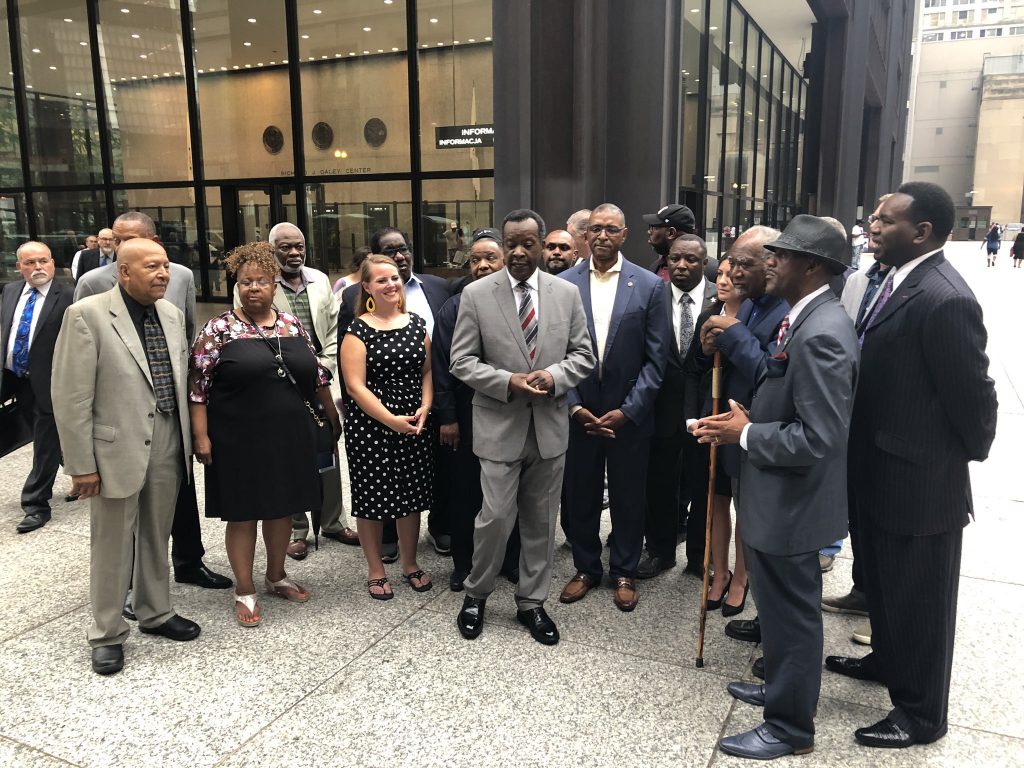 Former Cook County Comm. Richard Boykin formally launches his bid to replace retiring Cook County Circuit Court Clerk Dorothy Brown. [Alex Nitkin/The Daily Line]
-
House Speaker Mike Madigan (D-Chicago) was left mostly unscathed by a long-awaited outside investigation into claims of sexual harassment and intimidation within the the Illinois Capitol — but the report called on him to pay closer attention to the behavior of his closest aides.
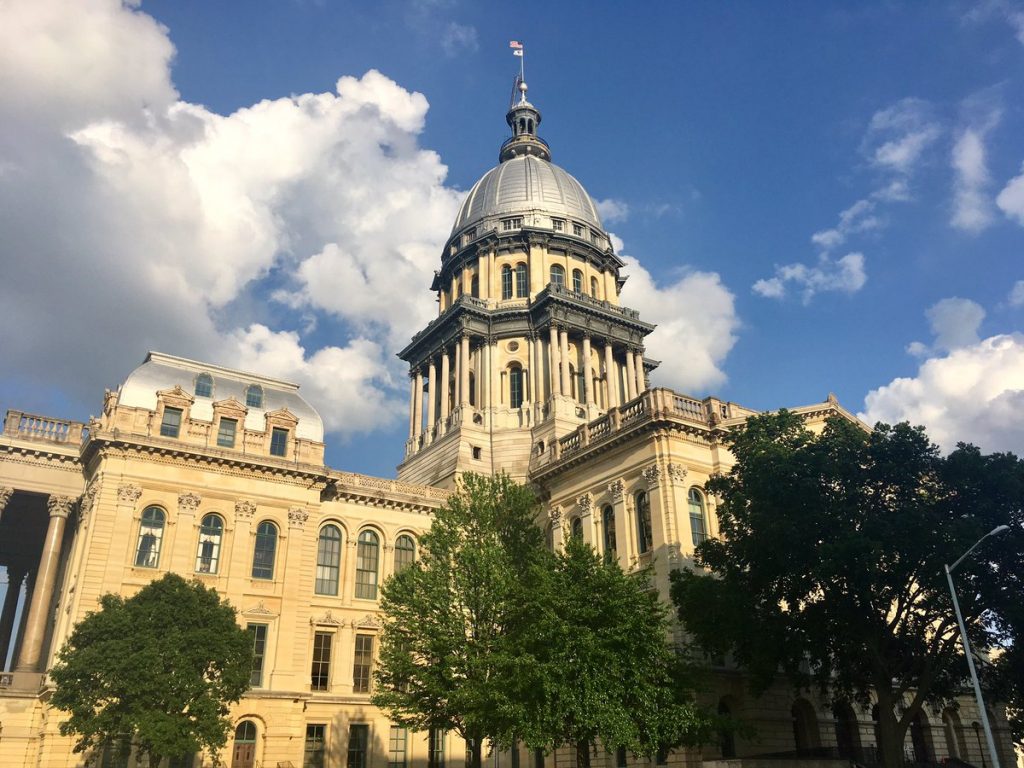 The Illinois Capitol. [Hannah Meisel/The Daily Line]
-
Wearing a dark suit and somber expression, State Sen. Tom Cullerton (D-Villa Park) entered a plea of not guilty at the Dirksen Federal Courthouse in Chicago, two weeks after a stunning 41-count indictment alleged the senator had been a ghost payroller for the Teamsters Joint Council 25 in his first few years after being elected to the General Assembly.
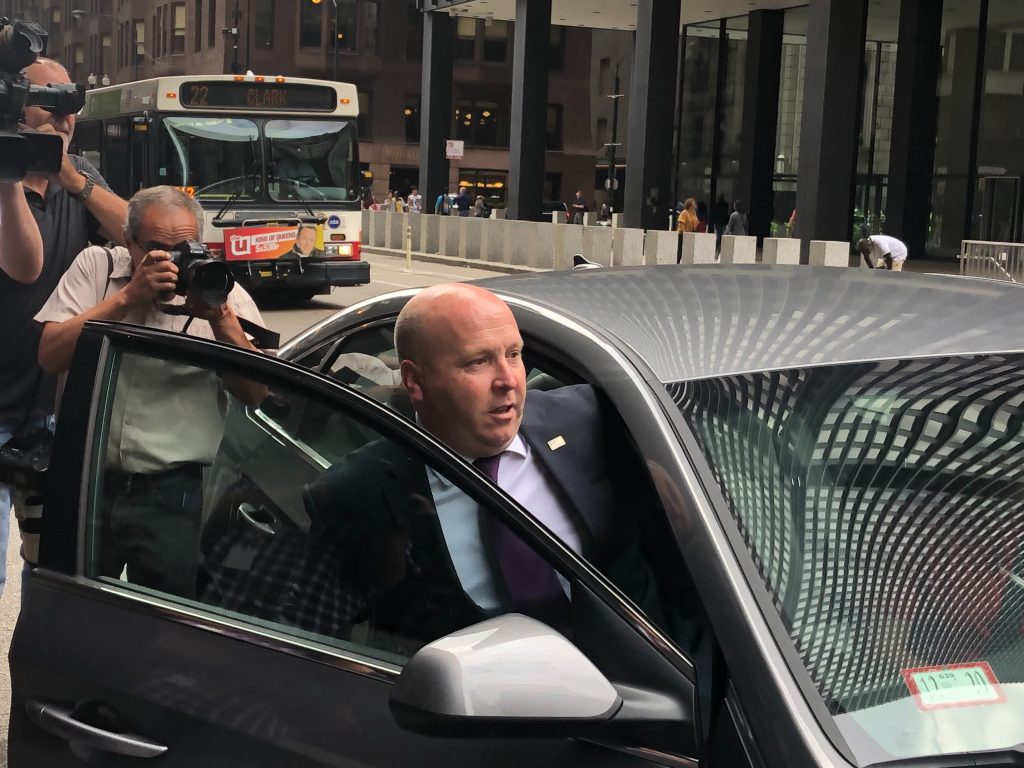 State Sen. Tom Cullerton (D-Villa Park) leaves the Dirksen Federal Courthouse after pleading not guilty. [Hannah Meisel/The Daily Line]
-
One day after U.S. House Speaker Nancy Pelosi (D-California) visited Springfield to rev up the Democratic base at the Governor’s Day brunch held by the Illinois Democratic County Chairs’ Association, the Democrat’s face loomed over the crowd assembled for Republican Day programming on the Director’s Lawn at the state fairgrounds — along with grayscale headshots Gov. JB Pritzker and House Speaker Mike Madigan (D-Chicago) — urging Republicans to “fight the machine.”
 U.S. Rep. Steve Scalise (R-Louisiana) addresses the crowd at Republican Day on the state fairgrounds Thursday, telling the Illinois GOP the party can rebuild. [Hannah Meisel/The Daily Line]
-
While U.S. House Speaker Nancy Pelosi (D-California) was billed as keynote speaker for Wednesday morning’s annual Illinois Democratic County Chairs’ Association brunch in Springfield, it was Gov. JB Pritzker who got the crowd of Democratic party faithful revved up as he promised a “blue tsunami” to continue last year’s “Blue Wave” that swept Democrats into office at all levels of government in November in a rebuke of President Donald Trump and former Gov. Bruce Rauner.
 U.S. House Speaker Nancy Pelosi (D-California) briefly speaks to reporters after the Illinois Democratic County Chairs’ Association brunch in Springfield Wednesday. [Hannah Meisel/The Daily Line]
As more than 2,100 Democrats milled about the lobby of the Crowne Plaza Hotel and Convention Center early Wednesday, many bought T-shirts for sale that proclaimed “Illinois Democrats get BIG things done,” a riff on Pritzker’s campaign promises to “Think Big,” and a continuation of his branding for Democrats’ legislative wins listed on the back of the $25 shirt.
Wednesday’s featured speakers boasted of the legislative victories, which include what they claim is the state’s first on-time and balanced budget in years, a $45 billion infrastructure plan, massive gambling expansion — including legalizing sports betting — recreational marijuana, a $15 minimum wage by 2025 and the Reproductive Health Act.
Pelosi, whose lengthy remarks largely focused on Trump and U.S. Senate Majority Leader Mitch McConnell (R-Kentucky), congratulated Pritzker, saying “you get big things done,” and called him a “model to the nation.” The California Democrat noted that she’d been friends with Pritzker’s mother, Sue Pritzker, when the governor was growing up in the Bay Area, and said it brought “tears to my eyes to see him…command the issues” in Illinois.Pritzker praised Pelosi for her navigation of Washington as Speaker of the House and in dealing with Trump.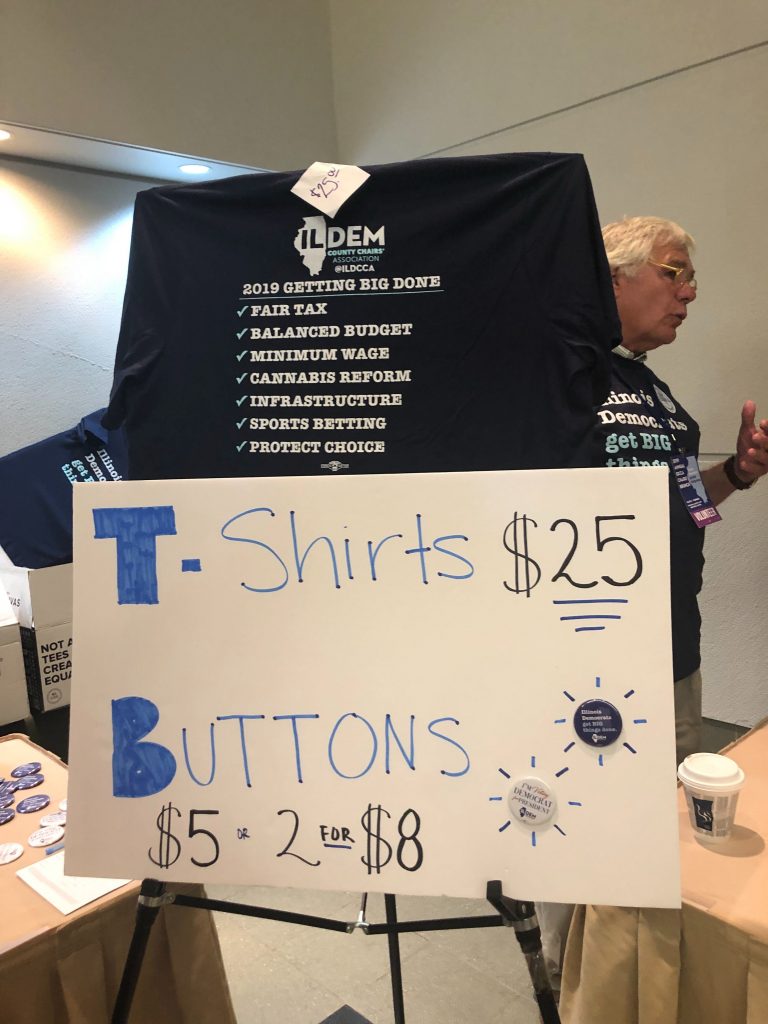 Merchandise for sale at the Illinois Democratic County Chairs’ Association brunch in Springfield Wednesday boasted Democratic legislative accomplishments from lawmakers’ Spring session. [Hannah Meisel/The Daily Line]
“I know I speak for everyone when I say thank God we didn’t send a man to do a woman’s job,” Pritzker said.
Pelosi praised the “persistent, bold experimentation” coming out of Illinois, saying that here and elsewhere, she sees evidence that “a mainstream agenda can also be a progressive agenda.” She referred to McConnell as “Moscow Mitch,” and used his own branding — describing himself as the “Grim Reaper” — against him.
“Since I’m in Springfield I’ll just quote a Republican president, Abraham Lincoln,” Pelosi told the crowd. “He said, ‘Public sentiment is everything.’ With it, you can accomplish almost anything, without it practically nothing.”
One Democrat who intimately understands public sentiment is House Speaker Mike Madigan, who is even more unpopular in his own state than Pelosi is, according to recent polling data. Madigan, who has mostly stayed in the shadows for Pritzker’s first year in office after being extremely visible for four years fighting Rauner, spoke for only three minutes Wednesday morning before departing out the back door.Though some Republicans last year acknowledged that a constant message of blaming Madigan may no longer be a winning one, a coalition formed to stop one of Pritzker’s top priorities — implementing a graduated income tax in Illinois via a constitutional amendment — put Madigan in the center of its branding Wednesday.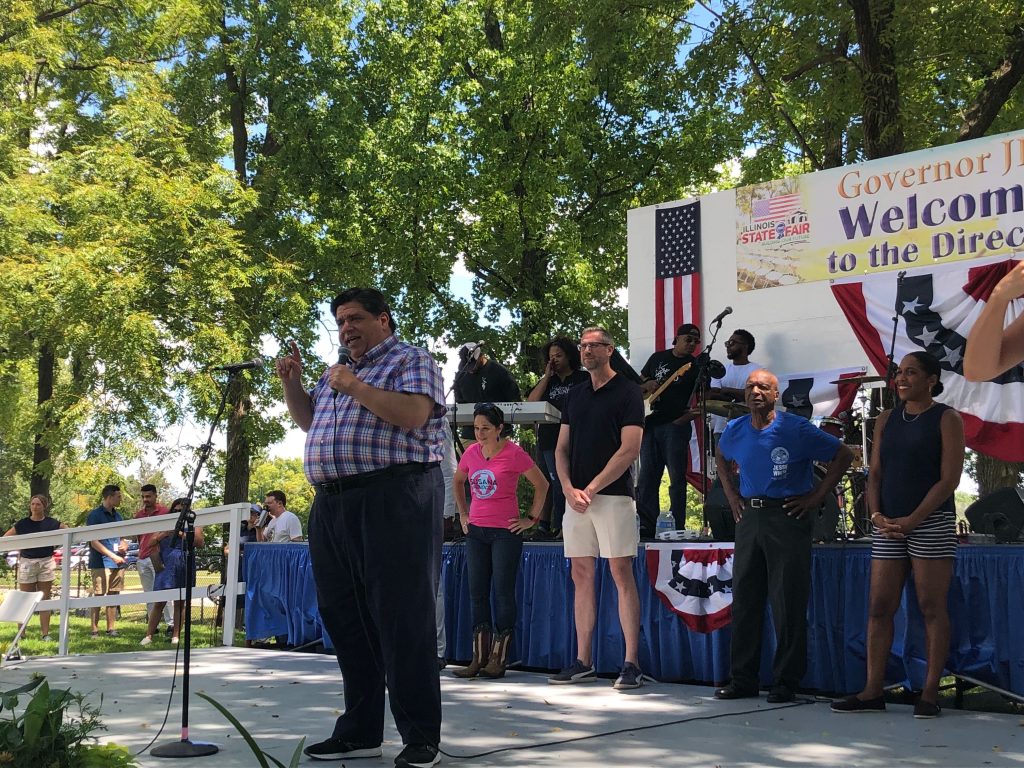 Gov. JB Pritzker addresses the crowd on the Director’s Lawn at the Illinois State Fairgrounds on Wednesday, Democrats’ first Governor’s Day since 2014. [Hannah Meisel/The Daily Line]
Greg Baise, the former head of the Illinois Manufacturers’ Association and current chair of Ideas Illinois, a 501(c)4 group dedicated to defeating what Pritzker has branded as the “Fair Tax,” announced a political action committee dedicated to the cause, dubbed the “Vote No on Blank Check Committee.”
The committee’s logo features the longtime House Speaker’s face, and polling released this Spring from Baise-connected We Ask America and commissioned by Ideas Illinois, found Madigan sits at an 18 percent favorability rating. A March poll from the Paul Simon Public Policy Institute at Southern Illinois University didn’t see Madigan faring much better, with only a 20 percent job approval rating.
Madigan, who is also the chair of the Democratic Party of Illinois, conducted what he jokingly called a “public opinion poll” gauged by the friendly crowd’s reaction.
“Are you happy about the fact that this year Illinois has a full-year budget, on time and balanced?” Madigan asked, with the crowd cheering for that and other Democratic victories, including a contract negotiated for approximately 80,000 state workers represented by AFSCME Council 31 — their first since 2015.
“All these things happened because there was a change in the occupant of the governor’s office in Illinois,” Madigan said. “We came together and decided that a budget impasse that lasted two and a half years was not acceptable…and we gathered together and we rallied, we removed Rauner from office and installed our governor, JB Pritzker.”After telling the crowd to enjoy their day, Madigan left the building without any chance of being intercepted by reporters. Earlier this summer, the Tribune reported on a series of FBI raids at the homes and offices of some of the speaker’s closest allies, apparently in connection with checks written to former Madigan political staffer Kevin Quinn.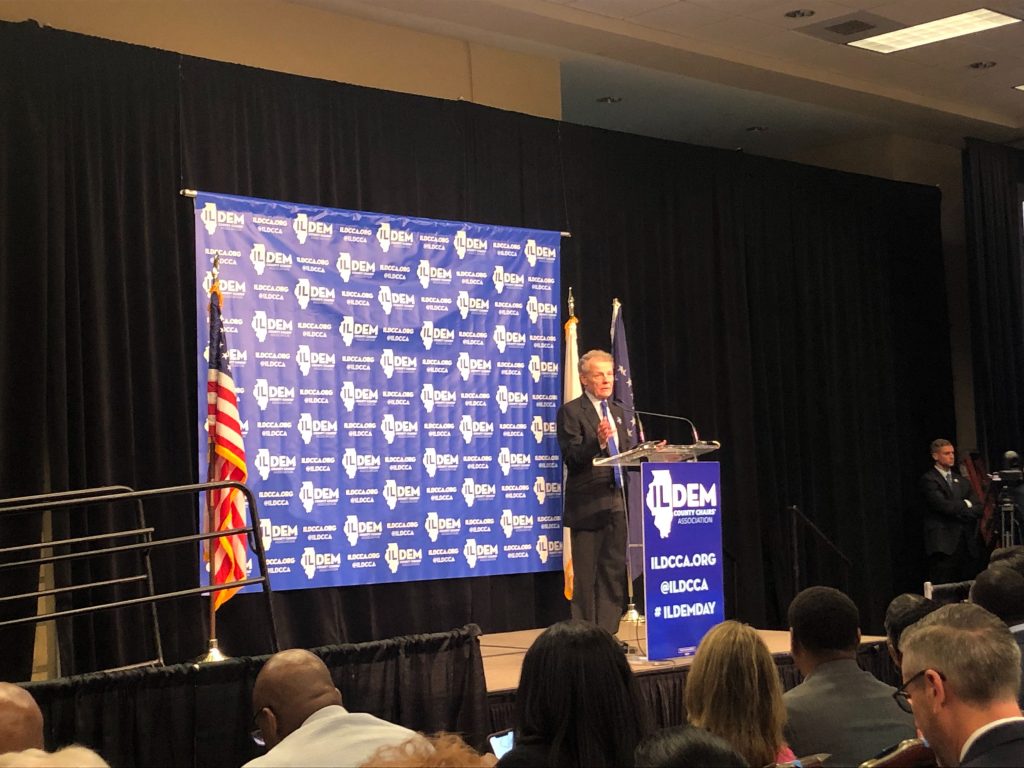 House Speaker Mike Madigan (D-Chicago) tells the crowd that big Democratic wins were all made possible by removing former Gov. Bruce Rauner from office and “installing our governor, JB Pritzker.” [Hannah Meisel/The Daily Line]
Madigan fired Quinn last year as campaign worker Alaina Hampton went public with her accusations that Quinn had harassed her in pursuit of a romantic relationship, and that Hampton had not been protected from his advances.
Madigan also dodged potential questions about State Sen. Tom Cullerton (D-Villa Park), who two weeks ago was indicted on 41 charges related to having been a “ghost payroller” for the Teamsters Joint Council 25 for the first three years he served in the Senate.
Cullerton’s arraignment, originally scheduled for Wednesday, was moved to Friday morning at the Dirksen Federal Court building in Chicago.
Cullerton’s caucus leader, Senate President John Cullerton (D-Chicago), who is a distant cousin of the indicted politician, told reporters again Wednesday that Cullerton is presumed innocent until proven guilty. Cullerton was removed from his chairmanship of the Senate’s Labor Committee, but was given another chairmanship, which lets him keep a $10,000 bump in his legislative pay.
“It is what it is and he’s got to face the charges,” Senate President Cullerton said Wednesday.
Attorney General Kwame Raoul, who served in the Senate with Cullerton, declined to speculate on whether it’s appropriate for Cullerton to continue serving while facing 41 counts, many of which are labeled as embezzlement of nearly $275,000 from the union over three years.
“I have nothing to say about that particular case,” Raoul told The Daily Line. “I am a former member of the General Assembly. I now serve in a role as a law enforcement officer for the state, so I would reserve any comment, as any responsible law enforcement officer would do.”
Not many present at Wednesday’s festivities at the county chairs’ brunch or out on the Director’s Lawn at the state fairgrounds volunteered to speak on the record about any sort of pall the FBI investigations have cast over the Democratic Party as the party tries to repeat wins in 2020.
One standout freshman House Democrat, State Rep. Joyce Mason (D-Gurnee), was featured in a video screened at Wednesday’s brunch about her surprise victory over former State Rep. Sheri Jesiel (R-Winthrop Harbor) in November.
Mason, who ran on a platform that included protecting abortion access in Illinois, said she was cognizant of the bigger picture hanging over the collective head of the Democratic Party in Illinois, but said it hasn’t come up while talking with constituents this summer while knocking on doors, as directed by Madigan.
“On one hand, it feels really far away because I’m such a newcomer,” Mason told The Daily Line. “It’s not like I’m hanging out with those guys, so it seems very far away. On the other hand, I’m focusing on everything we’re working on…and you know, I just try to let it play out and see what happens. I’ve heard stuff like, ‘Oh, people just make stuff up, it’s going to go away’ [or] ‘it’s not going to go away.’ Regardless of that, I just keep working for my hometown and my district. It’s one of those things, I guess.”
Mason was one of the female freshman House Democrats who State Rep. Kelly Cassidy (D-Chicago) and others have repeatedly given credit to as the driving force behind the passage of the Reproductive Health Act in late May, even after the speaker had put a brick on the bill.
Related: ‘Watch the rollercoaster, don’t ride it:’ Rep. Cassidy — The Aldercast -
Citing the state’s plans to spend a $45 billion on infrastructure in the next six years, Comptroller Susana Mendoza on Tuesday signed an executive order vowing her office will will refuse to pay construction vendors who aren’t paying workers the prevailing wage.
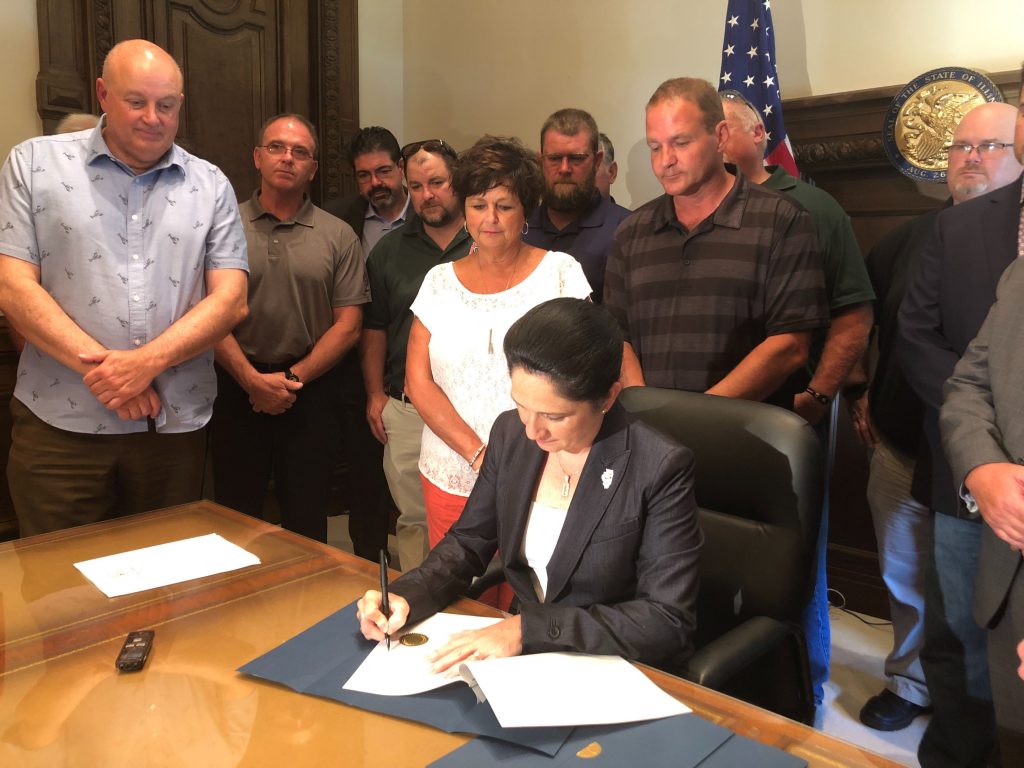 Illinois Comptroller Susana Mendoza signs an executive order requiring firms to pay the prevailing wage. [Hannah Meisel/The Daily Line]
-
Six years after a limited medical marijuana pilot project was signed into law in Illinois, Gov. JB Pritzker’s signature on Friday significantly expanded the now-permanent program that is booming.
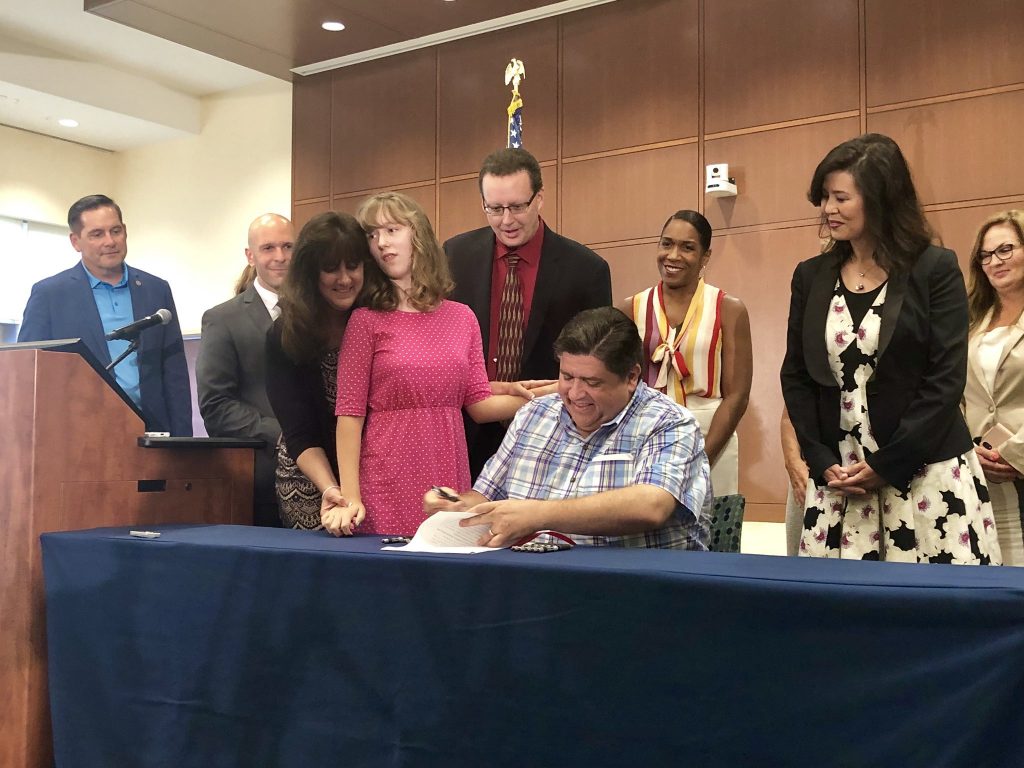 Gov. JB Pritzker signs a bill making an expanded state's medical marijuana program permanent. [Submitted]
-
On a late August morning last summer, the state’s Office of Executive Inspector General received an odd tip: an employee of the Abraham Lincoln Presidential Library and Museum was in the process of sawing a wooden desk into pieces and disposing of the parts in a dumpster in the parking lot of the museum in Springfield.
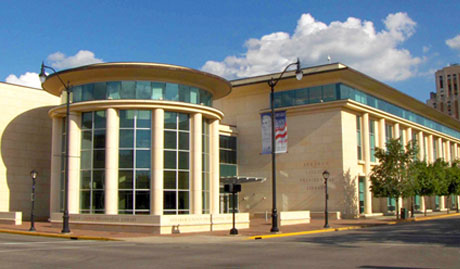 Abraham Lincoln Presidential Library and Museum [Submitted]
Upon receiving the call, investigators looked out their 14th floor windows and spotted the man using a machine saw to cut apart some sort of decorative wooden wall. They took photos of the scene. The tipster said the desk had once been in Springfield’s old Union Station, and may have had historical value.
The incident set off months worth of interviews and an eventual conclusion that the desk had indeed been purchased a decade before for $22,600 and its destruction was both a violation of state law and a missed opportunity for revenue to the state in a little-known program that brings in a few million dollars for Illinois every year.
-
Even after a bill is passed and signed by the governor, though it may have an immediate effective date in the legislative language, some measure of rule-making from an agency or state board may delay the actual implementation of a new law.
In the six weeks after Gov. JB Pritzker signed a massive gaming expansion bill into law — one of the major revenue sources for a $45 billion infrastructure plan, the city of Chicago missed a deadline to hire a consultant for a feasibility study of a new casino granted to the city under SB 690, and Pritzker’s administration scrambled to fill two spots on the Illinois Gaming Board, including the board chair.
But now that the board has been filled and the city contracted with Nevada-based Union Gaming for a feasibility study, the Illinois Gaming Board’s administrator on Thursday said emergency rules are nearly ready to go, allowing other parts of the new law tweaking existing casinos and video game terminals throughout the state.
-
AUG 08, 2019
UNLOCKEDSaying they need to “get to the bottom of this injustice,” Illinois lawmakers grilled university and state financial aid officials Thursday about how to prevent families from exploiting guardianship laws to obtain need-based college financial aid they wouldn’t otherwise receive.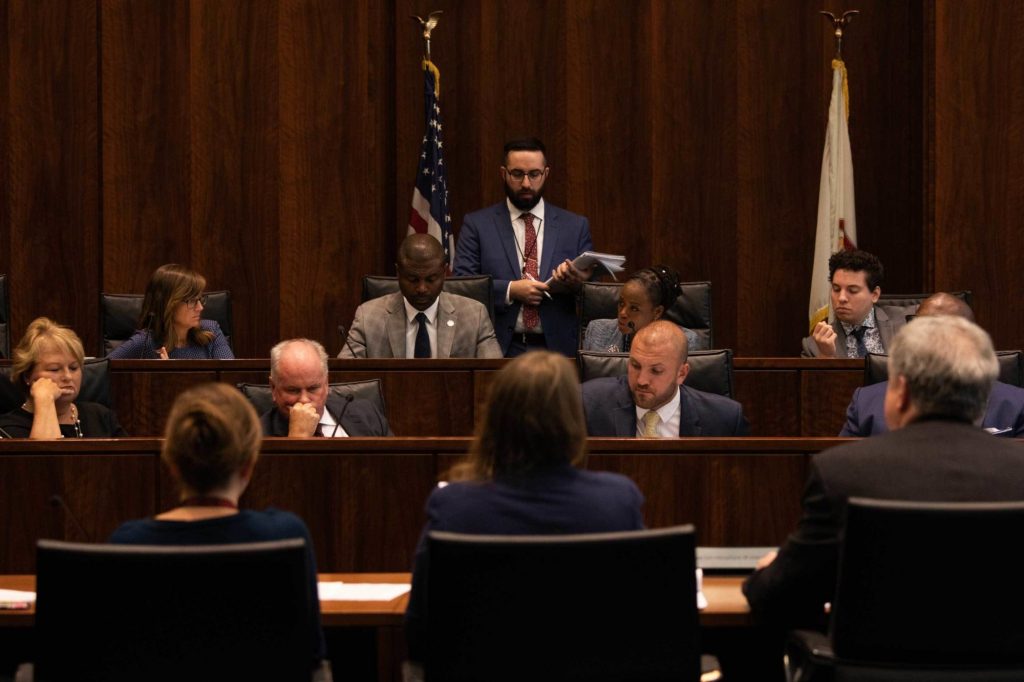 Members of the Illinois House higher education committee and appropriations-higher education committee listen to testimony from university and state financial aid officials during a hearing Thursday about parents who gave up guardianship of their college-bound children to qualify for financial aid. The hearing was at the Bilandic Building in downtown Chicago. [Pat Nabong for ProPublica Illinois]
At a packed hearing in Chicago, more than a dozen members of the Illinois House discussed possible reforms, from tweaking state laws and educating judges who sign off on questionable guardianship changes to denying college admission to students whose families have exploited legal loopholes for financial gain.
“Need-based financial aid programs are a zero-sum game. When a student who does not qualify for the aid manipulates the system and is awarded money, there are students who are qualified for the aid who don’t receive it … and consequently they lose out on college altogether,” said State Rep. Carol Ammons, a Democrat from Champaign. “However, the rising costs of college should not be overlooked in this case. A system that drives families to cheat is a broken system.”
Yet lawmakers appeared unsure what they could do to stop the practice, even as they tried to pin down whether any laws were broken. “You’re not alarmed or think they committed an illegal act?” Rep. La Shawn K. Ford, a Chicago Democrat, asked one state financial aid official. “So we’re here only because we want to fix the moral compass of people?”
The hearing before two House higher education committees was called after a ProPublica Illinois investigation last week exposed how nearly four dozen families from the northern Chicago suburbs in Lake County went to court to give up legal guardianship of their children, sometimes a few months before they turned 18, to relatives or friends. Reporters subsequently identified an additional 10 cases in McHenry County and two in Cook County.
By having someone other than their parents be their legal guardian, students can declare themselves financially independent so their parents’ earnings and assets aren’t taken into account when applying for need-based federal, state and university grants. They can also qualify for subsidized federal student loans. The Wall Street Journal also reported on this issue.
Officials from the University of Illinois at Urbana-Champaign first flagged the questionable guardianship changes last summer and alerted federal authorities. University officials said they can decline to give institutional funds to these students but are obligated to award state and federal need-based grants.
At Thursday’s hearing, university officials implored lawmakers to give them the authority to reduce or block state need-based grants from the Monetary Award Program, known as MAP, in cases where students obtained independent status because of questionable guardianship transfers. MAP grants are worth $300 to $5,300 a year.
“That level of authority and flexibility would give us a much stronger set of tools to immediately and effectively address instances like the ones that we are discussing today,” said Michelle Trame, the University of Illinois director of student financial aid.
Trame urged lawmakers to enact safeguards soon since financial aid for the coming school year will be distributed before the end of August.
Ford, who chairs the House higher education appropriations committee, told reporters after the hearing he was not convinced that giving universities discretion to reduce MAP grants was the solution. Instead, he said the focus should be on educating judges and examining the guardianship law itself.
“It’s not illegal. We can make it illegal,” he said.
Ford and other lawmakers cautioned that they want to protect children in legitimate guardianships and avoid making the financial aid process unnecessarily burdensome for them.
Several lawmakers highlighted the need to hear from judges in future hearings. “We have no one here today from the judiciary, is that right? I’m a little bit concerned we may be getting ahead of our skis,” said Rep. Terri Bryant, a Republican from Mt. Vernon in southern Illinois. “It appears to me that this is a problem with the judiciary granting guardianship rather than what the schools are going to do about it.”
The Illinois Probate Act, the law that governs guardianship, does not specify circumstances in which guardianship should be denied. According to the law, a court can appoint a guardian if the parents consent, the minor agrees and the court determines it is in the child’s best interest.
ProPublica Illinois found that one judge in Lake County, Donna-Jo Vorderstrasse, approved dozens of guardianship changes brought to her court since January 2018 on behalf of college-bound students. Vorderstrasse, who has since moved to another division, declined to comment and referred questions to the court’s executive director, who did not return a call.
This year, however, another Lake County judge, Joseph Salvi, took over hearing guardianship cases and last month denied the guardianship petition of a 17-year-old who lived with his parents in suburban Long Grove.
Four days after Salvi denied the petition, the same family filed a new petition in McHenry County. The case was supposed to be heard Monday, but the family didn’t show up.
Eric Zarnikow, executive director of the Illinois Student Assistance Commission, which administers the MAP grant, told lawmakers his agency plans to reach out to judges to educate them about the potential abuse of guardianship.
Zarnikow also said it appears that the scheme came to light before it became widespread.
“The good news is this appears to have been caught early,” he said. “If this works in Illinois, it likely works in other states.”
State Rep. Dan Brady, a Republican from Bloomington-Normal in Central Illinois, said he thought the law may need “some fine-tuning.”
Noticeably absent from the hearing were families involved in the questionable guardianships and attorneys who filed the cases. In an interview after the hearing, Ford said lawmakers asked the universities to notify families of the hearing, but “nobody wanted to come.” Parents still may be subpoenaed to appear at future hearings, he said. Ammons also said after the hearing she thought it was appropriate for the state’s attorney general’s office, which is investigating the abuse of guardianships, to finish its work before families are called to testify.
“We don’t know yet what the AG is thinking,” Ammons said. “Is this considered theft?”
An attorney for some of the families, Mari Berlin, of the Kabbe Law Group, has said families who took part in the guardianship changes said they make too much money to qualify for financial aid but struggled to pay for college.
Lawmakers repeatedly asked for more information about the students who have enrolled at the University of Illinois at Urbana-Champaign, including their high schools and how much money they received in need-based grants. University officials declined to provide that information, citing privacy laws.
State Rep. William Davis, a Democrat from East Hazel Crest, in the southern suburbs of Chicago, asked university officials whether they could deny admission to applicants who misrepresented their true financial status. Andy Borst, director of undergraduate admissions at the university, said the issue wasn’t clear-cut.
“I feel like we were limited with the judges in the state saying, ‘Yes, this was a legal transfer of guardianship,’” Borst said. “We have to abide by that.”
University officials also asked lawmakers to regulate college consultants. Several of the families identified by ProPublica Illinois hired the same firm, Destination College, which boasts on its website of “strategies to lower tuition expenses.” The company’s owner, Lora Georgieva, has declined to comment to ProPublica Illinois but said elsewhere she did nothing wrong and was merely pointing families to a legally available option.
The reporting last week from ProPublica Illinois drew national attention and spurred the U.S. Department of Education’s Office of Inspector General to call for reforms. That office, which called the tactic “student aid fraud,” has recommended adding language on federal financial aid forms to clarify that students involved in this kind of guardianship no longer qualify for aid if they continue to receive medical and financial support from their parents.
In addition, other universities across Illinois and in other states have begun examining their own records to see if students in questionable guardianships had obtained financial aid to which they otherwise would not have been entitled.
At Thursday’s hearing, representatives from all of the state’s public university systems testified about the issues. None, apart from the University of Illinois at Urbana-Champaign, had identified any questionable guardianship cases. Illinois State University said it was still seeking further documentation from fewer than five students in guardianships.
Only one official from a private institution, Dominican University, testified at the hearing. Lawmakers said they hoped to hear from some of the most prestigious private universities in the state, including the University of Chicago, in future hearings.
In a recent interview, Loyola University Chicago’s associate director of financial aid, Kelsey Gerber, said her office began looking into questionable guardianships last year after learning of the practice from officials at DePaul University.
Loyola has since identified two applicants with a similar guardianship setup. When the university asked for additional documentation, Gerber said, the students didn’t respond and didn’t attend Loyola.
DePaul has seen a “small number” of these types of guardianship cases, a spokeswoman said in an email, adding that the university has been in touch with the U.S. Department of Education for guidance.
ProPublica Illinois is an independent, nonprofit newsroom that produces investigative journalism with moral force. Sign up for The ProPublica Illinois newsletter for weekly updates.


