


-
Why Chicago’s Business Community Should Support the Hazel M. Johnson Ordinance
I’ve seen firsthand over decades of building and buying housing and commercial developments across the country how a city can reinvent itself. As the Chairman of Banner Real Estate Group, I’ve led our firm through many market cycles, always with a view toward long-term value, community impact and sustainable growth. That’s why I believe the Hazel M. Johnson Cumulative Impacts Ordinance is not just good policy — it’s good for business.
Our economy thrives when there’s predictability, fairness, and transparency in how the city makes decisions. The current system for siting heavy industry in Chicago lacks all three.
This ordinance isn’t about stopping development, it’s about steering it toward more sustainable, future-ready industries. At Banner Real Estate Group, we consider a diverse set of factors when we choose when and where to invest. When a city is actively involved in ensuring that that zoning follows clear rules that make communities more stable, that’s good for business.
When the rules are vague or the process is inconsistent, the burden falls on businesses like mine to determine how risky it is to invest in such a climate. We take into account how viable projects will be if the fabric of a community is significantly altered with a heavy industrial development that’s a bad fit or even a danger to a community.
The Hazel M. Johnson ordinance would change that by requiring the city to consider the total environmental burden a community already faces before approving new heavy industrial projects. It introduces common-sense environmental review, clear guidelines, and meaningful community engagement. These are not roadblocks to growth, these are guardrails that create stability for long-term investment.
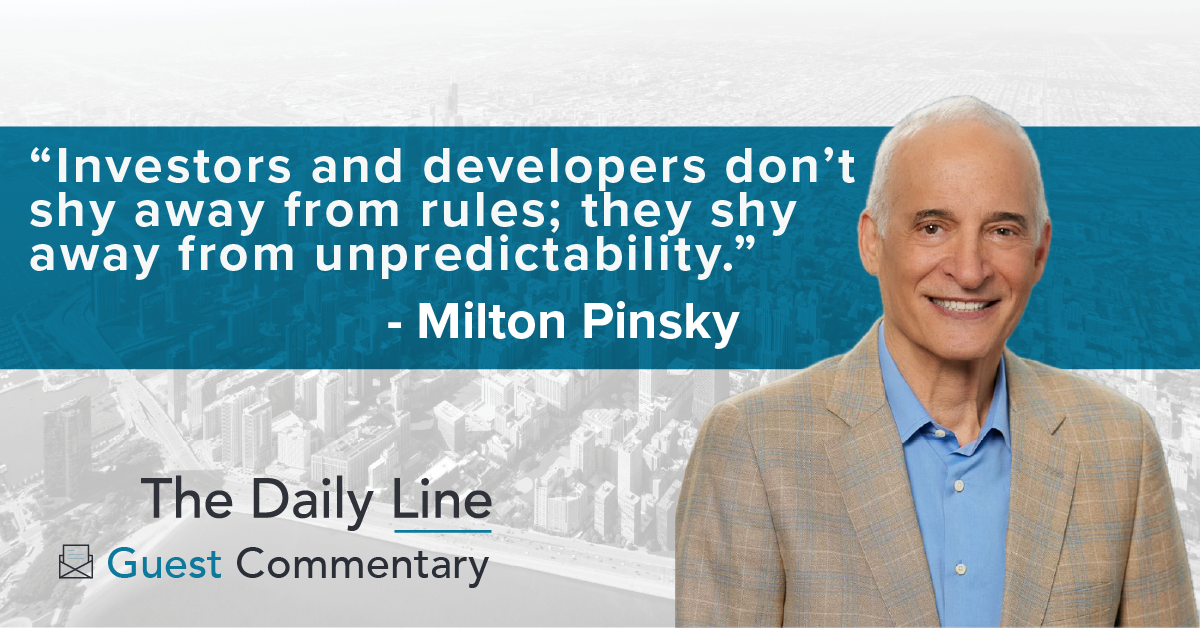
From a business standpoint, this is exactly the kind of smart, modern regulation we should support. Investors and developers don’t shy away from rules; they shy away from unpredictability. By creating a more structured and equitable permitting process, the ordinance provides clarity to companies and helps ensure that new projects are welcomed, not opposed.
In residential development, we are seeing a lot of growth in new sectors like clean construction, energy efficiency, and green infrastructure. Innovation can also drive a new wave of green real estate and Chicago is well-positioned to lead that transformation.
Some worry this ordinance might hinder job growth. That fear is misplaced.
The ordinance applies only to new heavy industrial uses, of which the city sees only a few each year. While it does not affect the vast majority of commercial or residential development, a poorly sited heavy industrial facility is bad news for everyone. The ordinance ensures that projects are sited thoughtfully, with an eye toward long-term community health.
The costs of inaction are real. Real estate businesses are determining where to invest in the future. Pollution and climate change can seem like distant threats but they are already a concrete part of the equation through lower property values and higher premiums on insurance.
In the face of weakened federal environmental protections, local leadership matters more than ever. Supporting this ordinance is a chance for Chicago to lead, not just in clean air, but in smart, responsible economic growth.
Hazel M. Johnson was a pioneer who saw the deep connection between racial justice, health, and the built environment. We have the opportunity to honor that legacy, not by choosing between business and community, but by recognizing that they are interdependent.
We can make Chicago more attractive to business by establishing clear, consistent city planning rules. Updating our zoning laws now will signal to businesses that this city is serious about sustainable, long-term growth.
Chicago’s future depends on forward-thinking policies like this. Let’s pass the Hazel M. Johnson ordinance and show that business leadership means building not just portfolios, but a healthier, more equitable city for everyone.
Milton Pinsky is the Chairman of Banner Real Estate Group, LLC and affiliates, which he co-founded in 1989. Banner has acquired and operated over 50 multifamily properties and developed over 25 multifamily and senior living communities and self-storage facilities, collectively worth over $2.3 billion. Milt received his JD and MBA from the University of Chicago.


Trending
Housing committee to consider QAP standards changes, Missing Middle sales
Fintech entrepreneur making outsider bid for Chicago mayor
Quigley enters mayor’s race, promising to distinguish as candidate not burdened by future ambitions
Mayor responds to organizers’ call for dedicated city gun violence reduction agency
Mayor proposes $425M in TIF assistance for public infrastructure at The 78 development
What makes up the mayor’s sweeping Residential Landlord and Tenant Ordinance modernization


