Springfield News

  • Gov. Bruce Rauner sent a bill that could change the way ambulance services are paid for back to lawmakers, even though the measure passed overwhelmingly. The governor did, however, lend his signature to a bill banning the sale of ivory in Illinois.
    To Read More Please Login or Join
  • A panel of lawmakers on Tuesday asked advocates, medical professionals and state officials to explain the reasons for often hospitalizing children in the care of the Illinois Department of Children and Family Services “beyond medical necessity” — a term used to describe a longer hospital stay after a child is cleared for release after a psychiatric stay.

    State Sen. Julie Morrison (D-Deerfield) called the hearing in response to a ProPublica Illinois investigation from June, which found that hundreds of children in the care of DCFS are forced to stay in psychiatric hospitals long after their treatment is over, as the state cannot find appropriate placements for them.

    Dr. Tom Cummins, the medical director of inpatient psychiatric services at Chicago’s Lurie Children’s Hospital, laid out the issue for lawmakers on Tuesday, saying the issue of prolonged stays by children in the care of DCFS means that hospitals are less able to accept other patients.

    In Fiscal Year 2017, for example, Cummins said Lurie was unable to accept 664 patients in part because of the children under DCFS care who occupied beds. But more importantly, Cummins said, prolonged stays leave scars on the children.

    “Prolonged hospital stays reopen old psychiatric wounds, including feelings of being unwanted,” Cummins said.

    Children being hospitalized beyond medical necessity is primarily a result of the issue of placement capacity, according to Danielle Gomez, an attorney with the Office of the Cook County Public Guardian.

    Children also wait unnecessarily at detention centers like the 13 youths who were technically released from Cook County Detention Center in July, but had not been found placements through DCFS, Gomez told lawmakers.

    “[Beyond medical necessity] is a really significant symptom because it’s such a severe restriction on a child’s civil rights to be kept at a hospital, but it’s a much bigger problem that we have in terms of meeting the needs of children with high-end needs in safe, appropriate placements in our state,” Gomez said.

    Gomez told the story of “Alissa,” an 11-year old girl who had been hospitalized for psychiatric trauma, and who had faced a childhood of sexual abuse at the hands of caretakers and even a cab driver who had been contracted with DCFS to take her to school. Gomez said the girl “needed a placement 255 days ago,” but has remained hospitalized due to DCFS’ inability to find an appropriate placement.

    “As children get older, every year counts so much when it comes to finding a placement for them,” Gomez said. “If you waste a year of a child’s life, it’s not only horrible for them but it makes it that much harder to heal them and get them placed in the future.”

    The state has made the problem worse by reducing the amount of beds in residential treatment facilities under the banner of reducing costs and finding alternative care, Gomez told lawmakers.

    “They’ve commended themselves for reducing reliance on residential care,” Gomez said. “There are 500 fewer beds…so now we have 300 kids [hospitalized beyond medical necessity] instead of 75.”

    DCFS Director Beverly Walker, however, refuted part of the witnesses’ critiques of the agency’s direction on kids in psychiatric care, telling lawmakers on Tuesday that “placement is not treatment.”

    “One of the reasons we’ve come to this fork in the road is that we had a big problem in Illinois with placements that weren’t appropriate for young people,” Walker said. “Out of that work, I believe we probably closed some placements but we did not do the adequate amount of work to replace what was closed. But some things needed to be closed.”

    The issues is about more than just finding a placement for children in DCFS’ care, and said it is never the agency’s intention to just “leave young people in hospitals,” Walker said.

    “This is about placement and treatment married to one another,” Walker said.

    Walker said DCFS is working to ensure that every child within its care has a discharge plan within 10 days of admission to a hospital. The agency has also upped the number of beds in both residential treatment centers and at specialized foster care homes around the state, that children can be sent to post-treatment, Walker said.

    Lawmakers also heard testimony about the extremely difficult choice some parents must make in order for their children to receive psychiatric health care, known as mental health lockouts. In a lockout situation, a parent gives up custody in order for their child to become a ward of the state, so the state is forced to provide the psychiatric care the parent could not access alone.

    Carrie Overbey, chief clinical officer of Riveredge Hospital in the near west suburb of Forest Park, told lawmakers Tuesday that she is experienced in lockout situations, but State Rep. Sara Feigenholtz (D-Chicago) told Overbey she was concerned about losing kids “to the system.”

    “Do you know how offensive it is to hear you say, ‘I know how to work a lockout?’” Feigenholtz asked Overbey.

    Overbey replied that she meant no offense by describing her experience in helping parents navigate lockout situations.

    “I mean the process of a lockout and the people and the involvement and the time is not something you learn when you’re hired to do a job,” Overbey said.

    It’s estimated that a parent gives up custody of a child about once every four days in Illinois.
  • Gov. Bruce Rauner on Monday vetoed a bill that would have expanded the Illinois Human Rights Act to make it explicitly illegal to discriminate against workers in companies with 15 employees or fewer, claiming the change would be burdensome for small businesses and startups. Meanwhile, State Sen. Tom Cullerton banked a large contribution.
    To Read More Please Login or Join
  • After Gov. Bruce Rauner said in a radio interview last week that Republican Attorney General candidate Erika Harold “will prosecute [House Speaker Mike] Madigan and the corruption,” Harold released a new ad Monday morning, which draws upon the same buzzwords and themes.

    To Read More Please Login or Join
  • Republican state senators say they will give Chicago Public Schools one more chance to answer questions about its policies — or lack thereof — surrounding sexual harassment and assault experienced by students, before the caucus asks for subpoena power. Attorney General Lisa Madigan joined a coalition of state attorneys general asking the U.S. State Department to intervene and stop the spread online of blueprints for 3-D printed guns. While Gov. Bruce Rauner gave a combined $5 million to Republican Attorney General candidate Erika Harold and the House Republican Organization, Democrats also did well in weekend campaign contributions.
    To Read More Please Login or Join
  • State Rep. LaShawn Ford (D-Chicago) and State Rep. Barbara Wheeler (R-Crystal Lake) invited every single member of the General Assembly to join a conference call Friday morning to discuss a strategy for combating gun violence in Chicago.

    Ford and Wheeler, who announced last summer she would not seek re-election, said they plan to orchestrate a news conference on Chicago’s West side Wednesday, which will kick off a 30-day period in which lawmakers will demand city and state officials coordinate a plan to stem gun violence.

    Lawmakers said they will insist the plan include elements meant to end the flow of illegal guns and drugs into Chicago’s South and West sides, along with asking for the direct infusion of resources from the state, city and Cook County to violence-affected communities.

    During the call, one suburban Democrat suggested that lawmakers push for Gov. Bruce Rauner to reconsider his March veto of the Gun Dealer Licensing Act, though it’s unclear if that suggestion will end up in the effort’s final plan.

    Resources for both the Illinois Department of Corrections and inmates themselves also may end up on lawmakers’ list of demands. One downstate Republican criticized legislation passed earlier this year aimed at reducing the state’s prison population, calling the levels to which the population would fall “arbitrary,” and saying the efforts were “designed solely for saving money within the department.”

    “If we are pushing inmates out the door, it is working to the detriment of local communities,” the Republican said.

    Other IDOC-centric ideas that may show up in the final demand list are job training programs and more resources for a group within the Department of Corrections focused on identifying gang leaders.

    One thing that likely will not be brought up again is sending in the Illinois National Guard, which Rauner was rumored to have been considering last week until he categorically denied it. When a suburban Republican asked on Friday’s call if that was on the table, the resounding answer was no.

    Though the effort is meant to be bipartisan, the press conference is set for Wednesday — Governor’s Day at the Illinois State Fair — meaning many Republicans may opt for Springfield instead of Chicago.
  • Gov. Bruce Rauner signs HB 4295 in his ceremonial office in the Illinois State Capitol on July 9, 2017. Screenshot courtesy of the Illinois Department of Central Management Services.


    As far back as his 2014 gubernatorial campaign, Gov. Bruce Rauner lamented his immediate predecessors’ habit of dropping by Springfield but living in Chicago, and treating the state’s largest city as the de facto state capital.

    Then-candidate Rauner promised to live in the Governor’s Mansion, which he largely has, minus the time he spent living on the State Fairgrounds while the mansion was being renovated with funds donated by and raised by the governor and first lady Diana Rauner.

    Rauner criticized the amount of money the state was spending on travel for both Governors Pat Quinn and Rod Blagojevich, both Democrats, and said he’d like to bring more state jobs back to Springfield. On Thursday, three-and-a-half years into his term in office, Rauner got his wish — sort of.

    Flanked by a few local legislators and other area officials, Rauner signed HB 4295, which will require the Department of Central Management Services to default state agency jobs as located in Sangamon County, where Springfield is the county seat, unless it can be proven the jobs need to be elsewhere within the state.

    The law will not force any current state employees to relocate to Springfield, but also does not provide guidelines for how a job can be moved from Springfield to somewhere else within the state.

    Bill sponsor State Rep. Sara Wojcicki Jimenez (R-Springfield) cited a 2016 study that found in-state travel by state agency employees had cost the state $126 million over a five-year period. The report found that nearly 400 state agency jobs currently located outside of Springfield could come back to Sangamon County, which Wojcicki Jimenez said could be a boon to the local economy.

    “Ever since I became a representative and growing up in Springfield as a journalist, there’s been a lot of concern among people who live in Sangamon County about where the state capital actually is,” Wojcicki Jimenez said.

    The bill, which passed unanimously in the state Senate and overwhelmingly in the House, will also help the state prepare for the much-vaunted sale of the James R. Thompson Center in Chicago, which has been a priority for Rauner for the last few years. The state’s current budget relies on savings from the sale, but not much progress has been made on the issue.

    Past coverage:
    State Budget Relies On $270M From Sale Of Thompson Center — But Mayor’s Office Says No New Proposal On Tap

    Ald. Reilly: ‘No One Has Come To Talk To Me’ About A New Plan To Replace Thompson Center

    “This is the state capital by law, by tradition, by history and by pride,” Rauner said Thursday. We should make sure that our government is run in a way that’s good for taxpayers and good for the state by making sure this is the capital, and that we don’t divide it, waste money and play politics with how government’s run.”

    However, the bill contains an exemption for any agencies not under the control of the governor, along with legislative and judicial staff jobs and any staff directly hired by the governor’s office. Wojcicki Jiminez said this carve-out was made because the study she relied upon when crafting the bill did only studied agency jobs.

    Those exemptions will contain most Rutan-exempt positions — jobs in which political affiliation can be taken into account in the hiring process.

    Blagojevich was widely panned, and even called “cruel” in 2008 when he announced a plan to move 140 government jobs to Harrisburg in deep southern Illinois. A little over five months after introducing the idea to move the Traffic Safety Division of the Illinois Department of Transportation out of Springfield, Blagojevich was arrested on corruption charges outside of his Chicago home.
  • Gov. Bruce Rauner criticized Mayor Rahm Emanuel Thursday after more than 70 people were shot and 12 killed last weekend in Chicago, taking credit for directing the Illinois State Police to assist the Chicago Police Department.

    Rauner was rumored to have considered sending in the National Guard, but told reporters at a Peoria event Wednesday that there was “no truth” to that report.

    But when asked again Thursday what he planned to do to respond to a spike in violence in Chicago, Rauner blamed Emanuel for not properly resourcing and staffing the Chicago Police Department and for failing to improve the economies of Chicago’s South and West sides, where most of the violence took place.

    Rauner said the “primary responsibility” to stem violence in the city lies with leaders in Chicago, but said his administration has been “proactive” by sending the Illinois State Police into the city.

    “We weren’t asked to — in fact, there was resistance — but I said, ‘You know what? We’re going to have State Police go into the neighborhoods in Chicago,’” Rauner said Thursday. “That’s not their primary jurisdiction, but we pushed it, CPD accepted it and we now have State Police and have confiscated a lot of illegal guns, we’ve arrested a lot of gang members and the State Police are making a difference.”

    The governor pointed to the State Police’s presence on expressways in the city — which is within the normal jurisdiction of the agency — as shootings on the highways increased dramatically in recent years.

    State Police spokesman Lt. Matt Boerwinkle told The Daily Line on Thursday officials believe extra patrols by state police officers helped to reduce the number of shootings on expressways significantly, as compared with last year.

    “[The State Police is] actively involved in enforcement efforts, particularly targeting gun violence on Chicago expressways, particularly 290 and 94,” Boerwinkle said. “This year we’re starting to see a real impact.”
    Number of shootings on Chicago-area expressways by year:

    2013 — 13

    2014 — 19

    2015 — 37

    2016 — 53

    2017 — 51

    2018 — 24

    * Source: Illinois State Police

    Since 2016, the Illinois State Police has been operating three distinct patrol units within the Chicago area, which Boerwinkle said has resulted in 201 gun arrests and the seizure of 2,013 illegal guns.

    The program Rauner explicitly took credit for on Thursday is called the Illinois State Police Gang Violence Prevention Task Force, a small unit of 24 to 25 officers that specifically patrols neighborhoods where gang violence is prevalent.

    Between the expressway patrol, the gang violence task force and another Illinois State Police initiative within the city,  Boerwinkle said the agency is responsible for 233 criminal charges in 2018 alone.
    Arrests and gun seizures attributable to ISP

    2016 — 73 gun arrests and 76 illegal guns seized

    2017 — 74 gun arrests and 92 illegal guns seized

    2018 — 54 gun arrests and 45 illegal guns seized

    * Source: Illinois State Police

    Despite touting the ISP’s efforts, Rauner maintained that Democrats in both city and state government should share the blame for gun violence, as he claimed they were responsible for blocking pro-business reforms the governor said would help the neighborhoods most affected by gun violence.

    “The real answer longterm is economic opportunity,” Rauner said. “The unemployment rate on the South Side of Chicago, on the West Side of Chicago is stunning. We have vital people in their 20s, 30s without jobs. It’s unconscionable.”
  • Illinois’ First District Appellate Court ruled Wednesday that de facto life sentences for those with intellectual disabilities is a violation of the 8th Amendment to the U.S. Constitution and the Illinois proportionate penalties clause.

    The appellate panel found that a 50-year sentence handed down to Illinois resident William Coty, who had been convicted of predatory criminal sexual assault of a minor in 2004, was too harsh. Because Coty had a prior conviction for aggravated criminal sexual assault, a Cook County trial court had no choice but to sentence him to mandatory natural life in prison without the possibility of parole. After an appeal, the sentence was shortened to 50 years, which was still a de facto life sentence for the 58-year-old Coty.

    But on this new appeal, the First District Court was asked for the first time to examine whether a de facto life sentence was imposed in a manner inconsistent with the 8th Amendment and the state’s proportionate penalties clause. The panel found that those with intellectual disabilities should be treated the same in sentencing as juveniles.

    “Intellectually disabled individuals, just like juveniles, are less culpable, where the deficiencies associated with intellectual disability diminish their personal culpability,” wrote Justice James Fitzgerald Smith, who delivered the opinion for the panel.

    The justices also pointed to other challenges defendants with intellectual disabilities face when put into a court system that normally deals with typically functioning adults.  

    “Additional risks accompanying the unique characteristics of the intellectually disabled are the possibility that they will unwittingly confess to crimes they did not commit, their lesser ability to give their counsel meaningful assistance, and the fact that they are typically poor witnesses, and their demeanor may create an unwarranted impression of lack of remorse for their crimes,” the opinion said.

    The justices said they looked to contemporary understandings of what qualifies as “cruel and unusual punishment,” but said the standards were difficult to pin down. However, they said, it’s clear that they are ever-evolving, and that it’s important to look at what might “shock the moral sense of the community.”

    “Accordingly, as of today, our community’s standards of decency appear to have evolved to prohibit the imposition of de jure and de facto mandatory and discretionary life sentences for juveniles, where procedurally the court fails to consider the attendant characteristics of youth,” the panel wrote.

    While cases involving those with intellectual disabilities are rare, juvenile sentencing has been a recent issue in Illinois. In 2012, the U.S. Supreme Court issued a landmark ruling striking down the sentences of juveniles who were given life without parole. A subsequent Illinois Supreme Court ruling gave inmates the chance for resentencing hearings, though many of those juveniles still sit behind bars waiting for their court dates.

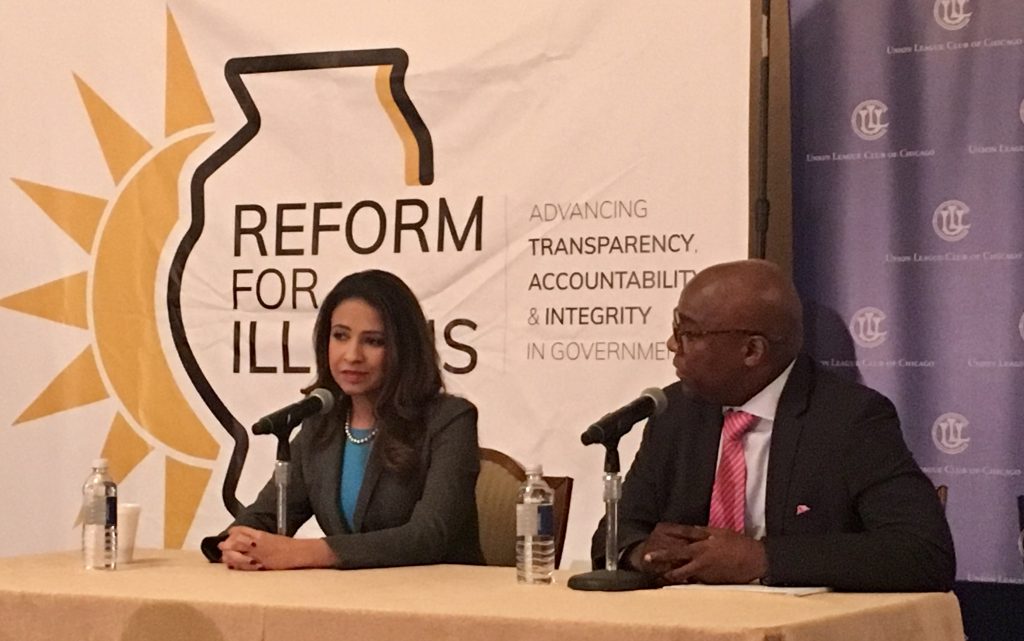
    Sentencing reform has not yet made a major appearance in the Attorney General race, but both State Sen. Kwame Raoul (D-Chicago) and Republican Erika Harold are expected to push the issue. Raoul is a former Cook County prosecutor and has served as the vice chair of the Illinois Sentencing Policy Advisory Council and on the Illinois State Commission on Criminal Justice and Sentencing Reform.

    In an email Wednesday, Raoul spokeswoman Aviva Bowen pointed to more than a dozen bills the Democrat has sponsored dealing with sentencing reform and juvenile justice.

    "Influenced by his experience as a prosecutor and his concern for neighborhoods plagued by crime and mass incarceration, Kwame has made criminal justice reform a focus of his career — and his volume of work is expansive," she said.

    Harold has long been involved in prison ministry, and serves on the national board of directors for the faith-based organization Prison Fellowship. A Harold spokesman described the Republican as "very passionate" about sentencing reform.
  • Democrats pushing a bill that would prohibit employers from asking about a job candidate’s previous salary finally sent the legislation to the governor’s desk on Wednesday. Meanwhile, an LGBT-focused independent expenditure committee filed paperwork with the Illinois State Board of Elections.
    To Read More Please Login or Join