


-
APR 23, 2026

UNLOCKEDIllinois House sends redistricting constitutional amendment to Senate
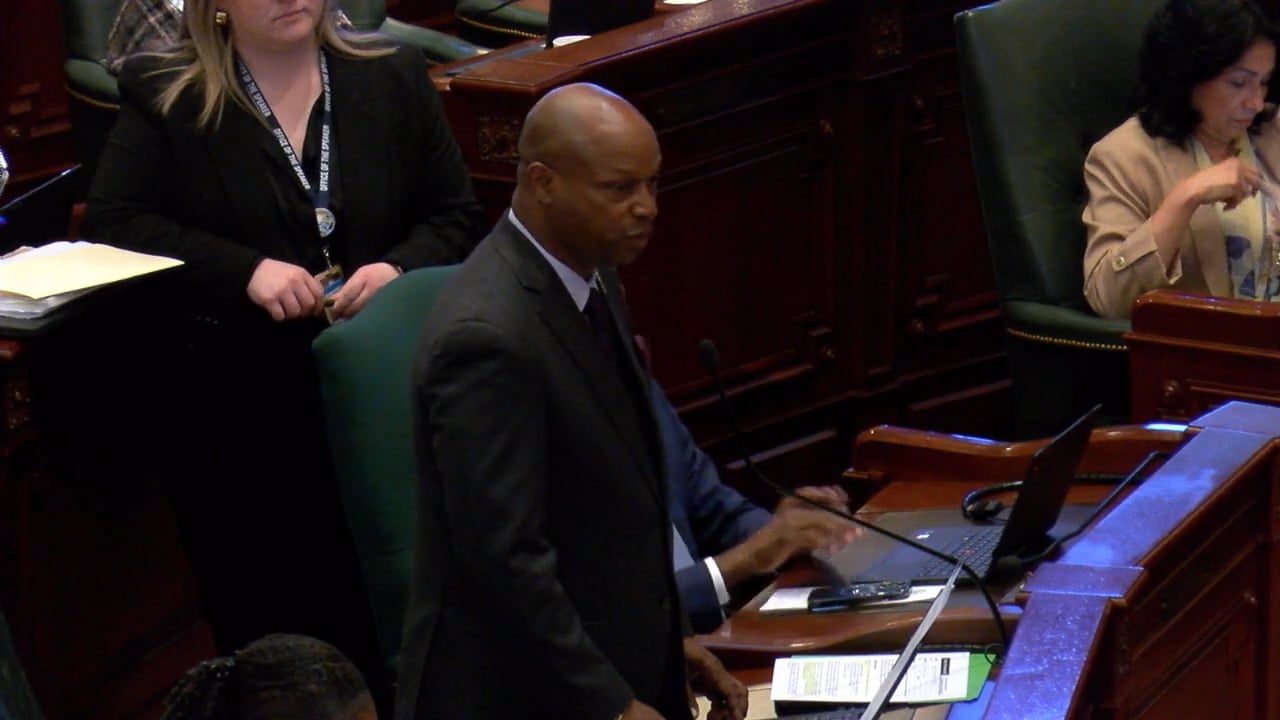
The Illinois House of Representatives approved a constitutional amendment Wednesday that would change the parameters by which the state redistricts.
Speaker Emanuel “Chris” Welch (D-Chicago) said the amendment is intended to preserve provisions of the federal Voting Rights Act and the Illinois Voting Rights Act into the Illinois Constitution that prevent minority communities from being split into various districts, limiting their voting power.
“Before the Voting Rights Act, Black representation in Congress consisted of five members, and towns across the country were racially gerrymandered in such a way that there was no minority representation on school boards, city councils and in state legislatures,” he said.
The U.S. Supreme Court appears poised to strike down this provision, limiting the ability of lawmakers to consider race when drawing districts, as reported by The New York Times.
“It is undeniable that the U.S. Supreme Court is poised to dismantle these protections,” Welch said. “And when it does, some states will quickly undertake new gerrymandering schemes aimed at stripping away Black and Latino and other minority representation. Here in Illinois, we refuse to go back.”
Welch’s amendment would preserve the provision in the state’s mapmaking process.
Currently, the Illinois Constitution states that districts “shall be compact, contiguous and substantially equal in population.”
House Joint Resolution Constitutional Amendment 28 would add two new considerations and create a priority scale. It would state that legislative districts must first be equal in population, then must ensure that “no citizen is denied an equal opportunity to participate in the political process and to elect representatives of his or her choice on account of race.”
Then, the state’s General Assembly — which draws the state’s maps that are then signed by the governor — must consider, where practical, the creation of “racial coalition or influence districts.” Those are districts where a racial or ethnic minority group holds enough of a majority to influence how the district votes.
Then, lawmakers must ensure districts are contiguous and, “to the extent practicable,” compact.
Rep. Theresah Mah (D-Chicago) — the state’s first Asian American elected to the General Assembly — said that the greater Chinatown community in her district was previously split up into four state House districts, preventing the Asian American community from electing one of their own.
She said it’s the Voting Rights Act — and subsequent court decision that prevented voter dilution based on race — that allowed the community to be compiled into one district.
“I am here in this chamber, the first Asian American representative in Illinois history, elected in 2016, almost 200 years into our state's history, because of the Voting Rights Act and because of our state's own work to guarantee that minority voices are not only heard, but have meaningful representation in their government,” she said.
Rep. Jehan Gordon-Booth (D-Peoria) said the amendment is intended to preserve voting rights for minorities in Illinois.
“What's happening at the federal level is not abstract,” she said. “If the Supreme Court is poised to gut the Voting Rights Act, we have to understand what we're dealing with. It literally is the last meaningful protection that we have against racial discrimination in voting.”
Illinois Republicans argue the amendment is not about preserving racial diversity but instead is intended to continue political gerrymandering in the state.
Rep. Dan Ugaste (R-St. Charles) said the deprioritization of compactness is a response to a lawsuit filed by House Republicans last year that argued the state’s current maps are unconstitutional. The lawsuit argued the maps violated that compactness standard.
“The communities in which we live were no longer taken as a whole; they were divided, and now we're going to put this in place to allow that to continue,” Ugaste said. “And that's just wrong. It's wrong because the people of the state of Illinois have a right to have their voices heard, and when we do this, we strip them of their right, because we as legislators then choose our voters, instead of them choosing us.”
Rep. Travis Weaver (R-Pekin) echoed this sentiment, saying lawmakers do not need to be the same race as their constituents to effectively represent them.
The amendment was approved 74-38. It now goes to the Senate and, if approved, to the Illinois voters. The Senate will have to approve it by May 3 for it to appear on the November ballot.


