


-
APR 22, 2026

UNLOCKEDIllinois House committee approves amendment enshrining ‘influence districts’ in Illinois Constitution
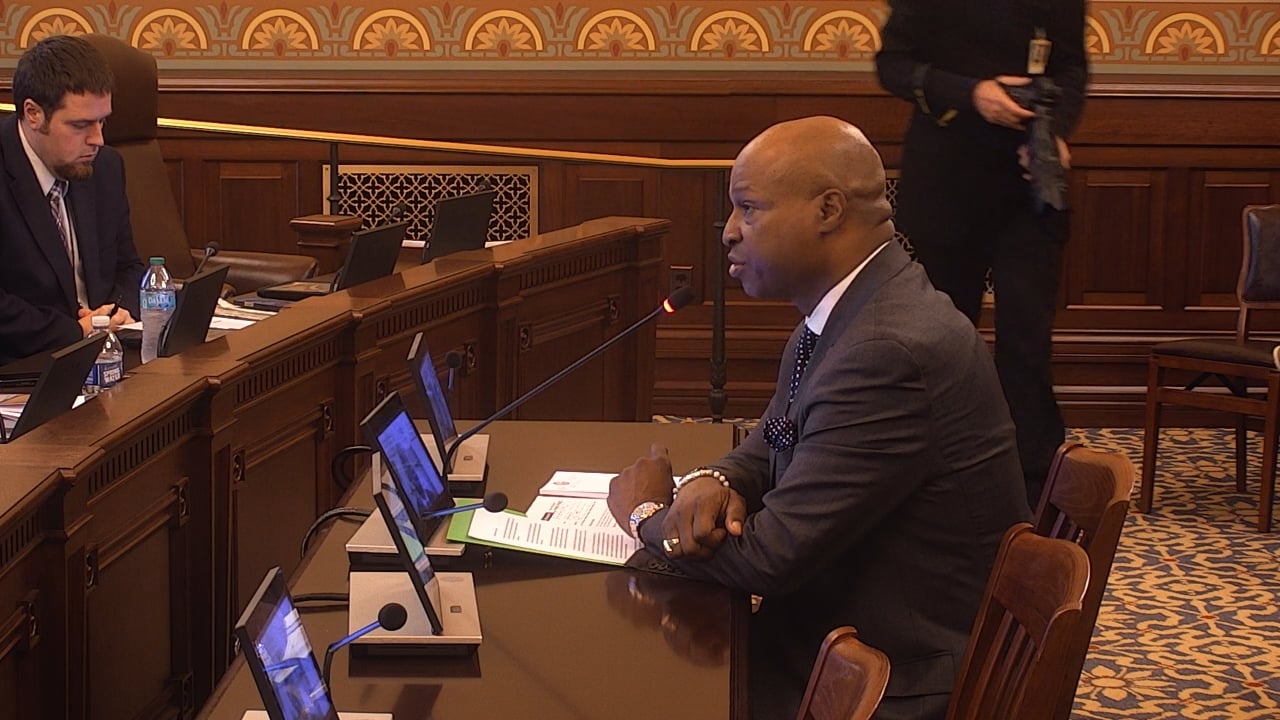
The House Executive Committee approved a constitutional amendment Tuesday that would change the parameters by which Illinois’ state legislative districts are drawn, making racial makeup a factor lawmakers consider when drawing the maps.
It’s a change Speaker Emanuel “Chris” Welch (D-Chicago) said is intended to preserve a provision of the Voting Rights Act that the U.S. Supreme Court appears poised to overturn.
Currently, the Illinois Constitution states that districts “shall be compact, contiguous and substantially equal in population.”
House Joint Resolution Constitutional Amendment 28 would add two new considerations and create a priority scale. It would state that legislative districts must first be equal in population, then must ensure that “no citizen is denied an equal opportunity to participate in the political process and to elect representatives of his or her choice on account of race.”
Then, the state’s General Assembly — which draws the state’s maps that are then signed by the governor — must consider, where practical the creation of “racial coalition or influence districts.” Those are districts where a racial or ethnic minority group holds enough of a majority to influence how the district votes.
Then, lawmakers must ensure districts are contiguous and, “to the extent practicable,” compact.
The U.S. Supreme Court — which has previously ruled against other provisions of the Voting Rights Act — heard arguments in October on whether a section of the act that allows voters to sue over dilution of voters based on race or gender is unconstitutional. The provision has been used to create districts with majorities based on race, which is intended to ensure minority voters are not shut out.
The case at the base of the decision is out of Louisiana, a state with a 30 percent Black population. The state was sued over its maps for voter dilution, as it had only one majority Black district. Louisiana ultimately redrew the map, creating two Black majority districts. As a result, two of the state's six representatives are Black, according to NPR.
But a second group of voters intervened, resulting in the case before the court, which could see as many as 19 congressional districts ruled unconstitutional.
Welch said his amendment is structured to maintain these protections in state races if the Supreme Court rules against the Voting Rights Act.
“[The amendment] ensures that no citizen, on account of race, is denied the opportunity to elect the representatives of their choosing and take steps to ensure Illinois voices are not silent, no matter what happens in Washington,” he said.
He noted the strides the act made in improving diversity both at the Congressional and state level.
“Our legislature looks like the state of Illinois,” he said. “We are the most diverse legislature in the history of this state. Gutting the federal Voting Rights Act would put that in jeopardy, and the people of Illinois deserve a legislature that looks like them.”
House Republicans quickly denounced the amendment, arguing it is an attempt to continue Democratic hold of the legislative maps. Democrats hold supermajorities in the General Assembly and currently hold 14 out of 17 Congressional seats.
“[This is] nothing short of the most blatant attempt to rig the system and permanently assure Democrat super majorities through a constitutional amendment,” said Rep. Dan Ugaste (R-St. Charles). “That's all it is. If passed, the amendment would permanently embed one of the most flawed and partisan map making processes in the country.”
Ugaste said lawmakers should instead consider a constitutional amendment filed by House Republicans to create a bipartisan commission to draw the maps, a process adopted by other states such as California to ensure fairness.
Gov. JB Pritzker has expressed his support for a bipartisan commission but said the change would have to be made at the federal level so it includes all states.
Rep. Ryan Spain (R-Peoria) argued the amendment is a response to a lawsuit filed by House Republican Leader Tony McCombie last year arguing the state’s current legislative map violated the Illinois Constitution.
The lawsuit argued the map gave an unfair advantage to Democratic voters and violated the compactness clause; the clause the constitutional amendment would no longer make mandatory.
The Illinois Supreme Court did not rule on the lawsuit, saying it was not timely as it was filed more than five years after the maps went into effect.
Spain said he believes the court would have ruled in their favor, and the amendment is attempting to change the Constitution before the next redistricting cycle so House Republicans can’t file the same lawsuit.
When asked about the lawsuit, Welch said that the maps had previously been upheld by federal courts.
The amendment was approved by a partisan 8-4 vote and now goes to the full House. The deadline for the amendment to appear on the November ballot is May 3.


