


-
SEP 19, 2025

UNLOCKEDCPD discusses overtime, staffing levels and alternative responses to some 911 calls during mid-year hearing
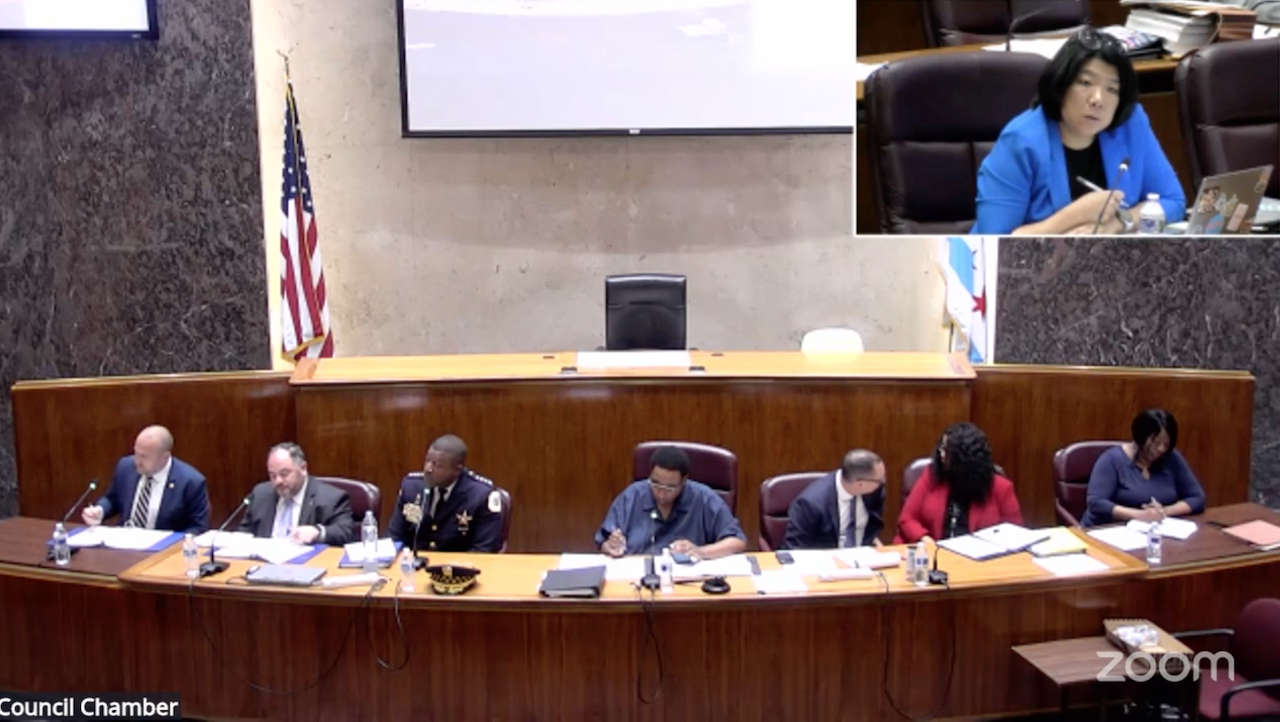
Chicago Police Supt. Larry Snelling responds to questions from Ald. Nicole Lee (11), budget vice chair, during a hearing Sept. 17, 2025. [Livestream]
During mid-year budget hearings on Wednesday, members of the public urged the City Council to divert hundreds of millions of dollars in unspent funds from the Chicago Police Department (CPD) to fill the gaps in the public health and violence prevention budgets that will be created by federal budget cuts.
But CPD Supt. Larry Snelling dismissed the arguments and told alderpeople that there weren’t many places to cut.
Through May 31, CPD spent about $754.1 million, or 40 percent of its non-grant-funded budget, which was more than $1.8 billion. Additionally, CPD was appropriated a $100 million overtime budget in 2025 and spent about $128 million through August.
In opening remarks to the budget committee, Snelling praised his department for the reduction in violent crime in the city this year, as well as an increase in the homicide clearance rate and funding for victim services.
Of CPD’s 12,646 authorized sworn officer positions, the department currently has 984 vacancies. It’s less than the 1,049 vacancies reported to the budget committee during last fall’s budget hearings.
CPD Deputy Director Ryan Fitzsimons told the committee that even though vacancies are down, the department’s overall number of authorized positions is down about 1,200 compared to 2019.
The hearing came after a morning protest that called on the City Council to divert funding from the police department and toward youth programs, mental health care and violence prevention. Many also spoke in favor of diverting funding during public comment.
“We need a holistic approach to violence prevention that’s centered in healing and incentivizing peace,” Reece Johnson, from GoodKids MadCity, said in a news release. “The $300 million slush fund in the Chicago Police Department budget is set aside year after year for 1,000 positions they can’t even fill, but Chicago youth are ready to keep the peace and do the work of violence prevention in their neighborhoods. When our work is funded, gun violence drops by 40 percent. That’s real safety we can see and feel. And we need to invest more, not less.”
Ald. Pat Dowell (3) asked Snelling to respond to the claims that CPD had a $300 million “slush fund.” Snelling said he didn’t know what organizers were referring to.
“I really wish I knew where that money was. It would be helpful to us,” Snelling said, with Fitzsimons claiming that CPD’s vacancy savings and overtime spending don’t add up to that total.
Ald. Jason Ervin (28), chair of the Committee on Budget and Government Operations, asked Snelling about CPD employees out on medical leave and the processes for getting them cleared to return to work. This follows discussions last week with the Office of Public Safety Administration (OPSA) — which manages medical leave and return-to-work clearance for CPD and other public safety agency employees — about ways to reduce lengthy medical leave, especially when people may be physically able to partially return to their work duties.
While the Chicago Fire Department does not have a partial return or “limited duty” option, CPD does. Snelling said CPD uses employees on limited duty for administrative functions, but he said he wished CPD had more control over returns to work.
“I would like to have the ability to have more control over how we go out and we determine those who are using the medical [leave] or those who are out on the medical [leave], for us to do those checks to make sure that we keep balance to keep down the possibility of any level of abuse,” the superintendent said. “It's necessary for us to have that function back.”
Dowell also asked the superintendent about how he plans to reduce overtime. Snelling responded that the summer tends to be when CPD uses the most overtime because of the combination of large-scale events, such as parades and music festivals, and the need to keep resources in the neighborhoods where violence ticks up in the summer. Protest response also drives up overtime costs, he said.
“Because we have to keep the city safe, and we don't want to pull all of our resources out of those areas where we know violence occurs on a higher level, we have to make sure that we maintain that balance in the neighborhoods,” Snelling said. “So when we are sending people out to these events, we have to do it on overtime.”
The force being budgeted for about 1,200 fewer officers compared to six years ago drives up overtime in situations that used to not warrant it, Snelling said. Yet despite being over the budgeted amount, overtime was still down from the same time period last year, when it was $156 million, Fitzsimons said.
Snelling also said that large events should consider hiring private security in order to reduce the burden on CPD.
Ald. Gilbert Villegas (36) asked Snelling about the potential for re-hiring retired officers on a part-time basis to cover special events.
Snelling said that while retired officers are sometimes rehired to work in training roles at the police academy to free up sworn officers, rehiring retired officers to sworn roles could present a union contract issue.
Some alderpeople also said that, given CPD’s comparatively reduced resources, more work should be done to ensure officers are not constantly being sent to respond to calls where a police officer is not necessary.
“Officers go out because they are called, [but] when they get on site, [it] turns out that they can't actually be helpful,” said Ald. Rossana Rodriguez-Sanchez (33), who chairs the Committee on Health and Human Relations and has been at the forefront of the push for non-police responses to mental health crisis calls.
While Snelling said he never thought it was a “waste of resources” for an officer to respond to a 911 call, he conceded that there were types of calls that officers don’t have the ability to properly respond to and address, such as parents calling 911 for behavioral issues with a child.
Still, Snelling said his department worries about potential liabilities if they were to decide not to respond to certain calls.
“When we start deciding as a police department that we're not going to a call, if it turns out to be more volatile than the call seemed like it was when it came out, then now the Chicago Police Department didn't respond,” Snelling said. “And as a result of not responding, someone's hurt, injured, possibly even lost their lives, and that becomes a liability for the department.”
Ervin said he doesn’t want the police to be deciding not to respond to calls that it has been dispatched to. Rather, he said there should be consideration about diverting certain categories of calls that don’t require police away from CPD.
“I do think that, intuitively, that it begs a conversation and at least some evaluation because, again, resources are at a premium,” Ervin said.


