


Chicago News
-
Voters in Woodlawn and Washington Park will be asked to weigh in on whether the Obama Presidential Center should sign a community benefits agreement that includes an affordable housing mandate and a property tax freeze for long-time residents.
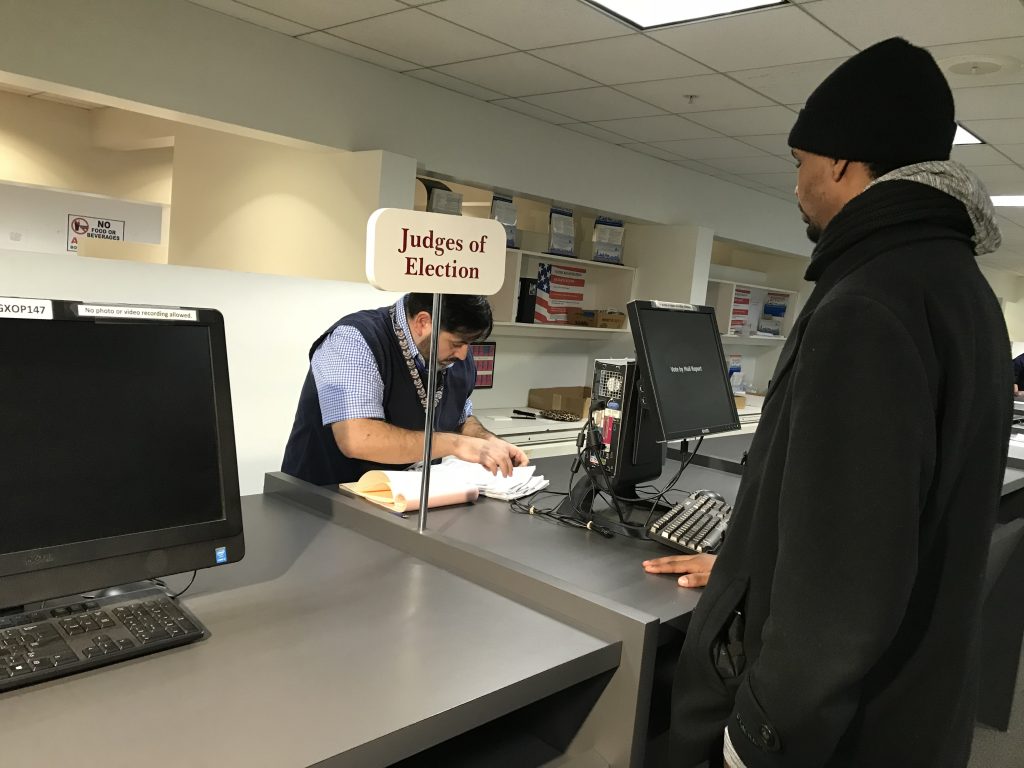 Devondrick Jeffers turns in petitions to put an advisory referendum about the Obama Presidential Center on the February ballot. [Submitted]
 -
Mayoral candidate Gery Chico’s law and consulting firms have contracts with multiple companies doing business with city agencies, while fellow candidate William Daley received more than $25,000 for two speeches, according to statements of financial interest filed with the Chicago Board of Ethics.
-
As the holiday shopping season kicks off in earnest after the last of the Thanksgiving leftovers are packed away, the Chicago Board of Ethics has a warning for city officials: “When in doubt, just say ‘no thanks,’” to gifts and avoid “employment sanctions, removal from office, fines, and public shaming. No gift is worth that.”
-
NOV 21, 2018


-
-
NOV 20, 2018
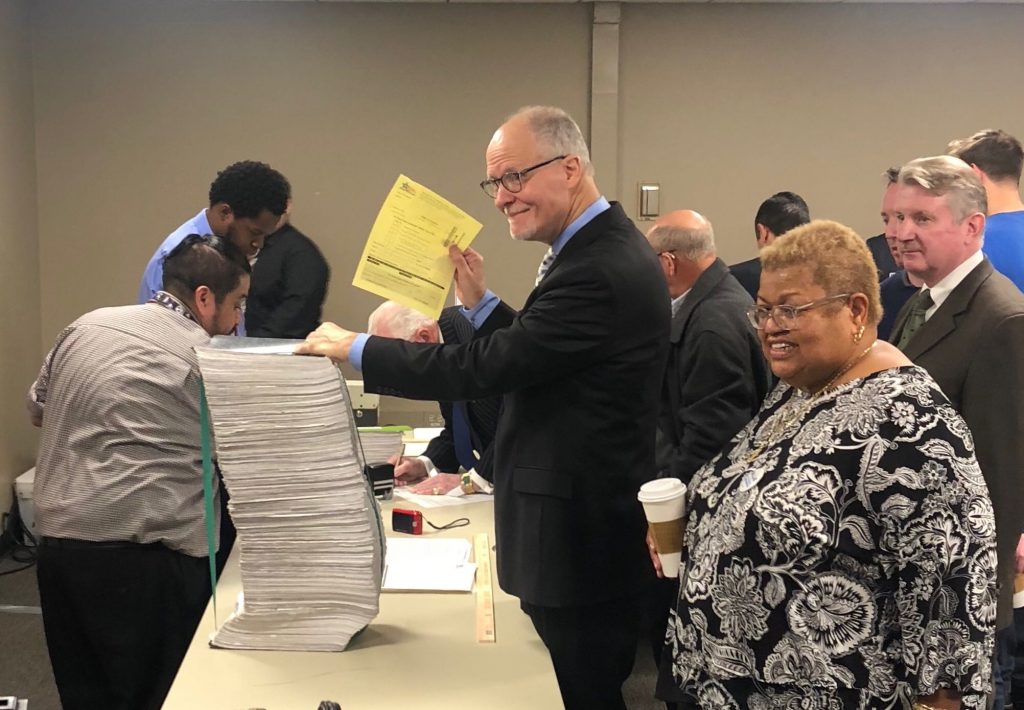
Mayoral candidate Paul Vallas submits his petitions to make it onto the ballot. [A.D. Quig/The Daily Line]
Precisely 120 candidates vying for Chicago mayor, city clerk treasurer and alderman filed nominating petitions Monday — with the vast majority lined up and ready to go before 9 a.m.
-
The city’s next five-year housing plan calls for Chicago officials to spend $1.4 billion to build or preserve 40,000 homes during the next five years.
 The city’s next five-year housing plan calls for Chicago officials to spend $1.4 billion to build or preserve 40,000 homes during the next five years. [BRIAN KELLY / FLICKR]
 -
NOV 16, 2018
City Hall fixture George Blakemore was tackled by a Chicago Police officer at Thursday’s Plan Commission meeting after being admonished not to speak out of turn. Five aldermanic candidates hoping to move the City Council to the left got a boost Thursday at City Hall with the endorsement of Reclaim Chicago, while a bill designed to address the future of the Cook County Board of Commissioners if Toni Preckwinkle becomes mayor advanced Thursday.
-
Plans to create a new neighborhood between the South Loop and Chinatown will include requirements for the developer to build 500 affordable housing units in Pilsen and Little Village, according to a detailed development proposal approved unanimously by the Chicago Plan Commission.
-
-
As of Dec. 3, the Cook County Board will fundamentally change, with seven new members — all Democrats — being sworn in. Wednesday’s full board meeting was a last chance for colleagues to say goodbye and share some memories as part of the official record.
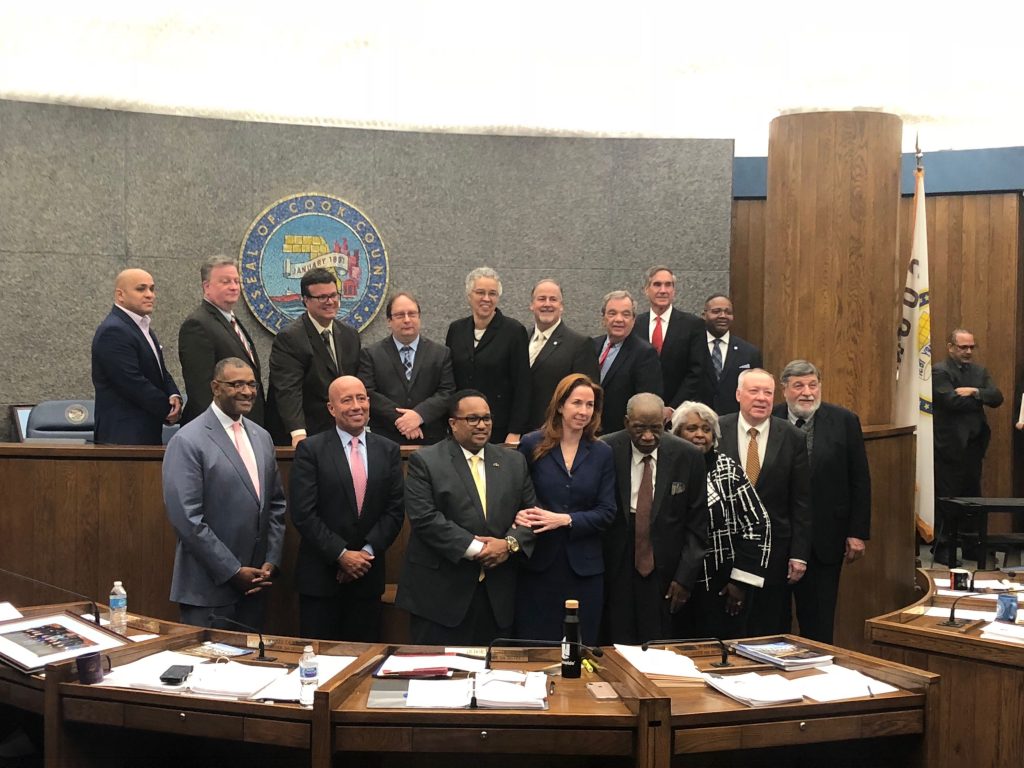 The Cook County Board of Commissioners gather for one last picture. [Cook County]
 -
With only a single dissenting vote, Chicago aldermen Wednesday approved Mayor Rahm Emanuel’s $10.67 billion 2019 spending plan, which contains no new taxes or fees.But as aldermen rose one by one on the floor of the City Council to celebrate the millions of dollars included in the budget for expanded mentoring services, rodent control, summer jobs and tutoring programs, several sounded the alarm about issues facing the city that the budget does not address, including the looming pension crisis and the demand for affordable housing.
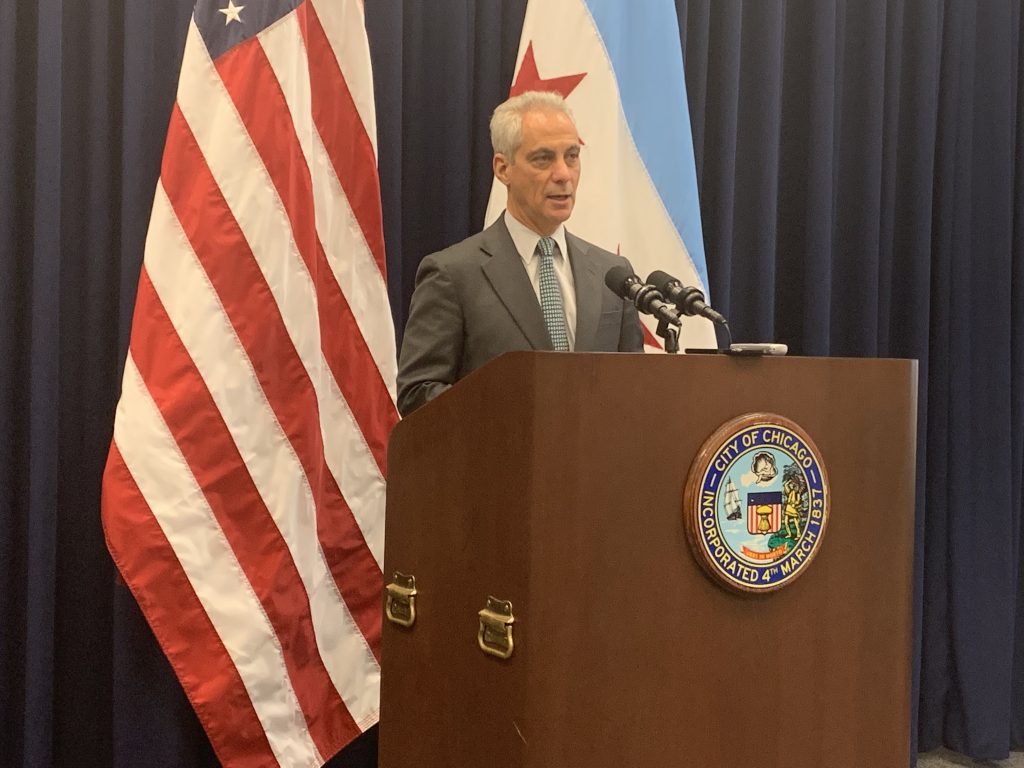 Mayor Rahm Emanuel said he would like to be remembered as a mayor who tackled problems head-on. [Heather Cherone/The Daily Line]
Mayor Rahm Emanuel once again claimed credit for bringing the city back from the edge of a fiscal cliff during his nearly complete two terms in office.
“We can say with confidence that Chicago is back on solid ground,” Emanuel said. “We have refused to allow the city’s past mistakes to rob us of the future we are trying to build. We have rejected the old way of doing business. We have replaced instability with stability, wishful thinking with honest accounting and broken budgets with balanced budgets.”
Ald. Scott Waguespack (32) cast the lone vote against the budget, while Ald. Derrick Curtis (18) was absent. Waguespack said he was disappointed that the budget did not address pensions or “devastating crime driven by poverty and disinvestment in mental health.”
“Perhaps most concerning of all, we are missing a funding mechanism to address the abatement of lead that pervades the pipes in our homes, daycares, schools, parks and businesses,” said Waguespack, who considered running for mayor before deciding to run for re-election. He is currently unopposed.
Emanuel said he would deliver a speech before the next City Council meeting, set for Dec. 12 to lay out how he plans to staunch the red ink set to flow from the city’s pension funds. The pension bill is set to jump 31 percent in 2020, and officials have yet to propose a way to cover that expense.
“Our work is not done,” Emanuel said. “But we have laid a foundation.”
In that speech, Emanuel vowed to “be honest with the public” about not only the costs of employee pensions, but also what benefits retirees get for their decades of service.
Nonpartisan watchdog group the Civic Federation called the jusbudget “a reasonable one-year financial plan that does not include any new taxes or fees [and] makes important public safety investments.”
Ald. Raymond Lopez (15) said the budget should have done more to confront pension funding.
"No one should kick this any further than it needs to be,” Lopez said. “More has to be done to address the financial crisis that's on the horizon."
But most aldermen used their time to praise Emanuel’s leadership for helping the city navigate rough financial waters.
Read all of The Daily Line’s coverage of Chicago’s 2019 budget here.
Budget Committee Chairwoman Ald. Carrie Austin (34) said she wished Emanuel had run for a third term.
“Mr. Mayor, you truly are a visionary,” Austin said.
Ald. Joe Moore (49) was one of several aldermen who praised Emanuel for re-establishing the Department of Housing, which was disbanded before he took office. The new department will have $1.4 million in additional funding, and a mandate to expand affordable housing.
Moore, the chairman of the Housing Committee, said the department will work to ensure "every neighborhood has its share of affordable housing."
Ald. Ariel Reboyras (30) lauded the mayor for including $27.5 million for police reform, including cost of the monitoring team that will be charged with ensuring the city and Police Department comply with the changes ordered by Judge Robert M. Dow.
But among the backslapping, several aldermen publicly contemplated what life would be like next spring under Emanuel’s successor.
Ald. Danny Solis (25) said he was "concerned about a future" without Emanuel, adding that the mayor’s stellar legacy "won't be recognized for three to five years, but it will be recognized" eventually.
Ald. Ed Burke (14) likened the aldermen to “lost sheep” in the wake of Emanuel’s departure. After the final vote, aldermen gave the mayor a standing ovation.
At his post-meeting news conference, Emanuel said he was proud of his work not only to establish “greater fiscal discipline and certainty” but also to redirect spending to focus on areas that improve the quality of life in Chicago.
“That is a peace of mind legacy,” Emanuel said. “I never, ever once punted on a tough decision. I may not have done everything you thought I should do, but you do not solve decades-old problems in one step. Every time there was a problem, I met it head on, was honest about it and addressed it.”
Chicago voters will go to the polls Feb. 26 to elect a new shepherd.
In other action, aldermen approved all of the other items outlined in our preview, including confirming the appointment of Richard C. Ford II as commissioner of the Chicago Fire Department.
Emanuel praised him as the “right man for the right job at the right time,” and aldermen followed their vote with a standing ovation.
Ald. Brendan Reilly (42) moved to kill once and for all three competing proposals to hike real estate taxes. He deferred and published Tuesday’s Rules Committee action, which meant the three proposals could not be referred to committee for another month.
One proposal would hike the city’s Real Estate Transfer Tax to fund police and fire pensions, the other would hike the same tax to expand efforts to end homelessness in Chicago and the third would raise taxes to replace lead service lines in Chicago’s homes.
The Rules Committee will not be able to schedule a hearing on the merits of those proposals before Dec. 10, the deadline for final City Council action to put the measures on the February ballot.
After the meeting, Reilly said he agreed with Emanuel that the city should not “treat homeowners as an ATM machine.”
The proposals are “irresponsible” but “well intentioned,” Reilly said.
“If all three passed … that would be a disaster for homeowners,” Reilly said. “It is best left for the next administration to address.”
Ordinances introduced Wednesday
Among the ordinances introduced Wednesday is a proposal from Mayor Rahm Emanuel to launch a new pilot program (O2018-9030) that would increase the city’s affordable housing requirement from 10 percent to 20 percent within large-scale, market-rate housing developments in a 7.2-mile area in Pilsen and Little Village. City officials said the measure was designed to keep Mexican and Mexican-American families in Pilsen and Little Village, according to Block Club Chicago.
In addition, Emanuel proposed a grant of $1 million (O2018-9197) to Catalyst Circle Rock Elementary School to rehab a vacant auditorium into a performing arts center and a grant of $720,000 (O2018-9196) Bronzeville Salon Suites to construct a three-story, 6,500-square-foot building with 18 fully equipped salon suites to enable established beauty professionals to become independent business owners. Both projects would be funded by the Neighborhood Opportunity Fund grant program.
Emanuel also proposed to terminate five tax-increment financing districts on Dec. 31. None of the TIF districts have pending obligations or ongoing projects, officials said.
Other proposals include:- A measure (O2018-9195) from City Clerk Anna Valencia to waive the fee for veterans to obtain city stickers.
- A measure (R2018-1243) from Ald. Raymond Lopez (15) to require all committees to have a majority of members present to act on legislation.
- A measure (O2018-9080) from Ald. Raymond Lopez (15) to ban the sale of menthol cigarettes and menthol-flavored liquid nicotine.
- A measure (O2018-9033) from Ald. Ed Burke (14) and Ald. Raymond Lopez (15) to ban all single-use plastic straws and drink stirrers. An advisory referendum passed in the Nov. 6 general election, winning more than 50 percent support from voters.
- A measure (O2018-9107) from Ald. Brian Hopkins (2) to change the zoning of the Hideout, in order to protect it from the adjacent Lincoln Yards development.
- A call for a hearing (R2018-1242) from Ald. George Cardenas (12) and Ald. Matt O’Shea (19) on the discovery that the water Chicagoans drink and bathe in might be tainted with lead. A similar request from Ald. Pat Dowell (3) and nine members of the City Council’s Progressive Caucus has been languishing since April.
 [Flickr/life_chasing]
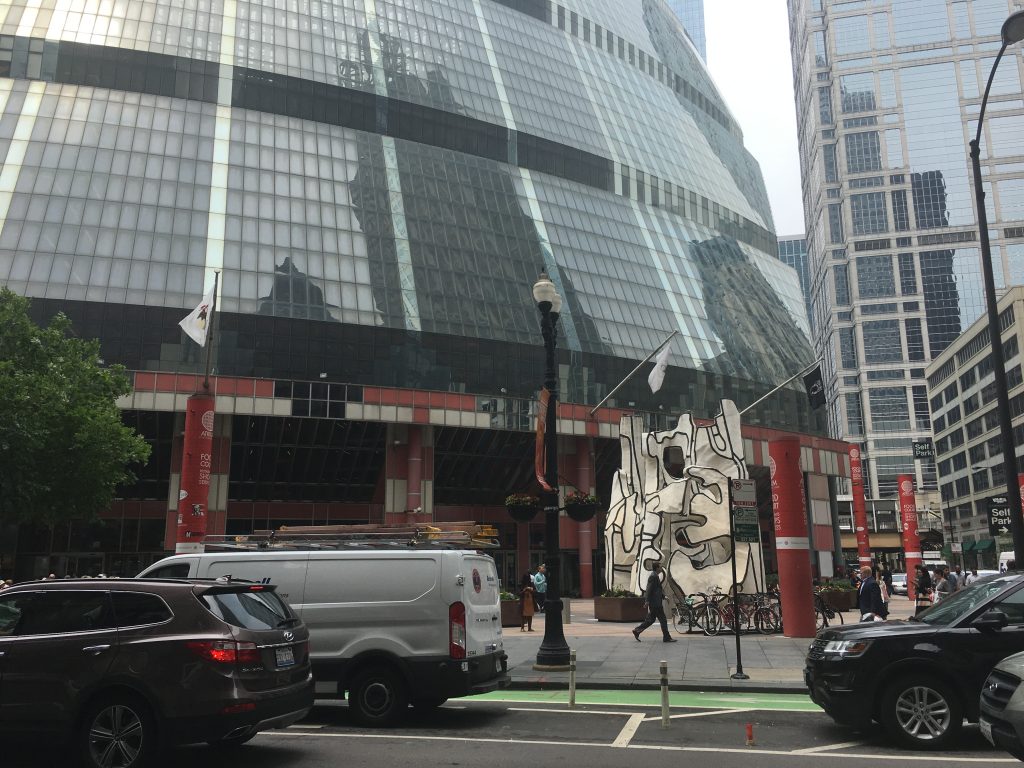 The Thompson Center in the Loop. [Heather Cherone/The Daily Line]
 A rendering of the proposed park in the The 78. [Related Midwest]

