


Chicago News
-
Ten progressive aldermen who plan to vote as a block on the city’s 2020 budget urged Mayor Lori Lightfoot Tuesday to close the city’s $838 million by taxing large corporations, imposing an income tax on high-earning commuters and Chicagoans and emptying the city’s tax-increment financing districts.
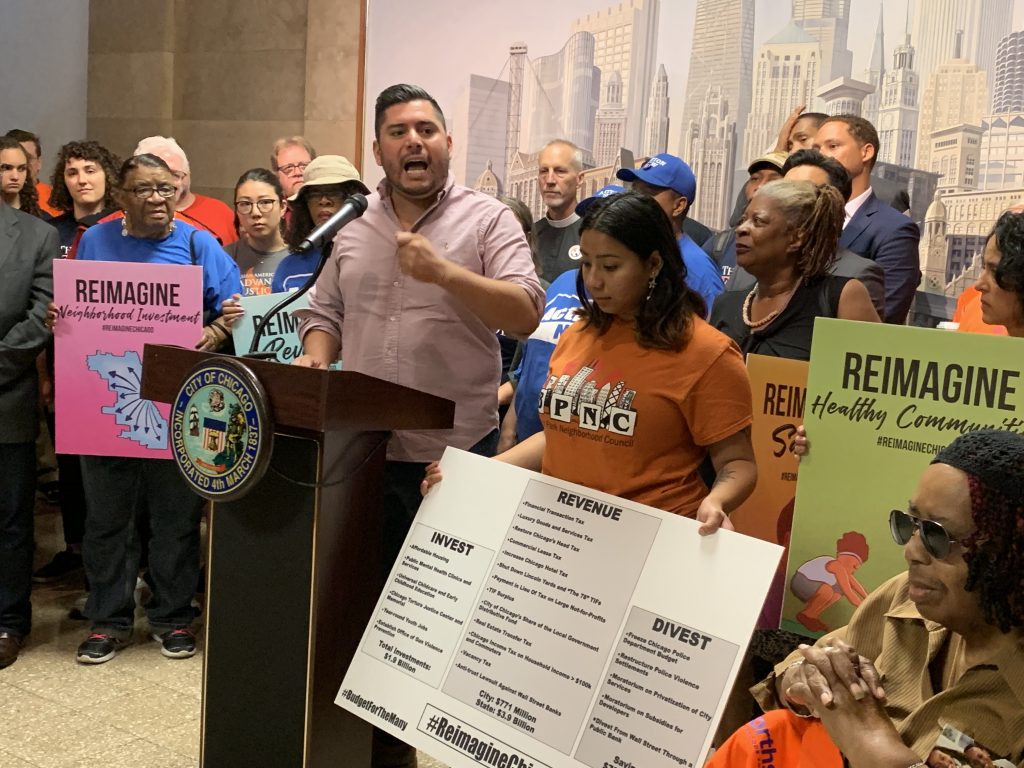 Ald. Carlos Ramirez-Rosa (35) rallies members of the Reimagine Chicago coalition. [Heather Cherone/The Daily Line]
-
-
With less than two months until 17,100 youth in Illinois’ foster care system are supposed to be switched from their current fee-for-service Medicaid healthcare programs and into a Medicaid Managed Care Organization, critics said Tuesday the agency and the organization are nowhere near ready for that transition and plan to ask for a delay.
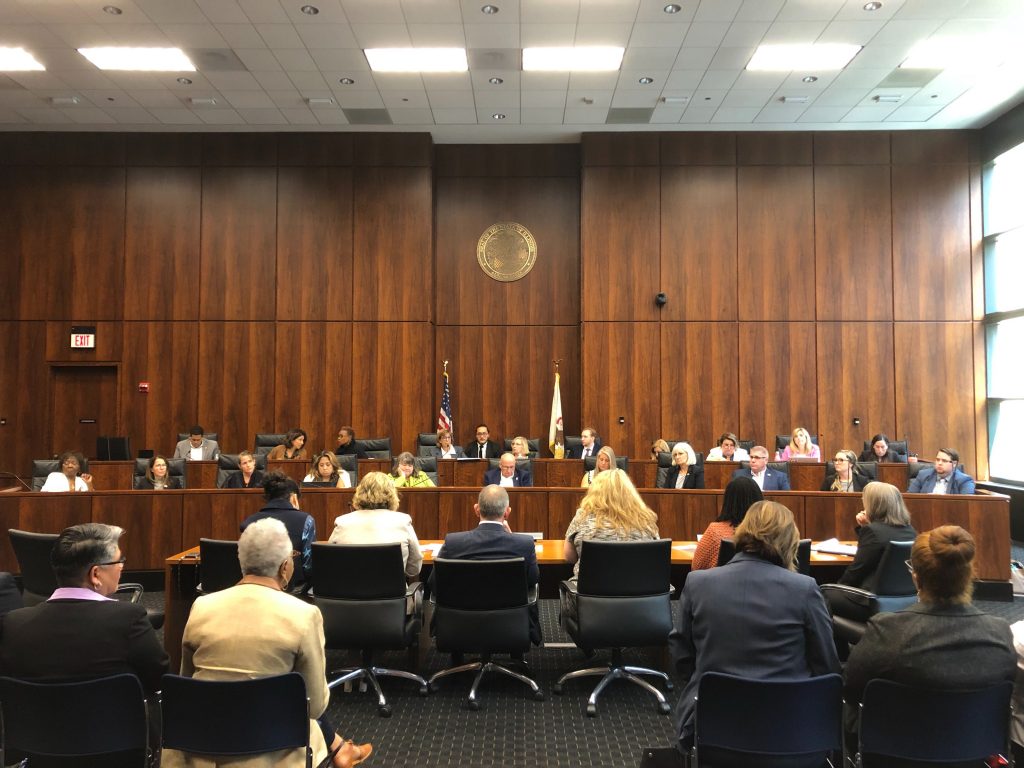 Officials with the Illinois Department of Children and Family Services, Department of Human Services and IlliniCare testify in front of a combined House Adoption and Child Welfare Committee and Appropriations - Human Services Committee in Chicago Tuesday. [Hannah Meisel/The Daily Line]
A marathon four-hour House hearing held in Chicago focused on issues with the state’s Department of Children and Family Services, which has been under fire for months.
In addition to 17,100 children and teens in state custody, 18,800 young adults younger than age 26 who were in state custody are also supposed to begin their healthcare coverage with IlliniCare, a part of HealthChoice Illinois, the state’s Medicaid Managed Care Program. The state’s Medicaid program has gradually been transitioning to largely managed care, which promises better healthcare outcomes — as well as savings through efficiencies — through caseworkers managing cases for Medicaid patients.
A law passed last year and signed by former Gov. Bruce Rauner was supposed to provide guidance for DCFS and whichever organization, known as a MCO, was selected as to the transition from fee-for-service to managed care.
The bill was pushed by the ACLU of Illinois, and passed the General Assembly unanimously in the Senate and overwhelmingly in the House last year. But since then, ACLU Illinois Director of Institutional Reform Heidi Dalenberg said DCFS hasn’t done enough to get ready for the transition, and that moving ahead anyway would spell danger, especially for the foster care population. Dalenberg told The Daily Line the transition is much more complicated than if an adult switched regular health insurers, which she noted is already stressful.
“Multiply that by 17,000 people,” Dalenberg said. “Add into that you’re not the birth parent, you’re the foster parent.”
Dalenberg said the intent of the bill was to make sure that when a transition to an MCO did happen, there would be assurance that the organization chosen would have an adequate amount of healthcare providers to serve the diverse medical needs of thousands of foster care children, and to ensure there is no disruption to care.
“I don’t think kids are getting adequate care now,” Dalenberg said. “That’s not a reason to push them into an MCO where there might be even less providers…They’ve made the choice to apparently not to be able to be in the position to be ready to roll this out now.”
Dalenberg, who oversees longstanding consent decrees that govern DCFS, said she hadn’t seen indication that IlliniCare had an adequate provider network of doctors and therapists, and that even basic infrastructure like “where to send bills in and how to get paid” hasn’t been established.
Related: DCFS struggling to follow decades-old consent decree: ACLU
State Rep. Mary Flowers (D-Chicago) hearkened back to periods in recent history when the state grappled with healthcare for its foster care population
“With all due respect, I’ve seen this show before,” Flowers said. “The 80s, the 90s…2019. I don’t know what it is about wards of the state that their healthcare should be different.”
Flowers read from the language of SB 1851 and asked if DCFS and IlliniCare had followed the steps included in the law. Officials pointed to a six-page document outlining the transition, which has been available online since last December, and said an updated plan would be available in the coming weeks.
But Flowers wasn’t satisfied.
“We’re playing with people’s lives,” Flowers said. “You’re not ready for November 1.”
IlliniCare President and CEO Leslie Naaman told the panel that the company was prepared, and rejected the notion that the MCO would intentionally save money by rejecting Medicaid claims, a frequent criticism of organizations in Illinois generally.
“The idea is not to get to an appeal,” Naaman said. “The idea is to get kids to safety, stability, permanently each and every time. I am totally committed to that goal. I would say to you: we have designed what I think is a very unique program…we get it done on the spot. “
Naaman pointed to what she called an “intensive” and “very responsive model,” in which IlliniCare has planned to hire 150 people, “many of whom are clinicians,” who will interact with children. She also said IlliniCare stands ready contracted with physicians, and a “rapid response unit” with eight liaisons at DCFS sites throughout the state.
Officials with IlliniCare declined to comment after Tuesday’s hearing, while DCFS Director Marc Smith declined a brief interview.
State Rep. Sara Feigenholtz (D-Chicago) was skeptical about DCFS’ ability to get the older population of former youth in care into IlliniCare, noting that the MCO would need a large and diverse population to succeed, just like any other healthcare insurance pool.
When she asked how these 18,800 former youth in care would be informed they’re eligible for healthcare through IlliniCare, DCFS Deputy Director Debra Dyers-Webster said the agency would send letters to the addresses on file for them.
“What do you think the return rate on those letters will be on the addresses you have?” Feigenholtz asked.
Webster replied: “I don’t know.”
Feigenholtz asked if “anybody want[ed] to make a bet.”
“Any bets?” she asked “I’m just really concerned…I think the reality of the lives of some of these children are really hanging in the balance. I appreciate your design but I’m not convinced.”
Tracy Johnson, the director of youth care and special needs children product implementation with IlliniCare, told the panel that when children age out of foster care, many couch surf or end up in the criminal justice system. Johnson said IlliniCare is “definitely open to other ideas” on how to reach former foster children.
State Sen. Robert Peters (D-Chicago) asked IlliniCare officials whether the firm would be making a profit from its contract with the state.
“Do you expect to make a profit off of foster care youth?” Peters asked after asking those in the room to raise their hands if they believe youth are some of the most vulnerable Illinoisans. “Or do you expect to lose money? Is there an income projection?”
“Yes, there would be a profit,” IlliniCare Deputy Administrator of Care Coordination Robert Mendonsa said, adding that the firm hadn’t “built any managed care savings into the first year of this program.”
“We know we need to invest and do the right thing and not have any expectations of those savings,” Mendonsa said. “We do believe they will exist over time.”
Johnson added that IlliniCare was “hoping to break even” in the first year.
Feigenholtz told The Daily Line after Tuesday’s hearing that she and State Rep. Robyn Gabel (D-Evanston) intended to write a letter in their capacity as chairs of the House’s Adoption and Child Welfare and Appropriations - Human Services committees to Gov. JB Pritzker’s office, in addition to Smith and Department of Healthcare and Family Services Director Theresa Eagleson, asking for a delay to prevent IlliniCare from going live on Nov. 1.
“I don’t think we want to demonize managed care,” Feigenholtz said. “I don’t think that’s the purpose. But at the end of the day, we want to see sort of the warm handoff…I think you heard every member asking questions from their own experience when a call comes into their office about healthcare coverage. It’s just adding a layer, a sort of more opaque unknown.” -
Mayor Lori Lightfoot’s first proposal to increase the supply of much-needed affordable housing would partner with the Chicago Community Land Trust to use fees that developers paid to avoid building homes for low- and moderate-income homes in order to increase home ownership.
-
SEP 11, 2019

UNLOCKED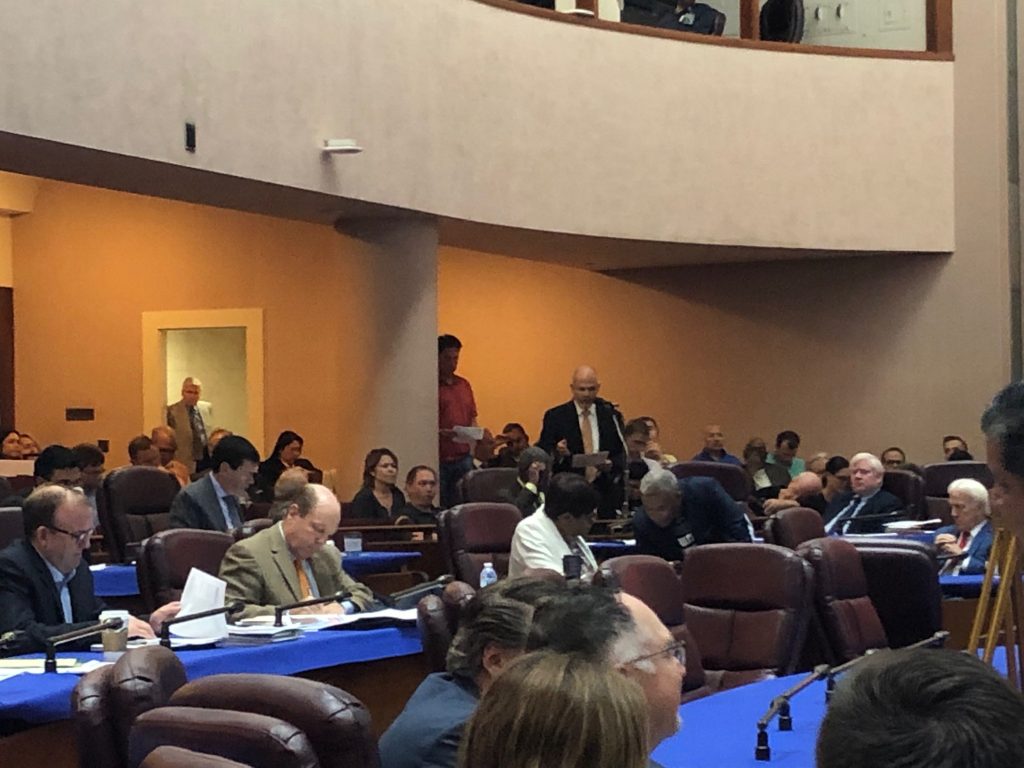
Roger Romanelli, of the Fulton Market Association, urged aldermen to rethink the changes to allow more community input. [Alex Nitkin/The Daily Line]
Aldermen on Tuesday advanced a sweeping initiative that would open the door for some offices and retailers to move into the industrial area west of Fulton Market, despite protests from some business owners who called the plan overly restrictive.
The changes (O2019-5606) were first proposed last year by the city’s Department of Planning and Development under former Mayor Rahm Emanuel as a way to invite more businesses into the Kinzie Industrial Corridor, which is bounded by Ogden Avenue, Sacramento Boulevard, Lake Street and Grand Avenue, while maintaining the area as a predominantly industrial zone. -
The City Council's Office of Financial Analysis now has two analysts ready to help aldermen break down Mayor Lori Lightfoot’s 2020 spending plan, which must close a budget gap of $838 million.
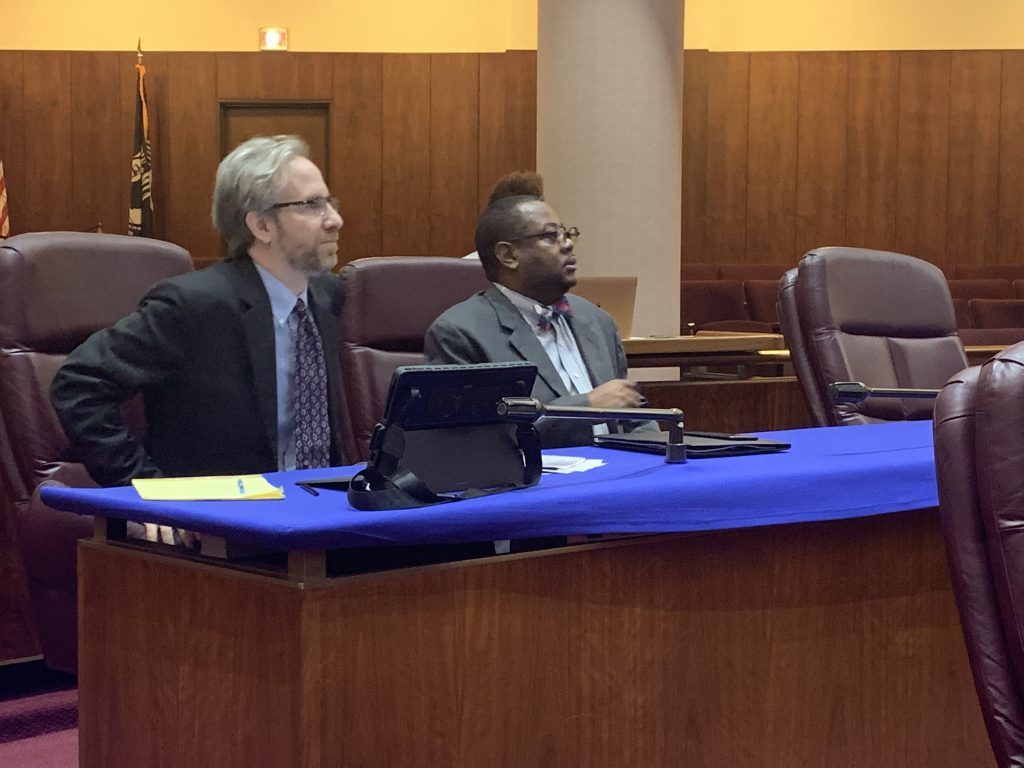 Kenneth Williams, right, joined Jonathan Silverstein as an analyst in the Office of Financial Analysis. [Heather Cherone/The Daily Line]
-
SEP 10, 2019
 Former State Sen. Ira Silverstein resigned over the weekend from his post as Democratic committeeperson for the 50th Ward, relinquishing his political pull as he ramps up his campaign for a Cook County judgeship.
 Ald. Debra Silverstein, right, and Halle Quezada. [Submitted]
-
Aldermen peppered city officials with questions Monday, demanding to know why the city changed the way it awarded $200 million in grants to nonprofit groups that educate low-income children younger than 5, icing out organizations that had served their communities for decades.
-
A years-in-the-making plan to allow offices and retailers to move into a traditionally industrial stretch of the Near West Side is set for a key vote Monday by the City Council’s Zoning Committee Tuesday, teeing it up for final approval next week.
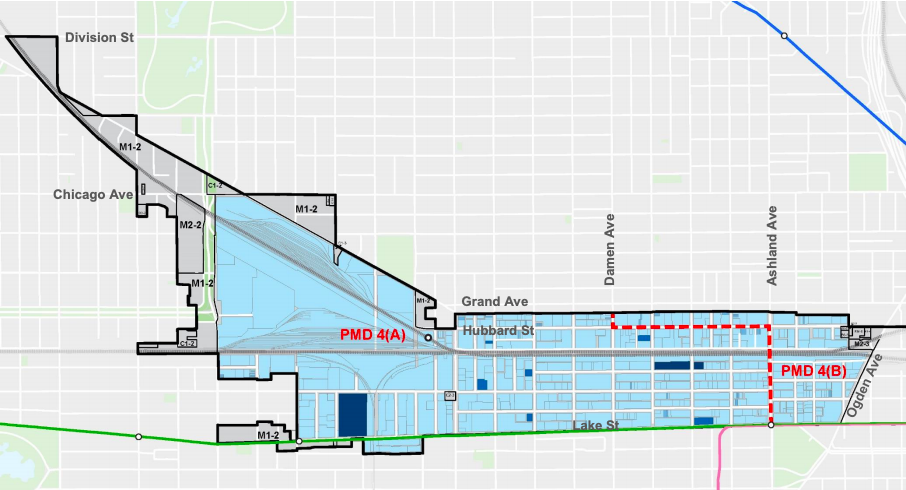 A map of the Kinzie Industrial Corridor. [City of Chicago]
-
Ten progressive aldermen plan to vote as a block on the city’s 2020 budget — putting Mayor Lori Lightfoot on notice that they will vote against any budget that does not build “a city that provides for the many, not just the wealthy few.”
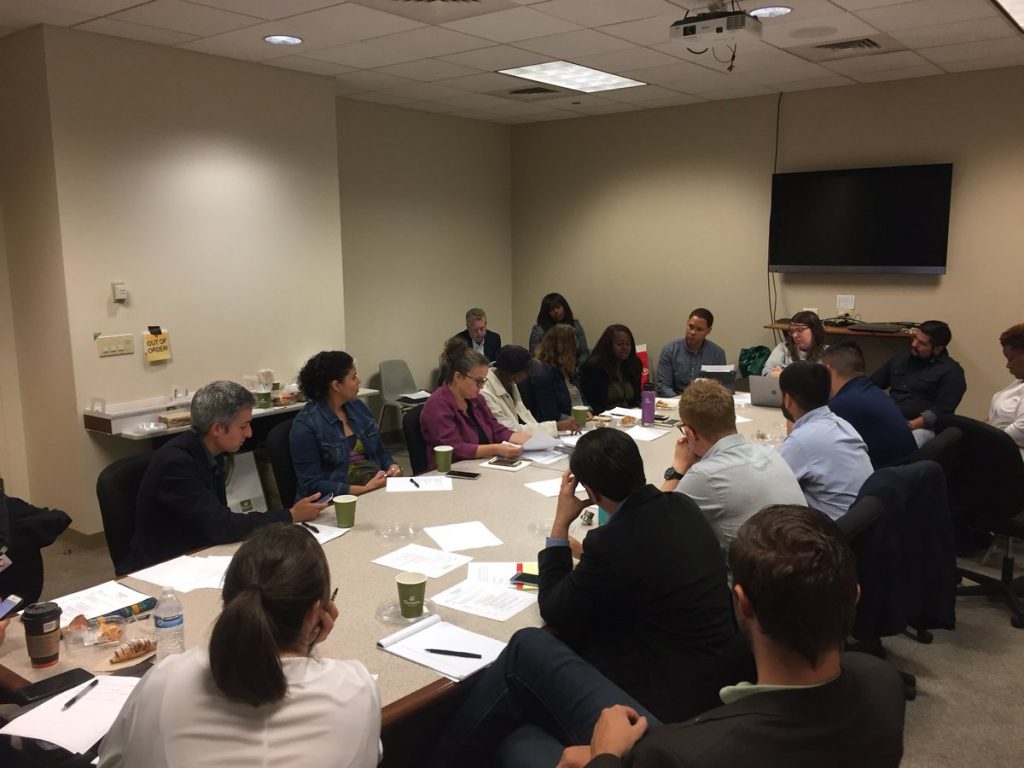 Several aldermen meet with members of United Working Families Thursday to strategize on the budget. [Twitter/@UWFIllinois]
-
SEP 09, 2019
-
A new study showing that rents and home prices are rising near the future site of the Obama Presidential Center proves that those warning that the $500 million project would fuel gentrification and displacement in Woodlawn have been right all along, Ald. Jeanette Taylor (20) said Thursday.
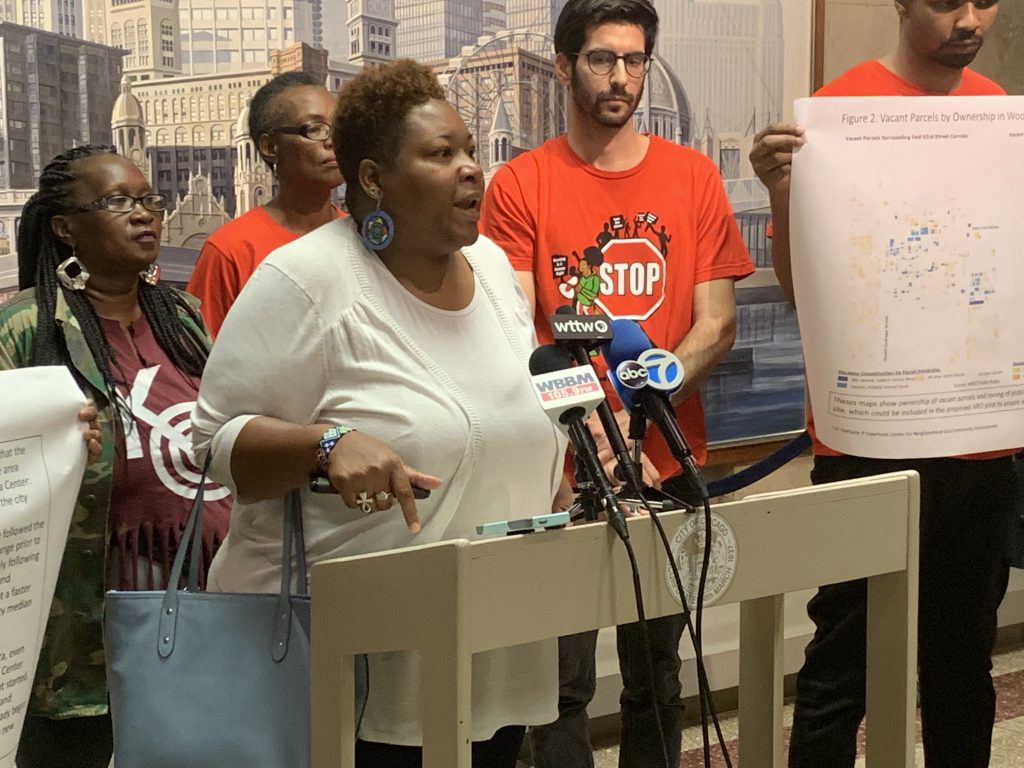 Ald. Jeanette Taylor (20) said it was obvious that plans for the Obama Presidential Center were fueling displacement. [Heather Cherone/The Daily Line]
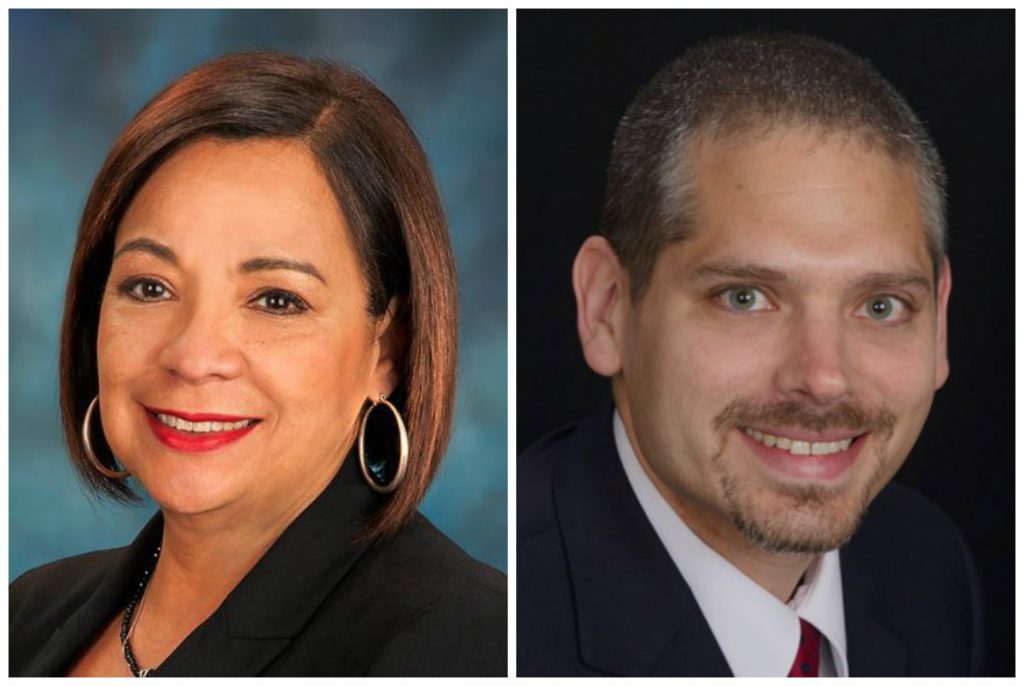 State Sen. Iris Martinez (D-Chicago), left, 33rd Ward Committeeperson Aaron Goldstein. [Submitted]


