Chicago News
-
(Illustration: David Alvarado)We likely won’t see the 75% cut that organizers have asked for, but there are some proposals on the table.
This story was originally published by City Bureau on 11.20.2020
By Grace Del Vecchio, City BureauSince this summer, the Defund CPD campaign has held mass trainings, canvassing and phone banking to explain police abolition to Chicagoans. Their official demand: to cut the $1. 8 billion police budget by 75% and reinvest that money in community-led programs, from anti-violence work to social services.
Yet Mayor Lori Lightfoot has made her opposition to the movement clear. “On my watch, we will never make cuts or policy changes that inhibit the core mission of the police department, which is to serve and protect us all,” said Lightfoot, despite proposing a relatively minor cut to next year’s police budget.
Budget experts agree: the political will is simply not there for massive cuts to the police budget at this time, especially as enthusiasm from summer Black Lives Matter protests has faded and gun violence rates rise. Even progressive City Council members have stayed away from proposing across-the-board cuts—but a few concrete proposals have emerged to chip away at the 37% of the city’s corporate fund that went to CPD this year.
In the meantime, Defund CPD organizers are working to persuade people to support police abolition as a way to improve public safety, invest in communities in need and dismantle a criminal justice system they say is inherently racist.
That means “bringing folks into a conversation that may challenge some of the things they already believe, and inviting folks into seeing the world differently, and seeing that more is possible,” said Asha Ransby-Sporn, a community organizer with the Defund CPD campaign and the Black Abolitionist Network. “We want to put pressure on [Lightfoot]. And we want to do that through massive popular support for our demands, to the point where we create an environment where it's politically impossible... to ignore.”
Whether they’ll reach the tipping point in popular support remains to be seen. But as City Council prepares to vote on Chicago’s budget for 2021, a few proposals on the table could actually put a dent in the police budget. Here’s a look at what’s at stake.
NOT HIRING NEW OFFICERS
As City Bureau and Injustice Watch previously reported, Lightfoot’s initial budget proposal included an $80 million decrease in tax funds to the Chicago Police Department, $34 million of which will come from not filling vacant positions. This process of not filling positions is called attrition and Chicago isn’t the first city to utilize it to meet budget gaps. Cities such as Los Angeles, New York and Austin have also cut the number of sworn officers through not filling vacancies and, for some, temporarily ceasing new cadet classes.
Northwestern University criminologist and policing expert Wesley Skogan said that while attrition is a viable strategy to cut police budgets, its long-term impact depends on how long a city is willing to sustain it in the future.
“Let's pretend that it's about 500 officers a year and the average cost of a Chicago police officer is about $150,000 a year. So if you would reduce the size of the force by just one year, you're saving [$75 million]. And of course, you can save the next year if you don't do any catch up,” said Skogan.
Currently, 89% of CPD’s budget is devoted to personnel. The strategy can be used as a way to quietly defund the police while saving political face without political risk with significant savings, according to Skogan.
THE PEACE BOOK
Proposed by GoodKids MadCity youth organizers in this July, the Peace Book would reallocate 2% (about $35 million) of the current police budget into community-led violence prevention programs such as employment opportunities, counseling and mediation, violence interruption, education and youth engagement.
The idea is supported by Ald. Jeanette Taylor (20th) who, starting in December, will begin talks with violence prevention groups and youth organizers to collaboratively write the ordinance.
“The city claims that it does this type of work but … without having young people at the table,” Taylor said. She added that either she or Ald. Rossana Rodriguez Sanchez (33rd) will introduce the ordinance to City Council in 2021.
GKMC hopes to create and fund a “Peace Book Commission,” a coalition of community groups that would train and pay peacekeepers to facilitate peace treaties between gangs and street factions, provide wrap-around services for violence-affected youth, create art and murals of Chicagoans whose lives have been lost to gun violence as well as provide real-time updates of gun violence occurring in the city.
They say that paying community members a livable wage to become trained peacekeepers addresses not only violence within communities but the root cause of it—poverty.
“We want to stop people from going out [and] retaliating against their enemies, and figure out ways that we can transform them and not throw them in jail and have them go away. Because that don't do nothing but create a circle of retaliatory violence,” said GKMC organizer Miracle Boyd.
To GKMC organizers, investing in and being present within communities is the biggest tool in violence prevention. On Halloween, the group held a block party on 53rd Street in Hyde Park to demonstrate the power of community-led peacekeeping.
“If you stand on blocks all day, and you have people do that, there will be no gun violence,” said GKMC organizer Jalen Kobayashi.
TREATMENT NOT TRAUMA ORDINANCE
Nationally at least one in four people killed by police has mental illness. Introduced by Ald. Rossana Rodriguez Sanchez in September, the Treatment Not Trauma proposed ordinance seeks to provide 24/7 mental health response to emergency calls by reallocating funds away from CPD and into public mental health services.
The proposal would reallocate an estimated $150 million (pending a full city assessment) from the CPD budget to reopen and expand mental health clinics throughout the city. The trained mental health responders would be housed in the clinics.
“We think that we should definitely be thinking about public safety in a holistic way that is public health-oriented. Cops are not public health, cops are not equipped to deal with any of the issues that we're trying to address with this model,” said Rodriguez Sanchez.
The order was inspired by programs in Eugene and Springfield, Oregon, where responders handle roughly 20% of all 911 calls made to those police departments.
A similar (but slimmed down) proposal by Lightfoot would allocate $16.5 million from the police budget to community-based violence reduction efforts including $1.3 million for a co-responder model where police and mental health professionals would respond to mental health crises.
It’s been criticized by Rodriguez Sanchez for not going far enough to fund public clinics and for continuing to include police in mental health crisis calls.
“I still can not understand why the mayor believes that there always should be an armed officer present where we're attending to [a mental health] crisis in our city,” she said.
THE CLOSING OF HOMAN SQUARE
On November 16, nine members of the City Council’s progressive caucus introduced an ordinance calling for the complete removal of police officers from the controversial CPD detention site at South Homan and West Fillmore. The proposal would divert money from that facility to fund “youth services, addiction services and rapid re-housing services” in North Lawndale.
In 2016, community organizers with the #LetUsBreathe Collective created the Freedom Square encampment in an empty lot directly across the street from the Homan Square facility. For six weeks, organizers created a safe space for community members to gather and learn about alleged torture and incognito detention at the site. This came after a 2015 investigation by The Guardian which detailed these allegations, including beating and shackling detainees as well as denying attorneys access to their clients.
Organizers with the #LetUsBreathe Collective, BYP100 and Black Lives Matter Chicago draw a direct connection from the secretive Homan Square facility to the city’s history of police torture. Also in 2015, Chicago passed the nation’s first reparations package for 57 torture survivors from the 70s and 80s, after a team of officers led by former CPD Cmdr. Jon Burge tortured over 125 individuals into confessing crimes many did not commit.
“In the last few weeks, the ordinance was drafted up which is connected to the budget process,” said Damon Williams, co-founder of the #LetUsBreathe Collective and community and cultural organizer at the Chicago Torture Justice Center. He hopes the budget framing will overcome hurdles faced by previous attempts to close the site: namely, the secrecy around what happens there. “A big part of [the Homan Square site] was so obfuscated. When there's so limited transparency, it's actually very difficult to know what's in there, who's operating it,” said Williams.
The ordinance brings this years-long battle into the conversation around the relatively new Defund CPD movement. Police abolition, after all, is not a new idea in Chicago. Even after this ordinance, along with Treatment Not Trauma, was relegated to the City Council Rules Committee (where they often languish, untouched), supporters of the Defund Police movement say they’ll continue to fight.
“We have this Defund [CPD] moment and we have this [year’s] uprising, where we're able to then build out on politics that have been kindling or been developing now, for four or five years,” said Williams.
-
Cook County commissioners voted Thursday to approve a $14 million settlement to resolve a lawsuit brought by a group of female assistant public defenders and law clerks who alleged a hostile work environment during visits to the Cook County Jail.
Incidents of jail detainees harassing female legal professionals “decreased substantially” since the 2017 lawsuit was filed, according to a spokesperson for Cook County Public Defender Amy Campanelli. [Flickr/Zol87] -
A map shows what the proposed Amazon shipping and logistics center along the Chicago River in Bridgeport would look like.
PROVIDEDThe Amazon plan along the Chicago River set off a debate about the future of logistics centers in Chicago. One commissioner called for a moratorium on approvals, noting that most of the facilities are landing on the South and West Sides.
By @jus10chi | Block Club Chicago
CHICAGO — A proposed Amazon distribution facility in Bridgeport narrowly secured approval from a key city committee Thursday, but the hearing turned into a debate on the future placement of logistics centers throughout the city.
The Chicago Plan Commission approved the 112,000-square-foot Amazon shipping and logistics center at 2424 S. Halsted St. along the South Branch of the Chicago River. Despite community opposition, the board endorsed the project by an 8-6 vote, a rare close decision for the commission.Plan Commission approves a 112,000-square-foot distribution center at 2420 S. Halsted St. Located in the Pilsen Industrial Corridor and the #Bridgeport community area, the plan includes a landscaped riverwalk. The $30 million project will create 200 permanent jobs. pic.twitter.com/lF0Q8g2awp
— Chicago DPD (@ChicagoDPD) November 19, 2020
The vote followed an extensive back-and-forth between Plan Commission Chairwoman Teresa Córdova and Department of Planning and Development Commissioner Maurice Cox, who also sits on the commission.
With online shopping booming, Amazon and other e-commerce leaders like Target have opened large “last mile” facilities in Chicago to reach consumers. But they’ve been concentrated on the South and West Sides, angering some residents who say the facilities bring heavy truck traffic and environmental concerns.
Amazon has planned distribution centers in Pullman and Gage Park, and operates an existing warehouse on Goose Island. Hilco Redevelopment Partners is building a distribution hub for Target at the old Crawford Coal Plant in Little Village.
But Córdova, who opposed Amazon’s proposal to set up shop in Bridgeport, used the meeting to call for a moratorium on considering applications for new logistic facilities until the city’s Department of Planning and Development develops a citywide strategy to locate the sites.
“Where are they going? They’re going to the South, Southeast and Southwest locations, so let’s not be disingenuous about acknowledging that,” Córdova said.
California-based developer Prologis is spearheading the construction of the 23-acre Amazon center between Halsted Street and Senour Avenue in the Pilsen Industrial Corridor that would include 487 parking spaces.
The developer’s attorney anticipated 12-16 trucks would visit the site daily, a claim Córdova later disputed.
Nearly 1,900 feet of publicly accessible riverwalk with seating areas and “floating wetlands” in the river are included in the plans.
Renderings of a publicly accessible riverwalk that would be part of a massive shipping and logistics facility for Amazon in Bridgeport. PROVIDED
Cox said the logistics and distribution sector is “growing rapidly” and Chicagoans “have to accept” the facilities will be a part of the future economy. His staff worked with Amazon to ensure community benefits like the riverwalk, and each new application would be a “test case” to learn how best to situate distribution centers across the city, Cox said.
“We can anticipate that we are going to have more requests for these facilities throughout Chicago and they will not be on just the West Side or the South Side,” he said.
But Córdova, who is the director of the Great Cities Institute at the University of Illinois at Chicago, pushed back against Cox’s claim the logistics centers will be popping up across the city.
Córdova said city officials shouldn’t put their “head in the sand” and fail to recognize “the land use changes that have been occurring have created high-priced properties on the North Side and removing those industrial locations.”
“Commissioner Cox makes the point that they’re going to be all over the city. Well, they are not all over the city, and they haven’t been all over the city,” Córdova said. “The applications are coming from the South and Southwest Sides.”
Córdova also highlighted a lack of community support for the development in rebuffing the proposal. Several neighborhood and citywide groups have opposed it, including the Metropolitan Planning Council, Bridgeport Alliance, Chicago Asian Americans for Environmental Justice, Active Transportation Alliance and the Little Village Environmental Justice Organization.
The large trucks entering the site would contribute to pollution in the neighborhood, and because the trucks would enter the site from Halsted Street, they would create a dangerous stretch for cyclists, Córdova argued.
“Do we want to make this a bicycle-friendly city, or is that only for some neighborhoods? Is that only for some people?” she asked.
Cox said the city will begin a study of Southwest Side industrial zoning early next year that will take approximately two years to complete.
But in the meantime, “we cannot put a moratorium on development in these areas,” he said. Instead the city must urge developers to build more environmentally friendly sites, including electric fleets.
Commissioners Andre Brumfield, Sarah Lyons, Linda Searl, Deborah Moore and Guancolda Reyes joined Córdova in voting against the proposal. All work outside government and were appointed to the board by Mayor Lori Lightfoot.
Commissioner Fran Grossman, who also works in the private sector, supported the proposal. The seven other votes in favor were all city officials: Cox, Department of Transportation Commissioner Gia Biagi, Ald. Walter Burnett Jr. (27th), Ald. Tom Tunney (44th), Ald. Scott Waguespack (32nd), Ald. Gilbert Villegas, and Zoning Administrator Patrick Murphy.Gold Coast Luxury High-Rise Secures Approval
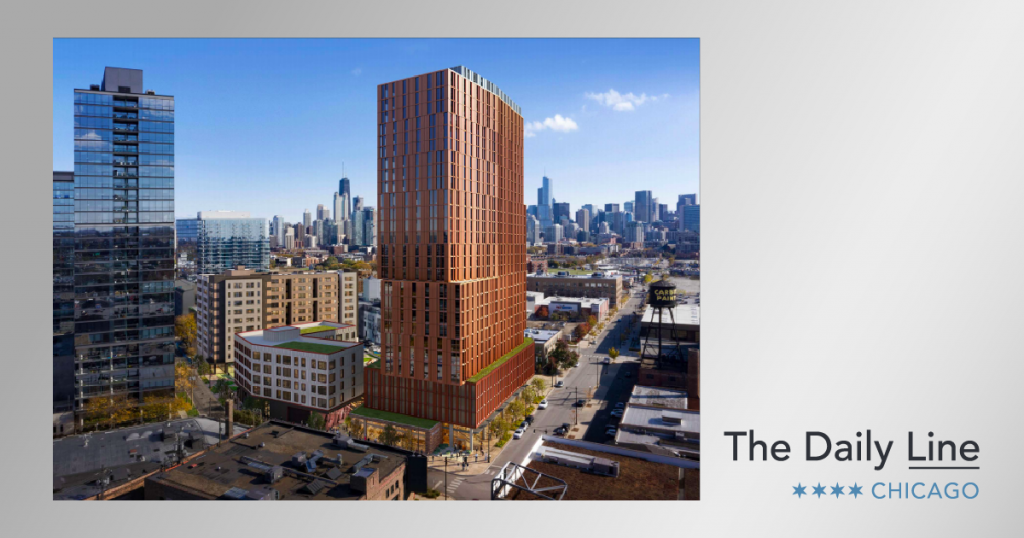
Plans for a 35-story luxury condo tower at 40 W. Oak St. in the the Gold Coast were also approved Thursday.
The 75-unit tower from New York-based Nahla Capita is located across the street from the Newberry Library and Ogden Elementary School. Following community feedback, he plan was scaled down from an earlier version that called for 90 condos to be built.
The project is expected to cost nearly $165 million to complete and will eventually contribute $3 million in taxes when complete. The development area includes the Warren Barr rehab center at 66 W. Oak St., which would remain.
The developer does not plan to offer affordable units on site and will pay $1.9 million, or $238,340 per unit, into a city fund to fulfill a requirement.Small Cheval Plans West Loop Outpost
Hogsalt Management, the restaurant group behind Au Cheval, which ranks among the best burgers in the nation, was approved to build its newest Small Cheval location at 1352 W. Lake St. in the West Loop.
The group plans to convert a one-story building into a 2,085-square-foot restaurant with a 3,800-square-foot patio that would be open year-round.
Currently, Hogsalt operates three Small Cheval locations at 1732 N. Milwaukee Ave. in Wicker Park, at 1345 N.Wells St. in Old Town, and 150 N. Riverside just west of the Chicago River downtown, although the latter location is currently closed.Other Projects Approved
The commission also approved an application to the city’s Lakefront Protection Ordinance by the Japanese American Service Committee Housing Corporation and Related Midwest to complete a $35 million renovation of the Heiwa Terrace senior living facility at 920 W. Lawrence Ave. in Uptown.
Originally built in 1978 to provide housing to aging Japanese Americans, the all-affordable housing complex will add three units for a total of 204 senior-living units and will retain a 12,220-square-foot Japanese garden.
Three other proposals were approved by the commission on Thursday:- An amendment to the planned development application submitted by the Habitat Companies, allowing for the addition of a drive-thru ATM facility at its affordable mixed-use Ogden Commons development underway at Ogden and Talman avenues in the 28th Ward.
- A planned development application allowing developer Belgravia Group to add one additional unit to the 366-unit Triangle Square apartment and condo development, which was approved in 2018 at 1701 W. Webster Ave. in the 32nd Ward.
- A planned development application by The Society for the Danish Old People’s Home to build two “lateral additions” to the existing three-story facility at 5656 N. Newcastle Ave. in the 41st Ward. The added “wings” would not increase the building’s maximum allowed number of beds but would provide for 13 additional parking spaces.
-
Ald. Pat Dowell (3) got a standing ovation from aldermen on Thursday at the conclusion of the budget committee meeting in which aldermen gave an OK to the city’s proposed 2021 spending plan.
Mayor Lori Lightfoot’s proposed $12.8 billion spending plan for 2021 on Thursday cleared the City Council Committee on Budget and Government Operations on a 26-8 vote, drawing support from the minimum number of aldermen the ordinance would need for approval in the whole City Council.
And despite a brief skirmish, the proposed management ordinance, which among other measures, creates a controversial new City Council Committee on Immigrant and Refugee Rights, also passed with near-unanimous support. -
The CTA, Metra and Pace could all be forced to lay off workers and make “drastic” service cuts if more federal stimulus does not come in by early next year, leaders of the transit systems told Cook County commissioners Wednesday.
Metra will have to make “drastic cuts” to close a $70 million gap if more federal aid does not come through, agency leaders said Wednesday. [Flickr/contemplative imaging] -
Nahla Capital is proposing to build a 35-story, 75-unit luxury condo tower at 40 W. Oak St. in the Gold Coast neighborhood.
Proposals to build a new 35-story condo tower in the Gold Coast neighborhood and a 112,000-square-foot distribution center in Bridgeport will headline a meeting of the Chicago Plan Commission on Thursday. -
Ald. Scott Waguespack (32), who chairs the City Council Committee on Finance, led the committee meeting on Wednesday and voted in favor of the proposed property tax increase.
Mayor Lori Lightfoot’s proposed $94 million property tax increase, a critical component of her 2021 budget plan, gained enough support on Wednesday to pass out of committee, putting it on course for a vote by the full City Council on Monday. Support for the property tax hike (O2020-5747) came just one day after aldermen took turns telling city budget officials to find other ideas to raise revenue. -
Mayor Lori Lightfoot and Alds. Scott Waguespack (32) and Tom Tunney (44) on Monday announced the proposal to cap delivery fees on takeout orders
A proposal to cap delivery fees on takeout food orders in an attempt to help financially struggling restaurants could be in place before Thanksgiving, but delivery companies are not keen on the proposal.
-
The city’s Chief Financial Officer Jennie Huang Bennett and Budget Director Susie Park on Tuesday answered questions on the proposed property tax increase.
Aldermen on Tuesday rallied against Mayor Lori Lightfoot’s proposal to raise property taxes by $93.9 million and tie future increases to the consumer price index, measures the mayor has said are necessary to close the historic budget gap the city faces headed into 2021.
-
Cook County Board President Toni Preckwinkle and key members of the county board of commissioners signaled they will consider asking voters for permission to raise their own property taxes in an effort to bolster the county’s 77,000-acre Forest Preserve District.
Advocates say raising taxes on the average Cook County property by $15 per year would be enough to put the forest preserves on firm financial ground. [Facebook/Forest Preserves District of Cook County] -
Jennifer Koehler, director of the Cook County Department of Public Health’s contact tracing program, speaks to commissioners in a hearing on Tuesday
Cook County public health officials have hired less than half the staff of contact tracers they had hoped would be working in time for an autumn wave of COVD-19, but leaders of the program say their efforts are already working.
-
Mayor Lori Lightfoot during a press conference on Monday said she is putting additional funding toward violence prevention and program that would send mental health professionals and police to mental health calls.
Mayor Lori Lightfoot vowed on Monday to pad her proposed 2021 budget with an extra $10 million in funding toward violence prevention efforts and expand a plan to send mental health professionals to respond to emergencies. Yet even with the added measures, the mayor faces an uphill battle to get at least 26 “yes” votes.
Many aldermen remain skeptical of Lightfoot’s plan to close the city’s $1.2 billion budget chasm by hiking the city’s property tax levy by $94 million and restructuring or refinancing $1.7 billion in debt. Lightfoot on Monday formally introduced her proposed $1.63 billion tax levy (O2020-5747), plus a revenue ordinance (O2020-5749) spelling out plans to issue more than $2 billion in borrowing. -

News in brief: Delivery fee caps set for approval; $134M Cook County Forest Preserves budget faces final vote
-
Mayor Lori Lightfoot said Monday that she opposes a proposal to legalize video gaming terminals in Chicago.
Aldermen on Monday sabotaged a series of their colleagues’ proposals aimed at averting Mayor Lori Lightfoot’s proposed $94 million property tax hike, but one pitch by a group of Democratic Socialist aldermen to raid three of the city’s most lucrative tax-increment financing districts remain on the table.