Chicago News
-
SEP 10, 2020


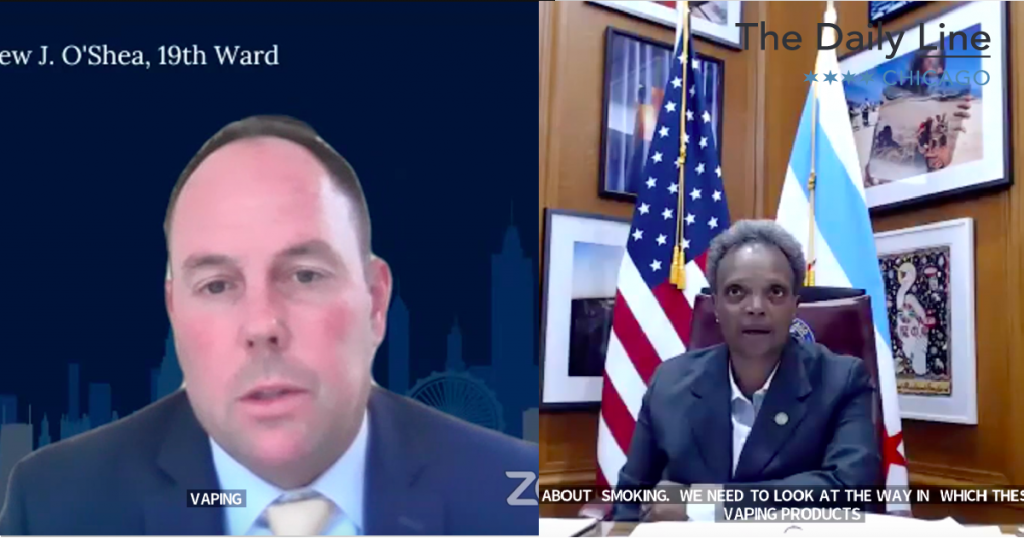 Ald. Matt O’Shea (19) and Mayor Lori Lightfoot during a virtual City Council meeting on Wednesday
The Chicago City Council voted overwhelmingly during a relatively drama-free meeting on Wednesday to ban the sale of flavored vape products, tighten oversight of the short-term rental industry and codify a measure to protect Woodlawn residents from potential displacement. -
SEP 09, 2020
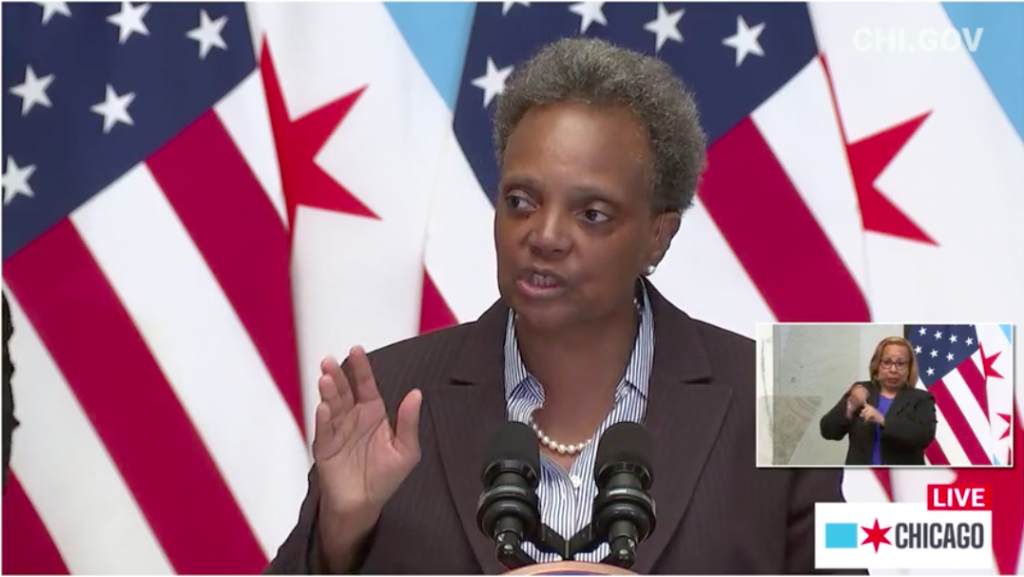 The City Council is set Wednesday to emerge from its August recess facing one of the grimmest fall budget seasons in memory, offering a test of Mayor Lori Lightfoot’s grip on the council as the city faces wrenching violence and a staggering $2 billion, two-year budget deficit.
-
SEP 09, 2020
UNLOCKED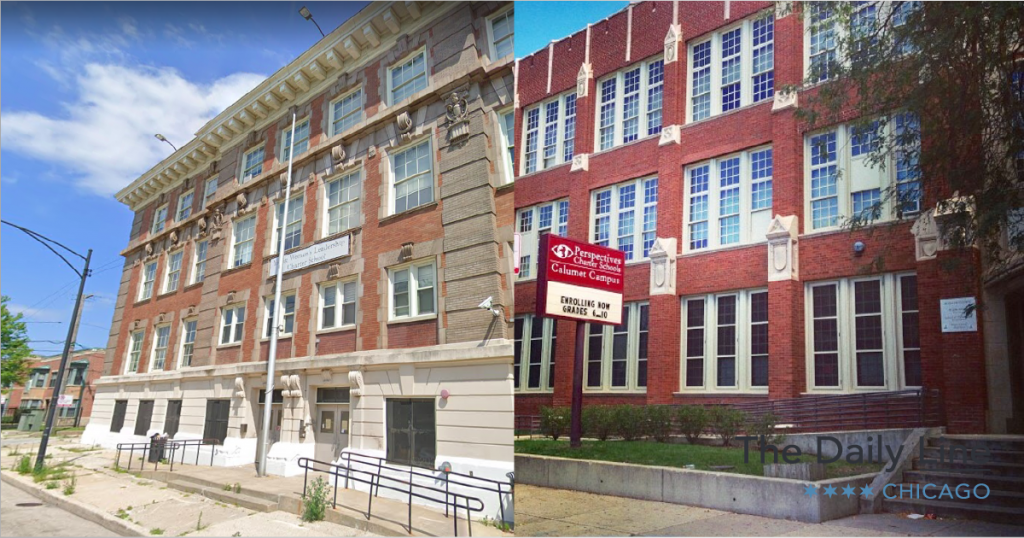 Calumet High School at 8131 S. May St. and the former Young Women’s Leadership Academy at 2641 S. Calumet Ave. [Wikimedia Commons/Google Streetview]
Aldermen gave a nod on Tuesday to a proposal allowing the city’s Department of Family and Support Services to open temporary homeless shelters at two Chicago Public Schools buildings, acknowledging in the process that the city’s Covid-19-related housing crisis is only beginning.
-
SEP 09, 2020
UNLOCKED The “Chicago Connected” initiative aims to provide free internet to 100,000 low-income students. Lex Photography/Pexels
Writen byWith the start of an all-virtual school year looming, Evelia Guzman got an email from her children’s school telling her she could sign up for free high-speed internet.
A sluggish home broadband had strained her family’s budget, but she didn’t even finish reading the email: She dismissed it as too good to be true.
Chicago Public Schools started the school year remotely Tuesday, and district officials say they are stepping up efforts to reach families about a new $50 million initiative, “Chicago Connected,” which aims to connect low-income students to the internet. But they have run into a “trust gap”: skepticism in some communities that they would get this service for free, no strings attached. The program has so far signed up a quarter of the 100,000 students that officials estimate can benefit from it.
“Some of the folks we are trying to reach don’t believe this is true,” said Philip DiBartolo, the school district’s chief information officer. “(They think) ‘I’m going to get a bill at the end of the month.’”
The district also is working to resolve barriers to signing up that some families and community-based groups have reported in recent weeks, including household incomes that were too high to qualify last year but have shrunk amid the pandemic.
Community-based organizations the initiative enlisted got the go-ahead to start reaching out to families two weeks ago, setting off a scramble to connect students. Meanwhile, Chicago’s teachers union raised alarms Tuesday about students who still can’t log onto classes because of technical hurdles.
Successfully ramping up participation in the program and showing that it is moving the needle on remote learning are key tests for the initiative, a project Mayor Lori Lightfoot has personally championed.
Lightfoot recently touted interest from other cities and states in replicating what officials have described as a one-of-a-kind program involving a partnership between the city, a slew of philanthropic organizations, and internet service providers.
“This program is robust and provides resources we need to fill the digital void in our students’ lives,” she said.
The national buzz “Chicago Connected” is getting is justified, says Angela Siefer of the nonprofit National Digital Inclusion Alliance, which is training the community organizations helping with outreach. The collaboration with those groups to overcome trust issues, a bid to provide digital literacy training to parents, and the four-year timeframe all stand out, she said.
Skepticism and excitement
Lightfoot’s office and school district officials unveiled the initiative after the end of the school year, following months of pressure on officials to come up with a more comprehensive, long-term response to uneven internet access for the city’s students. A study last spring by Kids First Chicago and the Metropolitan Planning Council estimated one in five Chicago students lacks access, with much higher rates in predominantly Black and Latino neighborhoods.
The first two years of the program will be funded by $5 million in federal coronavirus relief dollars and by donations from billionaire Ken Griffin, Crown Family Philanthropies, the Pritzker Traubert Foundation, and others. Former President Barack Obama and his wife, Michelle Obama, have chipped in as well. Chicago Public Schools is slated to cover the costs of the program in years three and four.
Since the announcement, more than a dozen cities and states have reached out to Chicago as they explore similar public-private partnerships, the city’s chief financial officer Jennie Bennett said at an event in August.
“We’re really excited about where the program is,” she said. “It has been an absolute success.”
Roughly two months after its launch, about 25,000 students have gotten free internet from Comcast or RCN through the initiative. The city and school district have not said how many households that represents.
Daniel Anello of the advocacy group Kids First Chicago, which helped spearhead the effort, said its architects did not expect to close in on the 100,000-student goal by the fall. The initiative was bound to be slower going at first, he said, as the city identified eligible families, tracked them down, and convinced them the program is legitimate.
More recently, the district shared lists of students eligible for the program with principals, who have been reaching out directly to families like Guzman’s. The city is also starting a marketing campaign, with commercials, public service announcements, and billboards.
But the key allies in overcoming skepticism about the program are the community-based organizations the city enlisted to help with sign-ups.
At the Gads Hill Center, Maricela Garcia, chief executive officer, said that she and her staff have put in long days and weekends to reach out to families since organizations were cleared to start making calls two weeks ago — what felt like a late start with the school year about to start.
She says even with the center’s deep ties on the Southwest Side, it’s still running into some disbelief about the program, so staff members often have to follow up on initial calls.
“Some families have responded they have to think about it,” Garcia said. “And some have said, ‘No, I don’t believe this is free. What’s the catch?’”
She said immigrant families, especially those with undocumented members, are reluctant to provide personal information over the phone or sign up for a program they might incorrectly perceive as a form of public assistance. Recent immigration policy changes can make it harder for those receiving such assistance to apply for citizenship.
But she said many families are enthusiastic to learn about the program, which addresses the “horrendous digital divide the families we serve experience.”
Joel Rodriguez of the Southwest Organizing Project says his organization is also running into skepticism but also excitement.
“Our community is one of the hardest hit by COVID,” he said. “The financial impact has been tremendous. This has been welcomed with open arms.”
Guzman, who has three children at Shields Schools on Chicago’s Southwest Side, said last spring she chipped in for her brother-in-law’s internet bill because the families share a home. But with several generations using the connection, it was often slow. After she ignored the school’s email about “Chicago Connected,” a friend persuaded her to take a second look.
“Are you going to charge me something?” she pressed the Comcast rep who helped her enroll.
Now she does outreach to other families at the Gads Hill Center.
Stepping up outreach
Officials say a key focus now is removing barriers for eligible families who are trying to enroll in the program.
Community-based organizations such as the Southwest Organizing Project have discovered that families who currently have a Comcast internet plan other than the company’s low-cost Internet Essentials program cannot readily sign up for “Chicago Connected.” On the Facebook page of the advocacy group Raise Your Hand, some parents said that because the eligibility criteria include qualifying for subsidized lunch in 2019, they were not able to sign up — even though the pandemic has worsened their families’ financial situations.
One parent, Melissa Ferguson said she was furloughed indefinitely when the coronavirus outbreak brought to a standstill her company, which provides audiovisual services to live events. Her internet was disconnected last month, and her son used her cell phone Tuesday to connect to his high school classes. Ferguson said her family income has shrunk to a third of what it was before last spring, but there was no way to reflect that on the “Chicago Connected” web site.
“The site didn’t ask me, ‘Have you been laid off? Have you been affected by the pandemic?’” she said.
Anello said he is reaching out to Raise Your Hand to encourage parents to contact the school district’s family and community engagement team to help them get around that hurdle. He said one community organization also reported a small number of would-be participants in the program being turned away because of unpaid past bills — an issue Lightfoot has been adamant should not be a stumbling block. Anello said officials are reaching out to internet providers about it. A spokesman for Comcast stressed that past debt is not a barrier to signing up for Internet Essentials, the plan available through “Chicago Connected.”
Bennett, the city’s CFO, recently stressed families will not have to provide a social security number, undergo background checks or pay installation fees to participate in the program.
Organizers say the stepped-up outreach and the community organizations’ more recent involvement are paying off: The pace of new enrollments picked up sevenfold during August, and the district is expecting even more sign-ups as the school year gets underway this week. They’re also bracing for possible service bottlenecks.
“We want folks to get through on the first try,” DiBartolo said. “We don’t want folks on hold for a long time.”
In the coming weeks, community-based organizations will also start offering training for parents about how to navigate the district’s digital platforms and guide their children during remote learning — an issue for some during the spring.
“We see this as a great opportunity to fill some of the gaps we see with digital literacy in our community,” Rodriguez said.
In the meantime, officials are eyeing an expansion of the program down the road to include families without school-age children, so they can use “one of the greatest equalizers,” as Bennett put it, to access healthcare virtually, apply for jobs, and more. At the August event, she put in a plug for further donations to the program.
“In the grand scheme of things, I am really proud of where we are,” Anello said. “If there’s anything that keeps me up at night is that Chicago Connected is only hitting households with kids in school. There’s way more we need to do.”
This story was published as part of a collaboration of seven Chicago newsrooms examining Mayor Lori Lightfoot’s administration. Partners are the BGA, Block Club Chicago, Chalkbeat Chicago, The Chicago Reporter, The Daily Line, La Raza and The TRiiBE.

-
SEP 08, 2020
 A proposed ordinance to ban the sale of flavored tobacco faces stiff backlash from store owners, law enforcement and some aldermen.
The sale of most flavored vaping products will be banned under a compromise ordinance advanced by aldermen on Friday intended to crack down on teen smoking without opening a new black market or inflicting too much pain on businesses. -
A proposal by Sulo Development (O2018-9330) to build a 15-story condo building in the West Loop is one of dozens of proposals set to be approved by the City Council Committee on Zoning, Landmarks and Building Standards during its meeting scheduled for 10 a.m. Tuesday.
 A 15-story condo tower proposed by Sulo Development at 19 N. May St. is scheduled to receive zoning approval on Tuesday. [Chicago Department of Planning and Development]
 -

 Survey released this week finds that Black men are most likely to have negative experience with CPD.
Maggie Hickey, the Chicago attorney tasked to oversee the federal consent decree with the Chicago Police Department (CPD), released a report Wednesday that shows “an alarming disparity” between responses regarding police interactions with the population as a whole and those between the police and young Black men. -
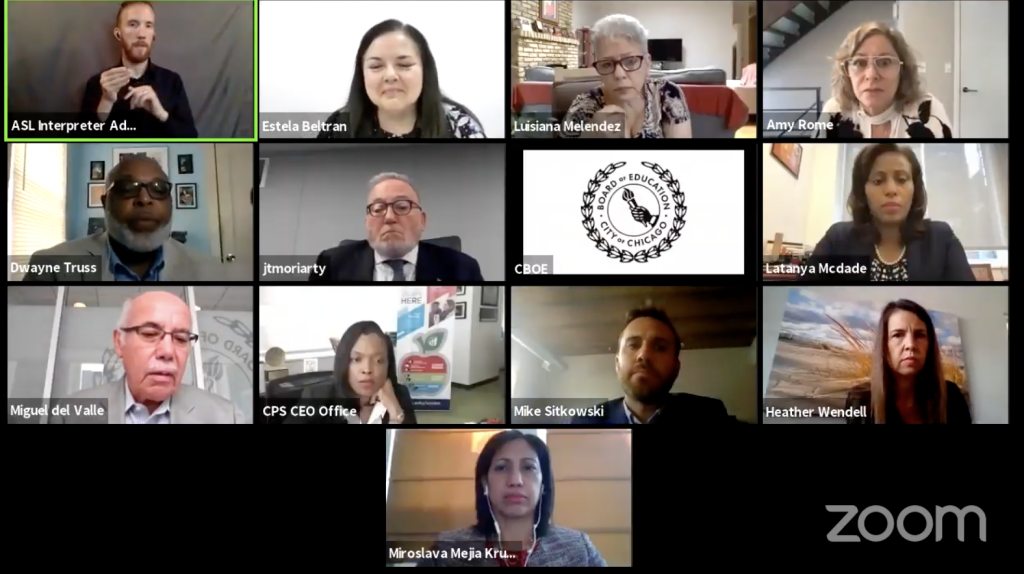 The Chicago Board of Education on Wednesday debating the SRO program.
The Chicago Public Schools Board of Education Wednesday voted to approve renewing its one-year contract with the Chicago Police Department to keep officers in schools whose parents and faculty vote to keep them. -
AUG 27, 2020
UNLOCKED
As time runs out, some of the neighborhoods in Chicago with the lowest census response rates are those with high numbers of Latinx immigrants.
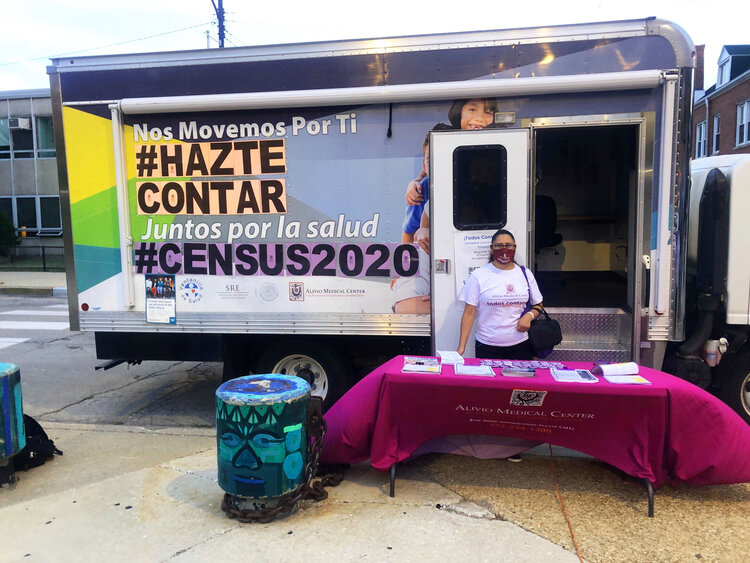 Pilar Rodriguez approached community members about the census at “El Zocalo” plaza in Pilsen. She noticed hesitancy from some Latinx community members on this year’s census. (Photo: Alexandra Arriaga)
By Alexandra Arriaga | City Bureau
This story was originally published by City Bureau on 08.26.2020Pilar Rodriguez sat at a table full of census brochures in front of a popular outdoor Zumba class in Pilsen during the first week of August. As the sun set, a group of mostly Latina women exercised to loud music while their children played nearby.
Rodriguez is a census ambassador for Alivio Medical Center, a clinic in Pilsen contracted by Cook County for census outreach. That evening, she approached people in the plaza for a few hours, talking to families in both English and Spanish to make sure they were counted in the 2020 census. But even at a joyful event like this, she picked up on some hostility.
“Many people fear the census,” Rodriguez said in Spanish.
The Trump administration’s attempted changes to the census have stoked fear and discouraged immigrants from responding, according to PRI The World reporting. On top of delays in outreach due to the COVID-19 pandemic, the U.S. Census Bureau announced recently it will end all counting efforts one month sooner than planned on September 30.
With just one month left, nearly one in every four U.S. households still need to be counted. This huge gap to connect with the nation’s hardest-to-reach residents includes some of Chicago’s immigrant communities. In the final stretch before the new deadline, census workers can be seen in neighborhoods with low response rates throughout Chicago, in a race against time to complete as many census forms as possible.
Which immigrant communities in Chicago have the lowest response rates?
According to recently reported response rates on Aug. 26, census tracts in Back of the Yards, Englewood and Little Village have some of the lowest response rates city wide—ranging from 25% to 32%. The census tract with the lowest response rate in Chicago is in Back of the Yards where almost half of the tract’s population is foreign-born, with 89% from Latin America. In this tract, the current response rate is at 25.8%, far below the 2010 final response rate of 44.6%. Citywide, Chicago’s response rate is at 57.9%, still below the goal of 75% or the 2010 response rate of 66%.However, not all census tracts with high foreign-born populations have low census response rates. The tracts with the highest foreign-born populations in Chicago—located in West Ridge, Edgewater and Chinatown—also have average response rates that range between 55% to 70%. The national 2020 census response rate as of Aug. 26 is 64.6%, according to the U.S. Census Bureau website.
“The immigrant community [in Chicago] as a whole is very diverse, and looking at the foreign-born population alone doesn't account for the many other factors that make a community hard-to-count, such as the presence of young children, housing insecurity and income levels that all contribute to civic participation,” said Brandon Lee, an Illinois Coalition for Immigrant and Refugee Rights census consultant.
Lee also mentioned that census outreach partners hear that warnings about ICE have played a role in some of the mistrust and low response in areas like Little Village and Back of the Yards.
How are census workers reaching out to these hard-to-count immigrant communities?
Under normal circumstances, census workers would have been knocking on doors since March. Local libraries, street festivals and block parties were slated to be public spaces where anyone could complete the census on computers. The pandemic shut down many of those opportunities.But the strategy—to meet people where they are—remains the same. ICIRR funded and oversees community partners throughout the state for census outreach efforts through a $2.4 million grant from the Illinois Department of Human Services, South Side Weekly reported.
Instead, census outreach workers like Rodriguez post up near popular outdoor spots like fitness-in-the-park classes, pop-up food banks, or drive through neighborhoods in census caravans to reach families who haven’t yet filled out the census. One organization, the Brighton Park Neighborhood Council, even collaborated with a laundromat to give residents a free laundry day in exchange for filling out a census form.
One Saturday in August, Brighton Park Neighborhood Council volunteer Maribel Sanchez filled out census forms for 30 to 35 people at Enrico Tonti Elementary School in Gage Park. All morning she dutifully unpacked fruit, vegetables, meat and milk at the food distribution site. After setting up the supplies for the day, she approached people in the line wrapped around the block to fill out their census forms.
“Many people lack information, some lack internet access or don’t know how to use it, so we help them because we all count,” said Sanchez in Spanish.
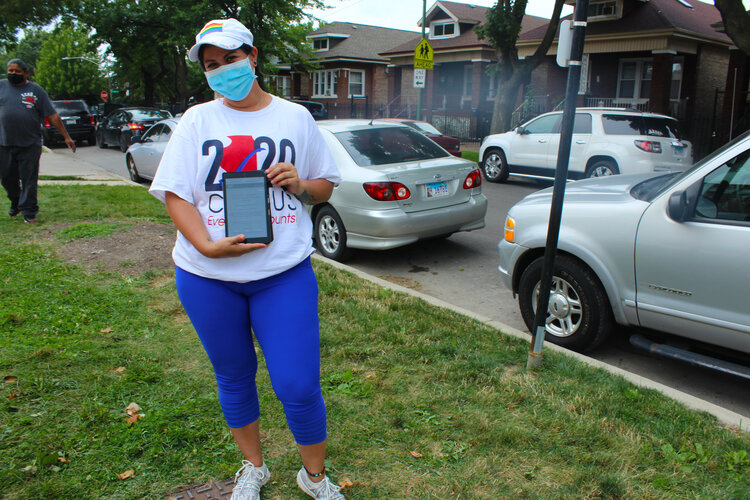 Maribel Sanchez, a volunteer with the Brighton Park Neighborhood Council, volunteered at a food distribution site before approaching people in line to count them in the census. (Photo: Alexandra Arriaga)
What motivates immigrants to participate in the census?
As a health worker, Rodriguez says she frames census participation to immigrants around bringing more healthcare resources to their communities.
“Don’t you get sick?” she’ll ask, “and do you have insurance?”
Rodriguez asks this with the understanding that one out of every three patients in the Cook County health system is uninsured, and many are immigrants who don’t qualify for Medicaid. Cook County used census data to start a program that helps uninsured people gain access to healthcare in 2016.
Resources for healthcare, education and other public services motivate immigrants in Chicago to participate in the census. City Bureau Documenters asked 15 first-generation immigrants why they would do the census in May. They gave diverse reasons for participating. Two said they saw it as their “civic duty,” or “like voting.” Six mentioned budgets and resources for their local communities, and two specifically mentioned school funding.
There was also a sense that people want to be counted for the sake of recognition and representation. Eight people from traditionally undercounted immigrant communities said they planned to complete the census this year because they want to establish that they exist and, in turn, gain more political representation.
“We want to be counted,” one respondent from the Philippines said. “We want to let them know that we’re existing, man.”
Who’s most likely to be missed in the census count?
Children under five can be particularly difficult to count, and are often a demographic with a lot at stake. If children go undercounted, programs like Medicaid, the Children’s Health Insurance Program (CHIP), the Supplemental Nutrition Assistance Program (SNAP), special education and preschool programs, may lose funding. Overall, Illinois risks losing $195 million each year for every 1% of the population that goes undercounted, according to state officials.
Nationally, Latinx children are at a high risk of being undercounted. In Cook County, 130,949 children are at a high risk of being undercounted, according to data from the Population Reference Bureau.Neighborhoods in Chicago with children under five living in immigrant families are at greater risk of an undercount. “Based on the characteristics we identified, these are areas with high shares of kids living in poverty, in female-headed households, in grandparent-headed households with limited English speaking abilities,” said Mark Mather from the Population Reference Bureau.
The census can be filled out online or over the phone by calling, 844-330-2020.
-
AUG 27, 2020
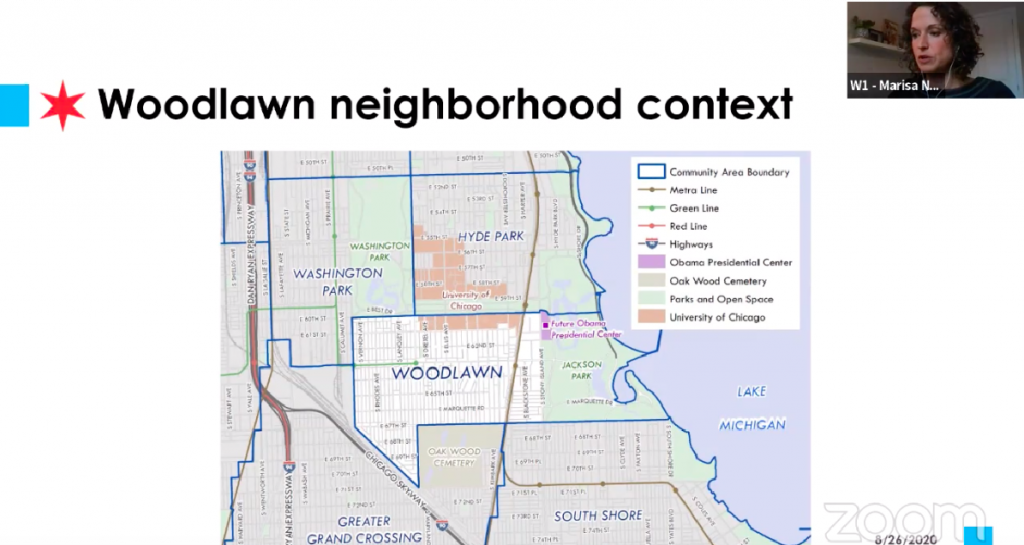 Chicago Department of Housing Comm. Marisa Novara showing a map of the Woodlawn neighborhood in relation to the planned site of the Obama Presidential Center during a meeting of the City Council housing committee on Wednesday
Aldermen on Wednesday celebrated a new ordinance aimed at protecting Woodlawn residents near the future site of the Obama Presidential Center in Jackson Park, touting the plan as a potential blueprint for stemming displacement in neighborhoods all over the city. -
AUG 26, 2020
 Department of Business Affairs Comm. Rosa Escareño and Ald. Michele Smith (43) during a meeting of the City Council Committee on License and Consumer Protection on Tuesday
A new ban on single-night stays in Airbnb and other short-term rental properties could be temporary, according to language inserted into a sweeping update to the city’s home-sharing regulations hours before the ordinance was approved. -
A sweeping ordinance designed to protect vulnerable Woodlawn residents from displacement stemming from the planned Obama Presidential Center is set for a City Council committee hearing on Wednesday, setting it on a course for final adoption early next month.
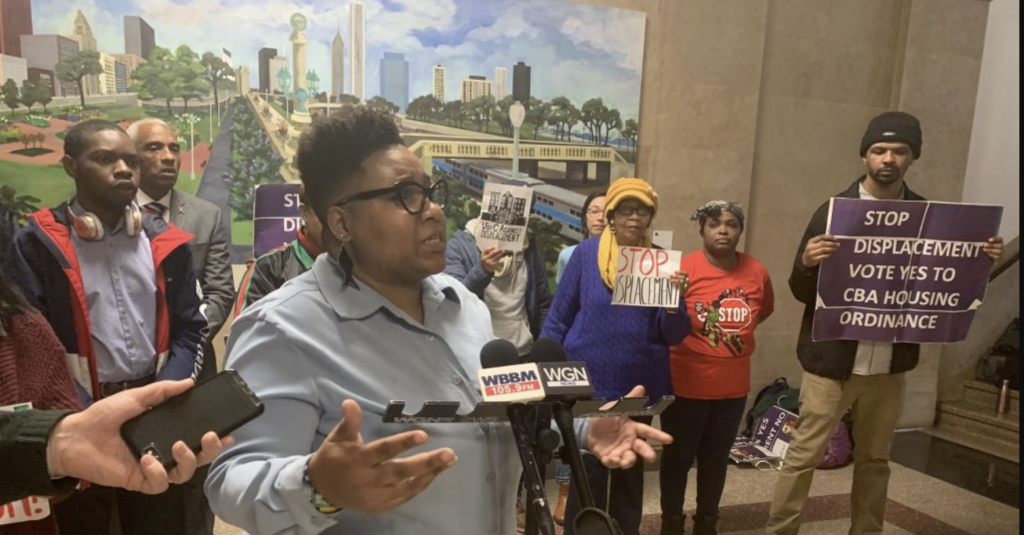 Ald. Jeanette Taylor (20) speaks during a press conference in February. [The Daily Line/Heather Cherone]