Chicago News
-
The City Council’s Committee on Housing and Real Estate is set to review the report detailing efforts made in April, May and June to meet the goals laid out in the city’s five-year housing plan at its meeting set to start at 10 a.m. Monday.
-
-
Chicago Inspector General Joseph Ferguson’s office released a draft of its 2019 investigation plans on Friday, which includes potential reviews of the city’s tax increment financing, minimum wage enforcement, and whether the city’s Department of Water Management has a plan to reduce lead levels in drinking water, if necessary.
-
In a new episode of his podcast, mayoral candidate Neal Sáles-Griffin recounted his disastrous campaign launch — and blamed himself for the debacle. In the 44th Ward, a former aide to former Gov. Pat Quinn filed to run against Ald. Tom Tunney. Got election mail? Send it to us at [email protected].
-
Efforts to repeal the statewide ban on rent control will take center stage at a hearing set for Thursday morning in Chicago, while Illinois Attorney General Lisa Madigan and Mayor Rahm Emanuel began the process of picking an independent monitor who will be charged with ensuring Chicago Police officers no longer violate residents’ civil rights.
-
SEP 26, 2018

 Early voting officially starts Thursday, with the opening of early voting polling places Downtown. Elected officials spent most of Tuesday urging residents to register to vote as part of a nationwide push pegged to National Voter Registration Day. Meanwhile, Cook County Board President Toni Preckwinkle will enter budget season without three top aides.
-
-
City Treasurer Kurt Summers, first appointed in 2014 and elected in 2015, is weighing a run for mayor of Chicago, going so far to set up a new website — ourchicago.net — to measure interest.
But he hasn’t ruled out running for a second full term as treasurer — and that has prompted some political watchers to pass around a portion of a state statute that suggests if Summers opts out of a mayoral bid, he could be blocked by state law from running for re-election as treasurer in 2019.
According to the little-known section of state law “the clerk and treasurer each shall hold office for a term of 4 years beginning at noon on the third Monday in May following the election and until a successor is elected and qualified. No person, however, shall be elected to the office of city treasurer for 2 terms in succession.”
Summers won one elected term in 2015 after being appointed in 2014.
FormerMayor Richard J. Daley changed the city code in 1975 to allow Treasurer Joseph Bertrand to run for a second term in a row, according to the Tribune archives. As part of Daley’s 1971 ticket, Bertrand, a former shoeshine boy, janitor and basketball star, was the first black man elected to a major citywide office.
The city ordinance now on the books reads: “There shall be no ineligibility of, nor disqualification or limitation upon, any person being elected to successive terms as city treasurer. Any prior law, statute or ordinance to the contrary notwithstanding, no restriction on succession in the office of city treasurer shall be applicable.”
Summers’ team argues home-rule authority is on their side.
But Daley’s ordinance change was improper under the Illinois Constitution, three election attorneys told The Daily Line. Article VII, section (f) stipulates that a home rule unit of government like Chicago “shall have the power to provide for its officers, their manner of selection and terms of office only as approved by referendum or as otherwise authorized by law.”
Despite apparent conflict, several treasurers besides Bertrand have run and won multiple re-elections. Treasurer Cecil Partee was elected in 1983 and 1987. Before she went to jail, Miriam Santos won elections in 1991, 1995 and 1999. Stephanie Neely won two elections in 2007 and 2011 before stepping down in 2014. Mayor Rahm Emanuel appointed Summers to succeed her.
“I’m not sure any of those folks were entitled to that under the statute,” one experienced local election attorney said, but “apparently nobody in the past for all these various city treasurers filed an objection… My reading would be that the state law applies and whatever ordinance the city passed was not effective, because the only way that could have been done is via referendum,” the attorney said.
“In theory, somebody would have to file an objection,” Chicago Board of Elections spokesman Jim Allen said, but confirmed the state’s provision of “no consecutive terms for city treasurer” has “actually been on the books for decades.”
”It sounds like a hypothetical and we’re going to avoid commenting on it,” Allen said. “We’ll see what happens with both the filings and any objections. We just advise every candidate — it’s always wise to get together with a seasoned election attorney.”
The Board of Elections is not tasked with investigating whether candidates meet criteria for holding office — that is up to challengers.
“If Kurt Summers files nomination papers and nobody objects, he would probably end up on the ballot, there’s no self-enforcing mechanism,” the election attorney said.
“The bottom line, as I see it, is the ‘it's legal until we get caught’ approach,” said election attorney Andrew Finko in an email to The Daily Line. “Until someone brings it in front of a Democratic Party-elected judge in the Circuit Court of Cook County to decide, and then take it up to the even-more Democratic Party selected First District Appellate Court. The final stop would be the super-Democrats on the Supreme Court. (Sorry, don't mean to offend, just being realistic about our court system, and its influences).”
“Although the city can adopt ordinances to change how it handles elections, or other procedures, I'm not certain that the city can disregard the Illinois Municipal Code,” Finko said.
Another legal alternative is the quo warranto writ, a civil procedure. Translated to “by what warrant (or authority)?”, the move challenges an individual's right to hold an office or governmental privilege. A citizen can send a letter to the state’s attorney or the Illinois attorney general making a case about why he or she believes a person is wrongfully holding office, which could result in a hearing.
Finko has had one of his candidates tossed out because of quo warranto action — a popular school board member in Thornton who was convicted of a felony during his teen years.
Illinois State Board of Elections spokesman Matt Dietrich said its general counsel was examining the issue but said “it looked like something that could end up in the courts.”
Ald. Ameya Pawar (47) is the only prominent Chicago politician openly considering a run for treasurer. But Pawar said he’s awaiting Summers’ final word. Pawar is not running for re-election in his North Side ward.
“Kurt is a friend and I don’t know what decisions he’s making, I know he’s got a lot of options,” Pawar said. “I’m not interested in nudging or elbowing someone out. I just think that there is a tremendous opportunity to use this office to drive meaningful social change, and that’s where I’m at.”
Pawar said he is interested in issues including creating a public bank, refinancing student loans locally, creating a universal basic income program and other measures to reduce income inequality.
“If Kurt wants to be the one to do that, I’ll stand behind him,” Pawar said. “But if he’s not running again, then I’ll take a hard look at it and start putting the pieces together.”
Alex Sims, an advisor to Summers who helped run his 2015 campaign and now has her own firm, APS & Associates, said the conflict between the state law, Constitution and city ordinance was a “moot point,” noting that several treasurers have served multiple terms.
“This ordinance was enacted to allow a black treasurer to serve, the first one to serve in citywide office,” Sims said. “It seems like stirring from a certain group of people.”
-
Budget season will start with a bang, as Mayor Rahm Emanuel and Cook County Board President Toni Preckwinkle chose the same day to unveil their spending plans for next year. Cook County Democrats are putting some financial muscle toward their effort to sweep Republicans from their seats on the Cook County Board. Meanwhile, Assessor Joseph Berrios lost another round in court over ethics rules.
-
SEP 24, 2018
An influx of federal cash will help the modernization of the will help move the modernization of the Red and Purple CTA train lines forward, while a judge will face re-election without the support of the Cook County Democratic Party for the first time in recent memory. New candidates have filed in the 7th, 14th and 20th wards — while 42nd Ward Ald. Brendan Reilly has no opponent, but a boatload of cash,
-
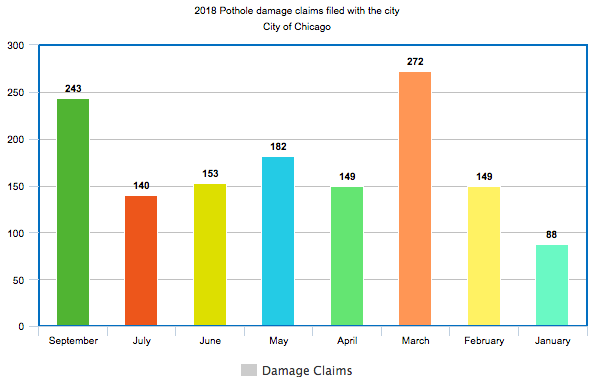
A 28 percent increase in the number of claims filed of damage with the City Council during the first eight months of 2018 as compared with the same period in 2017 will force city leaders to dig deep to pay for the damage.
Finance officials filed more than 240 claims of damage to vehicles at the City Council meeting on Thursday. That’s the most in a single month since March, the traditional start of Chicago’s unofficial pothole season.
Caused by Chicago’s frequent freeze-and-thaw-cycles, potholes are the bain of many Chicago drivers — as well as officials hoping to be re-elected.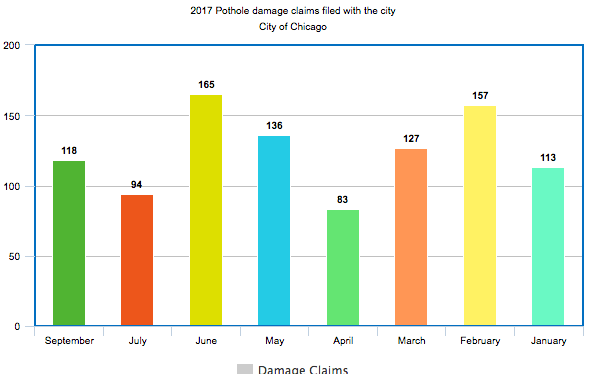
Tori Joseph, a spokesman for Mayor Rahm Emanuel, said city officials have “a strong commitment towards improving road conditions.
City crews have resurfaced 175 miles of streets and filled 222,958 potholes, bringing the total filled this year to 386,672, Joseph said.
City Clerk Anna Valencia’s office processes damage claims of as much as $2,000 to repair flat tires, bent wheels and out-of-whack alignments. The claims head to the City Council’s Finance Committee, which approves payment as part of its routine monthly agenda.
Drivers can file claim forms online at chicityclerk.com along with a copy of the police report as well as a paid repair bill or two estimates.
About six months later, drivers will get a check in the mail for about half — under the theory that any damage is at least partly the fault of the person behind the wheel.
According to the National Weather Service, the average temperature from December 2017 through February 2018 was 1.1 degrees above the normal temperature between 1981 to 2010. More than 30.2 inches of snow fell at O’Hare International Airport, 2.1 inches more than normal.
In 2016-17, however, the average temperature was 4.2 degrees higher than normal. Only 18.3 inches of snow fell, 9.8 inches less than normal.