


Chicago News
-
With Treasurer-elect Melissa Conyears-Ervin set to be sworn in as Chicago treasurer in less than two weeks, it will fall to a group of Democratic Party insiders from the city’s and Northwest and West sides to pick her replacement in the Illinois House.
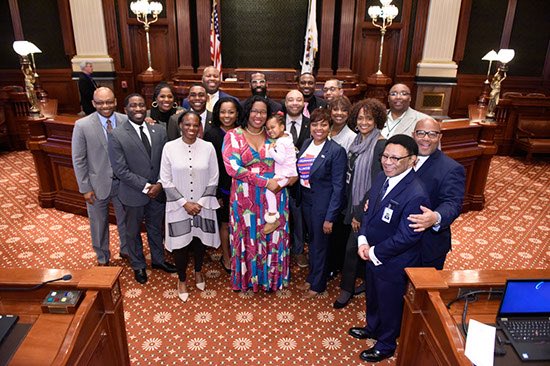 State Rep. Melissa Conyears-Ervin celebrates her last day as a member of the Illinois General Assembly. [Twitter/@Kam_Buckner]
When the committeepeople who represent the wards that make up the 10th Illinois House District gather at noon May 18, Conyears-Ervin’s husband Ald. Jason Ervin (28), Ald. Walter Burnett (27) and Ald. Scott Waguespack (32) will hold the lion’s share of the votes needed to pick Illinois’ newest state representative.
Burnett said he will back his stepson Jawaharial “Omar” Williams to replace Conyears-Ervin over the more than a dozen other interested candidates.
Williams has been working precincts since he was a teenager alongside the alderman, who has been a member of Secretary of State Jesse White’s political organization for decades along with Ervin and Conyears-Ervin.
“I don’t know of any family business that don’t — I shouldn’t say family business — but if your kids work hard... that’s what I work for, to promote my kids, help my kids if they do well,” Burnett said. “If they’re not deserving of it, they’re not deserving of it. So we’ll see how all the other members look at it and we’ll take it from there. It’s no different than Jason pushing his wife for the state rep spot and pushing her for treasurer.”
Ervin declined to say who he would back to replace his wife as state representative through a spokesman.
Ald. Scott Waguespack (32) said he had not decided whom to support.
Conyears-Ervin, who resigned May 1, said in a statement she would leave the choice of her replacement to the committeepeople.
"I want my replacement to continue fighting for working class families and pushing for increased education and childcare funding," Conyears-Ervin said.
WVON radio morning show host Maze Jackson told The Daily Line in an emailed statement he is also interested in replacing Conyears-Ervin and would strive “to bring economic resources back to the district, and to be an uncompromised vociferous advocate for self-interests of the Black community. I want to get an answer to ‘What’s in it for the Black People?’ in the state of Illinois.”
In addition to Williams and Jackson, Chavonne Carter, an assistant in White’s office; Dwight Lee, an executive in White’s office; Gerard Moorer in U.S. Rep. Danny Davis’ office; and former state Rep. Eddie Winters are also interested in replacing Conyears-Ervin, Burnett said.
Ervin and Burnett backed Conyears-Ervin’s bid for treasurer, and White featured prominently in her campaign’s television spots.
Williams’ mother, and the alderman’s wife, is former Cook County Comm. Darlena Williams Burnett, who is now the deputy chief of facilities for the Chicago Housing Authority. Williams, who has a bachelor’s degree in criminal justice, has been a plumber for 16 years, and has done work for Chicago’s water department, Burnett said, adding that his stepson is “looking at law school.”
Burnett said he “couldn’t go home at night,” if he didn’t support Williams for the spot, but “that doesn’t mean he’s gonna get it.”Ward Committeeperson 2018 GE Turnout Weighted Vote 1 Proco Joe Moreno 1,412 4.46% 2 Tim Egan 3,737 11.81% 24 Michael Scott Jr. 876 2.77% 26 Roberto Maldonado 989 3.12% 27 Walter Burnett Jr. 9,159 28.94% 28 Jason Ervin 5,679 17.94% 29 Chris Taliaferro 6 0.02% 32 Scott Waguespack 5,566 17.59% 37 Emma Mitts 2,375 7.50% 43 Lucy Moog 1,850 5.85%
State law requires a replacement to be picked within 30 days of a resignation from the Illinois House.
Conyears-Ervin’s replacement must receive a simple majority of votes of the committee, which will be weighted according to how many votes were logged in her race in the 1st, 2nd, 24th, 26th, 27th, 28th, 29th, 32nd, 37th and 43rd wards in the 2018 general election.
Those interested in replacing Conyears-Ervin can email their resumes to Burnett at [email protected].
“What we plan on doing is having a general session to allow everyone to present their credentials,” Burnett said. “After that, we’re going to have an executive meeting, then we’re going to choose the state rep.”
Conyears-Ervin was elected to the Illinois House in 2016 running unopposed in the Democratic primary and defeating Republican Mark Spognardi in the general election. She was unopposed in the 2018 election.
Conyears-Ervin replaced former state Rep. Pamela Reaves-Harris, who served one two-year term. Before her, former state Rep. Derrick Smith also served one term beginning in 2012. Smith was ousted by House colleagues after he was charged with accepting a bribe, and was convicted of bribery in June 2014.
Smith was replaced by Winters, a former Chicago Police officer.
Williams and the Ervins are “good friends,” Burnett said.
“So I don’t know if Jason’s gonna support him or not,” Burnett said. “Everybody’s still talking to everybody. At the end of the day, whoever takes it is going to have to run and start circulating petitions in August, hurry up and raise money, have soldiers, all of that good stuff. I think someone from our organization would be ready, would have all of that support.”Last week, my friend & colleague celebrated her last day in the Gen. Assembly. @melissa4chicago is moving on to become City Treasurer & I couldn’t be prouder of her work or more grateful to have had an opportunity to learn from and serve with her. The City is getting a winner! pic.twitter.com/FjthKOlmF1
— Kam Buckner (@Kam_Buckner) May 7, 2019
Conyears-Ervin, who is set to take office as treasurer on May 20, gave her farewell speech on the House floor on May 2. She thanked colleagues for “allowing me to be me,” and grew emotional discussing the future of the Black Caucus. She said she was proud to have been able to nurse her then-6-month-old daughter Jeneva in a special room for mothers in the Capitol.
Conyears-Ervin also thanked her husband for his support.
Ervin himself was appointed to his seat on the City Council by Mayor Richard M. Daley in 2011, won election the following month, and re-election in 2015 and 2019. -
Historians attempting to make sense of Mayor Rahm Emanuel’s tenure as Chicago’s mayor could do worse than to concentrate on the four events on the mayor’s schedule Monday, precisely two weeks before the buzzer is set to sound on his two terms in office.
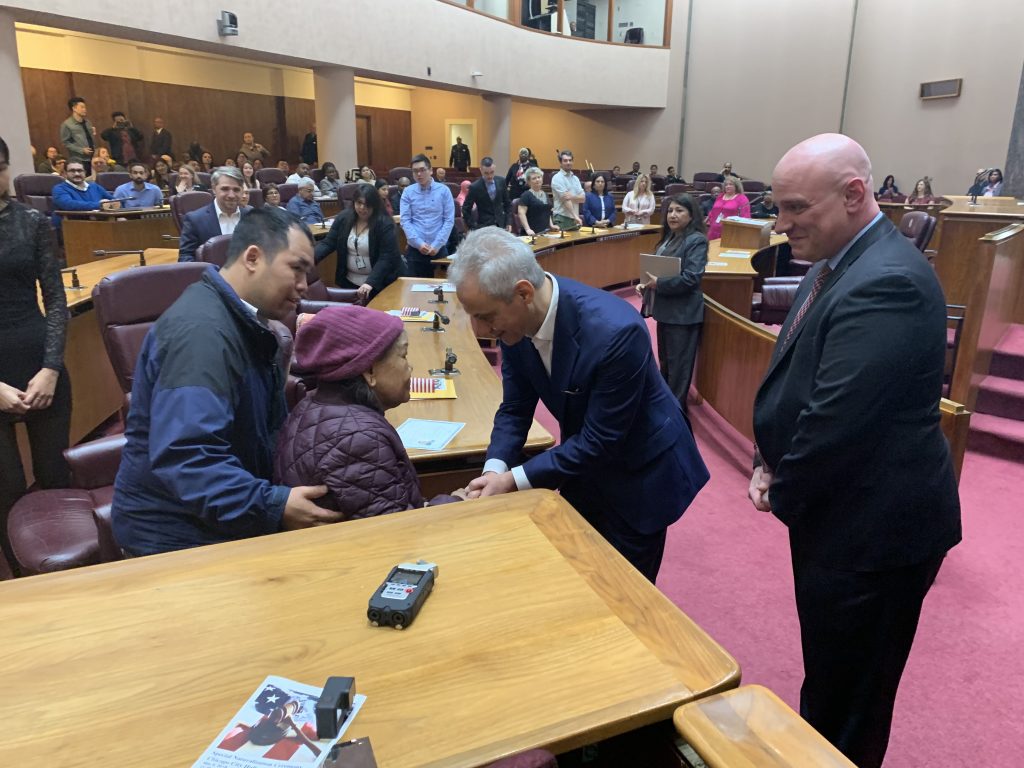 Mayor Rahm Emanuel congratulates a newly naturalized American citizen. [Heather Cherone/The Daily Line]
-
The Democratic Party of Illinois’ delegate selection plan for the 2020 presidential election pledges to include more LGBTQ and Millennial delegates as well as those who have disabilities and are members of labor unions and minority groups.
-
Ald. Roberto Maldonado (26) said Thursday he was back at work after undergoing surgery for a “benign growth.”
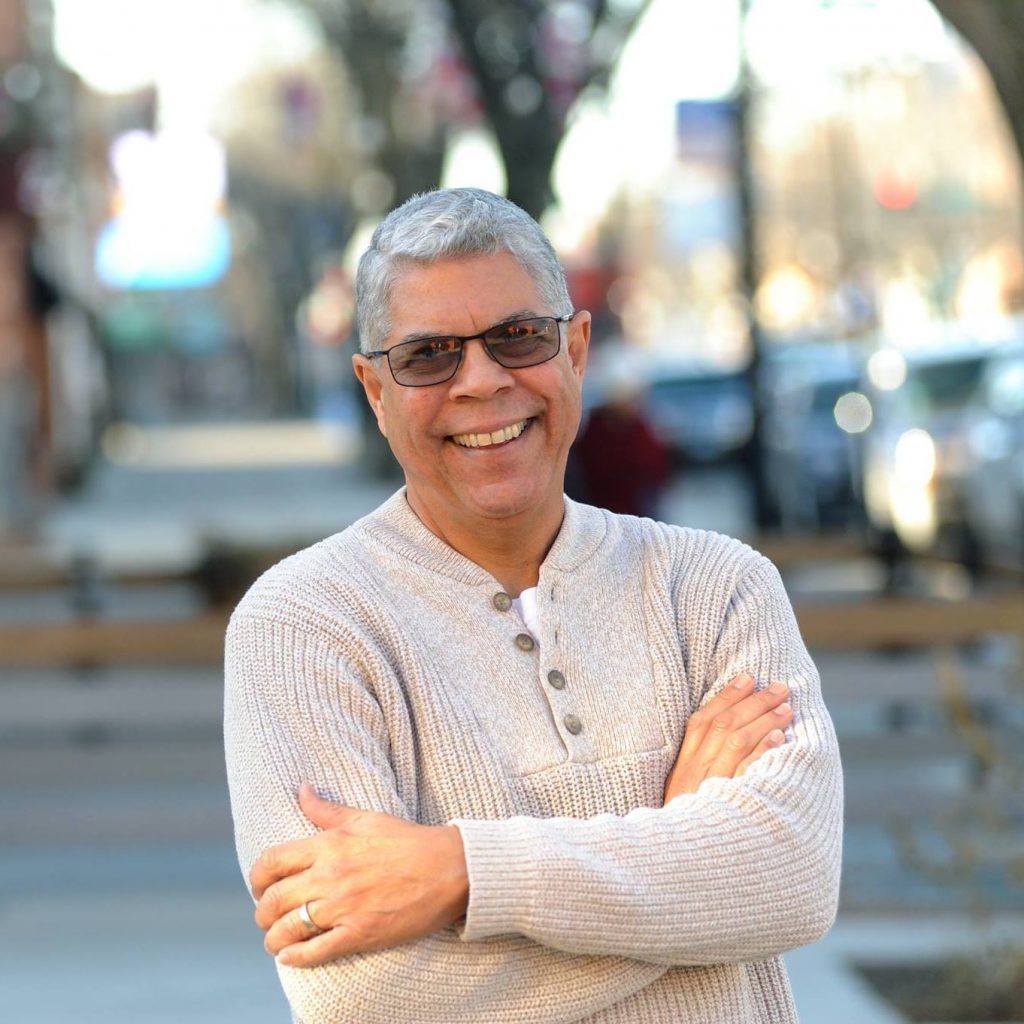 Ald. Roberto Maldonado (26). [Submitted]
Maldonado said his “doctors have granted me a full recovery with no ill effects or long-term symptoms,” according to a Facebook post.
“Thank you for the support and well wishes,” said Maldonado, who had not publicly announced he was ill. “I am glad to be back!”
Maldonado urged 26th Ward residents to get regular checkups and “stay active and make healthy choices.”
Maldonado could not be reached Thursday by The Daily Line. His wife and mother both died with days of each other in late 2016. His wife, Nancy Franco Maldonado, had pancreatic cancer. He has three children.
The alderman will be sworn in to his third full term later this month. His ward includes Humboldt Park as well as parts of Logan Square and West Town.
Maldonado was appointed to the City Council in 2009 by former Mayor Richard M. Daley after serving as a member of the Cook County Board of Commissioners for 15 years.
In February, Maldonado avoided a runoff against businesswoman Theresa Siaw by fewer than 50 votes, according to final results. -
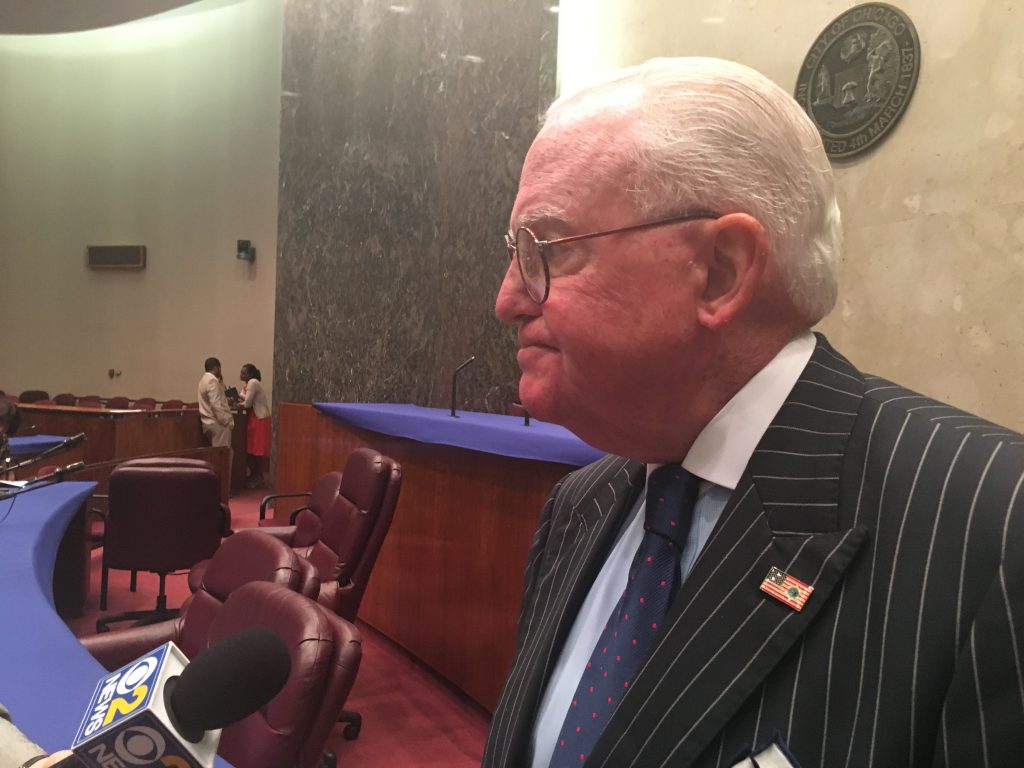 Ald. Ed Burke (14)
The Chicago Board of Ethics fined Ald. Ed Burke (14) $2,000 for exercising improper influence during a heated City Council debate in January 2018 over whether the city should spend $5.5 million to subsidize the new Downtown headquarters for the state’s largest Catholic health system.
-
Cook County Board President Toni Preckwinkle vowed to redouble her efforts to make the county’s criminal justice system more equitable by ending the requirement for those arrested for crimes to have enough cash on hand to pay their way out of jail.
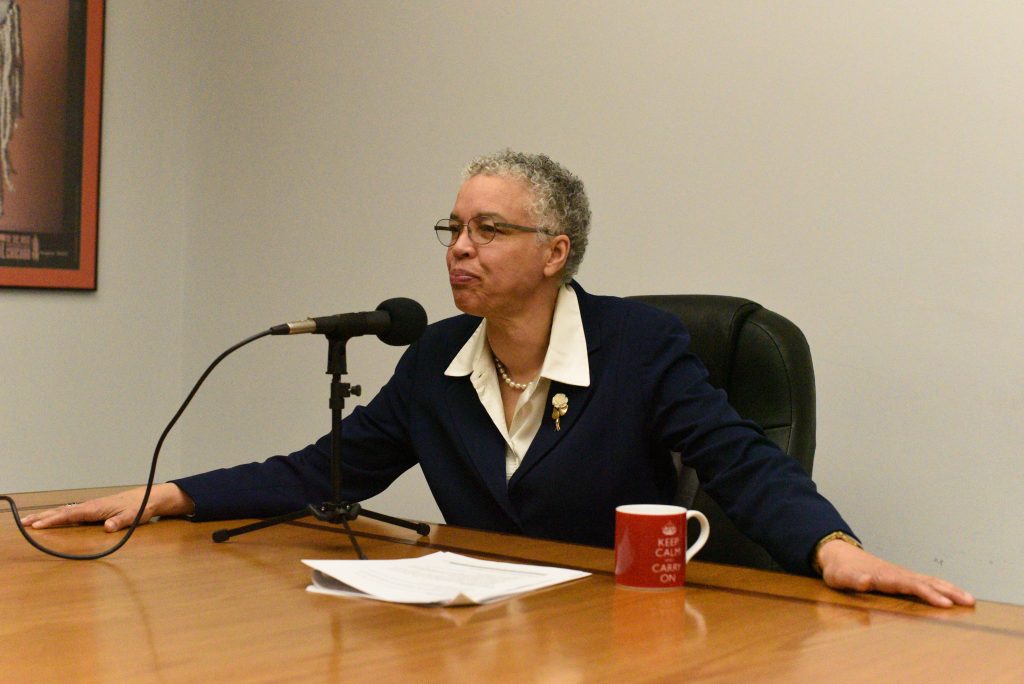 Cook County Board President Toni Preckwinkle speaks to A.D. Quig of The Daily Line for the Aldercast. [Don Vincent/The Daily Line]
The county has slowly changed the way its criminal justice system operates during Preckwinkle’s first two terms as part of a collaborative effort with the chief judge, state’s attorney, sheriff, public defender and the clerk of the court.
Preckwinkle’s longtime goal has been to reduce the number of people held behind bars simply because they cannot afford to pay, she said on The Daily Line’s Aldercast, and she supports efforts to abolish the cash bail system.
[audio mp3="http://thedailyline.net/wp-content/uploads/2019/05/Preckwinkle-Aldercast_mixdown.mp3">[/audio]Podcast: Play in new window | Download Subscribe: Apple Podcasts | Android | RSS
“We’ve been at it now for five and a half years, and what we’ve seen is a dramatic reduction in the jail population as a result of our decreased reliance on cash bonds,” she said. “When we started this initiative, two-thirds of the people who came in bond court got a cash bond and one third got released on their own recognizance or electronic monitoring, and now it’s the reverse.”
State Rep. Justin Slaughter (D-Chicago), a former staffer to Cook County Comm. Stanley Moore (D-4), introduced a bill to eliminate cash bond entirely this session. State’s Attorney Kim Foxx backed the measure, which drew criticism from some law enforcement groups who contend it would puncture their budgets and increase crime.
Asked whether she supported eliminating cash bail entirely, Preckwinkle said, “I think that this is the direction in which I would want to move, yes.”
Preckwinkle pointed to Washington, D.C. as a model. The city eliminated cash bail in the 1990s, and served as county stakeholders’ inspiration when they embarked on reforms in 2013.
Chief Judge Timothy Evans began requiring court staff and judges in the fall of 2017 to ask about a defendant’s ability to pay their bail. Non-dangerous, low flight-risk defendants — as determined by an assessment tool — would be released from custody pending trial. Bail amounts would be set at an amount they could afford.
Adherence to that rule has varied by judge. As recently as February, the Tribune reported of the 5,736 inmates in Cook County Jail, 5,390 has yet to stand trial. Approximately 48 percent could either not afford their bail or did not have a place to live where they could be electronically monitored.
Preckwinkle still has close to two more years as the chair of the Cook County Democratic Party, which was traditionally active in local campaigns but stayed silent on whether to retain judges that serve in county courts. That changed in the 2018 elections.
During the November election the party “took the position that not every judge deserved retention,” for the first time and joined criminal justice reform advocates to urge voters not to retain Judge Matthew Coghlan.
Coghlan was sued by two men he prosecuted for murder in the 1990s. Those convictions were later overturned, and the men say Coghlan worked with disgraced former Chicago detective Reynaldo Guevara to concoct a false case against them. Coghlan was also accused of racially biased sentencing and wrongfully denying hearings.
Aside from ensuring diverse slates in upcoming elections, Preckwinkle said she expects the party to continue to hold judges’ feet to the fire during slating.
“I think it’s really worthy of note that the Democratic Party took the position that we need to hold people on the bench accountable to being fair to all of the people who come before them in the courtroom, and I anticipate that that will be the case again in the next round, and there will be judges that we do not support for retention,” Preckwinkle said.
As Preckwinkle’s third term gets underway in earnest after her defeat in the mayoral election, officials at every level of government in Illinois are facing various allegations of wrongdoing, criminal investigations or charges — Gov. JB Pritzker, House Speaker Mike Madigan, Circuit Court Clerk Dorothy Brown, State’s Attorney Kim Foxx, Ald. Ed Burke and Ald. Danny Solis and Ald. Patrick D. Thompson.
Preckwinkle paused for a long time after asking if the mounting scandals represented a crisis.
“You’re listing people, some of whom have — let me back up,” Preckwinkle said. “You know, look, the first thing you should say is people are presumed innocent until proven guilty. The fact that somebody makes an allegation against you doesn’t mean you’re guilty of the allegation.”
“While the litany of things that you just described is surely discouraging, unless and until it results in charges and convictions, it’s simply allegations.”- Southland struggles — Preckwinkle is also doubling down on efforts to lift the south suburbs, among the areas hit hardest by industrial flight. “We will continue to have a challenge in the Southland of overreliance on residential properties because of the absence of vigorous industrial and commercial sectors in many of these neighborhoods, many of these communities,” she said. A recent Crain’s analysis found Southland homeowners are charged property tax rates at double the rate western and north suburban homeowners face. Preckwinkle did not address questions about how assessment changes from Assessor Fritz Kaegi’s office — which have seen industrial and commercial assessments rise by 82 percent in Elk Grove and 96 percent in New Trier — might hamper efforts to attract new businesses to the Southland. “My view is that the more equity we can inject into the system, the better off we are,” Preckwinkle said.
- Three priorities for Springfield — Preckwinkle will be in Springfield May 7 and May 8 to meet with leaders. Preckwinkle said she will push for a capital bill that “invests not simply in roads in bridges,” but in facilities; a pension clean-up bill; and to ensure that the county gets a piece of the pie if recreational marijuana and sports betting are approved. “We need to look at the records of those who are in jail or have convictions for simple possession, if we’re going to legalize marijuana, we need to do something about those who are detained or incarcerated for drug offenses,” Preckwinkle said.
- County census effort to begin in earnest this month — The county has set aside $2 million for community organizations to do outreach and communication ahead of the Census. That already-uphill climb could be made more difficult if the U.S. Supreme Court allows the Trump administration to include a citizenship question on 2020 forms, Preckwinkle said. Preckwinkle’s administration will release a request for proposals from community organizations to perform outreach within the next two weeks. The newly formed Complete Count Committee will also begin meeting this month. “We have to focus on growth and opportunity, not just downtown but in all of our neighborhoods, in all of our cities, towns, and villages,” Preckwinkle said. “When people believe there’s opportunity for themselves and their children, they’re more likely to stay.”
-
-
Mayor Rahm Emanuel tapped more African Americans to serve on citywide boards and commissions and head up city departments than any other racial group during his second term, according to an analysis by The Daily Line.
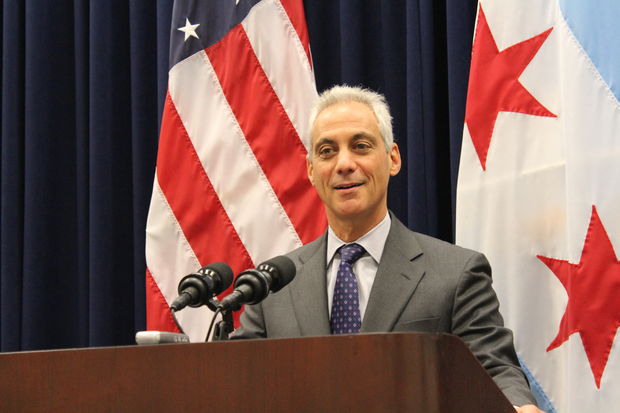 Mayor Rahm Emanuel addresses the news media. [Heather Cherone/The Daily Line]
-
Mayor-elect Lori Lightfoot said city officials were “on the right path” in developing “a real plan for the summer” as officials prep for the Memorial Day weekend, which is typically among the most violent of the year.
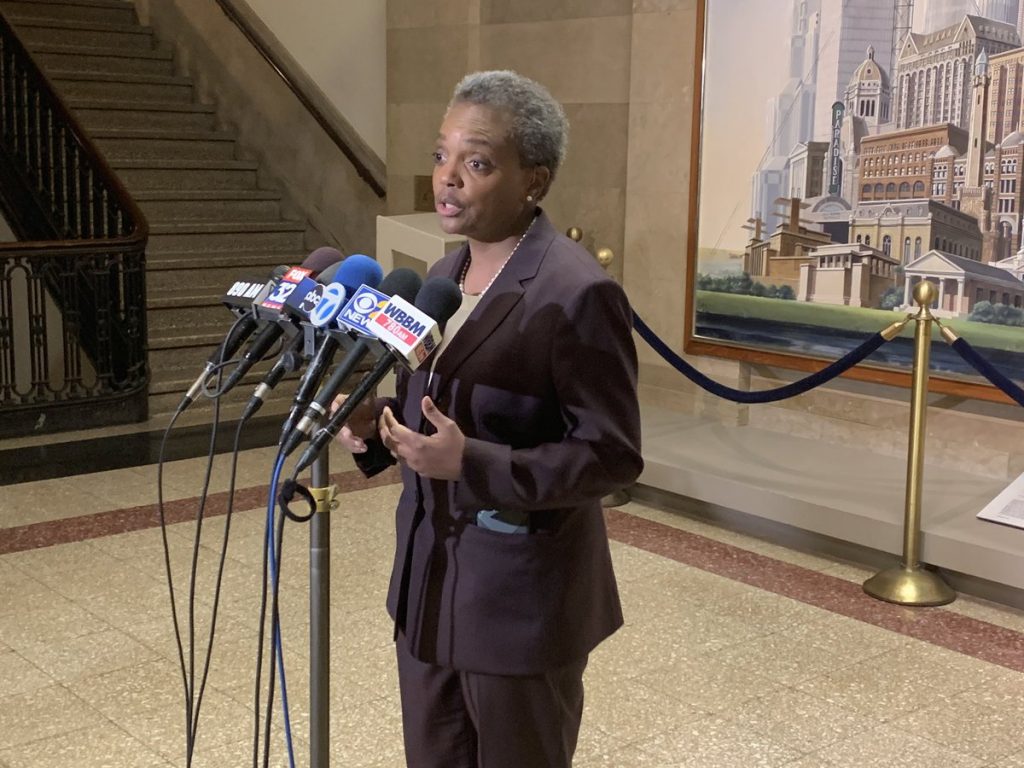 Mayor-elect Lori Lightfoot said all city departments have a role to play in reducing violence. [Heather Cherone/The Daily Line]
-
The Chicago chapter of the Democratic Socialists of America went from endorsing one unsuccessful candidate in 2015 – 25th Ward hopeful Jorge Mujica – to helping elect six Socialists who will take office on May 20.
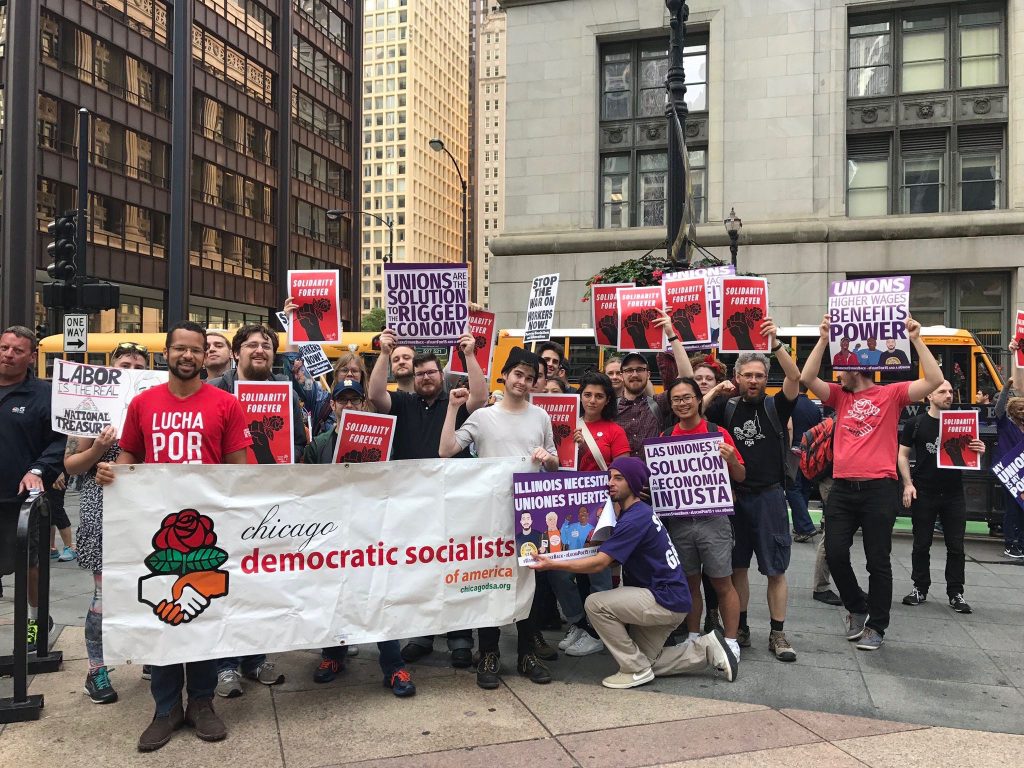 A Democratic Socialists of America rally on Daley Plaza. [Lucie Macias]
One of the City Council’s most vocal members, Ald. Carlos Ramirez Rosa, who joined DSA after he was elected, will be joined by five political rookies.
They will replace veteran or dynastic aldermen like Danny Solis (25), Deb Mell (33) and Pat O’Connor (40), while others will replace those who left under a cloud of scandal like convicted Ald. Willie Cochran (20) and Ald. Proco Joe Moreno (1).
While the group is finding its footing in City Hall, deciding what a potential City Council Socialist Caucus might do, its aldermen must also navigate how to stay true to DSA’s roots while cobbling together the 26 votes necessary to pass legislation — and delivering ward services.
Chicago DSA Co-Chair Lucie Macias said those tasks are difficult, but not impossible.
“We want to make sure that we are building coalitions, that we are working with other groups, ‘cause we’ve seen that already,” she said on The Daily Line’s Aldercast. “But I think if we start to make too many concessions, then we’re not actually building socialism or what we want to achieve.”
Podcast: Play in new window | Download Subscribe: Apple Podcasts | Android | RSS
“Yes, we may only have six DSA members, but I think that can still move the direction of where the conversation is. Just like we’ve seen nationally, Alexandria Ocasio Cortez, as a DSA member, has already done so much at the national level to shift the conversation further left on so many issues,” she said.
In tandem with other progressive groups that supported like-minded, progressive candidates in the 2019 elections — unions, Reclaim Chicago and United Working Families — “that builds up the numbers,” she said.
“There’s no real decisions that are being made yet,” regarding specific policy pushes, Macias said. “In my wildest dreams, when we started to take in some of these conversations about who we were going to endorse, I never imagined we would have six. So we’ve exceeded some of our goals. I don’t want to say we’re totally unprepared, but we want to make sure that we’re being very deliberate about the conversations we’re having and the way that we’re moving forward from here.”
Like thousands across the country, Macias was radicalized during the 2016 election by the presidential campaign of Sen. Bernie Sanders and the eventual victory of President Donald Trump.
“I think Trump getting elected was sort of a wake up call,” Macias said, “Sort of like I needed to become part of an organized movement.”
Macias had been active in politics previously, but pointed to catalytic events like witnessing multiple evictions, the difficulty of receiving affordable healthcare and the 2008 bank bailout as major factors in her activism. She went from attending a few meetings to manning communications for the growing chapter.
Nationally, DSA went from “an organization that had some local chapters and maybe 7,000 or so nationally to chapters forming in every state and 25,000 members in less than a year,” to close to 60,000 members nationally, Macias said. “That was huge.”
Takeaways from her interview:- Why DSA did not endorse in the mayoral race — Though City Council’s sole DSA member, Ald. Carlos Ramirez-Rosa (35), was an early and enthusiastic supporter of Toni Preckwinkle’s bid for the mayor’s office, the chapter did not end up reaching consensus about a mayoral endorsement, “which I think made a lot of sense,” Macias said. It allowed the organization to focus on a small number of races. “I don’t know that we would have been able to help support the six candidates that actually got elected had we also been focusing on a citywide race as well.” Macias herself ended up voting for Preckwinkle, but “personally, I was not super enthusiastic about either of the candidates.” Some in the group supported Amara Enyia, but not in sufficient numbers for an endorsement. In October, the group endorsed Byron Sigcho Lopez in the 25th Ward, Rossana Rodriguez Sanchez in the 33rd Ward and Rosa in the 35th Ward. In December, the group endorsed Ugo Okere in the 40th. In the runoff, they endorsed Andre Vasquez in the 40th and Jeanette Taylor in the 20th Ward. Taylor joined the organization at the same time as her endorsement was announced. Membership did not endorse DSA member Daniel La Spata, who won in the 1st Ward in February, but Macias said many members volunteered on his campaign.
-
Expectations for Lightfoot — Despite the group’s lack of enthusiasm for Lightfoot, the DSA supports Lightfoot’s calls for transparency, community involvement in decision-making and neighborhood investment. However, Macias said she was disappointed about how the Lincoln Yards TIF agreement played out. Lightfoot called for a halt to the vote and got a two-day delay before aldermen voted to give Sterling Bay hundreds of millions in TIF funding for infrastructure with concessions for increased minority contracting added by the mayor-elect and a promise that Lightfoot would hold Sterling Bay accountable throughout the construction process. “Already I’m like, ooh are we going to trust Lori Lightfoot? I don’t know,” Macias said. “I don’t want to say too much too soon about that, because I do think I want to see more details about certain things, because some of those things, in broad statements, seem like a good idea,” Macias said, adding that she wants to see how Lightfoot confronts neighborhood development, charter schools and the city’s mental health landscape.
-
Next push – municipalize ComEd? – The chapter is considering a big target – Commonwealth Edison – for its next organizing push. The city’s contract with electricity provider ComEd is up in 2020, and the chapter wants to push the company to “institute progressive rates, abolish electricity shut-offs, demand investment in renewable energy,” and empower employees. “It’s a pretty big undertaking, I’m not going to lie and say that it doesn’t sometimes seem very daunting,” Macias said. “It’s perfect timing,” she said, between the new City Council and the contract expiring. “If we’re going to try for something big this would be the time.”
-
Ald. Deb Mell (33) announced she will not challenge the results of the April 2 runoff, ensuring that six members of the Democratic Socialists of America will join the City Council May 20 — and ending the 44-year span of the Mell political dynasty. Chicago Teachers Union leaders Monday called for a mediator to be brought in to help negotiations, after Mayor-elect Lori Lightfoot called for changes to the timetable agreed to by Mayor Rahm Emanuel.
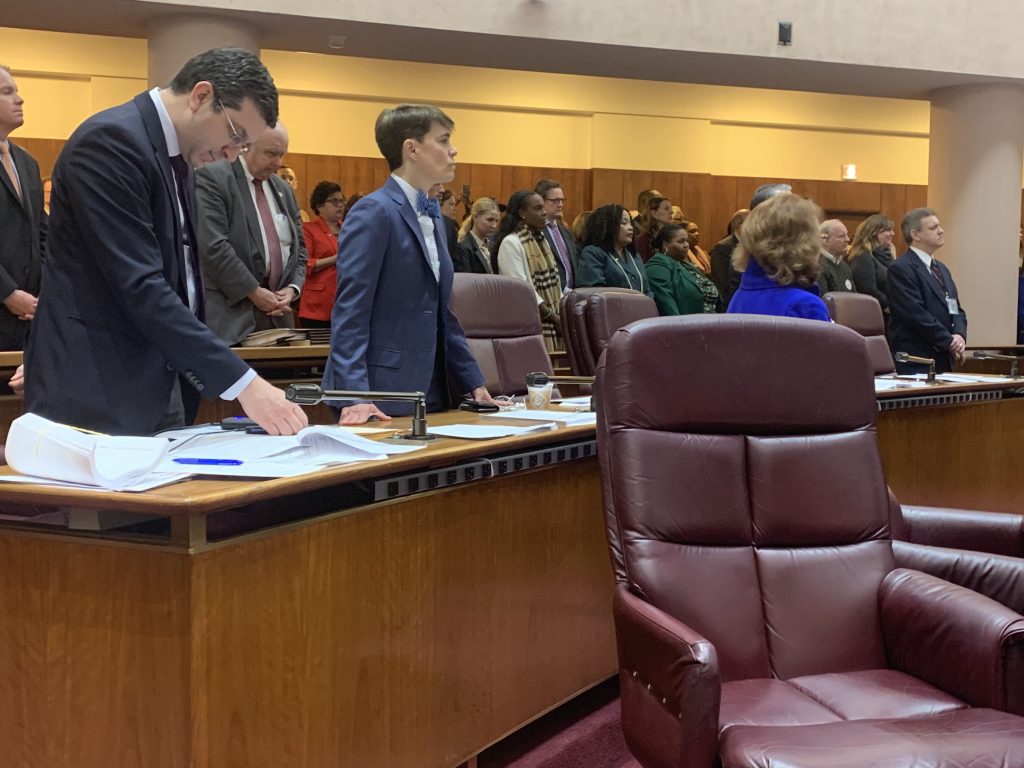 Ald. Deb Mell (33), center, her last City Council meeting in April. [Heather Cherone]
-
APR 30, 2019


Racing to beat the clock ticking down his term in office, Mayor Rahm Emanuel Monday dipped into the Neighborhood Opportunity Fund one last time to hand out $25 million to 94 businesses as part of an effort he launched in response to criticism that the South and West Sides had been left behind by the boom in construction in the Loop.


