Chicago News
-
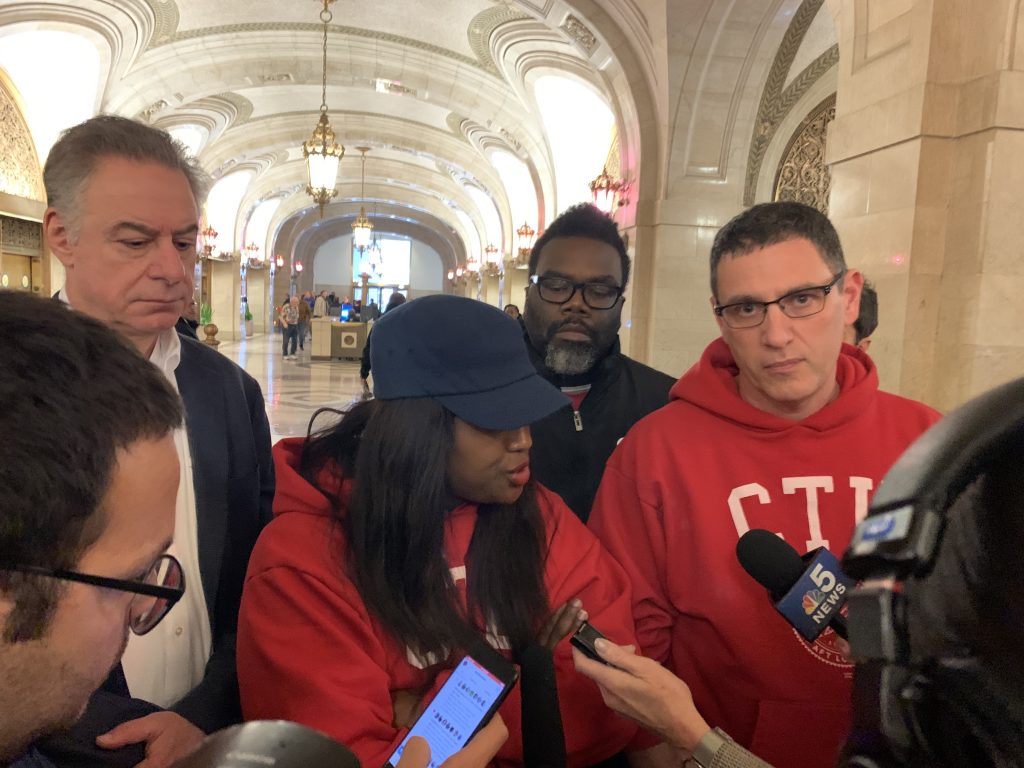
Leaders of the Chicago Teachers Union will meet this week to set a date to go on strike if a deal isn’t reached with city and school officials after 94 percent of CTU members voted to authorize a walkout. A pilot program that tested Chicago’s appetite for a free-floating car share system will end Dec. 31, and another member of the Democratic Socialists of America launched a bid for a leadership position in the Cook County Democratic Party.
-
On his way to a ninth-place finish in the race for Chicago mayor, Paul Vallas racked up bills totaling $885,357 sending unsolicited text messages to Chicagoans touting his campaign, according to documents filed with the Illinois State Board of Elections.
Former mayoral candidate Paul Vallas at City Hall with a broom, his signature campaign prop. [Heather Cherone/The Daily Line]
In addition, when the former Chicago Public Schools CEO closed his Paul Vallas for All Chicago campaign committee on Sept. 11, he still owed Link2Tek — the Asheville, North Carolina-based firm that sent the messages — $535,357 after paying the firm $350,000, according to state records.
Related: Mayoral hopeful Vallas hired firm behind mystery texts, but says poll was conducted by ‘independent firm’
Along with the outstanding debt, Vallas’s defunct campaign committee faces an ongoing lawsuit that claims the text messages violated federal law.
Related: Lawsuit: Vallas’ mayoral campaign broke federal law by sending unwanted texts
Because the campaign committee is closed, Vallas is not required to report when — or if — he pays off the debt, according to Matt Dietrich, the spokesperson for the Illinois State Board of Elections.
“The debt becomes a private matter between the committee or those in charge of the committee and the creditors,” Dietrich said in a statement. “As far as the State Board of Elections is concerned, the committee is terminated and has no further reporting requirements.
Through representatives, Vallas declined to comment on his campaign’s use of text messages to reach voters or its remaining debt.
Link2Tek, which is also named in the federal complaint, did not respond to an email message from The Daily Line about the money it is owed by the Vallas campaign or its work for the campaign.
Vallas’ campaign amended his committee’s last quarterly report to reflect the debt to Link2Tek one day before officials filed paperwork with the Illinois State Board of Elections to close the committee.
Vallas, who joined the board of the Museum of Broadcast Communications in April, could open a new campaign committee if he decides to run for elected office again, according to state law.
According to its website, Link2Tek “offers candidate organization, data analytics, voter modeling and voter communication, including texts and voice calls.”
The Vallas campaign began texting Chicago voters in August 2018 with cryptic messages that campaign observers told The Daily Line walked a fine line between polling and advertising. Many of the Chicagoans who got the messages took to social media to complain about texts.
The texts sent by the Vallas campaign included a link to a microsite that included information about Vallas’ campaign. For example, a message about the need to “win the war on crime” included a link to click for more information.
Texting campaigns to cell phones are perfectly legal, even without the voter’s prior consent, so long as the messages aren’t being sent through what’s known as an “autodialer,” according to FCC rules.
FCC rules also allow campaigns to make autodialed or prerecorded voice calls to landlines, even without the recipient’s permission.
However, autodialed live calls and prerecorded voice messages are not allowed to be made to cell phones, pagers or other mobile devices without the recipient’s express consent.
The class-action lawsuit, filed by attorney James Vlahakis on behalf of Chicagoans Jake Campbell and Jeff Klueh, alleges the system used by Link2Tek is an autodialer “dressed in sheep’s clothing.”
Lawyers for Link2Tek urged a judge to dismiss the case, arguing that the texts did not violate federal law.
A date has not been set for a judge to rule on that motion to dismiss, Vlahakis said.
When the lawsuit was filed in January, Vallas called it a politically motivated “dirty trick.”
Alisa Kaplan, policy director for Reform for Illinois, said the price tag for the texts sent by the Vallas campaign was staggering.
“That’s a lot of money even in our super-charged environment,” Kaplan said. “I wonder if it raised enough stink to make other candidates think twice about sending texts like that.”
Vallas’ debt to Link2Tek is the largest amount owed to a single vendor by any of the 14 candidates who made the February ballot for Chicago mayor, according to an analysis of campaign finance records by The Daily Line.
Vallas also owes $19,000 to his brother, Dean Vallas, who helped run his campaign.
Mayor Lori Lightfoot forgave a $250,000 loan she made to her campaign committee, Lightfoot for Chicago, records show. That is allowed by state law as long as it is reported, Dietrich said.
Cook County Board President Toni Preckwinkle and Bill Daley, who finished in second and third place behind Lightfoot, have no outstanding debt in their campaign committees, according to state records.
Willie Wilson, who used his personal fortune to fund his race and finished fourth, still owes himself $1.5 million for his 2019 bid for mayor, according to state records.
Illinois Comptroller Susana Mendoza, who finished fifth, owes four political strategy and law firms $228,778, according to state records. Mendoza’s largest debt is the $97,308 she owes to the firm of Adelstein & Associates.
Former Cook County Assistant State’s Attorney Jerry Joyce, who finished seventh, still owes his wife Jannine Joyce $2.26 million, records show. Joyce’s campaign also owes $150,000 to Bridget Smagala and another $90,000 to the Bizzieri Law Offices and the Shannon Law Group.
Gery Chico, who finished eighth and is now the chairman of the board for the nonprofit Local Initiatives Support Corporation Chicago, owes $178,154 to his closed campaign committee, records show. Neal Sales-Griffin, who finished in 14th place, owes $10,600 to his closed committee, records show.
Former candidates Amara Enyia, Garry McCarthy, Lashawn Ford and John Kozlar have no outstanding debt, records show. -
ProPublica Illinois is an independent, nonprofit newsroom that produces investigative journalism with moral force. Sign up for The ProPublica Illinois newsletter for weekly updates.
The city of Chicago said Friday that it will wipe out some, if not all, debt due to unpaid vehicle sticker tickets for motorists who come into compliance by the end of October, a program that has the potential to benefit an estimated 500,000 motorists and lead to hundreds of millions of dollars in debt forgiveness.
The announcement comes as the office of City Clerk Anna Valencia prepares to offer its own amnesty program next month allowing residents to buy prorated vehicle stickers without incurring late penalties.
The two-pronged approach from two offices of City Hall amounts to what officials term a “fresh start” for struggling Chicagoans, as the city purges old debts and makes stickers more affordable.
The use of city stickers is Chicago’s way of charging vehicle owners for using city roads. Stickers typically cost between between $88 and $139 per year, depending on vehicle weight.
Failure to buy a sticker can lead to some of the costliest citations in the city. Debt from those tickets, in turn, has contributed to tens of thousands of vehicle impoundments, license suspensions and Chapter 13 bankruptcies, ProPublica Illinois and WBEZ Chicago have reported.
At $200, city sticker tickets could rise to $488 with late penalties and collection fees, though last week the City Council voted to slash the late penalties. Aldermen also reinstated a 15-day grace period for lapsed stickers and banned consecutive and same-day ticketing.
Unpaid city sticker tickets are the largest source of outstanding ticket debt and represent one in four parking tickets tied to Chapter 13 bankruptcies. Motorists owe the city more than $500 million in unpaid city sticker tickets issued since 1990.
Chicago’s majority-black neighborhoods have been hit the hardest with sticker ticket debt, in part because they are ticketed at a higher rate, per household, than other parts of the city, according to the ProPublica Illinois-WBEZ Chicago analysis of sticker tickets from 2011 to 2015. Tickets issued by police drive the disparity.
“City sticker amnesty and debt relief are just the first steps toward building a more equitable Chicago,” Mayor Lori Lightfoot said in a video announcement Friday. “It’s a new day in Chicago and we’re going to make sure every single person gets a fair shot at economic opportunity.”
The city launched a website with more information about the amnesty program. Here are some key points about how the programs are supposed to work.
More affordable vehicle stickers: Starting next month, Valencia’s office will allow motorists to buy four-month city stickers at a prorated cost, a program designed to help low-income motorists comply with the municipal requirement and avoid tickets. What’s more, the clerk’s office in October won’t charge late penalties or backdate stickers for motorists who had allowed their vehicle stickers to lapse.
“As government we should be removing barriers from people’s lives, not put barriers in their lives,” Valencia said. “We want to make sure that we are helping people get out of debt, and stay out of debt, and prevent it from ever happening again.”
Debt relief for vehicle sticker debt: Between Nov. 15 and Dec. 15, motorists who have valid city stickers can apply to have at least three city sticker tickets forgiven. Those who are in financial hardship can qualify to have all of their city stickers forgiven. As part of the reforms passed last week, the City Council also expanded the hardship qualifications so motorists whose households earn 300% of the poverty level or less qualify.
Indebted motorists can sign up to be notified when the debt forgiveness program opens. The city is not offering refunds for motorists who have already paid their tickets.
The city is offering the debt forgiveness to motorists who have valid city stickers as of Oct. 31.
Motorists in bankruptcy or on city payment plans also qualify.
Indebted motorists who no longer own their vehicles or have left Chicago entirely and no longer need a city sticker will also qualify for the debt relief, city officials said. This year, WBEZ Chicago reported that tens of thousands of drivers whose cars were booted, towed and sold were still responsible for their ticket debt.
-
Leaders of Cook County’s multibillion-dollar health system spent hours on Thursday defending the fiscal health of the county’s Medicaid insurance program and challenging the methodology of an independent watchdog’s report released in June that found CountyCare owed $701 million in unpaid healthcare bills.
Cook County Healthy Health CEO Jay Shannon told commissioners CountyCare is “in the black.” [Alex Nitkin/The Daily Line]
-
Cook County’s public guardian asked a federal judge to stop state officials from changing the health care coverage for 36,000 Illinoisans currently or formerly in foster care, saying the move would violate a decades-old consent decree designed to improve care for the state’s most vulnerable kids.
Department of Children and Family Services Director Marc Smith addresses reporters. [Hannah Meisel/The Daily Line]
-
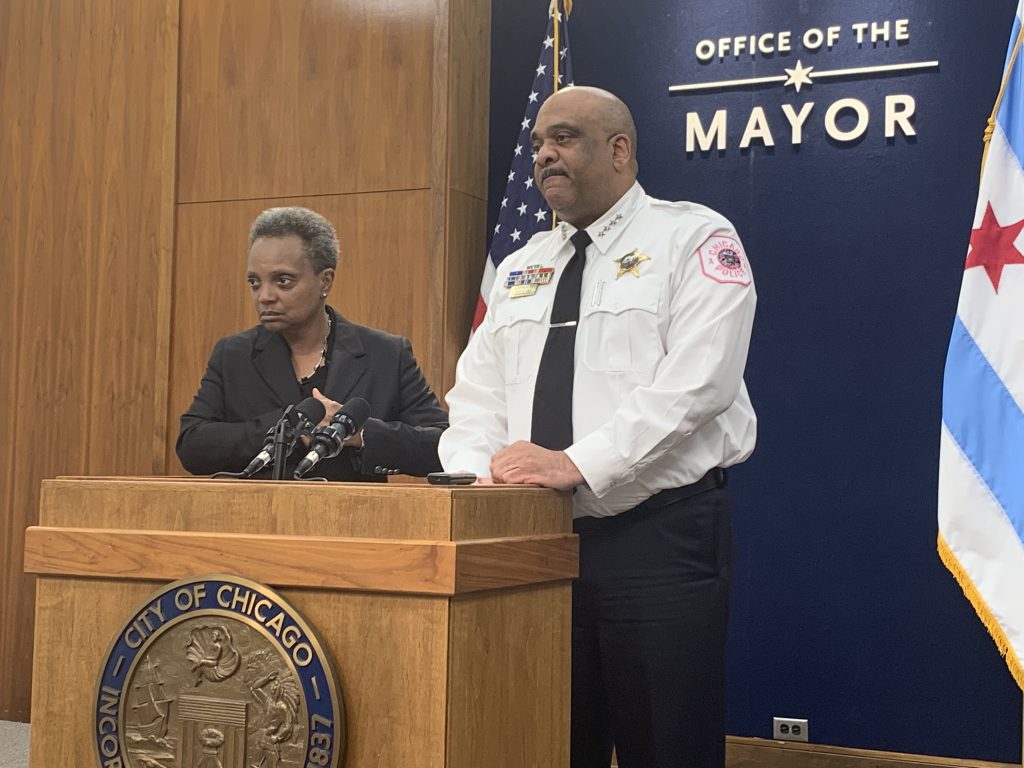
Mayor Lori Lightfoot rallied Thursday with immigrant rights activists outside the Chicago offices of the Immigration and Customs Enforcement Agency and announced new restrictions on how Chicago Police cooperate with federal agents.
"We will never, ever succumb to the racist, xenophobic rhetoric of ICE,” Mayor Lori Lightfoot said. [Heather Cherone/The Daily Line]
-
A diverse array of business, labor and transportation advocacy groups threw their weight on Wednesday behind county leaders who are calling for the three Chicago-area transportation agencies to converge on a plan to boost transit access on the city’s South Side and south suburbs.
The Metra Electric and South Shore lines. [Airbus777/Flickr]
-
The City Council’s Progressive Caucus urged Mayor Lori Lightfoot on Tuesday to partially close the city’s $838 million budget gap by taxing large corporations and imposing a sales tax on wealth management services.
Ald. Susan Sadlowski Garza (10), the chair of the Progressive Caucus details the group's budget proposals. [Twitter/@MattMartinChi]
-
An updated draft of the rules associated with the county’s Just Housing Ordinance inched closer on Wednesday to implementation, but at least one major sticking point remains before the controversial legislation can take effect.
Ahmadou Drame, of the Safer Foundation, addresses the Cook County Board. [Alex Nitkin/The Daily Line]
-
Mayor Lori Lightfoot should settle a complaint filed against the city before she took office that alleges the city’s tradition of giving aldermen the final say over housing developments in their wards has created a hyper-segregated city rife with racism and gentrification, housing advocates urged Wednesday.


Cook County Jail [Flickr/Zol87]
State Sen. Marty Sandoval (D-Chicago).