


Chicago News
-
Ald. Brian Hopkins (2) is set to launch a push to create a registry of Chicago murals, after it ran into a brick wall at last month’s meeting of the Zoning Committee failed to advance Thursday, after aldermen agreed the plan designed to prevent graffiti-removal crews from wiping them out could backfire. Two new candidates for the City Council surfaced, and a commissioner weighed in on what Toni Preckwinkle would be like as mayor.
-
SEP 11, 2018


-
-
Former Illinois Gov. Pat Quinn’s effort to limit Chicago mayors to two terms in office should not appear on the Nov. 6 ballot, a Chicago Board of Elections Commissioner ruled Monday.
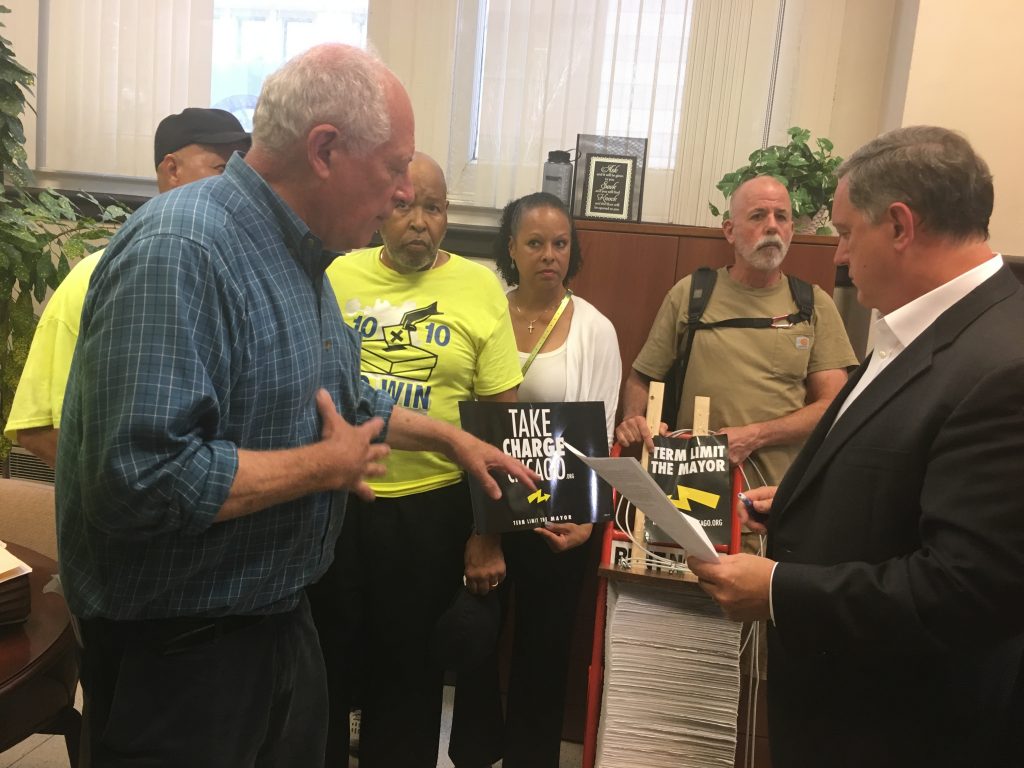 Former Gov. Pat Quinn delivers mayoral term limit petitions signed by more than 86,481 people to Peter Polacek, the managing editor of the City Council Journal. [Heather Cherone/The Daily Line]
 -
Cook County Board President Toni Preckwinkle is set to announce she will form an exploratory campaign for mayor — even though she is already running for a second term as county board president. After weighing a run for mayor, community activist Jedidiah Brown will run again for the City Council.
-
The latest round of tests found 644 homes near O’Hare and Midway airports have a foul odor coming from their city-installed sound-reduction windows, according to the latest tally of complaints investigated by city officials.
 A plane flies over the city. [Heather Cherone]
 -
SEP 07, 2018
Ald. Jason Ervin (28) drew a challenger, while the races in the 25th and 43rd Wards got even more crowded. Meanwhile, Jerry Joyce reported a big haul of campaign cash and Mayor Rahm Emanuel vowed to leave no ally behind — despite his looming departure from City Hall.
-
Chicago Police officers will be required to report when they pointed a gun at someone, after Illinois Attorney General Lisa Madigan prevailed in a dispute with Mayor Rahm Emanuel — one day after he announced he not seek a third term.
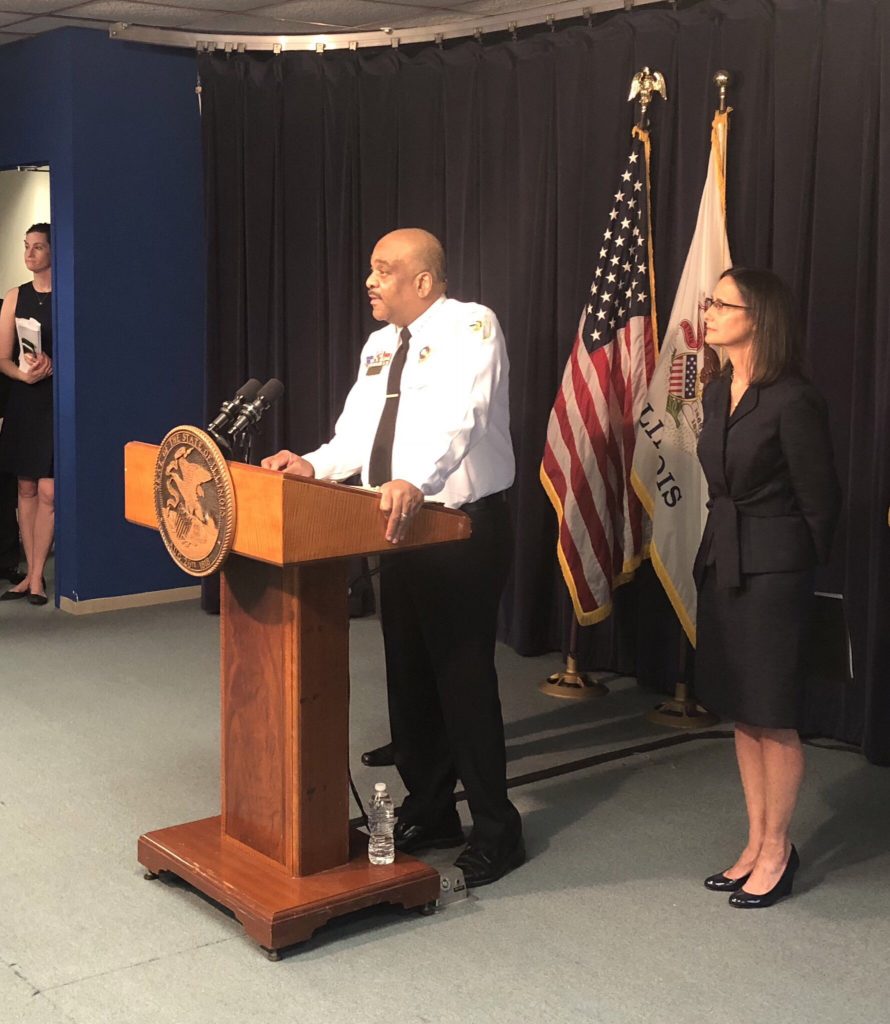 Chicago Police Supt. Eddie Johnson discusses the draft consent decree. [A.D. Quig/The Daily Line]
 -
-
Even as the mayoral race drew most of the attention, a new candidate filed to run for the open 22nd Ward seat, while the 33rd Ward committeeman dropped his bid for alderman of the Northwest Side ward. Despite Mayor Rahm Emanuel’s decision not to run for a third-term, his organization’s challenge of a measure that would impose a two-term limit on Chicago’s mayors will continue.
-
The Metropolitan Water Reclamation District Board will not vote Thursday as scheduled on a request to “recognize the authority” of Gov. Bruce Rauner to fill the vacancy of the late Commissioner Timothy Bradford through 2020.
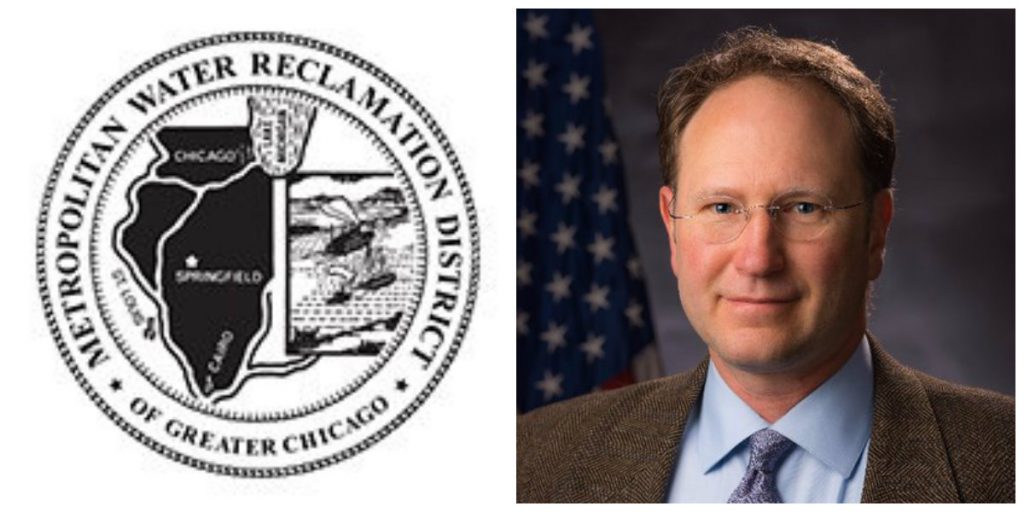 Metropolitan Water Reclamation District candidate Cam Davis called the vote, originally scheduled for Thursday, "so bizarre." [Submitted photos]
 -
Mayor Rahm Emanuel’s surprise announcement that he will not seek a third term in office leaves approximately a dozen high-profile projects and proposals in limbo — including the 2019 budget, with hearings set to start next month.
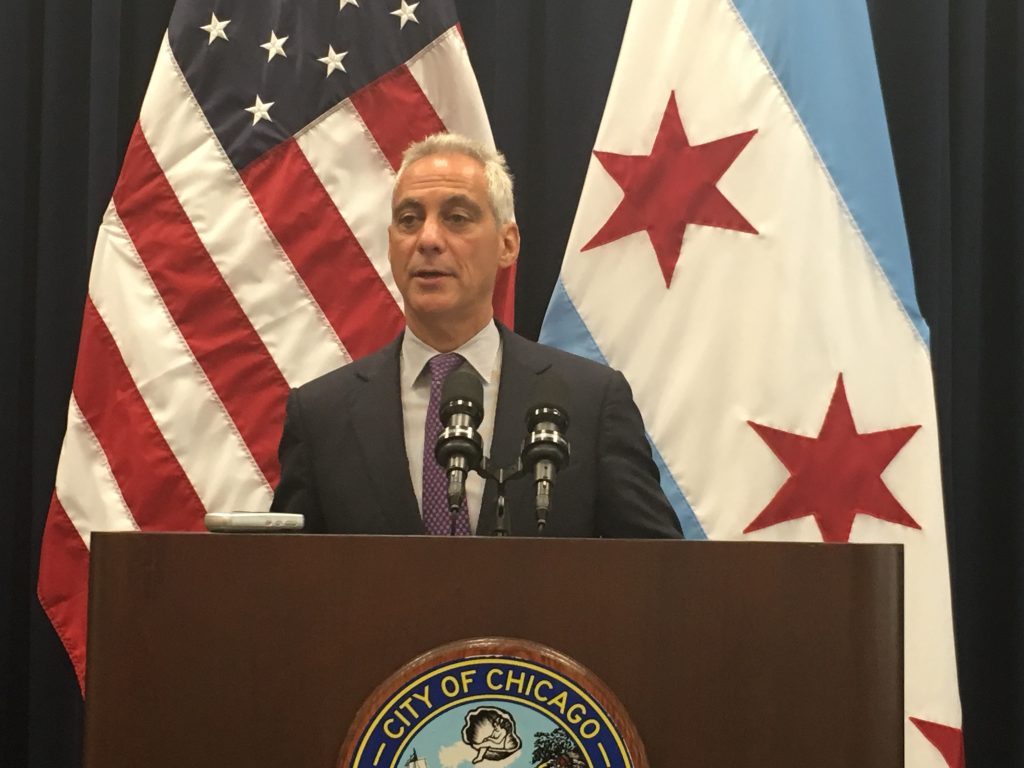 Mayor Rahm Emanuel has repeatedly claimed credit for the city's improving financial situation. [Heather Cherone/The Daily Line]
 -
On a day when metaphors were flying fast and furious at City Hall, Ald. Ricardo Muñoz (22) summed up the landscape hours after Mayor Rahm Emanuel announced he would not run for a third term.
“We saw a meteor hit a constellation today,” said Muñoz, who was one of dozens of aldermen, elected officials and political power players to immediately start weighing a bid for the office on the 5th Floor of City Hall. “Now, the dust is settling.”Flanked by his wife Amy Rule, Emanuel set off what promises to be an explosive chain reaction Tuesday morning at a hastily assembled news conference at City Hall.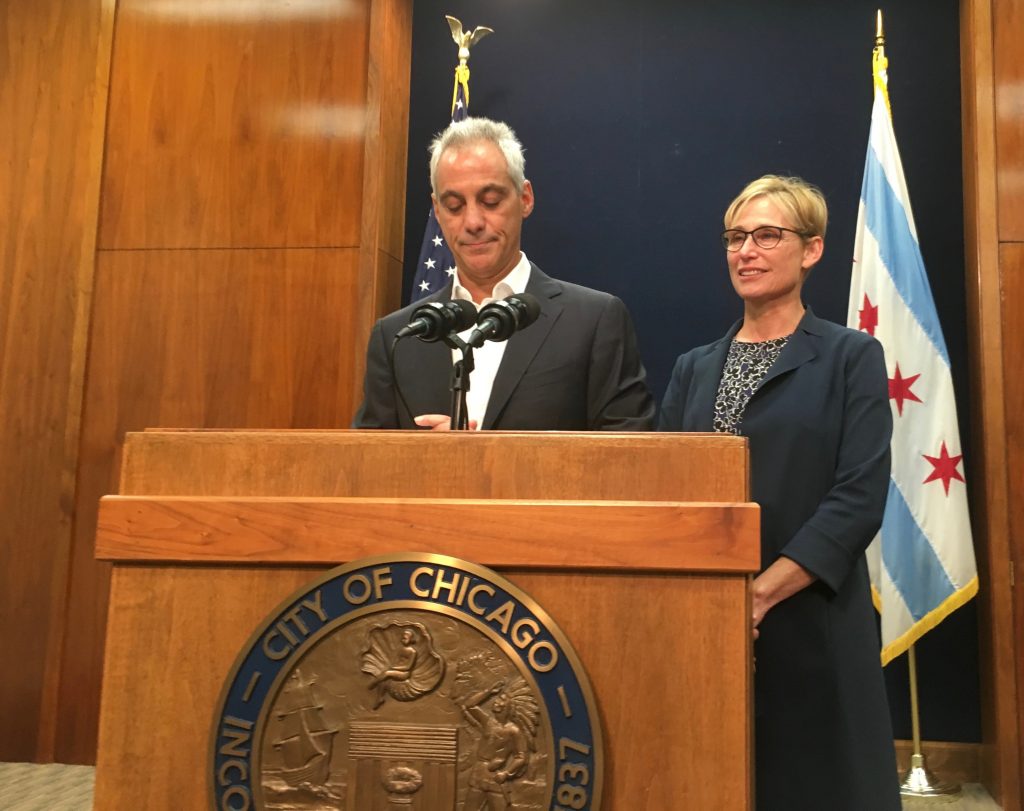 Flanked by his wife Amy Rule, Mayor Rahm Emanuel announces that he will not seek a third term. [Heather Cherone/The Daily Line]
“This has been the job of a lifetime, but it is not a job for a lifetime,” Emanuel said while clutching his wife’s hand and struggling at times to maintain his composure, especially while paying tribute to his immigrant grandfather.
After touting his record on education — “universal full day pre-kindergarten, universal kindergarten and a longer school day and year” — Emanuel took no questions, and gave reporters little insight as to why he pulled the plug on the re-election effort that had already hired staff and launched a signature-gathering effort.
“Politicians always say they’re leaving office to spend more time with their family,” Emanuel said. “My kids were smart enough to see that coming and scattered to the two coasts, so as of the other day we are now empty nesters. Amy and I are still young – and Amy still looks it. And we look forward to writing that next chapter in our journey together.”
Contenders scramble to weigh in
The already-announced challengers acknowledged that the contest’s landscape had shifted, with more donors freed up — or less fearful of the political ramifications — to back a challenger.
“I always assumed I would be outspent,” candidate Paul Vallas said. “I always assumed I would prevail on the issues, my ability to speak with great specificity about what I would do to deal with Chicago’s complicated problems.”
Vallas and challenger Lori Lightfoot both said voters should be skeptical of latecomers to the race.
“If they didn’t have enough guts to get into the race when Rahm Emanuel was still running, what makes you think that whoever, somebody gets in the race is going to have the guts to make the tough decisions to move this city forward?” Vallas asked.Lightfoot said Emanuel’s announcement was “undeniably big news, but it doesn’t change what we’re fighting for. It doesn’t change the needs of people all across this city.”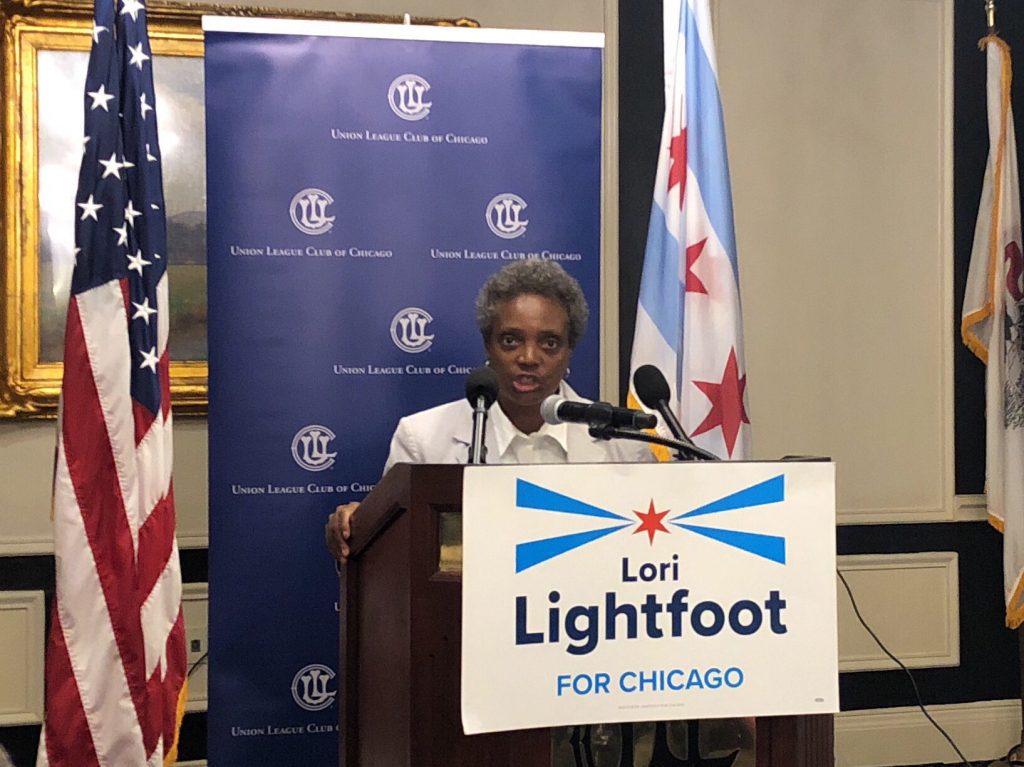 Lori Lightfoot addresses the media. [A.D. Quig/The Daily Line]
“We still need a leader to unite the city, and I plan to be that leader," Lightfoot said. "Everywhere we have gone in the last four months, Chicagoans tell us they need a government that sees them, that listens to them, and that invests in their communities."Emanuel’s exit “makes it easier for those who were afraid of the bullying tactics” of City Hall to voice their support, former Chicago Police Department Supt. Garry McCarthy said. “I’m counting on support from people who were afraid of him.”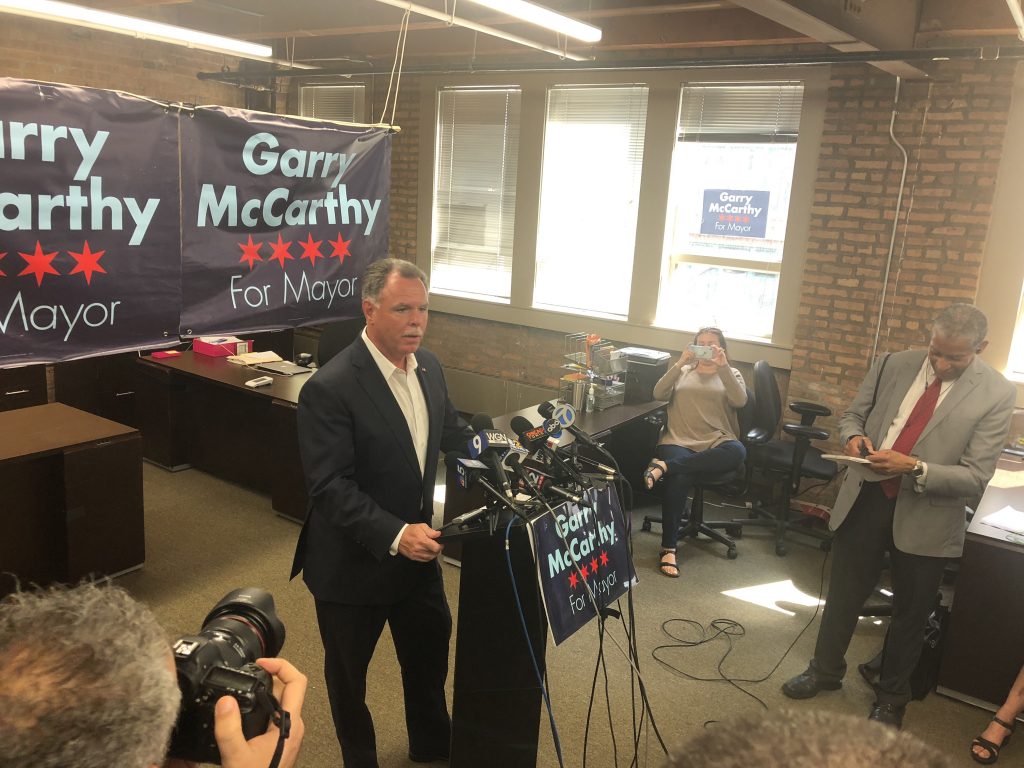 Former Chicago Police Department Supt. Garry McCarthy welcomed Mayor Rahm Emanuel's decision not to run for mayor. [A.D. Quig/The Daily Line]
Black Lives Matter activist Ja’Mal Green said he had no doubt Emanuel’s decision not to run again was related to the first-degree murder trial of former Chicago Police Officer Jason Van Dyke on in connection with the death of Laquan McDonald.
Chicago’s next mayor should not be part of the current political establishment, Green said, while standing just outside the office he hopes will be his next spring.
“We need someone who understands the issues from a community standpoint,” Green said, echoing calls that groups like Black Lives Matter Chicago, Black Youth Project 100 and Assata’s Daughters have made about Emanuel since the release of the McDonald video.
Reaction from outside the mayor’s circle
While Ald. Nicholas Sposato (38) is on the opposite side of Chicago’s political spectrum, he agreed with Green that Van Dyke’s trial — set to start Wednesday — pushed Emanuel to re-evaluate his plans to run for a third term.
“The pressure and the stress on the man must have been insurmountable,” Sposato said.
Both Sposato and fellow Far Northwest Side Ald. Anthony Napolitano (41) said they would wait to see which candidate won the backing of Chicago’s labor unions before endorsing anyone.
“It is quite a conundrum,” Napolitano said.
Chicago Teachers Union leadership said the unrelenting criticism Emanuel faced from former President Karen Lewis paved the way to push the mayor out of the race.
“We don’t get to this point as a city without Karen Lewis putting this entire city, racial justice, educational justice, social justice, economic justice on her back,” said the Chicago Teachers Union political director Stacy Davis Gates. “Karen Lewis made everyone in this city believe that they could demand equity, that they could demand justice... The people in the CTU who followed her and worked damn hard to make this happen. He hit the wrong people in 2011 and we hit him back.”
Late Tuesday, the union asked members to give $19 per month to CTU in “honor of a 2019 without Mayor 1% on the ticket,” using the derisive nickname the union and other critics have used for Emanuel for years.
The union has yet to make a decision on who to endorse, Davis Gates said, but she celebrated that “the city of Chicago gets to hear people who have a vision for this city express without the threat of millions of dollars looming in the background to destroy them.”
The Chicago Teachers Union isn’t the only labor union re-examining the mayor’s race. Groups that might have focused on aldermanic races could shift their priorities, said Jerry Morrison, assistant to the president of SEIU Local 1.
“We’d take a serious look at it, as would our friends and allies... Rethinking what the playing field in the election dynamics look like,” Morrison said. ”What are the priorities? I would assume that some folks that prioritized aldermanics might change their priority to the executive.”
Morrison warned the field of candidates was not yet set.
“You’ll see bigger names. You’re going to hear a lot of names floating out there. Whoever can put together the Obama – Toni Preckwinkle – Kim Foxx coalition has the best shot of winning a runoff. This undoubtedly will go to a runoff,” Morrison predicted, arguing a candidate who can pull progressive voters from each of Chicago’s traditional tribal political factions has the best shot.
Other contenders in the wings
Preckwinkle is likely to make a decision about her own run in the next two days, a source close to her told The Daily Line. Her former chief of staff, City Treasurer Kurt Summers, is also said to be weighing a bid for mayor, sources told The Daily Line.
Also in the mix of potential candidates is Illinois Comptroller Susana Mendoza, the former city clerk, Cook County Comm. Jesus “Chuy” Garcia and U.S. Rep. Luis Gutierrez.
Although Garcia is set to replace Gutierrez in Congress, he is considering a second bid for mayor, Muñoz said, adding that he would not run to replace Emanuel if Garcia chose to do so.
City Clerk Anna Valencia said Emanuel’s announcement had prompted her to weigh a run for the top job, even though she had planned to run for a full term as city clerk.
“This has been the best job I have ever had,” Valencia said. “But this does certainly change things.”
Valencia said she wanted to continue working to build an “inclusive” city government and to strengthen the “bridge between City Hall and the neighborhoods.”
Valencia said she was disappointed in the current crop of 13 candidates.
“We definitely need another woman of color in the race,” Valencia said. “We must be in the conversation.”
Ald. Ameya Pawar (47) — another potential mayoral candidate — said if he decides to run for mayor it would be to focus on alleviating “poverty and inequality.”
Pawar, who ran for the Democratic nomination for governor before dropping out and endorsing eventual winner J.B. Pritzker, is not running for re-election to the City Council after two terms.
Finance Committee Chairman Ald. Ed Burke (14), singled out as a target for progressive groups energized by Garcia’s “sweep” in the 2018 primaries, said Emanuel’s decision won’t change his campaign calculus.
The City Council’s longest serving alderman did not rule out his own run for mayor.
“Most people will wait to see when the smoke clears to see who remains of interest… whoever is interested has to really want the office more than anything else,” Burke said. “I’ve served with eight mayors now, and I’ve had a working relationship with all of them. It’s been a pleasure to occupy a front row seat to Chicago history.”35th Ward Ald. Carlos Ramirez-Rosa — who launched, and then dropped bids for lieutenant governor and congressman earlier this year — was one of only a few aldermen to definitively rule out a run for mayor.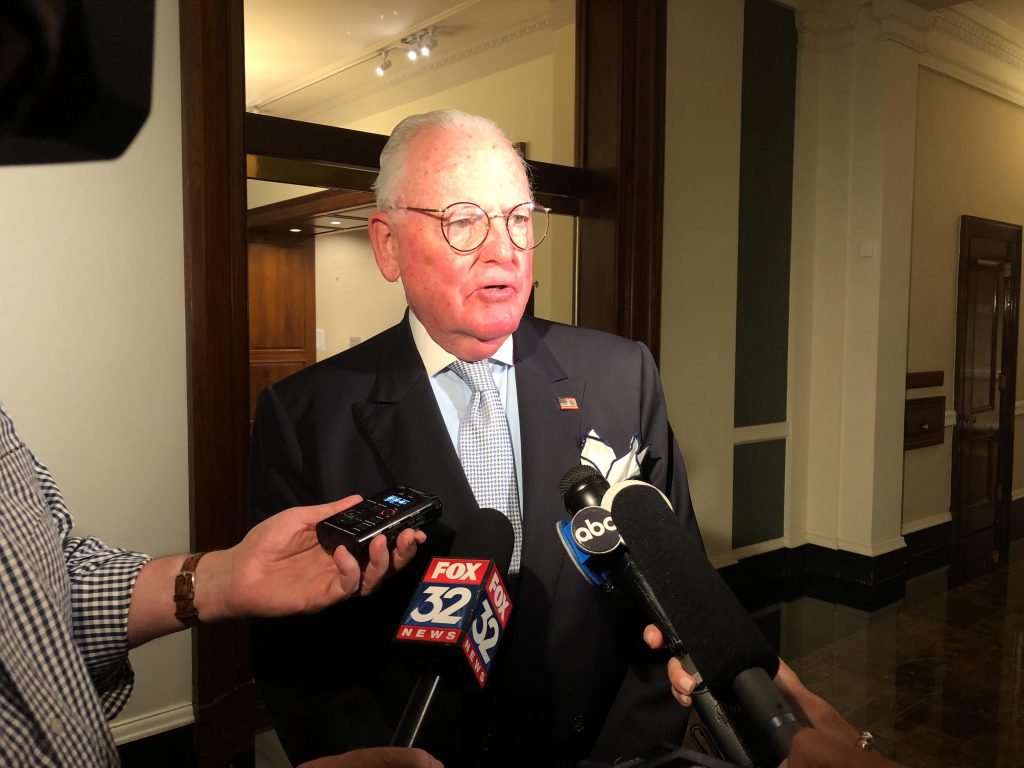 Ald. Ed Burke (14) did not rule out a run for mayor. [A.D. Quig/The Daily Line]
Ramirez-Rosa said he will continue his bid for re-election to the City Council, where he was one of Emanuel’s most vehement critics.
“This is a renewed opportunity to come together to decide what kind of city we want Chicago to be,” Ramirez-Rosa said. “Everyone needs to come together to meet the tough challenge of building a more inclusive Chicago.”
Former Gov. Pat Quinn joined Ramirez-Rosa in ruling out a run, saying he was focused on getting a referendum on the November ballot that would limit Chicago mayors to two terms.
“I think he did the right thing,” Quinn said. “Two terms are enough."
Ripples felt in City Council races, and on the floor
Latino Caucus Chairman Ald. Gilbert Villegas (36) said Emanuel was polling at 24 percent in his Far Northwest Side ward.
“I’m a little surprised,” Villegas said. “I mean I’ve done some polling in my ward and poll numbers were not very favorable, so a little surprised but not totally surprised.”
Emanuel not running shifts aldermanic races as well for, as Villegas put it, ”the hundred percenters,” aldermen who voted consistently with the mayor.
“Although he’s going to be out, those that voted 100 percent with him still have that record, that [opponents will] be able to tie to that alderman too,” Villegas said.
A political operative who works closely with City Council said they would be watching what happens to the Victory PAC, which was launched in July by allies of Emanuel to support to aldermanic candidates. The fund received $50,000 from the Chicago Regional Council of Carpenters PAC on Aug. 13, state records show.
"I'd be very curious to know what's going to happen to that and whether or not that's going to make the landscape a little less threatening," for challengers to Emanuel-aligned candidates, the operative said.
Aldermanic allies in the past could bank on the mayor's campaign coffers or associated committee to intimidate challengers, they said.
"You shouldn't need half a million dollars to run for alderman. That's pretty obscene. If you raised $250,000 in the last cycle you did really well for yourself. Now it's the minimum commitment."
The operative said Emanuel's decision also roils the council's legislative agenda.
"In City Council I think there's going to be a lot of scrambling to figure out who can get what done. What priorities is this going to realign?"
Emanuel's departure could change the calculus around the debate over the community oversight of the police department, Amazon's second headquarters, the Lincoln Yards development and proposed changes to the welcoming cities ordinance.
"How is this all going to affect what makes it on the roster?" they wondered, with Emanuel "standing at the doorway rather than at the head of the table."
The giant grain of salt list of potential contenders:
Per Crain’s Greg Hinz: Retiring U.S. Rep. Luis Gutierrez; city Treasurer Kurt Summers; Illinois Comptroller Susana Mendoza, former U.S. Education Secretary and ex-Chicago Public Schools CEO Arne Duncan; and former top Obama aide Valerie Jarrett, Cook County Board President Toni Preckwinkle, former mayoral hopeful Gery Chico and former U.S. Commerce Secretary Bill Daley.
Per the Sun-Times’ Tina Sfondeles: Ald. Roderick Sawyer (6), Ald. Scott Waguespack (32), Ald. Ameya Pawar (47), Illinois Attorney General Lisa Madigan, U.S. Rep. Mike Quigley, Chico, Duncan, Preckwinkle.
Per the Chicago Tribune’s John Byrne, Bill Ruthart and Greg Pratt: CEO Michael Sacks, Ald. Proco Joe Moreno (1), Ald. Tom Tunney (44), Duncan, Daley, Pawar, Chico.
Per Ted McClelland in Chicago Magazine: Cook County Commissioner Bridget Gainer, Cook County Sheriff Tom Dart, Chance the Rapper, Lisa Madigan, Gutierrez, Duncan, Summers, Jarett, Preckwinkle.
Past coverage:
Top mayoral contenders bank $9.2 million — here’s where the cash is coming from
Mayoral hopeful Vallas hired firm behind mystery texts, but says poll was conducted by ‘independent firm’ -
-
A proposal to create a registry of Chicago murals failed to advance Thursday, after aldermen agreed the plan designed to prevent graffiti-removal crews from wiping them out could backfire.
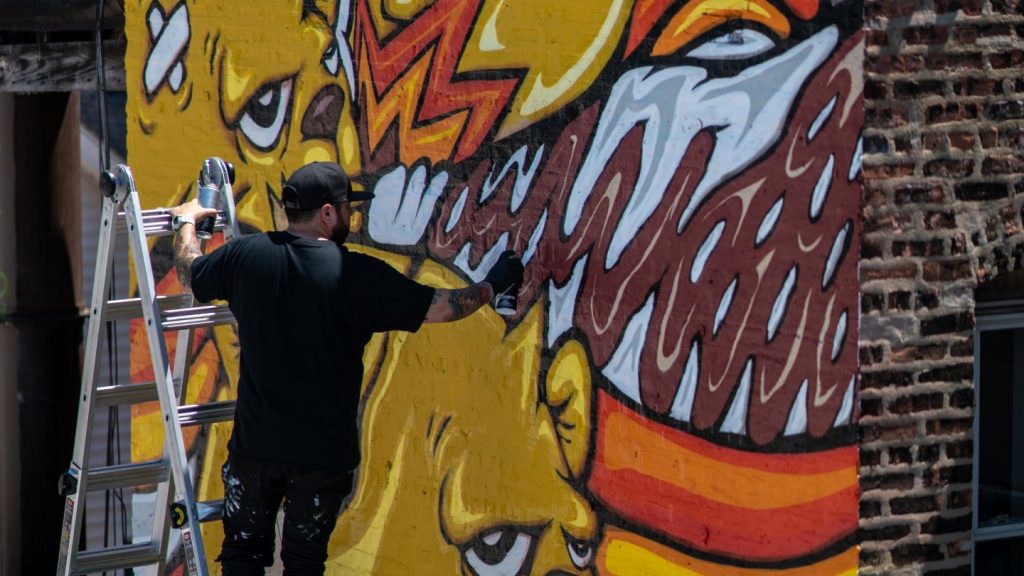 Artist J.C. Rivera paints a mural near the Paulina Brown Line stop. [Lakeview Chamber of Commerce/Facebook]
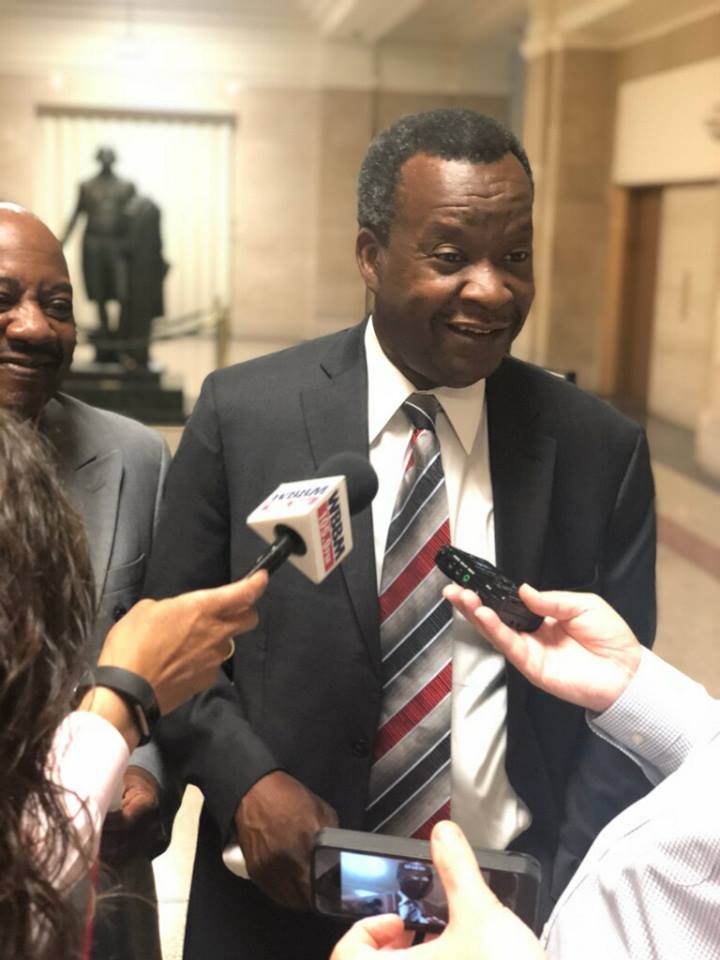 Mayoral candidate Willie Wilson speaks to reporters. [Submitted photo]

