


Chicago News
-
DEC 22, 2016

UNLOCKED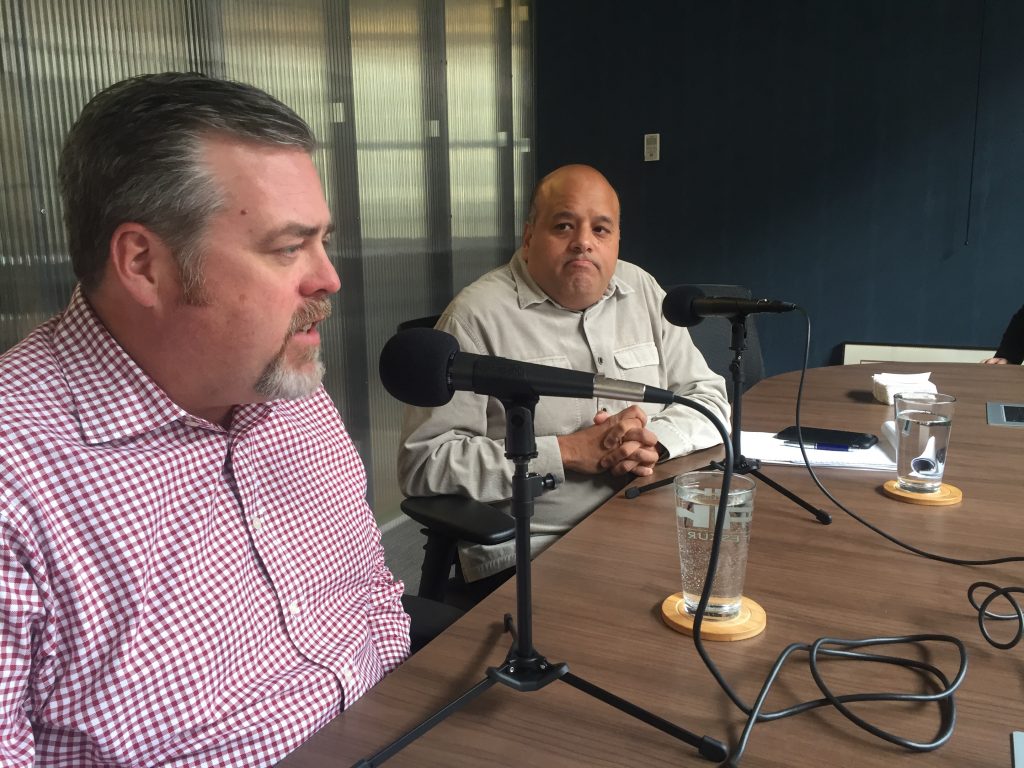 Mike Noonan (on right), Victor Reyes (on left), recored on Dec. 20th, (Photo Credit: A.D. Quig)
This week, our publisher, Mike Fourcher, sat down with two clued-in Chicago politicos: Mike Noonan and Victor Reyes. You might know them as the co-founders of the Roosevelt Group, a public affairs and lobbying firm that works in both Chicago and Springfield. In this hour long special episode, Reyes and Noonan talk about the upcoming gubernatorial race, ongoing dysfunction in Springfield, and reflect on Mayor Rahm Emanuel’s second term in office following a year in turmoil over fractured community-police relations in the wake of the Laquan McDonald video release.
A former assistant and director of intergovernmental affairs under Mayor Richard M. Daley, Reyes later created and managed the now-defunct Hispanic Democratic Organization (HDO). Noonan, a native of the South Suburbs, worked under Illinois Speaker Mike Madigan, and managed a slew of local races, including Lisa Madigan's 2012 election for Illinois Attorney General and John Stroger’s 2006 election for Cook County Board President.
-
DEC 22, 2016
UNLOCKEDWith low polling numbers and with few natural allies in the state or federal governments, Mayor Rahm Emanuel will be forced to make new allies and tough decisions in the coming years. Here, Mayor Emanuel delivered his anti-crime speech in September 2016. (Aaron Cynic)As he attempts to unify the city and rebuild trust, Mayor Rahm Emanuel is encountering a number of wedge issues he’ll need to overcome if he wants a third term, say community leaders across the city. From the recent election of Donald Trump as president to the upcoming gubernatorial race in 2018, these wedge issues will likely intensify in the years leading to the 2019 mayoral race, forcing Emanuel to make new allies and tough political choices.
-
DEC 21, 2016
UNLOCKEDWhile protests have died down since this December 9, 2015 demonstration following the release of the Laquan McDonald video, dissatisfaction remains in many Chicago communities with Mayor Rahm Emanuel's handling of crime and police-community relations. (Claudia Morell)The next municipal election is still more than two years away, tying Chicago’s destiny to Mayor Rahm Emanuel until 2019. But for many community leaders throughout the city, continuing problems with crime and police reform and a lack of equitable development are causing people to lose patience with his leadership. Increases in property taxes and fees have well-to-do parts of the city grumbling more than before. And many black community leaders are still so alienated from Emanuel following the Laquan McDonald video release that they’d rather have nothing to do with him.
Since taking office, Mayor Emanuel has faced a series of bad or worse choices: to balance the city’s books, he has to increase revenue through taxes and fees, or cut government services. To bring accountability to law enforcement, he has to balance scrutiny of the police department without further jeopardizing morale among the rank and file–who also feel overburdened by the city’s crime wave.
“I think Chicago crime is on the top of mind for every resident… whether they live in River North or Englewood,” said one young Democratic politico who asked to remain anonymous. “I think a lot of people are hoping that not only will we turn the crime around in the neighborhoods, gang violence and whatnot, but that we will build trust between police and communities on both sides. I think if you talk to mothers of Englewood, folks who are in church on Sunday, who are living in the communities, they want jobs, they want to be able to go to work, go to school, feel safe in their community for themselves, their children, their families. Right now they don’t feel safe.”
The Neighborhood Perspective: A Five Part Report From The Daily Line
Monday, Part 1 – Community Leaders: Frustrated With Emanuel Administration, But Waiting, Hoping For Improvements
Tuesday, Part 2 – A New Group Of African American Influencers Taking The Stage
Wednesday, Part 3 – Challenges For Mayor Emanuel: Trust, Violence And Development
Thursday, Part 4 – Chicago’s Wedge Issues And Emerging Challengers
Friday, Part 5 – Their Words: Raw Comments From Our Interviews With Community Leaders
Share this story using the social media links above.
This issue impacts those communities the mayor has lost most credibility in. Those young mothers in Englewood, that politico said, “feel endangered by the gang violence, and they feel targeted, discriminated against” by police officers too often. The mayor has to negotiate a difficult situation: fight crime with the help of a police department that feels unsupported by the Mayor, in neighborhoods where trust in both the police and the mayor are low.
“His number one issue now is the police department, right behind that is CPS [Chicago Public Schools]. The biggest hurdle is the police-involved shootings, and so-called reform of the police department,” said Richard Wooten, a retired Chicago police officer and one-time 6th Ward aldermanic candidate.
“I think if the mayor is able to fully reform the police department before the next election, he has a good chance of winning reelection. Short of that, in a pool of weak candidates, he will get re-elected,” added Wooten.
“I think for the most part, people are going to be pretty unhappy,” one anonymous consultant for aldermanic and countywide campaigns said. “People don’t like taxes. Doesn’t matter if the purpose is to stabilize government. People inherently distrust when they say they’re raising taxes to help keep government going. A lot of people see Chicago as a body of government that has wasted a lot of money.”
These observations are the result of dozens of interviews The Daily Line conducted of neighborhood-level political leaders across Chicago. During December 2016, hours of interviews of pastors, not-for-profit leaders, former aldermanic campaign staffers, activists, precinct captains, fundraisers and ground-level organizers were held over the phone and in person.
Rising Violence & Mistrust of Police
More than anything, demands to stem the city’s wave of violence and to visibly reform the Chicago Police Department overshadow any other concerns among Chicago’s community leaders, especially those in largely black and Latino wards.
“That’s his number one challenge: safety,” that anonymous campaign consultant said. “Whether he’s talking to the black community, white ethnic communities on the outer parts of the city, or lakefront people, crime is an issue that everyone sees and worries about. Because everyone thinks something bad’s gonna happen to them, living in a big city.”
Fear of crime is pervasive in minority communities, because violence has pervaded every element of daily life. That fear is compounded by a general distrust of the police, says Asiaha Butler, Executive Director of the Resident Association of Greater Englewood (RAGE). “I think the police piece is very prominent in Englewood. We have a large amount of violent cases still happening. It doesn’t mesh really well. You’re driving down the street and you can get stopped, but violence still occurs in our area.”
“I was in the gym the other day, and a guy was talking about how in the Englewood area he was emptying his garbage and found a crate of guns–A crate of guns! Just left in the alley. Now this crate of guns was for those guys on the street killing each other,” said Homer Lyons, a former West Side organizer and now a construction contractor.
Leaders outside of black South and West Side communities are concerned about crime too, but their concern is more existential, usually linked to concerns about not receiving their fair share of police protection. As one aldermanic chief of staff from the Northwest Side who spoke on the condition of anonymity explained, “All it takes is for one shooting and people feel like our neighborhood is falling apart and that we don’t have enough police.”
“People always say crime is one of their top concerns. There’s places in the city, where you ask them what do you mean? They say, ‘My car was stolen,’ something specific to them. In other parts of the city, they just have a sense that crime is bad, that something may happen to them,” said Carl Nyberg, who leads Northside Democracy For Action, a grassroots organizing group. “Crime is also a codeword that whites use to say ‘I’m uncomfortable with the number of blacks and people of color in my community.’”
“The worst trend is spreading of crime into the Northwest and Southwest Side neighborhoods that didn’t get it in the past. I don’t think there’s the same sense of security there was ten, twenty years ago,” said Southwest Sider and journalist Ray Hanania.
“Crime has been going through the roof. Murders on Devon, this sort of stuff was unheard of. We’ve never seen this before,” said Majid Mustafa, a 50th Ward precinct captain and restaurant manager. “Residents are asking, what plan do you guys have to not help, but stop and get the crime down? As of right now, I don’t think there’s a real plan. Sure the mayor’s got his plan of hiring 1,000 police officers to man the city, but I think people forget that’s barely going to keep up with retirement.”
“We were down to one car in the entire 41st Ward,” said 41st Ward Chief of Staff Chris Vittorio. The ward is home to a significant number of police officers and firefighters, and is generally considered a safer district, but many noticed the lack of visible patrol presence, he said. “This blew up on social media. That’s another thing that now our resources are being sent elsewhere in other districts where crime is uncontrollable, and [residents] feel like, ‘Why aren’t we getting resources?’ I believe 41 is seventh on list for [the amount of] property taxes they pay out of 50 wards, but they’re last on the list for officers, even though they’re the bigger district.”
Robert Murphy, the Democratic Committeeman of the 39th Ward, said Northwest Side aldermen had been lobbying for more police for a while before the Mayor pitched adding 970 officers to the force. “I don’t know when those officers are supposed to come online. For Emanuel, and this is like everything he’s ever talked about, the devil is in the details. He rolls out this big promise, and two or three years down the road, it only saved us half as much money or made us back half as much [as was initially promised],” he said, pointing to the city’s take in the parking meter deal. He says there are more non-violent crimes like robberies and burglaries in the neighborhood, and there have been more shootings than in the past.
Mayor Emanuel bears more of the burden for fixing crime problems than his predecessor, some argue. There’s a sense among community leaders that Emanuel is more personally involved in the police department, said David Doig, president of Chicago Neighborhood Initiatives, a nonprofit developer in Pullman and Roseland who also worked in the Daley Administration.
“With [former Mayor Richard M.] Daley, he always had a buffer with the police superintendent. He’d say, ‘Talk to him, it’s him’. Right or wrong, in the early 90’s, Daley was always able to deflect it with the community. By and large, he had police superintendents who were willing to wear that jacket and take that role. I don’t know Rahm has had that respect. Rahm is very hands on in ways Daley never was. By involving himself so deeply, he has kind of owned it.”
Owning the issue of crime and police reform has become a two-edged sword for the mayor. While it allows citizens to draw a direct line to him for problems, it also gives him a boost when things are fixed, says Rev. Torrey Barrett, a pastor in Washington Park and the Executive Director of the K.L.E.O. Center.
“I think appointing Superintendent Eddie Johnson as police commissioner [added credibility]. Even before that, firing the previous Superintendent Garry McCarthy–the community called for his firing and he acted on that. That established some credibility. The dismantling of [the Independent Police Review Authority] and bringing in [the Civilian Office of Police Accountability] and extending time before his decision to have community input on that. The investment in additional mentoring in the black and brown young boys in 8th, 9th and 10th grades. The huge investment in Becoming A Man, but also all the other non-profits in the city serving that population” all helped with the mayor’s perception around crime and prevention, said Barrett.
But close behind violence and police reform concerns, the city’s record property tax increases and new fees are drawing attention–often in economically challenged communities as much as in wealthier North Side neighborhoods.
“People connect him with increased fees for parking their trucks. They connect him with the red light cameras, the speed cameras. People connect him with the property tax increases, the water tax increases, the garbage tax increases,” said Pete DeMay, a one-time aldermanic candidate who is now active in the 12th Ward Independent Political Organization (IPO). “This is not a wealthy ward and people feel those. They don’t feel their input has been solicited. They see CPS schools having their staffs cut. People aren’t happy.”
“Hey, if you’re going to squeeze water from a stone, if you add taxes, we want to see something for it. We don’t see it in the 12th Ward. In McKinley Park, Brighton Park, Little Village… we’re not seeing the change,” he said.
“In 41, they feel that they’re taxed to death and it never ends. It’s not so much the continual taxes and fees, it’s just they feel they don’t get anything for their money,” Chris Vittorio said. “The condition of streets… we can’t put a dent in what needs to be done. Not only are they getting an increase [in taxes], they don’t feel like they’re getting a return.”
Taxes are a big issue in the 25th Ward as well, according to former aldermanic candidate Byron Sigcho, who is still an organizer in a gentrifying Pilsen. “Not only increases across the board, people are feeling pressures of water and sewage bills, the cost of living has gone up dramatically. In Pilsen in particular, home prices have gone up dramatically. Taxes have gone off the roof because of assessments.”
The city’s new property taxes and water fees were adopted to pay long-ignored (and compounding) pension debts. But unlike other city revenue increases, there’s no tangible benefits for citizens to see, only filling in a deep financial hole created by past mismanagement. Water rates and property taxes will both continue to increase–according to the consumer price index (CPI), and to match actuarial needs in the city’s police and fire pensions.
But in the eyes of some community leaders, Mayor Emanuel has not and still is not doing enough to convince residents that they’re getting something in return for their tax dollars. Even though almost all understand Chicago’s poor fiscal position, most residents just don’t understand their increased taxes are going to pay long-standing debt.
“A lot of people feel water isn’t billed fully. You go the Southwest Side, we’re paying 100%. And what do we get for it? Crime is spreading all over the place,” said Ray Hanania.
“It’s more to me a question of education, but people that aren’t really involved can’t find the tangible things the mayor has done for us, but the majority of people just don’t understand and aren’t aware of how those things work,” said Frankye Payne, Executive Director of the Southwest Chicago Chamber of Commerce. “Every business owner is concerned about their taxes. If they can’t see that transparent connection, they’re not going to be happy with what’s happening.”
But the mayor, like he did in the 2015 campaign, has an opportunity to bill himself as the city’s fiscal steward in 2019, according to Dan Shomon, a political consultant who has worked on aldermanic, county, legislative, and three of President Obama’s campaigns. “The criticism against the mayor has never been that he’s a poor fiscal manager, it’s been his responsiveness,” he said. With “CPS on brink of financially disastrous situation, it’s a good chance for the mayor to show off fiscal skills.”
Desire For Development & Critiques of TIFs Loom Large
Chicago is in the middle of a building boom, making gains not seen since before the Great Recession. There’s a record number of construction cranes and building permits, mostly within the city’s central business district, but the building upswing hasn’t hit predominantly low income areas, where boarded up buildings and vacant lots are still common.
Since taking office in 2011, Mayor Emanuel has contended with charges of “Two Chicagos”, where the majority-white North Side and downtown areas receive the vast majority of development and city resources, while the minority South and West Sides receive short shrift. Perceptions that the fifth floor cares more about improving the city’s downtown–the Mayor often touts Chicago is the number one city for corporate relocations and foreign investment–looms large among many organizers and community activists who also describe the city’s Tax Increment Financing (TIF) system as a mayoral slush fund, and contend many large scale projects in low income areas are more ceremonial than substantive.
“If you grow up in West Englewood or on the Southwest Side, Gage Park or even Archer Heights, and you go downtown, it’s like, man, they’ve spent a lot of money. That’s nice, that’s sweet, but it’s just now that we’re getting viaducts repaired after decades of neglect,” said Dion Miller-Perez, a political organizer and consultant based in Little Village.
“The number of cranes up, that’s true, it’s some testament to the downtown boom. That’s the disconnect, said Craig Chico, Executive Director of the Back of The Yards Neighborhood Council. “But [Mayor Emanuel has] been talking about that since the first term, that he wouldn’t be a mayor of the tale of two cities. Is it working yet? It’s not working like anybody wants it to.”
“If we could write the Tale of Two Cities again it would be Chicago. North Side: downtown, Michelin star places, that’s one part of Chicago,” said Frank Avila, Jr., a Southwest Side activist and frequent office-seeker, but “I see a ton of homeless now. I see a lot of hurt. I think unemployment in Chicago is very high. Foreclosures are high. Loans are still not being met. Bankruptcies are high.”
“Density drives development, but with so many single family units, we’re not made for that kind of density [in Southeast Chicago]. So how do you create commercial projects and programs for businesses that work here? We haven’t really solved that issue. That’s one of the things I want to personally spur with the city of Chicago,” said Frankye Payne.
Regularly, Emanuel and his team roll out new development plans, ranging from the Method factory in Pullman, a new Whole Foods Distribution Center, a massive capital program for streets and sewers, strengthened affordable housing requirements, ribbon cuttings at parks, businesses, and initiatives, and plans to modernize and expand the city's busiest CTA line.
To address the large swaths of city-owned vacant land, the city rolled out a program that sells those lots to neighboring homeowners or businesses for $1, or adjacent lots for a low, negotiated price. Since its inception in 2014, more than 550 lots have been sold in the Greater Englewood area, East Garfield Park, Austin, Roseland and Pullman under the Large Lots program. And in November 2016, the Emanuel Administration announced it would expand the program to include more than 4,000 lots in other South and West Side communities.
“He is going overtime to bring developments to the black community, many people see this as too little to late,” explained Wendell Hudson, a former reporter and campaign manager for Richard Wooten’s aldermanic campaign in the 6th Ward. “You’re doing it now because you think you need us, but when you thought you didn’t need us, particularly with the schools, it’s too little too late.”
On the West Side, which still shows visible scars from the 1968 riots after the death of Martin Luther King, Jr, “We never fully recuperated,” said Karl Brinson, Executive Director of the NAACP West Side Chicago Branch. Many buildings burned in those April riots were never rebuilt and looted businesses were boarded up. “The West Side never replaced stuff after that. Lawndale and Garfield [Park] have the highest number of vacant lots in the city. We never recuperated… We just didn’t get here today. We have been suffering trying to get on par, we never caught up. Those buildings and businesses never returned. That has an impact, mental and physical on generations… Some people say God left the place a long time ago.”
“I’m trying to think how can we include these communities in the investment portfolios of the flow of capital in the city. I’m in West Garfield Park,” said Rev. Marshall Hatch, pastor of New Mount Pilgrim Missionary Baptist Church. “We have here the least number of building permits of any neighborhood area in any one of those in the city. And correspondingly, there’s lower life expectancy and there’s higher infant mortality and lower employment and lower income and losing the most population. Thirty percent of housing stock is unoccupied. It’s also ripe for development. Vacant lots… If you focus on the weakest, everything flourishes from there.”
Mayor Emanuel has made gains to address the disconnect during his second term in office. In addition to those major projects listed above, his administration has designed a new system to link downtown development to some of the city’s poorest areas, created a new Community Catalyst Fund, and revamped the Chicago Infrastructure Trust, a private-public partnership aimed at offsetting the cost of infrastructure improvements.
Designed by Department of Planning and Development Commissioner David Reifman, a former zoning attorney with DLA Piper, the city’s new Neighborhood Opportunity Fund is one of the most significant changes made to the city’s zoning code in decades, and could lead to substantial catalytic projects in some of the city’s most underserved areas. The fund collects fees from developers who want to add more density and height in downtown projects than would be allowed under the zoning code, was designed to use that money to finance projects in low income, investment deserts
The fund has already collected millions of dollars in fees from major downtown development projects, like the team building McDonald’s new corporate headquarters in Fulton Market. But it has yet to invest that money in any projects. Downtown alderman Brendan Reilly (42) raised concerns that it would be nothing more than another mayoral slush fund, while South Side alderman raised concerns it would be used as a political tool to reward aldermen that side with the mayor.
Similarly, the city’s TIF system, created specifically to spur development in blighted areas of the city, remains a sore subject for many of those interviewed for this series. Although the critiques are often hyperbolic–some people interviewed tended to inflate TIF subsidies provided to developers or accused the entire system of siphoning away property tax revenue they believe should go to Chicago Public Schools–many perceive the TIF system as opaque, and a pot of money the city uses to subsidize projects in areas that don’t need incentives. One project mentioned frequently: a $55 million subsidy to fund development around DePaul’s new sports arena.
“One institution. And he’s proposing to give $100 million dollars to 23 communities, and that’s going to take up a third of the population of Chicago,” said Jerry Brown, president of the South Area Civic League, referring to the new Community Catalyst Fund, in which the city will invest $100 million over three years. The fund will in turn invest in other funds that invest in lower income areas. “That does not really pan out to be as equitable, it doesn’t pan out to be fair. It’s not going to actually be a textbook economic development.”
“His investments with TIF funds are criminal,” added Brown. “The whole TIF plan was brought about by the state to help impoverished and deprived communities. None of that money is going toward that, it’s all going downtown.”
“We don’t feel like the city has our interests at heart. It feels like our well-being is largely being ignored,” said State Rep. Will Guzzardi (D-39), a recently-elected official that echoed common concerns he hears from Northwest Side residents. “They can’t trust city government to give equitable opportunities to people while nickle and diming people while turning a blind eye for using our TIF funds.”
Until these communities see a steady stream of tangible development projects, the perception that that the Emanuel Administration “doesn’t care” about poor people will remain a dominant issue in the next mayoral race. And it’s likely to intensify, as many interviewed see economic development and the city’s crime surge as part and parcel: no developer would dare invest in a neighborhood no one wants to visit.
There is a “sense of lawlessness when order breaks down” explained Rev. Hatch. “That affects development, investment. All of that together affects quality of life of families, creates a sense of desperation. People not feeling invested in where they live, they’re trying to get out. It’s very difficult to live in this kind of environment.”
“You go to the South Side of the city, West Side, it’s a different city, it’s a different place.” said one union organizer, calling for Emanuel to establish a larger economic vision. “The violence in this city is out of control, but it’s not like, “Oh, we need to get guns off the street.’ No, you need to solve the problem of poverty. It’s the root cause of so many issues in our city. If we could address them in real ways and not put bandaids on them, we’d have a different city.”
Gentrification Fears
With every good deed comes suspicion of an ulterior motive, our sources said. While there has been development in once-impoverished neighborhoods like Pilsen, Bronzeville and East Garfield Park, some community leaders see the changes as concerning. Labeling it “gentrification”, there are worries the development will only bring white, wealthy residents and reduce the original character of their majority-minority neighborhoods.
Emanuel’s administration has not done a good job of engaging community members to inform them of how development will improve and stabilize the original character of their communities, says Lawndale resident and former aldermanic candidate Frank Bass. “A lot of people think they just want to push black folks out so the yuppies have a new place to gentrify. Rahm will have to build trust with people on the West side by doing things for people on the West Side.”
“You can start to see the fringes of Pilsen, Bronzeville. There’s no rapid run for white folks to live in all black communities. You do see some of the major projects happening in these communities, if they aren’t thought about in equitable ways, you exacerbate who gets X to improve these neighborhoods,” said South Shore activist Anton Seals, Jr.
Byron Sigcho said the increased assessments in Pilsen have squeezed landlords and tenants out. “How [the mayor’s] going to create equity, a more sustainable, more inclusive city, is a question he hasn’t been able to answer yet.”
And then for some, there’s just flat out suspicion of any development motives, according to Mark Carter, a West Side activist. “In North Lawndale near the Center Space movie studio, there are people coming in that live near the movie studio. Where they work, where they play, is where they stay. They’re looking to create this model in communities like North Lawndale where they work. Sports lodges and clubs on Ogden Avenue.”
Restoring Trust
Repeatedly, black community leaders from across the city, even those who openly support Emanuel, told us that the Mayor lost the trust the African American community by first closing schools that were the bulwarks of their communities, and then mishandling the Laquan McDonald video release. They point to the lengthy, and still incomplete, rollout of police reforms, and public comments on the issue, like his prime time public address in October on the city’s surge in violence, and question his sincerity.
“The biggest challenge is for people to look at [Mayor Emanuel] and believe he is genuine. Even when he cried on TV about the whole situation of people dying [during his speech at Malcolm X College]. A lot of activists took it as a joke. ‘He’s not really crying for real.’ I don’t know what it would take for him to gain respect,” said Melanie Brown, an activist and talk radio producer.
“There’s a growing awareness in our community of how much things like police violence impact people with disabilities. A lot of people of color being killed by police are those with disabilities, including Laquan McDonald,” said Adam Ballard, the Advocacy Manager for Access Living, a disability group. “Police violence is an issue that impacts us. A lot of communities are underwhelmed by the mayor’s response as a whole on that issue.”
“Restoring trust. That’s the biggest. The first year he was in office he made the decision to close fifty public schools and you know, it may have been the right decision to make, in terms of–were those schools being actually utilized? Were they vacant? Does it make sense to consolidate schools when you have a public school budget that’s severely in deficit? What he did wrong was not having community buy-in and trust before making that decision,” said Tom Elliot, a former campaign staffer for the pro-Emanuel super PAC, Chicago Forward.
The famous “sweater commercial” has become a cultural touchpoint for many Emanuel opponents. Once known for its personal appeal, for some it has become an indication they were being sold a false bill of goods.
“I think it will always be difficult for him to be the cashmere sweater leader; I think the central problem is trust. I don’t know how he gets over that. In my estimation he’s not come close to offsetting the trust factor,” said Thom Clark, a Rogers Park activist and radio host.
“Fool me once shame on you, fool me twice, shame on you. The African American community gave him a second chance. He wore the sweater in the video, but it hasn’t brought anything to the benefit of the black community. We have suffered way more,” said Rev. Jedidiah Brown, activist and pastor of the Chosen Generation Church in Woodlawn.
But some, like Rev. Torrey Barrett, think Emanuel has turned a corner when it comes to trust.
“I sit on a lot of round tables, I sat at one hosted by [U.S. Attorney] Zach Fardon yesterday, the new State’s Attorney [Kim Foxx] and the police commander [Eddie Johnson] was there, and the rest around the table were youth from the South and West Sides. And we were just listening to those people, trying to learn how can we make sure they have a better future. Just by what we heard from that table alone, and hearing their stories of police interactions prior to police interactions prior to the Laquan McDonald video and their interactions after shows there’s been some change and improvement. And I think the challenge now is to go a little bit above and beyond that.”
-
DEC 20, 2016
UNLOCKEDThere’s a growing new political power infrastructure in Chicago’s African American communities. Led by young activists in their teens and early twenties, it is characterized by coordination through social media, management by individuals rather than organizations, and strengthened by a network of people fed up with Chicago machine politics. This network of protesters, as many have told The Daily Line, could play a critical part in 2019, if only they were less fractured, and more concrete in their demands.
-
DEC 19, 2016
UNLOCKEDWhile Mayor Rahm Emanuel has been busy rolling out new policies, development programs and cutting ribbons across the city, his efforts have either been falling on deaf ears or gone unnoticed, say Chicago’s community leaders. Appetite for a third term for Mayor Emanuel remains low among these community-level political leaders, yet no contenders have yet to capture their imagination. Although the mayor’s credibility is low or almost non-existent in most parts of the city, many neighborhood political leaders say, a non-establishment leader with considerable funding has yet to emerge.
-
DEC 16, 2016
UNLOCKEDSouth Side Alderman Willie Cochran was indicted on federal corruption charges–right in the middle of a City Council meeting. Accused of pocketing money from a charitable ward fund to pay his daughter’s college tuition and feed his gambling habit, Cochran bolted out of the council chambers, and refused to comment on the merits of the allegations. The Council’s Progressive Caucus, often known for butting heads with the Emanuel Administration, is down a member: Ald. Nick Sposato (38), citing health reasons, resigned from the group this week. Ideology played a role, too. And the City Clerk vacancy is no more: Mayor Emanuel has appointed Anna Valencia, his 31-year-old director of legislative affairs, to the seat. We’ll discuss what the mayor’s expectations are for his new appointee, and some new programs she’ll have to handle.
-
DEC 16, 2016

The Chicago Plan Commission approved all items on their December agenda with minimal public opposition. Only one project, a proposal to construct a 252-unit apartment building in Old Town sparked opposition, albeit with only five witnesses. The projects now advance to the Council’s Zoning Committee, followed by the full City Council.
252-Unit Mid-Rise Building In Old Town
1415 N. Sedgwick (27th Ward)
The oldest application on the agenda, and the only one to receive opposing public testimony, advanced out of the Plan Commission, giving LG Development the zoning change they need to build a seven-story residential building with 252 units and 89 parking spaces at the corner of Orleans and Schiller.
-
It was a relatively quick and low-key Cook County Board meeting yesterday, the final one of the year. Board President Toni Preckwinkle was absent, away to attend a National Association of Counties-related event. President pro tempore Robert Steele (D-2), still recovering from surgery that sidelined him a month ago, was absent as well. Finance Chair John Daley (D-11) presided over the full board meeting, which attracted a sparse audience and had no major divided votes, but a few highlights of things to watch for in the new year.
-
The Chicago Plan Commission is finishing off the year with a slate of highly contentious zoning projects, including a huge residential development in Old Town that has gone through at least three revisions since it was first introduced in January.
Lathrop Protest
An hour before the meeting, a coalition of community, housing and social service organizations will hold a press conference outside the Council Chambers to protest the redevelopment plan for the Julia C. Lathrop Homes–a project the Plan Commission approved in February.
The 525 Task Force, named after the 525 public housing units that’ll be eliminated from the northwest side public housing complex as part of a massive redevelopment initiative, is requesting the city replace all lost public housing units. Of the 1,208 units planned by Related Midwest for the 30 acre site, only 400 will be public housing. Former Plan Commissioner Juan Linares, the Executive Director of LUCHA, is part of the task force, even though he voted in favor of the planned development application during his short nine-month stint on the board. One of the most vocal proponents of affordable housing on the Plan Commission, he resigned April.
-
38th Ward Alderman Nick Sposato is stepping down from the Progressive Caucus, Sposato and fellow members told The Daily Line this week, claiming that the groups intensive meeting schedule is too much for him to handle. Sposato suffers from multiple sclerosis and has been strictly wheelchair-bound for the past few months.
-
DEC 15, 2016
The last full City Council meeting of the year was likely one of the most eventful ones of 2016: A federal indictment accusing Ald. Willie Cochran (20) of using a special ward fund to pay his daughter's college tuition and gambling habit was filed in federal court and made public less than an hour into the meeting as aldermen were in the midst of praising the Cubs. Mayor Rahm Emanuel officially announced the city’s new Clerk: Anna Valencia, his Director of Legislative Counsel and Government Affairs (LCGA). And aldermen spent hours discussing–and at times arguing over–two contentious ordinances that ultimately passed: a rollback of the city’s flavored tobacco rules and the formation of a $1.3 million legal defense fund aimed at protecting undocumented residents from the threat of deportation.
-
Commissioners approved a new health plan, a new Metra Board member, and an agreement moving oversight of the county’s Veterans Affairs Commission, but delayed consideration of some costly technology contracts because by the time the meeting was set to start, most of the commissioners left.
-
Cook County commissioners meet starting at 9:15 a.m. today for committee meetings to vote on a $600,000 settlement to a man accidentally locked up at the Cook County Jail, a new agreement for the county to contribute sales tax revenue to the pension fund, and eight property tax breaks. A shuffle in committee leadership, an overhaul of the county's tax break system, and a new report on gun violence in the county will be referred to committee at the full board meeting later today.
-
The Council Committee on Cultural Affairs and Special Events approved an ordinance Tuesday giving the Department of Cultural Affairs and Special Events (DCASE) the authority to produce public events and festivals for next year, such as the Taste of Chicago, an action the committee must take every year. Updated language concerning public art displays is expected to land next Spring.
-
DEC 14, 2016
A proposal to allocate $1.3 million in unspent money from the city’s property tax rebate program to establish a new legal defense fund for immigrants in Chicago advanced out of the Council’s Budget Committee. One alderman, Nick Sposato (38), voted against the plan, while some members of the Council’s Black Caucus urged the Administration to set up a similar fund for organizations that focus on anti-violence or legal services in predominantly African-American neighborhoods.


