


Chicago News
-
-
State and local elected officials blasted Peoples Gas Thursday at a City Hall news conference, saying the utility was misspending ratepayers’ money on new gas mains.
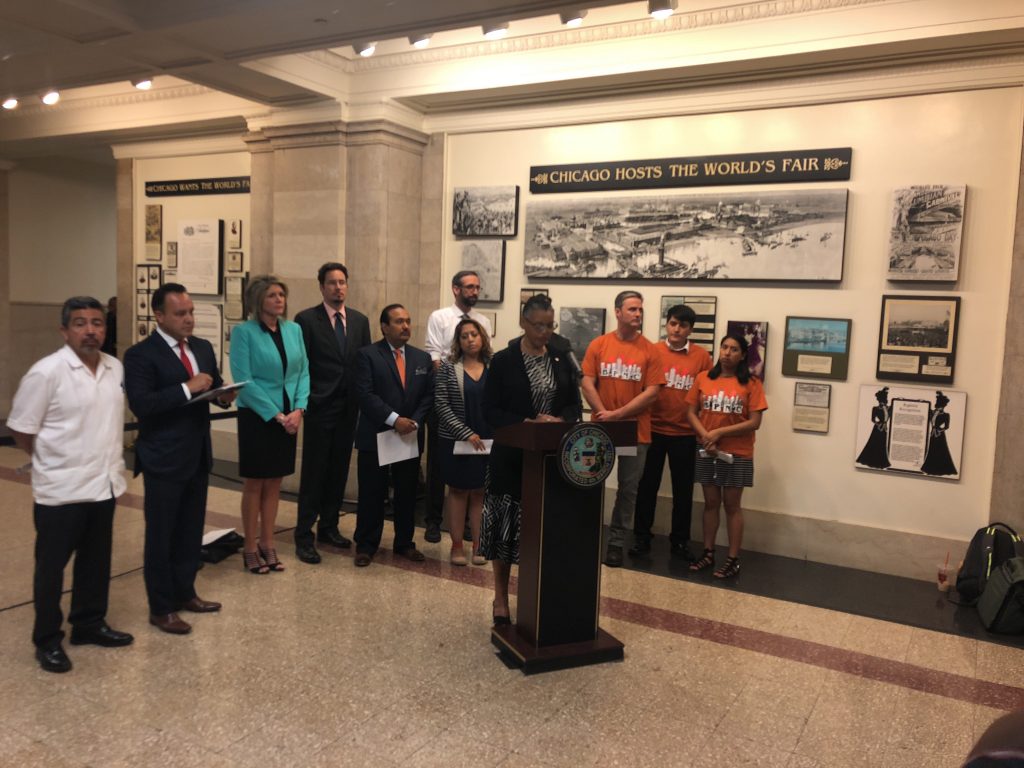 An affordability crisis is looming, Illinois PIRG’s Abe Scarr said, adding that he worries that those that can’t afford their bills will heat their homes with their ovens or other unsafe methods, or keep the heat at a dangerously low temperature. [A.D. Quig/The Daily Line]
 -
SEP 20, 2018

 Police reform advocates will gather at City Hall before Thursday’s meeting of the full City Council to renew their call for civilian oversight of the police department. In addition, Mayor Rahm Emanuel has named a replacement for the executive director of Chicago Animal Care and Control that he fired in July.
-
Correction: A previous version of this story misstated Lanetta Haynes Turner's salary as interim chief of staff as $186,000 annually. It is $154,000.
Cook County Board President Toni Preckwinkle announced late Wednesday that she’d “demanded and received” resignation from her Chief of Staff, John Keller, after she learned of a corroborated allegation that Keller “had engaged in inappropriate behavior on his personal time.”
-
Aldermen will gather Thursday for the first time since Mayor Rahm Emanuel set off a political earthquake by announcing he will not run for a third term.
Part of the newly altered landscape includes the possibility of a much different City Council in the spring, with Emanuel ally Mayor Pro Tem Ald. Margaret Laurino (39) set to retire — bringing an end to another political dynasty at City Hall. Ald. Pat O’Connor (40) — the mayor’s floor leader — is also considering ending his time on the City Council after 36 years. Ald. Ricardo Munoz (22) will step down as well, and is weighing a run for mayor.
Emanuel’s vow to squeeze two years of work into his last eight months as mayor will face its first test Thursday, as he asks aldermen to pass a massive tax hike on e-cigarettes and liquid nicotine through committee and council within a single day.
Other tests are on the docket as well. Emanuel will introduce a measure Thursday that would lease part of Jackson Park to the Obama Presidential Center for 99 years in return for $10 as well as a measure to change the city’s sign ordinance to allow big companiesto adorn downtown buildings with their names.
As the aldermen meet, the race to replace Emanuel will take shape. Cook County Board President Toni Preckwinkle whether she will run for mayor from the same Hyde Park hotel where former President Barack Obama launched his campaign for the U.S. Senate. Meanwhile, Cook County Comm. Jesus “Chuy” Garcia inched closer to launching his own campaign for the fifth floor of City Hall Wednesday, as his team filed the paperwork required in order for him to start raising money.
At the top of the City Council’s agenda Thursday will be four police misconduct settlements totalling $18 million, including one of the largest settlements (Or2018-414) in the city’s history for the family of Bettie Jones.
City lawyers recommended settling the wrongful death suit filed by Jones’ family because “any jury would likely develop a profound sympathy” for Jones. Jones was “an innocent bystander” who was trying to aid the police and a neighbor, Quintonio Legrier, who was also killed by police. Our coverage.
Aldermen are also expected to give final approval (O2018-3178) to a 75-unit complex in Jefferson Park at the heart of a furious debate over affordable housing on the Northwest Side. However, the project at 5150 N. Northwest Highway still needs to win state tax credits to break ground.
Aldermen will also retroactively grant the Chicago Cubs permission to hold a Friday night game on Sept. 13 instead of an afternoon game to boost their chances to win a playoff berth. [The Cubs beat the Washington Nationals 4-3.]
Other developments slated for approval:
- Hilco deal fires up environmentalists, businesses (O2018-6028) — A proposal to transform a former coal-fired power plant in Little Village into a hulking distribution center as part of a $100 million project was opposed by some locals for adding pollution to neighborhood streets. Our coverage.
- Southbridge neighborhood to rise from Ickes Homes (O2017-3198) — A proposal to build 972 units on the now-vacant 20 acres that were once home to 11 high-rises run by the Chicago Housing Authority to create the new neighborhood of Southbridge. Our coverage.
- New Fulton Market tower (O2018-4929) — A proposal to build a 13-story building at 1375 W. Fulton St. that would feature 315,300 square feet of office space, shops on the ground floor and 116 parking spaces on what is now a vacant lot and surface parking lot along the western edge of the Fulton Market District.
- Bucktown/Wicker Park luxury building near 606 (O2018-1835) — A six-story building at 1750 N. Western Ave. would have 109 luxury apartments, a 42-spot parking garage on the first floor and retail on the second floor, where a plaza will connect to the trail and include public bathrooms. Our coverage.
- Soup kitchen to become apartments (O2018-3178) — A Wicker Park community center and soup kitchen will be transformed into 16 apartments. Our coverage.
- Two new breweries set (O2018-4976) (O2018-4941) — Blind Pig plans to open a new brewery, distillery and restaurant in Fulton Market and Naperville-based brewery Solemn Oath won permission to open a brewery and tap room in Logan Square.
Other items slated for approval:
- $9 million loan forgiven (O2018-6573) — Aldermen begrudgingly approved this ordinance, which requires the city to forgive $9 million of the $11 million it is owed. In exchange, Neighborhood Housing Services would sell eight multifamily buildings in the 27th, 28th, 29th and 37th ward to Villa Capital for $7.7 million and prevent the buildings from going into foreclosure.
- New dog parks on the South Side (O2018-6106, O2018-6117, O2018-6122) — The new parks are at 3906 S. Lake Park Ave. in the 4th Ward, 4149-53 S. Vincennes Ave. in the 4th Ward, and 3938-40 S. Indiana Ave. in the 3rd Ward.
- Tax break for Morgan Park medical office (O2018-6317) – A new medical office space that will replace the mid-century Chesterfield Bank in the 19th Ward with the help of a Class 7c tax break over the next five years. Our coverage.
- Park grants and reimbursements (O2018-6300, O2018-6260, O2018-6175) –Aldermen will chip in close to $225,000 to parks projects in the 12th and 9th ward, including efforts to bring a water source to a popular community garden. Our coverage.
- Old Main Post Office plaza updates (O2018-6582) – An earmark of at most $18 million from the Canal/Congress TIF to renovate a city-owned plaza ahead of Walgreens relocating its headquarters at the Old Main Post Office. Our coverage.
- Pop up stores get green light (O2018-6162) – Aldermen approved a proposal from Mayor Rahm Emanuel that will allow for the operation of short-term “pop-up” stores, including restaurants, as well as six measures governing the sale of packaged liquor.
- Closed Chatham school set to become union offices (O2018-6076) – The Amalgamated Transit Union Local 241 plans to buy a city-owned site adjacent to the former Garrett A. Morgan Elementary School, which shut down as part of the 2013 school closings. Our coverage.
- Donations to Puerto Rico, Mexico approved (O2018-6021, O2018-6022, and O2018-6033) – Aldermen will donate an ambulance and pumper to Manati, Puerto Rico, and an ambulance, fire truck, gear and other fire equipment to Chilpancingo, Guerrero and Tuxtla Gutierrez in Mexico.
Several appointments are also up for approval:
- Ethics reappointments (A2018-86) — Neither Daisy Lezama nor Zaid Abdul-Aleem were in committee for their reappointments earlier this week, leading Council fixture George Blakemore to ask. “Where are they? I want to hear from the person.” Our coverage.
- Housing appointments (A2018-83 and A2018-84) — The appointments of City Hall veteran Jacqueline Edens (the current CEO of social service nonprofit Inner Voice) and Richard Rowe (the senior program manager at the Corporation for Supportive Housing) to the 15-member Low Income Housing Trust Fund Board. Our coverage.
- Commission on Human Relations reappointments (A2018-85) — Naderh H. Elrabadi, Stephanie A. Kanter, David J. Mussatt and Nabeela Rasheed would serve until 2021 if confirmed.
In a break with recent business as usual, a number of the most controversial measures considered by aldermen during committee meetings failed to advance. They are:
- A proposal from Ald. Brian Hopkins (2) to create a registry of Chicago murals after several were removed by city graffiti-removal crews in error. Opponents said it could complicate the city’s decades-long war against graffiti-removal.
- O2017-8598 — A measure to ban horse-drawn carriages stalled Wednesday in the City Council’s License Committee in the face of opposition from chairwoman Ald. Emma Mitts (37), who wondered why aldermen cared more about horses than those injured and killed by guns in her ward. Our coverage.
- O2018-4049 — Two of City Council’s biggest ride-hailing antagonists put off a vote requiring taxi companies and ride-hailing services to report violent incidents involving their drivers to city officials every three months. Our coverage.
- O2017-5612 —A measure requiring City Council approval for Corporation Counsel settlements, claims, judgements or verdicts of $100,000 or more failed to move in Finance Committee this week. Our coverage.
- R2018-833- This resolution from Ald. Anthony Napolitano (41) and Ald. Nick Sposato (38) calls for city and county officials to investigate the claims of a former Independent Police Review Authority investigator, Kelvin Lett, who alleged he was fired after refusing to reverse his finding that a police shooting was justified. Our coverage.
- Or2018-80 — Scrap metal facility General Iron will be allowed to continue to operate at night near the North Branch of the Chicago River after an effort by Ald. Brian Hopkins (2) to revoke the firm’s permit failed earlier this week. Our coverage.
- O2018-5201 — The zoning committee deferred Ald. Brendan Reilly’s (42) request to downzone 1045 N. Rush St., the former home of Proof Nightclub. He says his ward is saturated with nightclubs.
- O2018-4980 — A proposal to convert a convenience store at 3579W. Dickens Ave. in Logan Square into a shelter by dog-rescue group One Tail At A Time.
-
-
A discussion around two new appointments to Chicago’s Low Income Housing Trust Fund board expanded Tuesday to include needed changes to the city’s next five-year affordable housing plan, the affordable requirements ordinance and direct city payments intended to help make rent more affordable for families in all of Chicago’s neighborhoods.
-
SEP 19, 2018
Correction: A previous version of this story misstated Lanetta Haynes Turner's salary as interim chief of staff as $186,000 annually. It is $154,000.
Mayor Rahm Emanuel’s future came into sharper focus with the news that he will write a book, set to be published in 2020, about the shift of power away from gridlocked state and federal governments and toward cities. Cook County Board President Toni Preckwinkle announced late Tuesday that her chief of staff had stepped down for personal reasons.
-
-
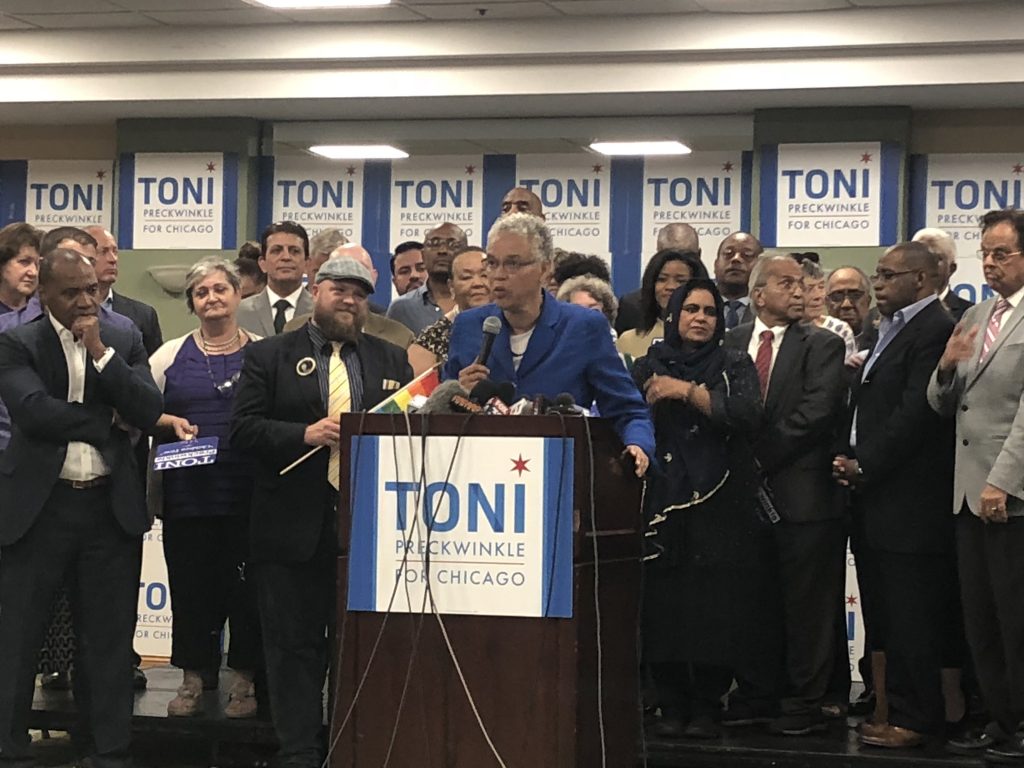 Cook County Board President jumps into the race for mayor surrounded by several dozen of her closest friends. [A.D. Quig/The Daily Line]
 A man uses an e-cigarette. [Illinois Academy of Physicians]

