Chicago News
-
-
Economic Interest Statements (EIS) from candidates for top Cook County executive positions released to The Daily Line this week cast a little light on hopefuls. The disclosure form only applies to economic activity from the preceding calendar year, does not require candidates to disclose dollar amounts of gains or payments from outside work or holdings, and does not require disclosure of lobbying other units of government like the state or city of Chicago.
-
The Progressive Caucus issued a press release Wednesday afternoon saying the group intends to force a hearing on special education funding at Chicago Public Schools. In October, 34 aldermen signed on to a resolution asking CPS officials to answer to a WBEZ investigative series on program reductions for special needs students. A meeting to consider the resolution was canceled last month.
-
It’s a new year, but there’s a lot of old business for aldermen to consider in 2018. Since the start of City Council’s 2015 term, dozens of big ordinances and resolutions have gathered dust, including an examination of the Finance Committee’s workers compensation section (R2016-94, Feb. 2016), a small donor matching program for municipal elections (O2016-232, Jan. 2016), hearings into job retention at companies with redevelopment agreements with the city (R2016-182, Mar. 2016), the “Back to Basics” TIF ordinance (O2016-8118, Nov. 2016), and CHA reforms in the “Keeping the Promise” ordinance (O2015-5397, Jul. 2015).
Here we’ll examine some of the bigger issues that have been introduced since May of 2016 that have yet to come up for a vote of the full City Council.
-
The Cook County Officers’ Electoral Board will rule on 29 contested petitions in Cook County Board races and 10 in Cook County executive office races throughout the week according to the Clerk’s website.
-
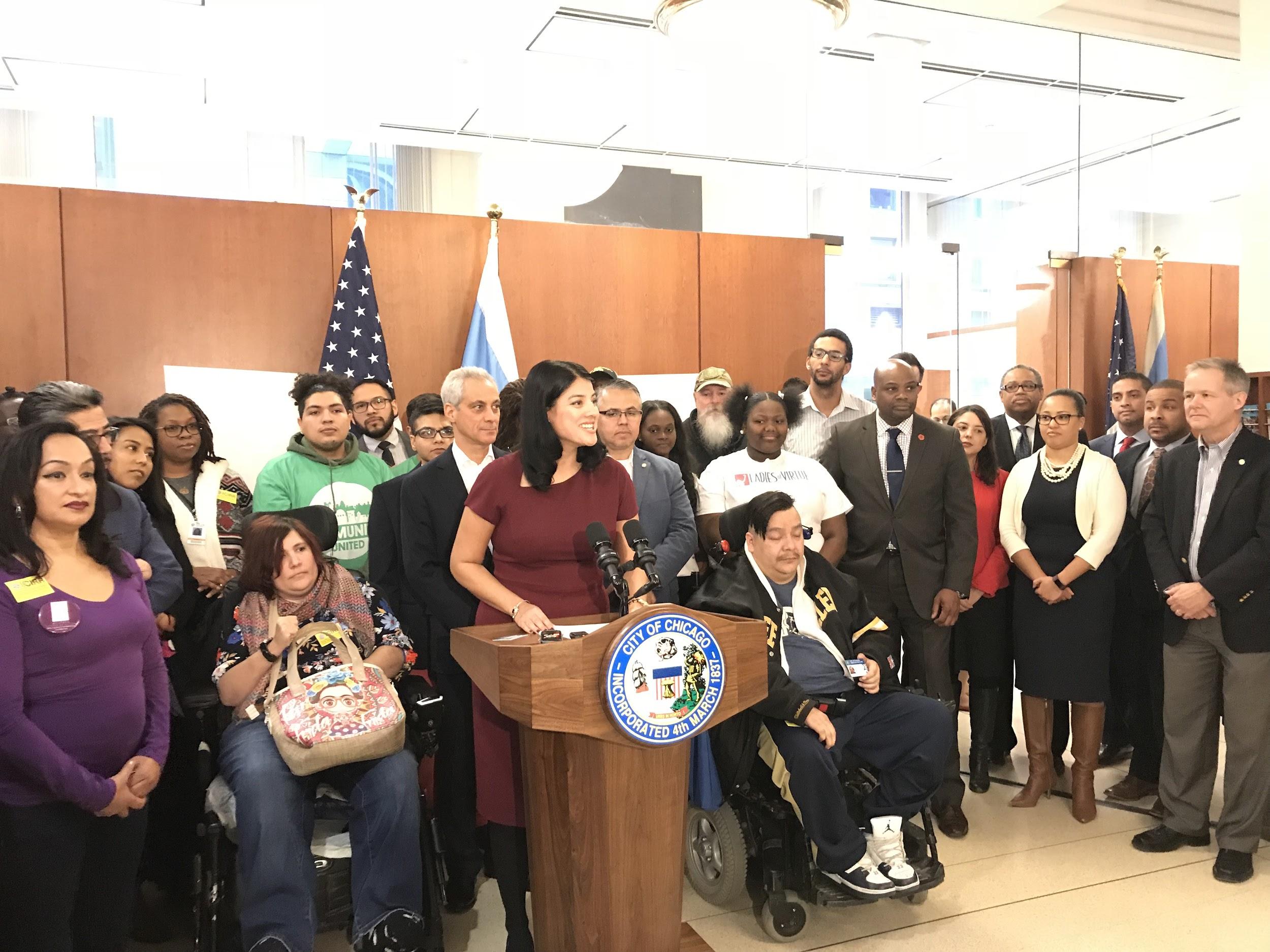
(Valencia joined Mayor Rahm Emanuel, Chicago aldermen, and dozens of city youth and veterans for the inaugural launch at the Clerk’s office on the first floor of City Hall, the main location where Chicagoans will be able to register for the ID. Photo: Claudia Morell, The Daily Line)
-
Two nonprofit groups filed suit in Cook County Circuit Court Thursday, accusing Assessor Joseph Berrios’ office of illegally shifting property tax burdens from white to Hispanics and African-American homeowners. The Berrios campaign alleged the suit was a political move by Comm. Jesus “Chuy” Garcia to help Berrios’ opponent, Fritz Kaegi, an allegation both camps deny.
-
-
Cook County commissioners will meet to consider rolling back some wage requirements for recipients of county property tax incentives, a ballot referendum question on recreational marijuana, and mandated sexual harassment training countywide. A new proposal would also allow presiding officers to ban a member of the public from testifying–a move that will likely raise the hackles of frequent public commenters like George Blakemore.
-
DEC 13, 2017

 Today is the final full City Council meeting of 2017. Actionable items include increased authority for the Department of Aviation to set temporary fee and lease terms for the 61 airliners that operate at O’Hare International Airport. Thirty-five-year-old leases at city’s largest airport expire next Spring and the administration wants to ensure the transition is “seamless.”
-
Aldermen from the city’s Northwest and Southwest Sides criticized Chicago Department of Aviation (CDA) officials for not acting decisively to comfort and assist constituents whose soundproof windows near the city’s airports are “off-gassing” noxious smells. Many of those windows are past their warranty to be replaced by the city, leaving residents holding the bag.
-
DEC 12, 2017
A $1 city-owned land sale in West Englewood to support an urban agricultural and job transition center is one of six land sales under consideration by the Council’s Housing Committee Tuesday.
After addressing the regular agenda, the committee is scheduled to receive its quarterly status update on the city’s progress toward its 2017 affordable housing goals. For 2017, the city has committed to spend $244 million toward 7,600 units of affordable housing. At the close of September, according to the report, Chicago is $42 million over budget and 800 units short.