


Chicago News
-
City Council’s License Committee approved a new wine and dessert bar in Ald. Danny Solis’ 25th ward, a virtual reality bar in the 47th Ward, beer sales at a new craft brewery incubator on Milwaukee Avenue in Ald. Proco Joe Moreno’s 1st ward and packaged liquor sales at the new Twisted Hippo brewery in Ald. Deb Mell’s 33rd ward.
-
-
Abdelnasser Rashid, the young Our Revolution member and only Muslim candidate to run for the Cook County board, acknowledged Wednesday morning that his bid to unseat Cook County Republican Party Chairman Comm. Sean Morrison (R-17) had fallen short.
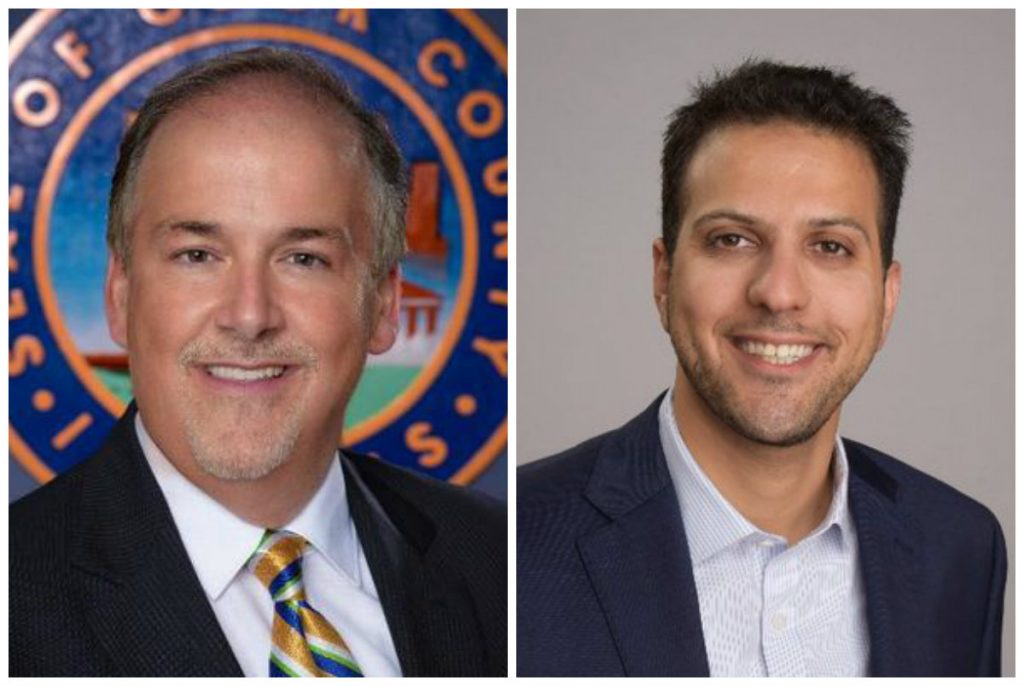 Cook County Board Comm. Sean Morrison (R-17), left, defeated challenger Abdelnasser Rashid. [Submitted]
 -
-
Secretary of State Jesse White, Cook County Treasurer Maria Pappas, Cook County Sheriff Tom Dart and Recorder of Deeds Karen Yarbrough led the night for overall voter turnout, as did three countywide referenda on a mandated minimum wage, paid sick leave and gun control.
-
Mayor Rahm Emanuel Wednesday signed an executive order aimed at Target, which is planning to open a new Mayfair store — in a development that will get a $13 million city subsidy — while shuttering stores in Chatham and Morgan Park.
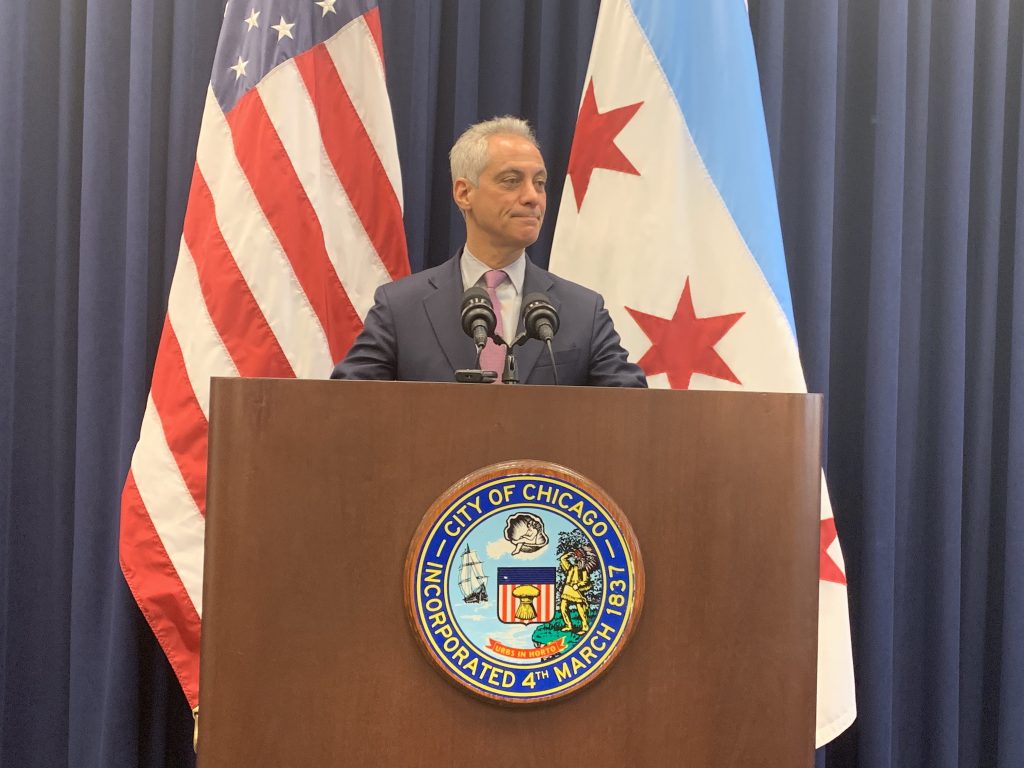 Mayor Rahm Emanuel Wednesday signed an executive order aimed at Target, which plans to close two South Side stores while opening a Northwest Side store with a city subsidy. [Heather Cherone/The Daily Line]
The order — which can not be applied retroactively to force Target to change course, officials said — is designed to “better guard against a lack of good-faith commitment and actions by outside parties to the city's detriment.”
The order requires developers of large shopping centers getting assistance from any of the city’s Tax Increment Financing Districts to sign an affidavit declaring that it has no plans to close any stores in other parts of the city.
“If you are going to call yourself a Chicagoland store, you should be in all parts of Chicago,” Emanuel said. “Not some. It is not right.”
If the developer violates that agreement, the city “shall have the right to declare the developer in default and terminate the TIF transaction,” according to the executive order.
The order is designed to force firms getting city subsidies to tell planning officials about plans to close other stores in different parts of Chicago, Emanuel said.
“Seeing this weakness, I signed an executive order that tightens up the city’s regulatory enforcement,” Emanuel said.
Emanuel’s action comes after Target’s decision to close two South Side stores as of Feb. 2, just as construction gets underway on a new store in Mayfair, which is part of a new $58 million development at Foster Avenue and the Edens Expressway. The City Council approved $13 million in TIF funding for that development in May, which will be built at the former site of Sunstar, a dental company which moved its operations to Schaumburg.
“To say the mayor is not happy with Target's decision would be an understatement,” said Adam Collins, Emanuel’s spokesman. “And he's also not shy. He's been on the phone at least five times with the CEO of the company since early last week trying to save the two stores Target is planning to close on the South Side and trying to save those jobs. He has offered the company millions in TIF assistance to keep the stores open. He'll keep at it, but it's a long shot.”
A Target spokeswoman said the South Side stores are among five stores nationwide picked to close because they’re not profitable.
The Chatham store, which opened in 2002, is 126,000 square feet. The Morgan Park store, open since 2008, is 128,000 square feet.
The Chatham store employs about 120 full- and part-time workers. There are about 115 in Morgan Park, according to the Tribune.
Earlier this week, mayoral candidate Bill Daley, the one-time U.S. commerce secretary of brother of former Mayor Richard M. Daley, urged city officials to pull out of the Mayfair TIF agreement.
Eight city, county and state elected officials signed their names to a letter addressed to Brian Cornell, president of Target Corporation. In it, they voiced their “concern, dismay and disappointment” over Target’s decision to close the two South Side stores. -
-
With some aldermen no doubt nursing hangovers from Election Night celebrations — or drowned sorrows — the City Council will gather at 10 a.m. Wednesday to move Mayor Rahm Emanuel’s last budget one step closer to final approval.
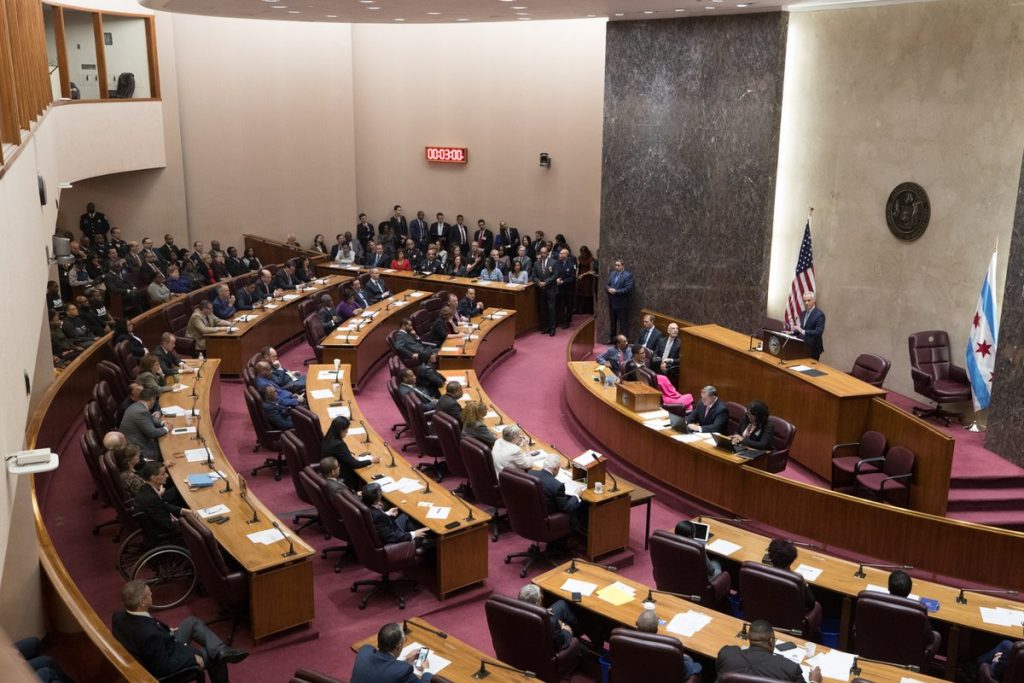 Mayor Rahm Emanuel delivers his final budget speech. [Chicago Mayor's Office]
Emanuel’s proposed $10.67 billion spending plan contains no new taxes or fee hikes — an election year gift to aldermen, whose campaigns for re-election will shift into high gear now that midterm and statewide elections are over. If the budget advances as expected Wednesday, aldermen will schedule a final vote for Nov. 14.
But the new fiscal year won’t be entirely painless for Chicago taxpayers, thanks to tax hikes approved by aldermen in years past. Included in the budget is a second 5 cent-per-ride increase on all trips via ride-hailing services such as Uber or Lyft to help modernize the CTA; the third installment of a 29.5 percent hike in water and sewer bills and a $63 million property tax increase to help fund police and fire pensions.
Nonpartisan watchdog group the Civic Federation called the budget “a reasonable one-year financial plan that does not include any new taxes or fees [and] makes important public safety investments.”
Read all of The Daily Line’s coverage of Chicago’s 2019 budget here.
But the respite from tough budget decisions will be short lived. The bill for the city’s pensions is set to jump 31 percent in 2020, and officials have yet to propose a way to cover that expense.
“There remains an enormous elephant in the room — a projected doubling in required pension contributions over the next five years — that the next administration and City Council must tackle,” said Civic Federation President Laurence Msall.
Chief Financial Officer Carole Brown told aldermen on the first day of budget hearing they would likely have to again show “courageous will” and raise taxes to cover shortfalls projected in 2020 and 2021 entirely due to a $400 million increase the city must make to its four pension funds under a change in state law that ties payments to actuarial estimates. Currently, the city’s payments to its four pension funds are fixed by state law.
Mayor Rahm Emanuel has said he plans to deliver a major address about how the city should address the issue before the end of the year.
The city’s structural deficit — the imbalance between revenues and expenditures — is set to balloon in 2020 to $251.7 million and then in 2021 to $362.2 million, based on an outlook that assumes the economy does not get significantly better — or worse, according to the city’s annual financial analysis.
Other budget line items of note:- Chicago Public Schools officials will pick up half of the $33 million tab racked up by assigning 211 Chicago Police officers to patrol public schools, and cover the $14 million cost of the Safe Passages program. Both line items were paid in full by the city last year.
- A new Department of Housing to focus on affordability issues — and a $1.4 million boost for the new department’s operations over its last incarnation. The city is in the midst of drafting its next five-year housing plan.
- $2.07 million to hire formerly incarcerated men and women in three programs. Eighty people would be hired to clean and beautify vacant lots in high-crime neighborhoods; 34 people would be hired as part of the CTA’s Second Chance Program and another 25 would be hired by the Department of Transportation’s Greencorps programs.
- $27.5 million for police reform, including cost of the monitoring team that will be charged with ensuring the city and Police Department comply with the changes ordered by Judge Robert M. Dow.
- $1.3 million more to buy garbage and recycling bins in an effort to get new trash cans to residents faster.
- $500,000 more for rat abatement that would allow crews to go into yards to search for and close rat holes rather than responding to complaints.
- $308,000 more for tree trimming.
Aldermen are also set to approve Emanuel’s appointment of acting Chicago Animal Care and Control Executive Director Kelly Gandurski (A2018-102) to the post permanently. Aldermen will also gave Emanuel’s appointment of Helios Digital Learning CEO Ivy Walker (A2018-118) to the Chicago Public Library Board the green light. If approved Wednesday by the full City Council, Walker will serve through June 2021. -
Democrats swept all of the contests for statewide office Tuesday, pushing Republican Gov. Bruce Rauner out of office. Democrat JB Pritzker won approximately 80 percent of the vote in Chicago, and 60 percent in suburban Cook County, where turnout surged to its highest levels in more than three decades.
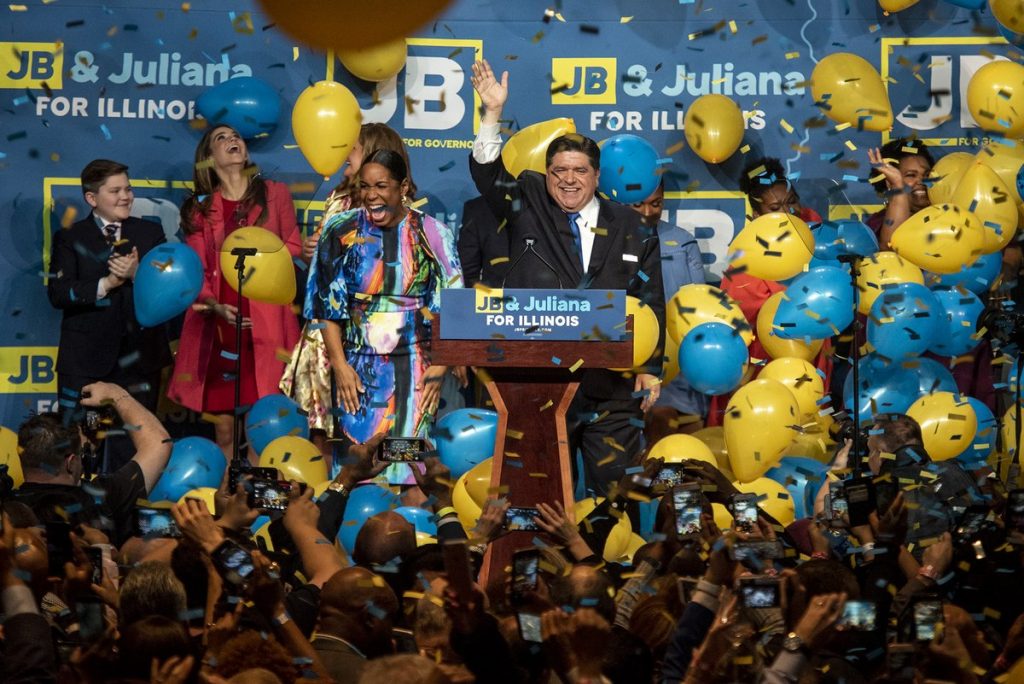 J.B. Pritzker declares victory. [Twitter/JBPritzker]
 -
Two of the Cook County Board’s four Republicans — Illinois Republican Party Chairman Comm. Tim Schneider (R-15) and longtime Comm. Gregg Goslin (R-14) — were swept out in a blue wave Tuesday, giving Cook County Democratic Party leader and Board President Toni Preckwinkle a victory.
-
An effort by a small group of aldermen to take $25 million from the budget of the Chicago Department of Transportation to fund free mental health clinics throughout the city failed to get a vote or even discussion Monday, as aldermen moved full-speed ahead to adopt the city’s 2019 budget.
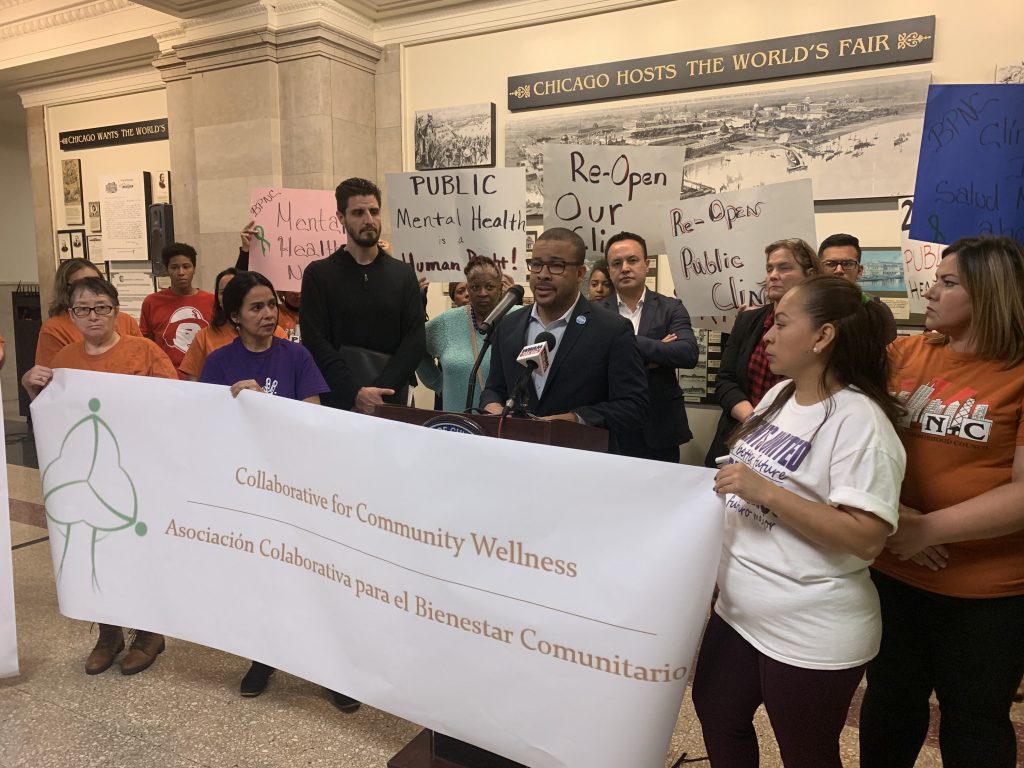 Ald. Michael Scott (24) said his ward does not have the mental health services that it needs. [Heather Cherone/The Daily Line]
 -
The Rules Committee failed to act to send three questions aldermen would like to see on February ballots after a rare call for quorum. Meanwhile, Ald. Susan Sadlowski-Garza (10) was granted leave from the Chicago Public Schools — nearly four years after she first won elected office.
-


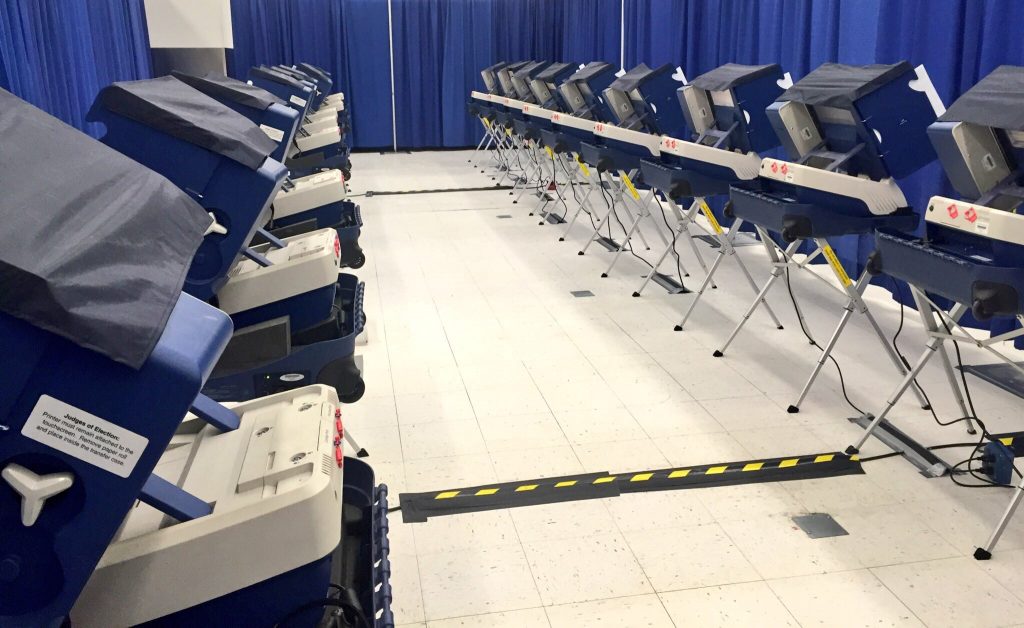 A polling place in March 2018. [A.D. Quig/The Daily Line]

