Chicago News

  •  After more than a year, many Pilsen homeowners want to see a landmark designation voted down in the Lower West Side neighborhood. MAURICIO PEÑA / BLOCK CLUB CHICAGO

    Neighbors fear a landmark district would increase costs for longtime Latino homeowners, pushing them out of the area.

    PILSEN — For nearly two years, city officials have pushed to establish a historic landmark district in parts of Pilsen despite the objection of some neighbors.

    Longtime neighbors who oppose the plan argue the designation would stack working-class homeowners with added costs, restrict what owners are able to sell their properties for and lead to more gentrification. But the city has moved forward on the plan anyway, with officials saying the historic designation will prevent booming developments from changing the character of the neighborhood.

  • A public hearing is scheduled for 10 a.m. Monday to issue $7 million in Multi-Family Program bonds to fund renovations at Humboldt Park Residence at Division Street and Christiana Avenue.


    The issuance of $7 million in Multi-Family Program bonds to help fund renovations at Humboldt Park Residence will be considered during a public hearing by the City Council’s Committee on Finance at 10 a.m. Monday.
    To Read More Please Login or Join
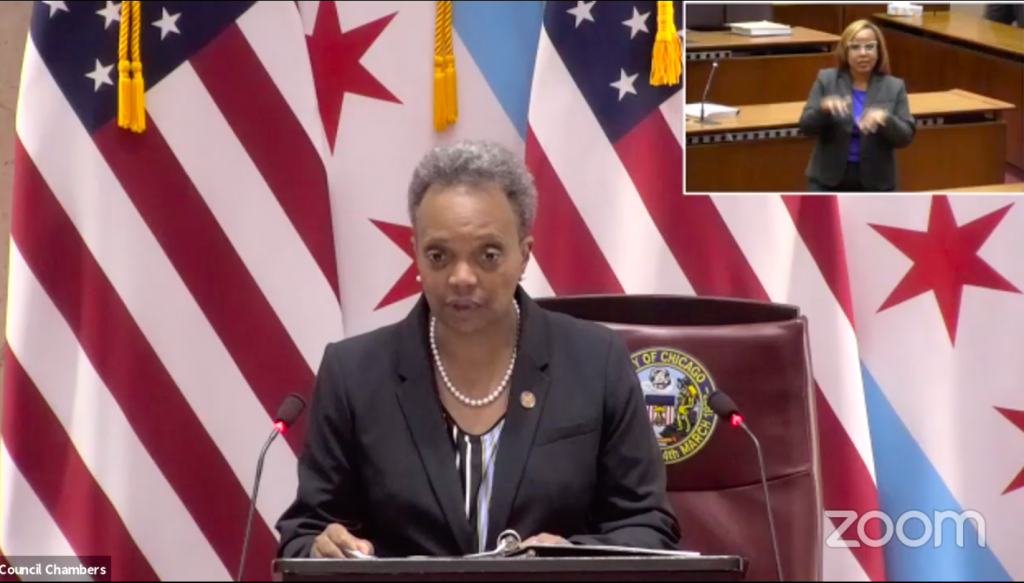
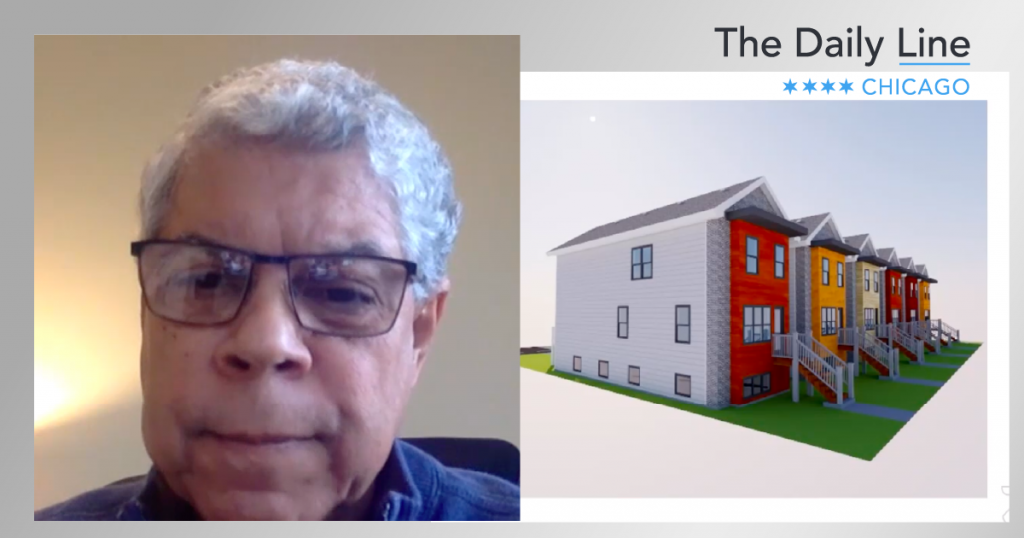
  • Mayor Lori Lightfoot speaks at the Sept. 29 Triibe Tuesday Town Hall event; a rendering of Full Circle Communities’ 48-unit affordable housing proposal at 6001 W Lawrence Ave.


    A Northwest Side alderman is pushing forward with a plan to slow down a proposal for an affordable housing development in his ward, just as Mayor Lori Lightfoot has all but backed away from her campaign promise to loosen the tight grip aldermen have over zoning decisions.

    At the same time, the city’s top attorney is warning aldermen not to invoke their ward-level powers to push for more affordable housing to be included in projects on their own turf.

    Asked by The Daily Line last week during a town hall event organized by The Triibe whether Lightfoot foresees a way to limit aldermanic control over housing, an issue she repeatedly raised in 2019, the mayor said she does not “know that aldermanic prerogative is the barrier” to creating more affordable housing.

    Related: Zoning code reform to root out aldermanic prerogative coming, Lightfoot says

    “The barrier that we’ve heard over and over again…is just making sure that these deals work —making sure that there is a funding stream to support affordable housing,” Lightfoot said.

    Her remarks came one week before the City Council Committee on Zoning, Landmarks and Building Standards is set to hear a proposal by Ald. Nicholas Sposato (38) to downzone a property at 6001 W. Lawrence Ave., which would hobble nonprofit developer Full Circle Communities’ plan to build an all-affordable 48-unit housing development on the site.

    The developer began putting together plans for a pair of four-story apartment buildings at the site last year after realizing its existing zoning would allow for it, meaning it would not need direct approval from the alderman, according to Full Circle Communities CEO Joshua Wilmoth.

    Wilmoth added that he emailed Sposato in January to alert him to the plans, but it was only after the proposal secured tax credits from the Illinois Housing Development Authority in July that the alderman announced his opposition, saying neighbors had not been given the opportunity to vet it.

    The state housing authority “said they checked all the boxes, but they never checked the box about community approval, aldermanic approval [or] a traffic study,” Sposato said.

    Wilmoth said he is “disappointed” in the alderman’s push to rezone the property, but he is “heartened” by “cordial and professional” conversations he has had with Sposato and hopes to reach a compromise. Full Circle still plans to acquire the property in the next month and is aiming to break ground next spring, Wilmoth said.

    Sposato said he would support the development if Full Circle reduced its unit count from 48 units to 32, saying the larger proposal would exacerbate traffic and parking availability in the busy intersection. He added that he has no inherent objection to the affordable units, calling any accusation to the contrary “totally ridiculous.”

    “I’m just trying to take control to say there’s no problem with 32 units,” Sposato said. “But 48 won’t work.”

    When asked whether the mayor’s administration will oppose Sposato’s downzone, Eugenia Orr, a spokesperson for Lightfoot, declined to answer but wrote in a statement to The Daily Line on Friday that the city “remains committed to increasing access to affordable housing, especially near transit lines across all 77 neighborhoods.”

    “We will continue to work with the City Council and all stakeholders to ensure that our land-use decisions reflect a commitment to an inclusive, equitable Chicago,” the statement continued.

    The Chicago Department of Housing supports the Full Circle Communities proposal and has agreed to offer $1.6 million in city tax credits, according to a department spokesperson. The developer’s current plan does not involve city-backed financing.

    Full Circle Communities kicked up a fierce backlash in 2017 when it proposed a 100-unit mixed-income housing development at 5150 N. Northwest Hwy., about a half-mile east of the Lawrence Avenue site. The proposal, later trimmed to 75 units, earned zoning approval with the support of former Ald. John Arena (45) and broke ground earlier this year. Arena was unseated in last year’s city elections by Ald. Jim Gardiner.

    A spokesperson for the group Neighbors for Affordable Housing, which sprang up in the aftermath of the Northwest Highway proposal, wrote in a statement to The Daily Line that any move to block the Lawrence Avenue development would “result in a continuation of a pattern of segregation” on the city’s Far Northwest Side.

    The spokesperson also took a shot at Lightfoot’s dismissal of aldermanic prerogative as a barrier to affordable housing, noting that Neighbors for Affordable Housing is party to a federal complaint against the city “specifically because aldermanic prerogative has been used as a barrier to building affordable housing units equitably throughout the City.”

    Related: Advocates call on Lightfoot to settle complaint blaming aldermanic prerogative for segregation, racism in Chicago

    “Chicagoans need the 48 units of affordable and accessible housing being proposed at 6001 W. Lawrence, and we hope aldermanic prerogative will not be used improperly to stop this project development,” the Neighbors for Affordable Housing statement continued.

    City attorney warns aldermen on pushing beyond affordability rules

    During her mayoral campaign, Lightfoot proposed to push an Affordable Housing Equity Ordinance, which would create a “streamlined approval process” for any development with affordable units proposed in a ward where less than 10 percent of housing stock is affordable.

    But the mayor has since stopped promoting that plan, and aldermen have largely dismissed it.

    Instead, her administration has warned aldermen not to use aldermanic privilege as a cudgel to force the construction of more affordable housing, a common practice among multiple aldermen in gentrifying wards.

    In response to an email last week in which Corporation Counsel Mark Flessner warned aldermen not to push beyond the legal limits of minority hiring requirements, Ald. James Cappleman (46), who consistently allows Uptown developers to build the minimum of legally required affordable units, asked Flessner for clarification on the limits on the city’s Affordable Requirements Ordinance.

    “I've heard it said a number of times that it's okay for aldermen to use aldermanic prerogative to interpret the Affordable Requirements Ordinance as a ‘floor, not a ceiling’ for going beyond what is spelled out in this ordinance,” Cappleman wrote. “Is it appropriate to make a requirement to developers to go beyond what is spelled out in the ARO?”

    Flessner responded by affirming Cappleman’s approach, writing that the city code does not allow city officials to “deny necessary governmental approvals on the basis of a property owner's refusal to exceed regulatory requirements.”

    “A ward-by-ward and project-by-project application of ARO requirements is not predictable and has the potential to discourage development in Chicago,” Flessner wrote. “In addition, ad hoc application of land use regulations has the potential to violate basic constitutional principles of fairness and due process.”

    Cappleman told The Daily Line last week that he has been working to make sure more people understand those legal restraints, noting that community groups in Uptown have criticized him for not demanding the inclusion of more affordable units in new developments like JDL Development’s Eight Eleven and Praedium Development’s proposed apartment tower at 4600 N. Broadway.

    “My belief has always been that when there’s a problem, you change the system that caused it — you don’t do a quick fix,” Cappleman said. “And because I follow these rules, I get beat up on social media. I get blamed for the loss of affordable housing in the 46th Ward.”

    The Uptown alderman raised the issue again in a Sept. 22 meeting of the City Council’s Committee on Housing and Real Estate, saying that aldermen who risk legal exposure by negotiating for more affordable units “are seen as the hero, and I’m seen as the villain.”

    That prompted a rebuke from Ald. Walter Burnett (27), who has made an open practice for decades of trying to squeeze individual developers to increase the proportion of affordable units they include in new apartment buildings.

    “Why are you worried about other [aldermen] asking to do more?” Burnett said. “It sounds like you player-hating, man.”

    Cappleman published a YouTube video of his testimony, including when Department of Housing Comm. Marisa Novara said the city “cannot require” affordable unit inclusion beyond the minimums set out in the city’s rules.

    “I want this all out,” Cappleman said, adding that he does not believe aldermen should be empowered to approve or veto zoning changes.

    “I believe the city is in the mess it’s in because of housing precisely because of aldermen,” Cappleman said. “We are at fault, and it’s because we have 50 aldermen playing by 50 sets of rules.”

    The “Lens On Lightfoot” project is a collaboration of seven Chicago newsrooms examining the first year of Mayor Lori Lightfoot’s administration. Partners are the BGA, Block Club Chicago, Chalkbeat Chicago, The Chicago Reporter, The Daily Line, La Raza and The TRiiBE. It is managed by the Institute for Nonprofit News.

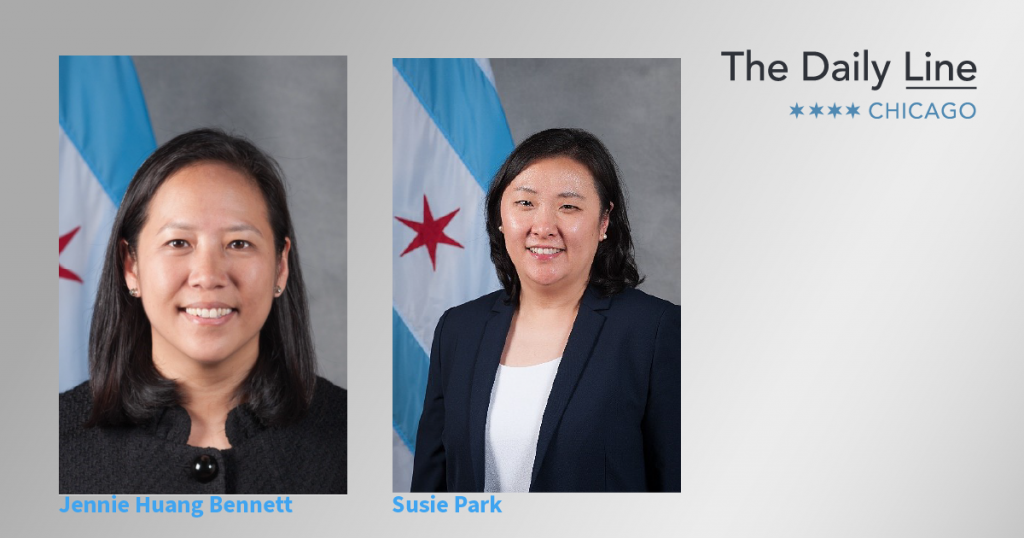
  • Mayor Lori Lightfoot and Budget Director Susie Park on Wednesday held a virtual town hall to discuss results of a budget survey that shows residents want money reallocated from police services to other departments.


    At a time when policy analysts say Mayor Lori Lightfoot’s task of presenting a balanced budget amid an economic downturn due to the pandemic is already “a challenge,” a citywide survey released by the mayor’s office shows nearly nine in 10 respondents  support reallocating city resources away from police .
    To Read More Please Login or Join
  • News in brief: City officials allow trick-or-treating, with restrictions; Cook County hands out 500K masks to ‘underserved’ suburbs
    To Read More Please Login or Join
  • A UPS Cargo e-bike being demonstrated in Seattle. [UPS]
    Delivery drivers from companies like FedEx and UPS could soon haul packages with bicycle trailers instead of 28-foot box trucks under a measure advanced through a City Council committee on Thursday.
    To Read More Please Login or Join
  • article-image
    The four-story, mixed-use 4400 Grove development on Cottage Grove Avenue in Bronzeville. [Chicago Housing Authority]

    The $38 million, 84-unit complex will bring 38 affordable apartments, 21 public housing apartments and 25 market-rate apartments to the old CHA site demolished in 2002.

    BRONZEVILLE — Bronzeville residents, elected officials and developers celebrated the grand opening of a 84-unit mixed-income housing complex nearly a decade in the making Thursday.

    The 4400 Grove complex, named after the Cottage Grove Avenue block it inhabits, features 38 affordable apartments reserved for those making up to 60 percent of the area median income, or $43,680 annually for a two-person household.

  • The franchise owner of a Huddle House restaurant being built at 9401 S. Stony Island Ave. was awarded up to $1.1 million in Neighborhood Opportunity Fund grant money for what will be the city’s first Huddle House restaurant.


    The City Council Committee on Budget and Government Operations on Wednesday approved up to $1.1 million in Neighborhood Opportunity Fund grant money (O2020-4583) for the city’s first Huddle House restaurant, which is under construction at 9401 S. Stony Island Ave. in the 8th Ward.
    To Read More Please Login or Join
  • article-image
    Black Caucus Chair Ald. Jason Ervin (28) confers with Alds. Pat Dowell (3) and Sophia King (4). [Heather Cherone/The Daily Line]

    Ald. Jason Ervin (28) used a rare parliamentary maneuver late Tuesday to resurrect a previously stalled proposal to pare back new rules barring outside elected officials from lobbying the city.

  • article-image
    Mayor Lori Lightfoot answers questions during a Triibe Tuesday virtual town hall event.
    Mayor Lori Lightfoot has given up on working with the Grassroots Alliance for Police Accountability (GAPA) and plans to propose her own ordinance to establish a civilian police oversight board later this year, she said Tuesday.

    Responding to a question from The Daily Line during a town hall event organized by The Triibe, Lightfoot said she has “spent a lot of time with the GAPA folks,” but they never came back with a counteroffer to settle “remaining issues” following the mayor’s rejection of their last plan introduced in March.
  • article-image
    News in brief: Lightfoot ‘moving on from GAPA; ‘Tuktuk’ regulation ordinance set for License Committee; Lightfoot brandishes 3-year anti-violence plan
    To Read More Please Login or Join
  • article-image
    Measures approved on Tuesday helped pave the way for the construction of the new Auburn Park Metra Station and rehabilitation of the Laramie State Bank building


    A pair of projects associated with the Mayor Lori Lightfoot’s INVEST South/West program inched closer to reality on Tuesday as aldermen endorsed efforts to breathe new life into South and West Side commercial corridors.
    To Read More Please Login or Join
  • article-image
    An ordinance introduced by Ald. Michael Rodriguez (22) to establish a process for revoking property tax rebates from developers was approved Tuesday by the City Council’s Committee on Economic, Capital and Technology Development, which is chaired by Ald. Gilbert Villegas (36).


    Ald. Michael Rodriguez (22) said an ordinance setting framework to revoke property tax incentives from irresponsible developers that passed the City Council’s Committee on Economic, Capital and Technology Development Tuesday will ensure companies are held responsible for their actions and that public dollars are being spent wisely.
    To Read More Please Login or Join
  • article-image
    Chicago Mayor Lori Lightfoot spoke about school reopening at a virtual townhall organized by seven newsrooms on Sept. 29, 2020. YouTube

    Among the factors Chicago Public Schools is weighing when deciding whether to reopen school buildings: the experience of the Archdiocese of Chicago’s 150-plus campuses, Mayor Lori Lightfoot said Tuesday.


    The mayor, who oversees public schools in Chicago and appoints the schools chief and board, is expected to make the final call about reopening campuses along with city health officials. Chicago started the school year virtually three weeks ago after initially planning to begin the year with a hybrid schedule.


    Meanwhile, the Archdiocese of Chicago, which is the state’s largest private school operator with 70,000 students last spring, reopened its campuses in late August. Schools are offering full-day instruction — some larger campuses have hybrid schedules where students go a few days a week — and families have the option of choosing all-virtual instruction.


    “We haven’t made a decision yet on whether (reopening) is going to be possible,” Lightfoot said. “We’re following very closely the experience of Archdiocese schools, many of which have been in-person learning five days a week or in a hybrid model that includes in-person learning. There’s a lot we can learn from their experience. They are in many of the same neighborhoods where CPS schools are.”


    The mayor, who stressed a decision about schools was coming “relatively soon,” spoke Tuesday night at a Lens on Lightfoot virtual town hall organized by the Triibe and six other independent newsrooms, including Chalkbeat Chicago.


    In one week this month, the Archdiocese reported 16 positive COVID-19 cases among its students and staff, which is considerably less than 1% of its system, according to the Chicago Sun-Times. The archdiocese declined requests to provide a full accounting for cases since the start of school, the paper said.


    At least one campus, St. Rita of Cascia High School on the city’s Southwest Side, temporarily shifted to virtual learning after two students tested positive in late August. The campus has since reopened.


    Students are divided into cohorts and stay in those same small groups each day. The reopening plan also requires students and educators to wear masks and undergo temperature checks each morning before entering buildings.


    The Archdiocese also published an infection protocol guide that details what happens if students or educators test positive. The plan includes contact tracing.


    “There are things we can learn from them. They seem to have done a really good job keeping their school community safe,” Lightfoot said.


    As virtual learning progresses, Chicago parents have begun pressuring the mayor and school district to make a decision about whether students will return to campuses in November, at the start of the second quarter. The school district has floated a plan to bring some special education students back earlier.


    The mayor also said the city had made progress in closing the digital divide that has complicated the shift to virtual learning. This summer, Chicago announced a plan to provide free internet for up to four years for 60,000 households representing 100,000 students. As of Tuesday, the city had signed up 38,000 students, slightly more than a third of the goal, Lightfoot said.


    She acknowledged the challenges of reaching some families, citing some households’ outstanding debt as one obstacle slowing sign-ups. “We’re working through those issues,” she said. “We’ve made significant progress in a short amount of time.”


    “Part of the difficulty is that, even though it is free, it’s about making sure families feel safe signing up,” she added. “We’re really leaning into building up principals where we are seeing low connectivity among students, making sure parents know this option is available, and providing the technical assistance they may need so they can get registered and we can get them connected.”

  • article-image
    A plan to rebuild both Division Street bridges and make other streetscape improvements around Goose Island is poised to take a leap forward Tuesday with the approval of a measure allowing the city to seize a cluster of Near Northwest Side properties.
    To Read More Please Login or Join