Chicago News
-
-
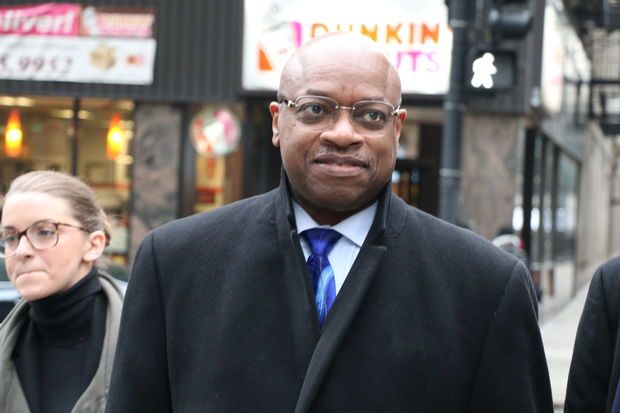 Indicted Ald. Willie Cochran (20th) pleaded guilty Thursday.
KELLY BAUER/DNAINFO
Ald. Willie Cochran (20) reluctantly pled guilty Thursday to one count of wire fraud, telling U.S. District Court Judge Jorge Alonso that he deposited a $2,000 check into a bank account he opened to fund charitable events in his South Side ward and took out $489 in cash at an Indiana casino.
Cochran, 66, a former police officer, is the 30th Chicago alderman to be convicted of corruption since 1973 as well as the third alderman of the 20th Ward to plead guilty after being charged with crimes.
Read the full plea agreement here.
Cochran’s conviction removes him from the City Council under state law. After deciding not to run for re-election while under indictment, he will be replaced by Nicole Johnson or Jeanette Taylor, who are set to face off in the April 2 runoff.
Cochran is set to be sentenced June 20. Under sentencing guidelines laid out by Alonso and agreed to by Cochran, the former alderman could face between a year and a year and a half in prison.
Had Cochran been convicted on all the counts he faced, he could have been sentenced to 10 years.
Cochran stumbled several times while Alonso asked him routine questions as part of the plea hearing. Cochran said he had taken medication for anxiety and his “health could be better” when quizzed by the judge.
The agreement the alderman reached with the U.S. Attorney’s Office nearly derailed during Thursday morning’s hearing, when Alonso asked if Cochran admitted that he had participated in a scheme to defraud donors to the 20th Ward Activities Fund, a charity he set up, between 2010-14.
Assistant U.S. Attorney Heather McShain laid out a series of events that began when an unnamed donor, identified in court as individual I, gave Cochran $2,000 for the activities fund, which the alderman said would fund back-to-school picnics, holiday parties and other community events.
Cochran deposited that check into the activity fund’s bank account. But then he withdrew $489 at a casino for his personal use, McShain said.
Alonso asked Cochran whether that was accurate.
The hearing ground to a halt after Cochran responded, “for the most part.”
When the judge asked Cochran to clarify what part of McShain’s statement was not accurate, his attorney, Christopher Grohman, asked for a recess. Alonso could have rejected the agreement if he was dissatisfied with Cochran’s admission of guilt.
When the hearing resumed more than 20 minutes later, Alonso said he wanted to hear from Cochran directly — noting the “circuitous route” the case has taken since Cochran was indicted during the Dec. 14, 2017 City Council meeting on 15 counts of wire fraud, bribery and extortion.
Prosecutors said he took $25,000 to support a gambling habit and $5,000 to pay his daughter’s college tuition from a 20th Ward fund he set up to help kids and other local residents. Cochran also shook down a lawyer for $1,500 and a local liquor store owner for $3,000 in exchange for helping them in the ward, prosecutors said.
As alderman, Cochran earned $116,208 annually in addition to his $60,280 yearly police pension, records show.
In November, Cochran rejected a plea agreement that would have required him to plead guilty to one count of wire fraud — a deal substantially similar to the one finalized Thursday.
At the time, the indicted alderman said he “could not stomach” admitting that he defrauded donors to the activity fund, Grohman said.
After another recess, Cochran returned to read a prepared statement in front of the judge that sought to clarify that he had not personally solicited the donation from Individual I.
“Does that cover it?” Cochran asked Alonso.
The judge agreed, and the hearing ended shortly afterward.
Cochran and his attorney declined to speak with reporters after the hearing, instead releasing a statement saying that the now-former alderman was gratified that all of the counts of bribery and extortion had been dismissed.
“Cochran has always steadfastly denied taking any bribes and continues to do so,” according to the statement.
However, Cochran admitted taking $14,285 from that fund for his own personal benefit. The statement said he “looks forward to repaying the $14,000 in monies” and notes that he paid taxes on that income. “Alderman Cochran looks forward to putting this saga behind him, and moving forward by focusing on his family and continuing to serve his community.” -
 Flickr/Joselito Tagarao; Inset: @AldermanWBC/Twitter
The last time Ald. Willie Cochran (20) appeared before U.S. District Court Judge Jorge Alonso, his attorney said the indicted alderman “could not stomach” pleading guilty to charges that he shook down a local business owner and stole $30,000 he collected to help people in his ward.
Instead of accepting a plea that would have required the South Side alderman to admit to one count of wire fraud, but face no mandatory jail time, Cochran asked Alonso to set a date for a trial that could result in the former police officer facing a five-year prison sentence.
That trial was scheduled to start June 3. Instead, Cochran will be back in front of Alonso Thursday morning to write the latest chapter of a saga that began during the Dec. 14, 2017 City Council meeting, when Ald. Ed Burke (14) showed Cochran an online newspaper article announcing his indictment while reporters looked on.
-
-
In his Budget Address last month, Gov. JB Pritzker asked lawmakers to send him a standalone sports-betting bill, instead of working to craft an omnibus gambling package that would include sports betting, using the common statehouse metaphor of a “Christmas tree,” which tends to collapse under its own weight.
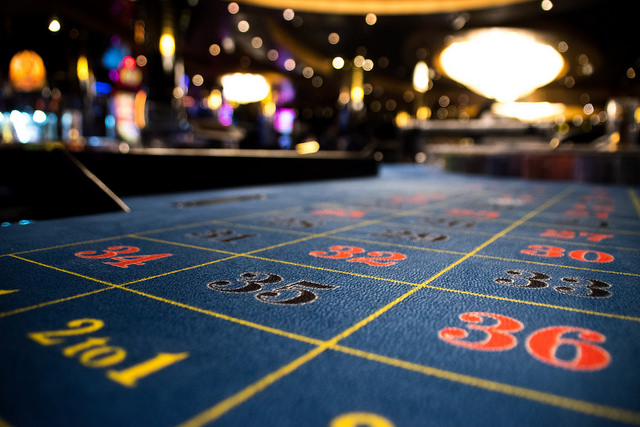 A gaming table. [Ralf Steinberger/Flickr]
Pritzker’s proposed budget relies on $170 million in licensing and other fees the state would charge to get sports betting — which last summer was essentially legalized by the U.S. Supreme Court — off the ground in Illinois, with the promise of $200 million in annual tax revenues later. The governor asked for urgency in the legalization effort.
“Every day we argue about who’s in and who’s out is money that goes to other states and to the black market,” Pritzker said.
Related: Pritzker vows ‘constrained’ budget proposal will chart new course for Illinois
State Rep. Mike Zalewski (D-Chicago), who has long advocated for various forms of gambling expansion, took the governor’s advice and on Thursday will file four amendments to HB 3308, to offer four different models of legalized sports betting for lawmakers to debate. Those four choices, Zalewski said, will hopefully jump start negotiations on the bill.
-
-
-
The steep decline in the number of students enrolling in Chicago Public Schools will continue for at least the next three years, according to a new district analysis. County officials put off proposals to end some tax breaks for vacant properties, as well as a plan to allow some defendants to appear by video in front of a judge.
-
MAR 20, 2019

UNLOCKEDA new campaign ad in Chicago’s race for city treasurer is calling out Ald. Ameya Pawar for his chronic absences at City Council committee meetings.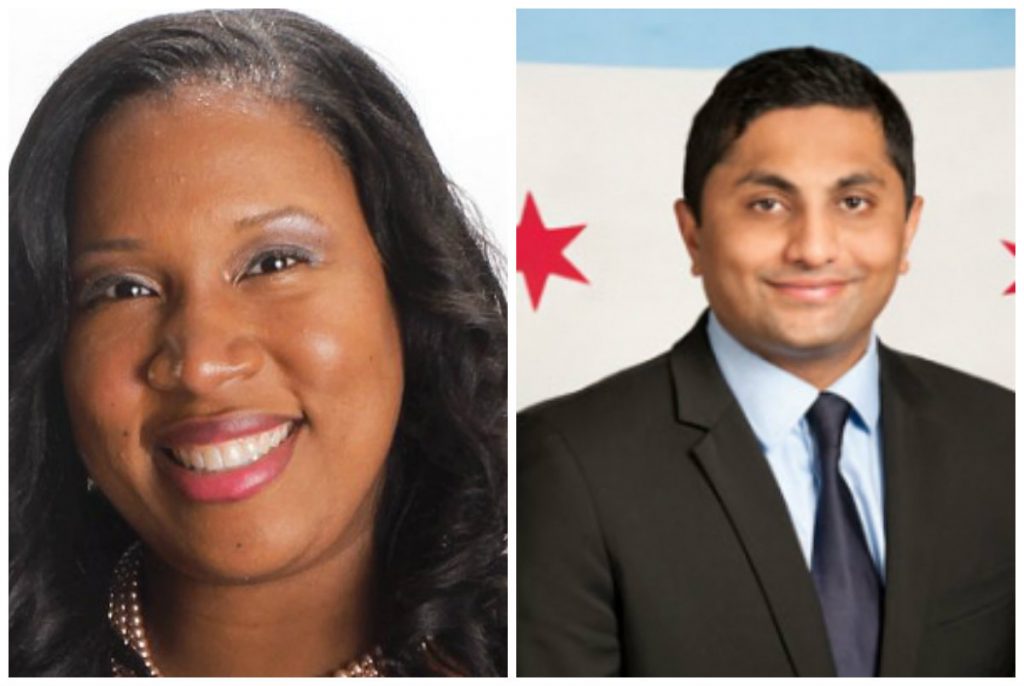 Melissa Conyears-Ervin, left, and Ameya Pawar. [Submitted]
The 30-second spot, called “Every Day,” is funded by Pawar’s opponent, Democratic state Rep. Melissa Conyears-Ervin, D-Chicago.
The ad highlights data from an analysis by WBEZ and The Daily Line, which found the 47th Ward alderman has one of the lowest attendance rates in the City Council. Pawar went to less than half of the committee meetings he was required to. That was below the average 65 percent attendance rate for all 50 aldermen.
Read More: How Often Did Your Alderman Show Up To Work At City Hall?
“Ameya Pawar is a typical politician,” the voice-over in the video begins. “Pawar’s missed more than half his meetings as alderman.”
It goes on to ding Pawar for voting in favor of the city’s record property tax hike in 2015. The ominous soundtrack flips to jubilant music when Conyears-Ervin is introduced as she appears to walk the city talking with voters.
A person familiar with the Conyears-Ervin campaign said they placed a $190,000 ad buy for the commercial to run on all local TV stations this week, and expects to spend more next week before the April 2 runoff election.
Pawar’s campaign shot back in an emailed statement, saying that he has a 95 percent attendance rate at full City Council meetings. But that only includes monthly meetings, and not the vast majority of subject-specific committee hearings where aldermen can make changes to legislation and hear testimony.
The alderman also called Conyears-Ervin “a machine backed Springfield politician” who voted in favor of a state income tax hike, while Pawar highlighted his record on “social justice and government reform.”
Pawar and Conyears-Ervin will go head to head in next month’s runoff election because neither of them garnered a majority in the first round of voting on Feb. 26. The city treasurer oversees the city’s bank accounts and its investment portfolio.
Conyears-Ervin is the wife of 28th Ward Ald. Jason Ervin. Pawar is nearing the end of his second term on the City Council. Though there are no official term limits for Chicago aldermen, Pawar has long said he would leave after two terms. In 2018, he abandoned a longshot run for governor before the March Democratic primary.
Recent polling shows both candidates in a dead-heat ahead of the April 2 election. -
MAR 19, 2019
 As early voting expands citywide, North Side wards — including some where Lori Lightfoot showed the most strength during the first round of voting — and young voters led the way. Two more incumbent aldermen facing tough runoffs benefited from Mayor Rahm Emanuel’s promise to leave no City Council ally behind.
-
Ald. Roderick Sawyer (6) — facing an unexpected runoff against accountant Deborah Foster-Bonner on April 2 — has his fingers crossed that history won’t repeat itself.
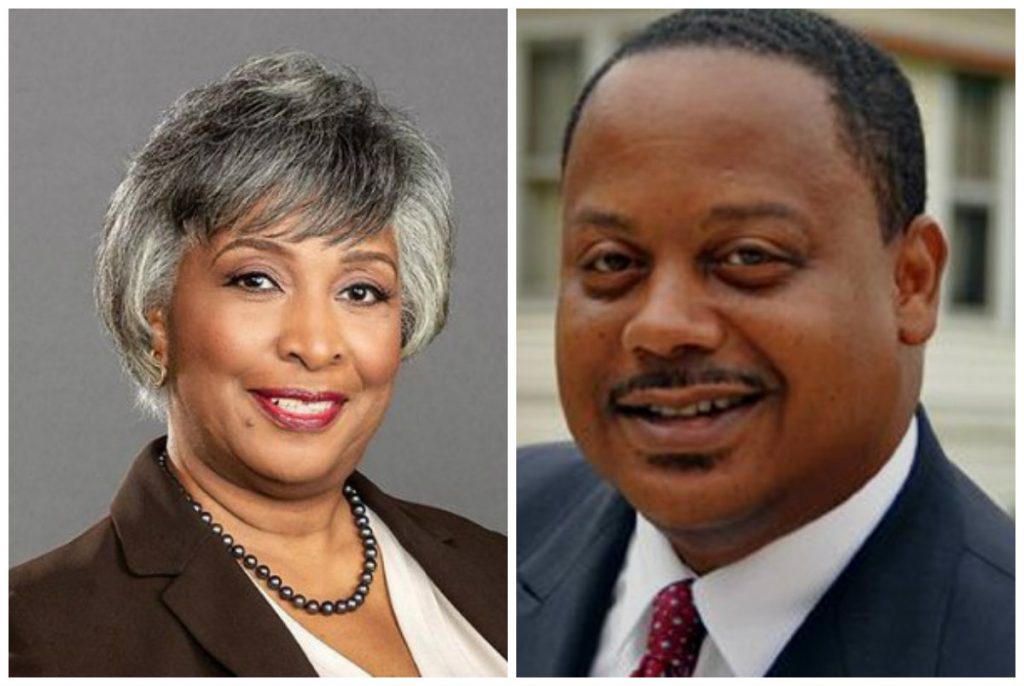 Deborah Foster-Bonner, left, and Roderick Sawyer. [Submitted photos]
Eight years ago, 6th Ward Ald. Freddrenna Lyle, who was first appointed by Mayor Richard M. Daley in 1998, won 44.5 percent of the vote in the first round of voting.
In his first race for office, Sawyer, the son of a former mayor taking on the establishment’s preferred candidate, finished with 25 percent.
Despite Mayor Rahm Emanuel’s support, union and business backing, Lyle lost to Sawyer by 104 votes in the runoff.
After all of the votes cast Feb. 26 were counted, Sawyer ended up three votes shy of the 50-percent-plus-one threshold to win re-election. Foster-Bonner won 31 percent of the vote.
-
Mayoral candidate Lori Lightfoot rolled up a series of high-profile endorsements while celebrating St. Patrick’s Day, including U.S. Rep Jesus “Chuy” Garcia and several African American aldermen, while members of the Cook County Board began to line up support to replace President Toni Preckwinkle, should she defeat Lightfoot on April 2.
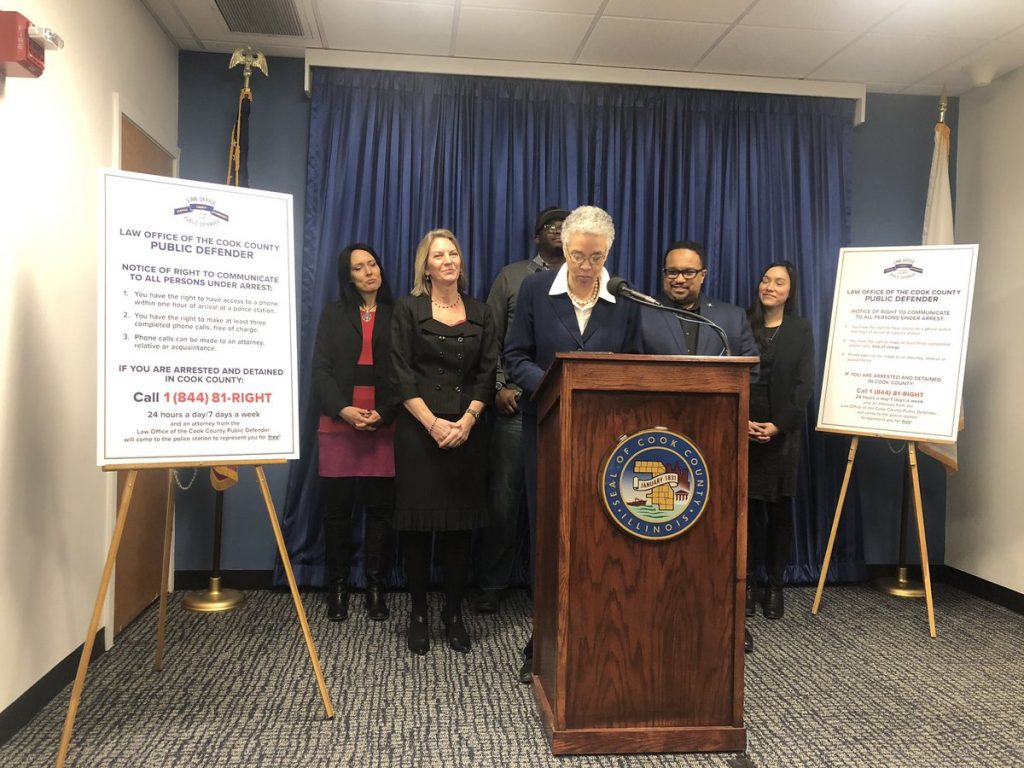 Cook County Board President Toni Preckwinkle said she's backing a new state law to ensure the rights of. arrestees are protected. [A.D. Quig/The Daily Line]
-
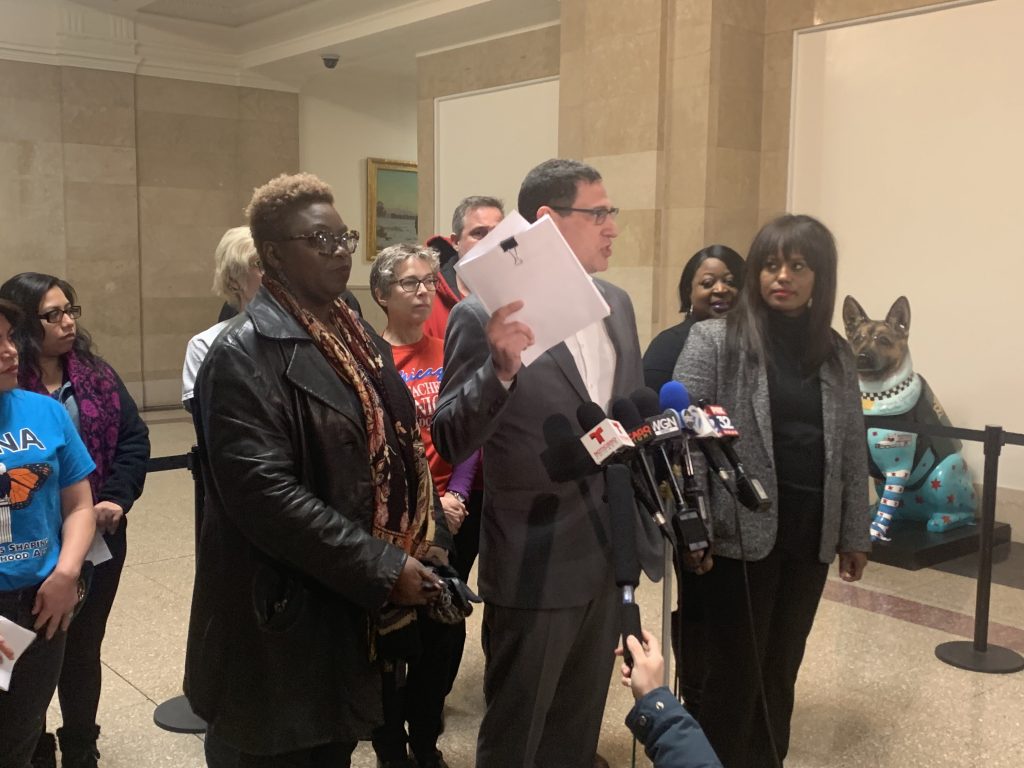 Chicago Teachers Union President Jesse Sharkey displays the unions demands for a new contract at a January news conference. [Heather Cherone/The Daily Line]
The first proposal from city and school officials to Chicago Teachers Union leaders would “roll back key wins for better learning conditions,” the union told its members — and urged them to begin saving in case of a strike.
 [Flickr/life_chasing]
 Cook County Comm. Brandon Johnson (D-1)
 State Rep. Kelly Cassidy (D-Chicago). [Submitted]