As the push to move the Chicago City Council left in the wake of
Mayor Rahm Emanuel’s decision not to run for a third term takes shape, the Chicago chapter of the Democratic Socialists of America endorsed three candidates in February’s election.
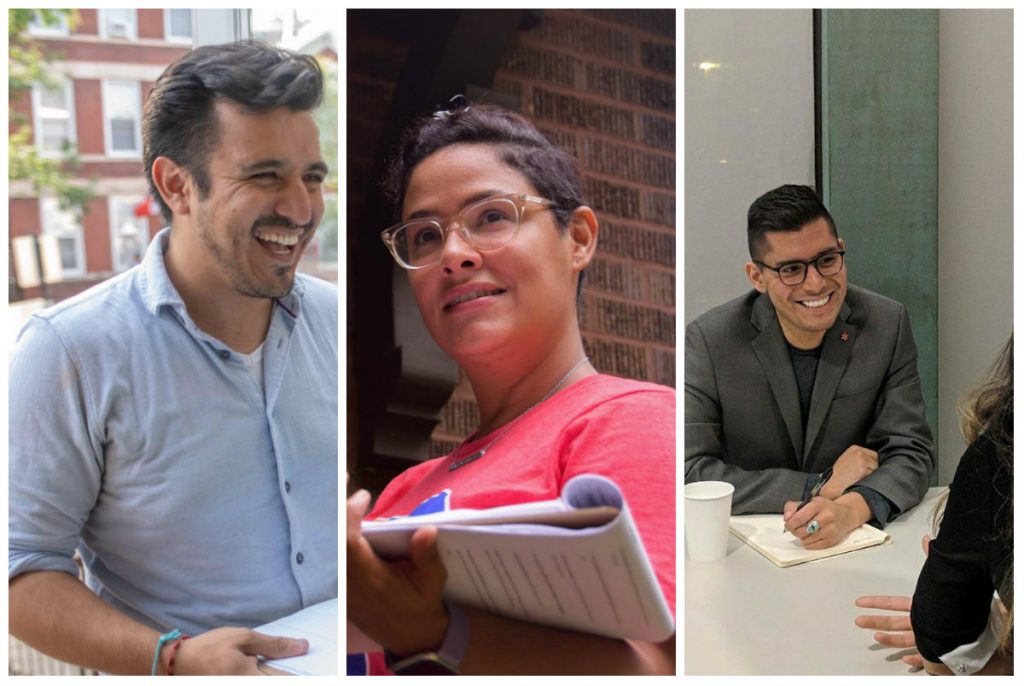
From left, Byron Sigcho-Lopez, Rossana Rodriguez-Sanchez and Ald. Carlos Ramirez-Rosa (35.) [Submitted photos]
In addition to 35th Ward
Ald. Carlos Ramirez-Rosa — the only member of the DSA on the City Council — the group endorsed two challengers trying to unseat aldermen who have allied themselves with Emanuel.
The group endorsed Pilsen Alliance founder
Byron Sigcho-Lopez in the 25th Ward race against
Ald. Danny Solis, the chairman of the powerful Zoning Committee and a 22-year veteran of the City Council. Three other candidates have also filed to challenge Solis.
Related: The TDL
aldermanic spreadsheet
Tom Bowen, a spokesman for Solis’ campaign, declined to comment on the DSA’s endorsement of Sigcho-Lopez.
In the 33rd Ward, the Chicago DSA endorsed
Rossana Rodriguez-Sanchez, who is attempting to unseat
Ald. Deb Mell and end her family’s dynastic hold on the Northwest Side council seat that stretches back to 1975, when her father
Ald. Dick Mell was elected to City Council.
Mell declined to comment on DSA’s endorsement of Rodriguez-Sanchez.
Rodriguez-Sanchez is a youth educator and community activist who helped build the 33rd Ward Working Families organization, which has focused on immigrants’ rights.
The Chicago chapter of the DSA is made up of three branches covering the North Side, South Side and West Cook suburban area, and has approximately 1,700 members, said
Steve Weishampel, co-chairman of Chicago DSA’s Electoral Working Group.
“We’re thrilled to offer endorsements to three brilliant and committed fighters for the working
people of Chicago,” Weishampel said in a statement. “The DSA group of candidates offers the only real, coherent alternative to the pro-corporate, anti-worker city government we have now. This group believes in the power of working people, and we in turn believe in them and are ready to fight for them.”
Chicago DSA will canvass, phone bank and fundraise for its endorsed candidates before the municipal election Feb. 26. Chicago DSA aims to turn out 1,000 of its members to support
its endorsed candidates, who won the nod after submitting their answers to Chicago DSA’s
candidate questionnaire and answered questions directly from members at in-person interviews, Weishampel said. Candidates who were endorsed won more than two-thirds of the vote of the membership at the meeting, he added.
The working group submitted five candidates for endorsement, Weishampel said and the endorsement meeting featured a “robust debate” about how many candidates DSA had the capacity to support in a meaningful way, Weishampel said in an interview with
The Daily Line.
“We are not a rubber stamp,” Weishampel said. “We don’t want to stretch ourselves too far. We want to be a disruptive force in next year’s election.”
Ugo Okere, who is running in the 40th Ward against
Ald. Pat O’Connor, Emanuel’s floor leader, won 62 percent of the vote at Sunday’s meeting, falling just short of the threshold necessary to win the group’s endorsement. Both Okere and
Andre Vasquez, another 40th Ward candidate, are DSA members, Weishampel said.
Daniel La Spata — who is running against 1st Ward
Ald. Proco Joe Moreno — won more than 50 percent of the group’s vote, but not enough for an endorsement, Weishampel said.
The DSA may consider endorsing additional City Council candidates at its next general membership meeting in December, Weishampel said.
In addition, Chicago DSA may consider endorsing in the mayoral election, with candidates
Troy LaRaviere and
Amara Enyia expressing interest in the group’s support, Weishampel said.
The upset victory of DSA member
Alexandria Ocasio-Cortez in the Democratic primary for Congress representing New York City put the socialist group in the nation’s political spotlight and caused its membership to surge.
In an opinion piece
published two weeks ago, Ramirez-Rosa and Rodriguez-Sanchez laid out a 10-point progressive platform for candidates that included a tax hike on large corporations, an end to tax-increment financing districts, an elected school board and the end to the Chicago Police Department’s database that is used to track those affiliated with gangs. The group is also organizing around efforts to lift the statewide ban on rent control.
Several other candidates for City Council have made common cause with the DSA, including
Pete DeMay, who is running in the 12th Ward.
“We need more members of the DSA on the City Council,” said chapter co-chairwoman
Lucie Macias. “For too long aldermen have not listened to their constituents.”
Macias said the endorsement process was “democratic” and conducted in the “right way.”
Even though the municipal election is 140 days away, the endorsements from the DSA are the second from a progressive group determined to reshape the City Council, which often served a rubber stamp for Emanuel and
Mayor Richard M. Daley.
United Working Families, a political organization formed by progressive labor and community organizations, claimed credit for pushing Emanuel out of the mayor’s race.
“Now, we’re building a City Hall that will fight back against those who have profited from skyrocketing violence, displacement, and unemployment,” said executive director
Emma Tai. “Black and Latinx working families bore the brunt of Emanuel’s racist, pro-corporate economic agenda. Now is the time to win a different future and a city for the many, not the wealthy few.”
UWF endorsed Ramirez-Rosa and Rodriguez-Sanchez in the group’s “early wave” of endorsements as well as:
- 10th Ward — Ald. Susan Sadlowski Garza
- 15th Ward — Rafael Yañez
- 20th Ward — Jeanette Taylor
- 22nd Ward — Michael Rodriguez
- 46th Ward — Erika Wozniak
- 49th Ward — Maria Hadden
The UWF said it planned to build on its undefeated record during the March Democratic primary, when it helped Cook County Board candidates
Brandon Johnson and
Alma Anaya to victory along with Illinois House candidates
Delia Ramirez and
Aaron Ortiz.


 The Women’s March Chicago is set to return to Columbus Drive and Jackson Boulevard Saturday — this time in an effort to get first-time voters to turn out for next month’s midterm elections. Three progressive aldermen agreed to lead an exploratory committee for Peter Gariepy, and Cook County Board President Toni Preckwinkle named a permanent chief of staff, and prepared to unveil her 2019 budget proposal.
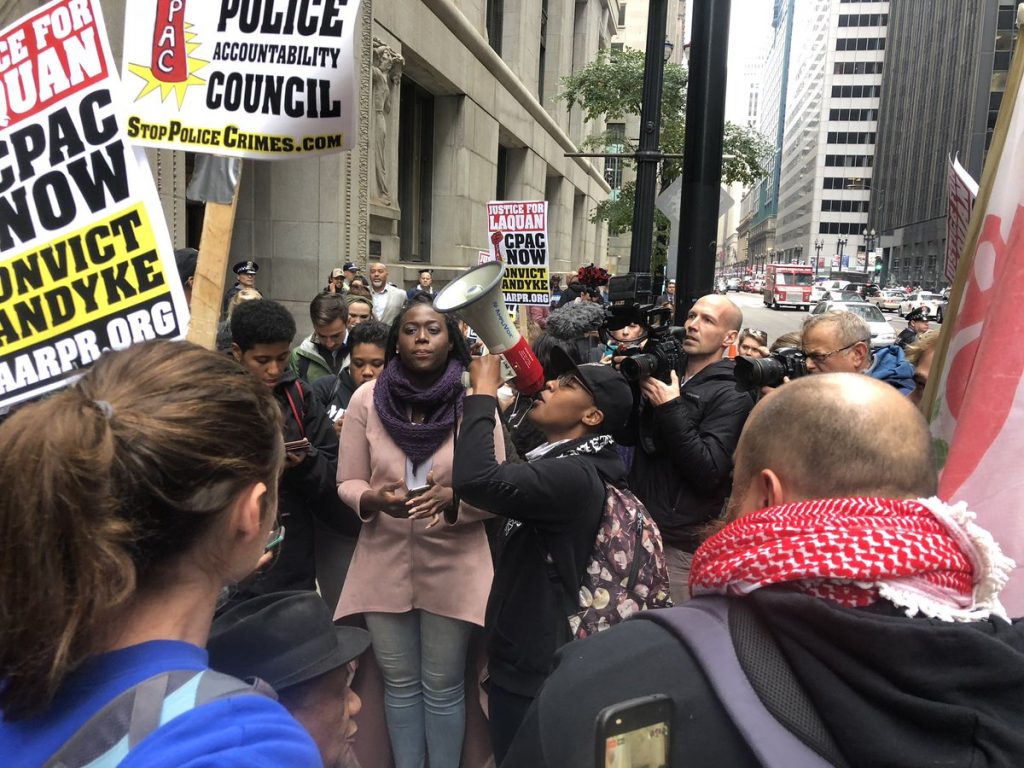 The crowd outside City Hall at the time the verdict in the Van Dyke case was read. [A.D. Quig/The Daily Line]
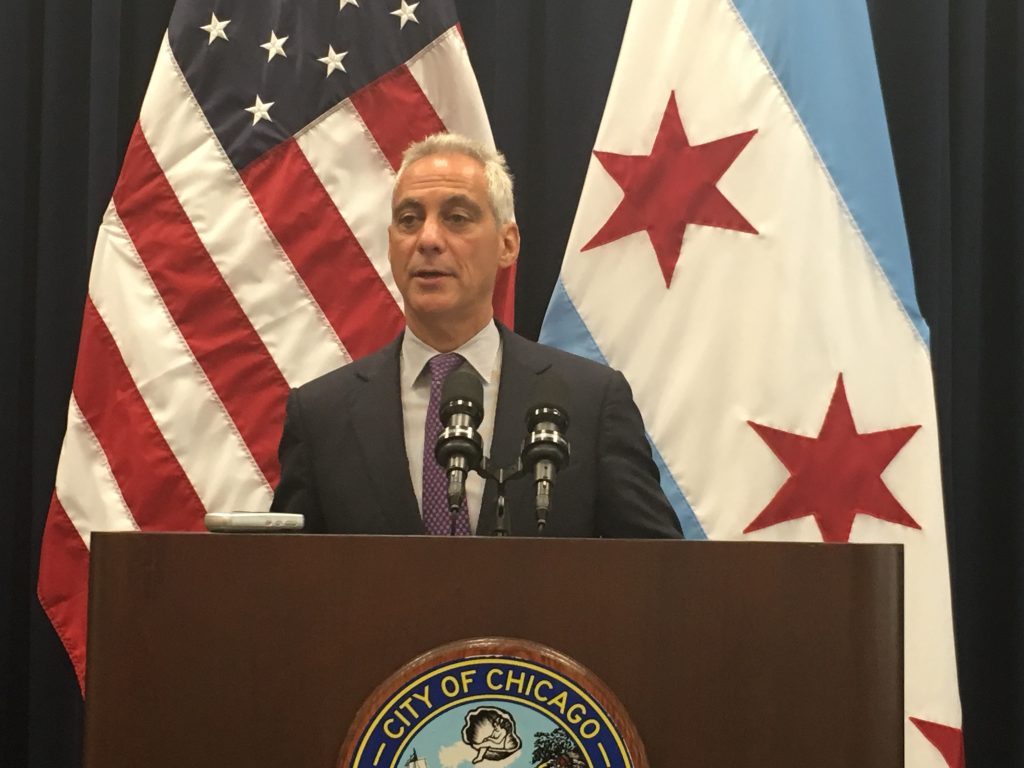 Mayor Rahm Emanuel has repeatedly claimed credit for holding the line on health care costs. [Heather Cherone/The Daily Line]
 Progress Chicago, the not-for-profit, “tax-exempt social welfare organization” has been dark since Sept. 12. [Website]

