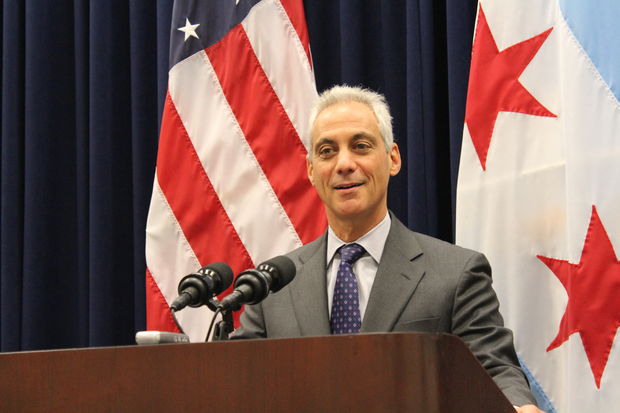
Mayor Rahm Emanuel. [Heather Cherone]
RAHM EMANUEL'S 2018 BUDGET ADDRESS(Delivered to Chicago City Council, Oct. 17, 2018)
Members of the Council, Chairman Austin, Chairman Burke, and fellow Chicago residents:
It is a privilege to present our 2019 budget proposal.
This year, Chicago’s fiscal and economic health is stronger than it has been in many years.
I would like you to think of where we were seven years ago, almost to the day, when I gave my first budget address.
The City of Chicago’s fiscal crisis, brewing for years, had reached a boiling point. We faced a structural deficit of 635 million dollars. 20 percent of the entire budget was in the red.
For each of the previous three years, the City had taken more than 300 million dollars out of the reserves just to balance the budget.
All four city pension funds were hurtling towards insolvency.
Companies and jobs were leaving the city. In October of 2011, Chicago’s unemployment rate had hit 11 percent.
Many believed our best days were behind us.
That the energy and vibrancy that had defined Chicago for generations were part of our past, but not our future.
Some predicted Chicago would be the next Detroit.
Others thought our best hope was a Hail Mary pass: privatize Midway, build a casino, or scale back garbage pickup and other basic neighborhood services.
The Chicago Tribune wrote that the crisis, “threatened to sabotage much of this city's future: the schooling of our children, the size of our police force, the willingness of businesses to stay here and grow jobs.”
Because we were willing to chart a different course and to break with the past, we did not let a fiscal crisis become an academic crisis. Every year for the past seven, a new record number of Chicago’s students have graduated high school. More graduates than ever now go to college.
Stanford University found CPS students are learning faster than 96 percent of students of all districts in the United States. A child who is born in Chicago today will get four more years worth of school than a child born a decade ago. We are fortunate to have a CPS graduate, parent, teacher and principal leading that progress. I want to acknowledge
Dr. Janice Jackson for her hard work on behalf of Chicago’s children.
Because we were willing to chart a different course and to break with the past, we did not let a fiscal crisis affect the size and strength of our police force. Under the leadership of
Superintendent Eddie Johnson, we are growing the size of the force by close to 1,000 additional officers. Just as important, we are bringing real, fundamental, lasting reform to the Chicago Police Department. Superintendent Johnson is with us in the chamber today, and I want to recognize him for his extraordinary leadership on behalf of all the people of Chicago.
And because we were willing to chart a different course and to break with the past, rather than fleeing, more businesses moved their headquarters to Chicago than any American city for five years running and there are more jobs per capita in Chicago today than any time in the past five decades.
To those who thought demise and decay were preordained and just around the corner, from the schooling of our children, to the strength and size of our police force, to the success of our economy, Chicagoans showed the resolve and resilience that define the character of this great city.
****
Seven years ago, standing right at this podium, I said we could start shaping our future or let our future shape us.
That we would show the world that no matter how tough times got, we Chicagoans were tougher.Together , those of us in this room and taxpayers across Chicago, stopped kicking the can down the road and started putting our pension funds on the road to solvency. All four funds now have dedicated revenue streams. All four funds are now on the road to recovery.
We traded gimmicks and financial games for true and honest accounting. We did away with scoop and toss, put an end to the use of long-term debt to cover short-term costs, and stopped privatizing public assets.
Rather than relying on reserves to balance the budget, we added money to the reserves every year. We have contributed more than 70 million dollars to Chicago’s rainy day funds. With this budget, I am proud to say we will add another 10 million dollars. We are sending a clear statement that we believe in saving for Chicago’s future, not mortgaging it.
We reined in runaway health care costs, which were growing at 10 percent a year compounded. Today, our health care budget is 33 million dollars lower than the day I took office. A seven percent reduction, while health care costs have risen 30 to 40 percent across the country.
With this budget we will achieve another 73 million dollars in structural savings and reforms. We will save ten million dollars by reducing the cost of workers’ compensation. We will save more than 15 million dollars by using zero-based budgeting in every department. We will save millions of dollars in energy costs from installing more efficient LED streetlights, with more savings to accrue in the years ahead.
Let me be clear.
Getting the city back on track has not been a walk in the park, and by no means is our work finished. But that does not mean we should undersell the journey we took and the work we did in this Chamber.
We took tough votes. You demonstrated political courage.
I have been in politics a long time.
One thing I have learned is that they do not build statues for people who restore fiscal stability.
But without sound, strong, stable finances, nothing else is possible.
So you will not get a statue. But you have built something more important, more fundamental, and more lasting than any statue: you have built a foundation.
And on that foundation you can build a home and a neighborhood. On that foundation, you can build businesses and jobs. On that foundation, you can build a firehouse or a police station or a tech startup. On the foundation you have created, we can build an even greater Chicago.
****
While we cut our structural deficit by 538 million dollars over the last eight years, simultaneously we made new investments in neighborhoods across the city, in small businesses that create jobs and a sense of community, and in emerging sectors of our economy like technology, advanced manufacturing and tourism.
We rejected the false choice of slashing government, regardless of its effect on residents, or raising citywide taxes without real structural reforms to accompany them.
We rejected the bad idea of cutting back on garbage service and replaced it with the good idea of a grid system, which enabled us to add citywide recycling service for every resident of Chicago.
To help address rising health care costs, we did away with the Olympic contracts and giveaways, including in our recent agreement with AFSCME. We restructured copays, deductibles, premiums and salary caps for the first time in over a decade, brought down the high prices of prescription drugs, and put city employees on a wellness plan that will not just help lower costs,but more importantly has helped make our workforce healthier.
While health care inflation in the last eight years is up 30 to 40 percent across the country, I want to repeat, we brought the City’s healthcare budget down by 33 million dollars.
At the same time, we have increased investments in our children by 54 million dollars. Our budget is now better balanced with our priorities.
We consolidated three separate Chicago tourism agencies into one entity to market the city across the globe, and achieved six consecutive years of record tourism. This year, Chicago is on track to welcome more than 57 million visitors, a 30 percent increase since 2011. Conde Nast just named Chicago as the best big city to visit in America for the second year in a row. We have added more than 22,000 new jobs in the hospitality industry alone. Those are jobs for Chicagoans in every neighborhood. We have strengthened a 15 billion industry for the future.
Our work to create fiscal stability and certainty, while investing more in our neighborhoods and residents, has sparked private sector confidence in the city’s future as well.
Chicago’s economic growth has not just kept pace with other cities across America; on key measures we have grown faster and gone further.
Not only has Chicago been number one in corporate relocations for five years in a row. We have been number one in foreign direct investment for six years in a row.
In 2017, the top five cities in the world for foreign investment were London, Paris, Singapore, Amsterdam and Chicago. We are the only American city in the top ten globally. Chicago is one of the safest, strongest investments in the world.
More companies moving to Chicago, and more investment surging to Chicago, adds up to more
jobs for Chicagoans.
Today, unemployment in Chicago is at an all-time record low. Last year, Chicago achieved the largest drop in unemployment of the ten largest U.S. cities. Tech jobs in Chicago are growing almost as fast as they are in Silicon Valley.
In partnership with the private sector, we built a tech sector from the ground up. Created new incubators like 1871, the top incubator in the world. mHUB for advanced manufacturing. Matter for health care. Current for water technology. UI Labs for digital innovation. The Hatchery for the next generation of food businesses.
The net result: KPMG ranked Chicago as the sixth strongest tech hub in the world. Deloitte ranked Chicago as one of the top five financial tech hubs in the world. Modis called Chicago the world’s number one emerging tech hub. The Harvard Business Review called the growth of Chicago’s tech sector a model for other cities to follow.
We believe the economy should work for all Chicagoans, not just some. And we believe that hard work should come with fair
pay. We don’t just believe those things; we did something about them.
The Illinois minimum wage remains stuck at $8.25 an hour. The federal minimum wage is $7.25.
But this coming July, Chicago’s minimum wage will rise to 13 dollars an hour, a 40 percent increase over the last five years.
When we raised the minimum wage back in 2014, there were some voices in the city who said that the sky would fall.
Since their predictions, Chicago has added 72,000 new jobs. 91,000 fewer Chicagoans, including most importantly 44,000 fewer children, are now living in poverty.
We proved that fair pay and a growing economy can be complementary.
Since we started to raise the wage, Chicago’s unprecedented building boom has not abated, it has accelerated.
Today, there are over 20 billion dollars in major private sector developments across the city. The Tribune noted, “The sheer number of mega-projects stands out, making this a unique time in Chicago.” Since they made that observation, even more new projects have broken ground. It is another vote of confidence in a city willing to shape its future, not be shaped by it.
****
But the strongest measure of Chicago’s future is not the new buildings going up, or even the unemployment rate coming down. It is not the new start-ups opening their doors, or the record number of companies, investors, and tourists flocking here.
The strongest measure of Chicago’s future, and the true hallmark of our collective work, is the remarkable academic progress of our children.
When our youngest students were caught in just a half-day of Kindergarten, could we really expect them to come out on top?
When our children were trapped in the shortest school day and school year in the United States of America, could we really expect them to succeed?
When too many children had too few after school activities, summer jobs or mentors could we really expect them to reach their potential?
When Illinois was dead last in the country in education funding, could we really expect Chicago’s children to beat the odds?
Last year, with the support of Speaker Madigan, Senate President Cullerton, and members of both parties in the Illinois House and Senate, we turned a page on that old inequity.
The historic funding formula we fought for was passed into law, and Chicago’s students and teachers are no longer second-class citizens in Illinois.
It was a crucial step in the decades long march towards fairness for Chicago’s children.
When you step back and look at the arc of what we have done over seven and a half years together; from after school activities to summer jobs; from free pre-k to free community college; from Safe Passage routes to mentors; from more tutors in our neighborhood libraries to more camp counselors in our local parks; from free eyeglasses to free books for Rahm’s Readers; at the end of the day it is really no different than what Amy and I or you and your partner do for
your own children.
To all those parents who are juggling a job and a family, we said with one voice the City will
stand by your side. And we have.
125,000 students in after school activities.
32,000 young adults who have summer jobs.
80,000 students who go to school on a Safe Passage route.
7,800 young men and women with mentors.
118,000 tutoring sessions at Chicago Public Libraries last year.
55,000 children who get free eye exams and free eyeglasses if they need them.
16,000 four year-olds in Full Day Pre-K.
24,000 five year-olds in Full-Day kindergarten.
More than 6,000 CPS graduates who have gone to City Colleges for free.
Chicago’s children are doing their part - by setting records in the classroom. They have risen to the challenge. They are choosing to shape their own futures, not let their futures shape them.
Our schools CEO Dr. Janice Jackson will be the first to tell you: For children to succeed in the classroom they need to be supported outside the classroom.
Think about it. For every year we invested more in our children with a record number of summer jobs, Chicago’s graduation rate went up, and is now at a record high 78.2 percent and growing.
For every year we invested more in our children with after school activities through After School Matters and the Chicago Park District, Chicago’s freshman on track rate went up. It is now a record 89 percent.
For every year we invested more in our children with a record number of mentors and college counselors, more high school students enrolled in college. A record 68 percent of CPS graduates now enroll in college. Last year, they earned more than 1.3 billion dollars in scholarships.
When that many young people make that much progress, it means the whole city is doing something right.
Parents and teachers, principals and pastors, coaches and college counselors, tutors and mentors.
If you want to change the direction of a young person’s life, you have to be part of it.Superintendent Johnson can attest to this.
The Chicago Police Department’s ongoing fight and progress against crime is strengthened not just by more beat officers, but also by more young men and women with mentors.
Not just new strategic support centers in our police districts, but more after school activities in our neighborhoods.
Not just new body cameras and Tasers for every officer, but more ex-offenders who are given a second chance because a failed system never gave them their first chance.
Just the other day, I was at an event sponsored by Loyola University where I ran into Christophe Collens. Christophe was part of our pilot program at CTA for ex-offenders. Before the Second Chance program, he could not find a job. He could not provide for his family. He had become homeless.
The Second Chance program helped him get back on his feet. Today he is working full-time, supporting his family, and giving back to Chicago through volunteer work with the homeless.
Christophe is with us in the Chamber this morning. I hope you will join me in recognizing his hard work to turn his life around, be a good father, and give back to his fellow Chicagoans.
This budget will support 2,600 more men and women to follow Christophe’s journey back into the workforce.
The solutions to our public safety challenges do not rest on the shoulders of our police officers alone. With this budget, we will also provide mentors for an additional 600 7th grade young men.
Bringing our total to 7,800 students in seventh, eighth, ninth, and tenth grade. Four consecutive years, five days a week, nine months of the year.
I have taken part in several Becoming a Man sessions. So has President Obama. So has Theo Epstein. So has Bill Gates as recently as recently as six weeks ago. Everyone one of us have walked away inspired and impressed by what these young men are doing today and what they have planned for tomorrow. We can see the spark of confidence in their eyes and we can hear it
in their voices.
In my second inaugural address, in 2015, I focused on the lost young men in Chicago. We pass them on the streets, but we don’t really even see them. When we think of them at all, we think they are someone else’s problem. But we are all responsible for giving them a chance in life.
I said then, “When young men join gangs in search of praise, we must do better. When young men turn to lives of crime for hope, we must do better. When prison is the place we send boys to become men, we must do better.”
If they can change the direction of their lives with the support of a summer job, an after school activity, or a mentor, we owe them that chance.
Last week, I received a letter that I would like to share with you.
****
Rajay and Mr. Dorsey are with us in the chamber this morning. I would like to ask them to please stand up. I hope you will join me in congratulating them, and all of the mentors and students in BAM and WOW, who are with us today.
We have been able to invest in Rajay, Mr. Dorsey, and young men and women across Chicago because we have done the hard work of putting our fiscal house and priorities in order.
This budget builds on the steady progress we have made together over the past seven years.
Public officials, and private citizens. Fortune 500 executives and family-run small business owners. Members of my cabinet, and members of neighborhood block clubs. All with an oar in the water, all guided by the same north star of a brighter future for our city and our children.
There is work we have done together that you will be able to see as clear as daylight: A modernized O’Hare and Midway. A revitalized River and Lakefront. New schools and science labs with computers for every student. New early childhood education centers in our neighborhoods and new learning centers for our retooled City Colleges. A new Union Station and new CTA stations. New neighborhood branch libraries, and the Obama Presidential Library.
A new life for the Old Post Office, and new grocery stores in former food deserts. New space for
survivors of domestic violence, and new homes for veterans who were once homeless.
And there is work we have done together that we cannot see, but that will equally benefit Chicagoans for generations to come: Free community college through the Star Scholarship. Free, universal full-day pre-k for every four year-old and a full-day of kindergarten for every five year-old. The summer job that becomes a gateway to a career in coding. The afterschool activity that becomes a scholarship to college in the arts. The child who walks to school on a Safe Passage route and their attendance and grades go up. The student with eyeglasses who can now see the chalkboard or book in front of them. The young man or woman with a mentor that helps them shape their future, not be shaped by it.
All of this adds up to thousands of young people who have been given a choice and a chance because they can now believe in themselves again.
When I made the difficult decision not to seek re-election, I said our duty as public servants is to do the best we can and pass the torch.
Let us challenge those who sit in this historic chamber or stand at this rostrum in the future to remember the responsibility that comes with that torch.
If our leaders spend money we don’t have, they will steal the future our children could have had.
If our leaders make phony promises instead of tough choices, it is countless kids in tough neighborhoods whose true promise they will scoop and toss.
If our leaders run up debt, run down pensions, and run dry the rainy day fund, it is the next generation whose chances will run out.
If we want to show the next generation that character matters, we have to pass this test of character ourselves. The best part is, great things happen when we do. When we live up to our responsibilities, more young people in Chicago get the values and experience that come with a summer job.
When we confront challenges instead of ducking them, more students in Chicago have a safe place to be after school that helps them develop a better sense of who they are and what they want to become.
When we do what is necessary instead of what is easy, more young men and women have a mentor who can help change their chances for a lifetime.
When we work together to level the playing field for our children, their future is brighter and Chicago’s best days are not behind us, they are still to come.
It has been the honor of my career to work alongside each of you. And I will forever be profoundly grateful for the privilege of a lifetime to serve the citizens of Chicago and help them build the lasting future the greatest city on earth deserves.
Thank you. God bless you, and God bless the City of Chicago.


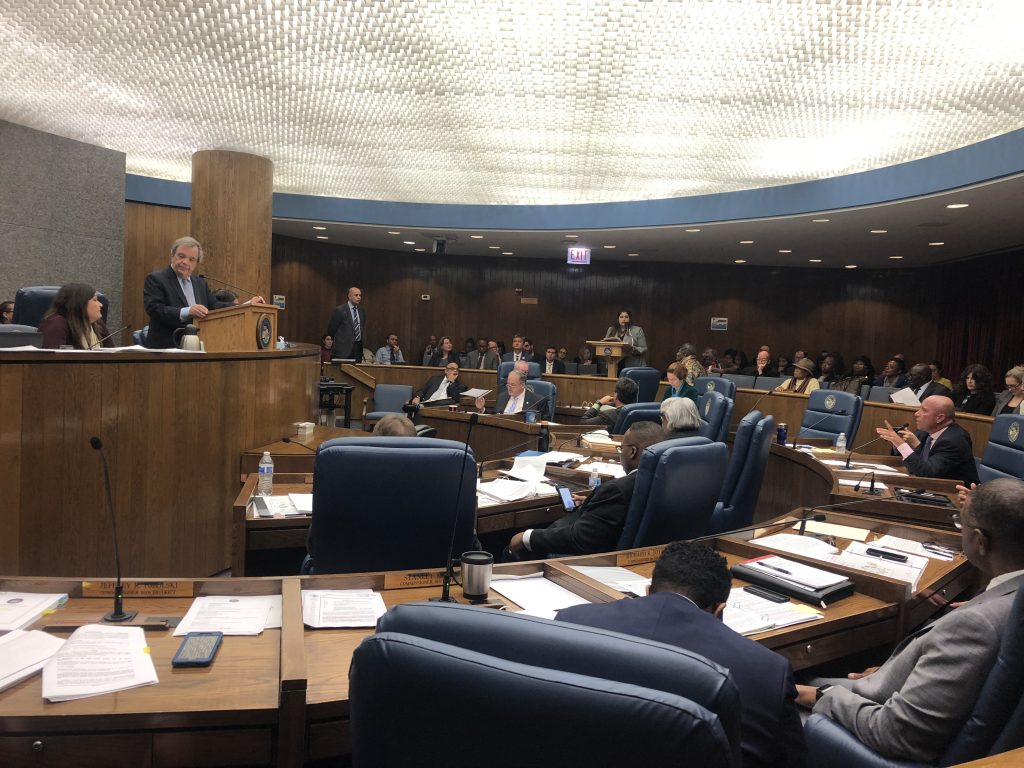 Comm. John Fritchey address Finance Committee Chairman John Daley at a meeting of the Cook County Board Wednesday. [A.D. Quig/The Daily Line]
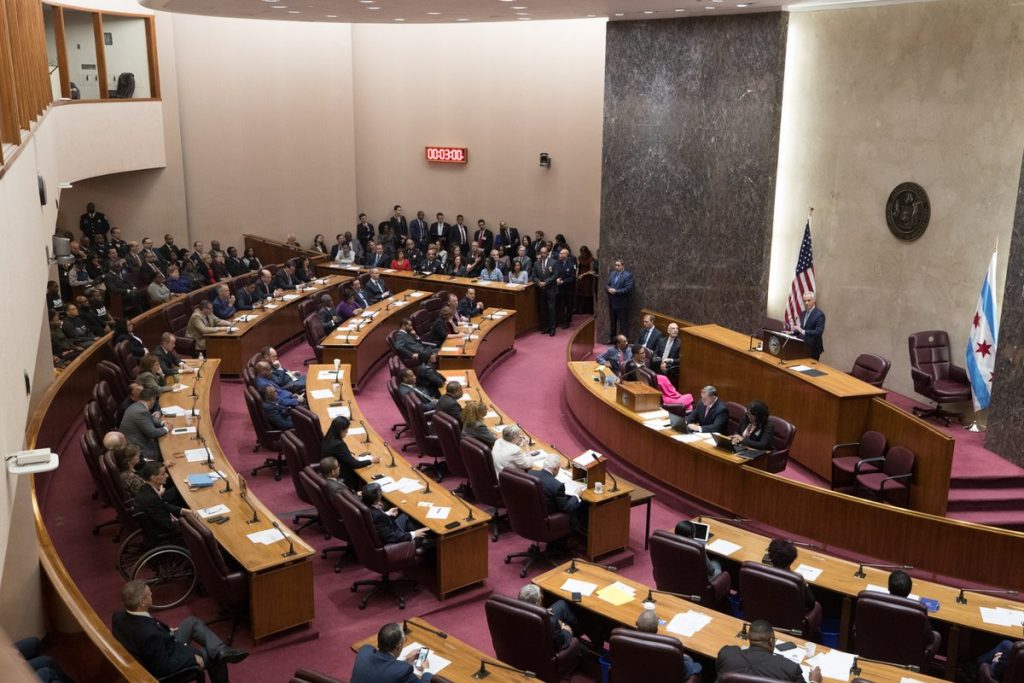 Mayor Rahm Emanuel delivers his final budget speech. [Chicago Mayor's Office]
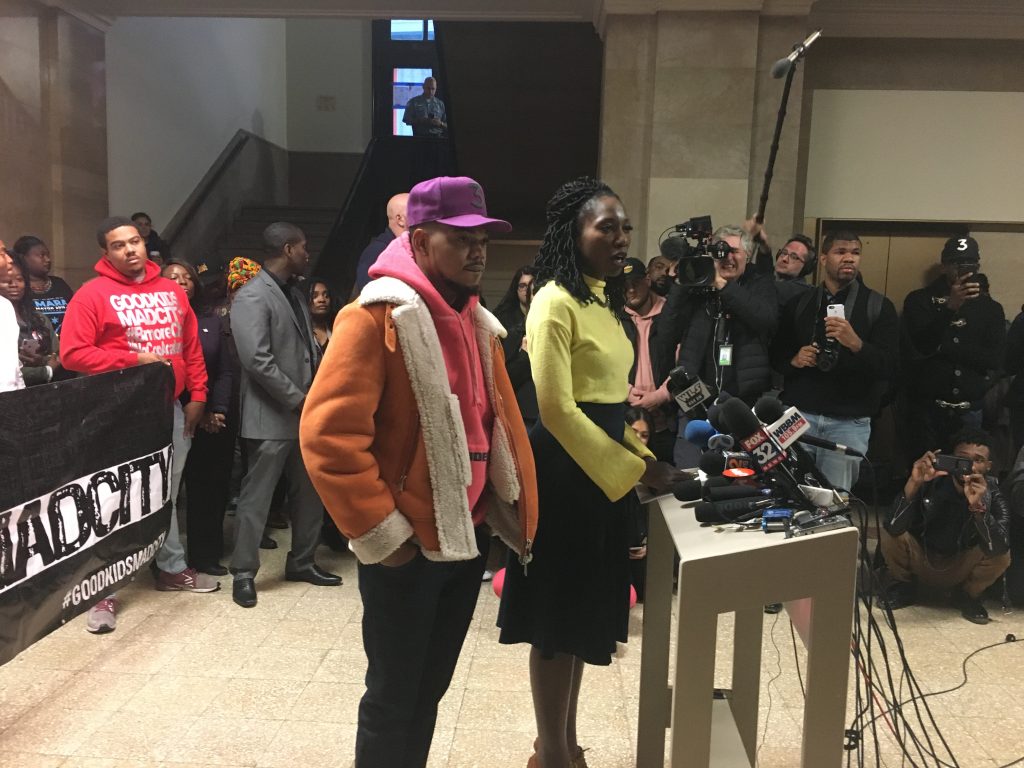 “I’d like to say very narcissistically, if I back you, you have a chance — absolutely,” Chance The Rapper said Tuesday at City Hall. [Heather Cherone/The Daily Line]
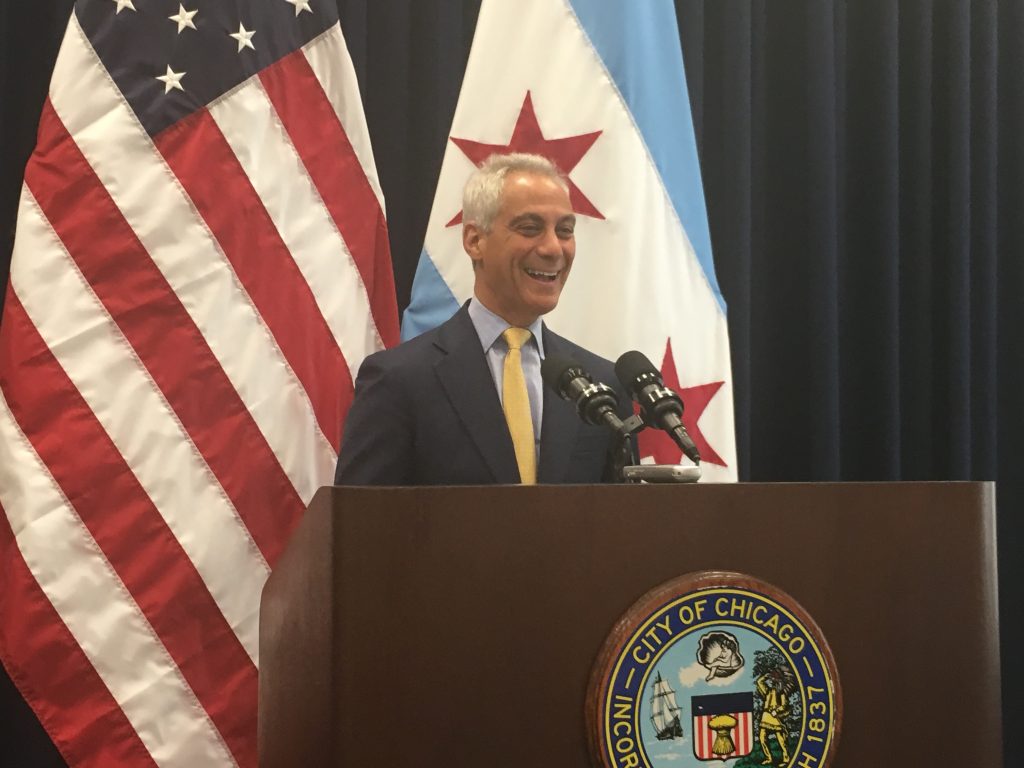 Mayor Rahm Emanuel address the news media. [Heather Cherone/The Daily Line]
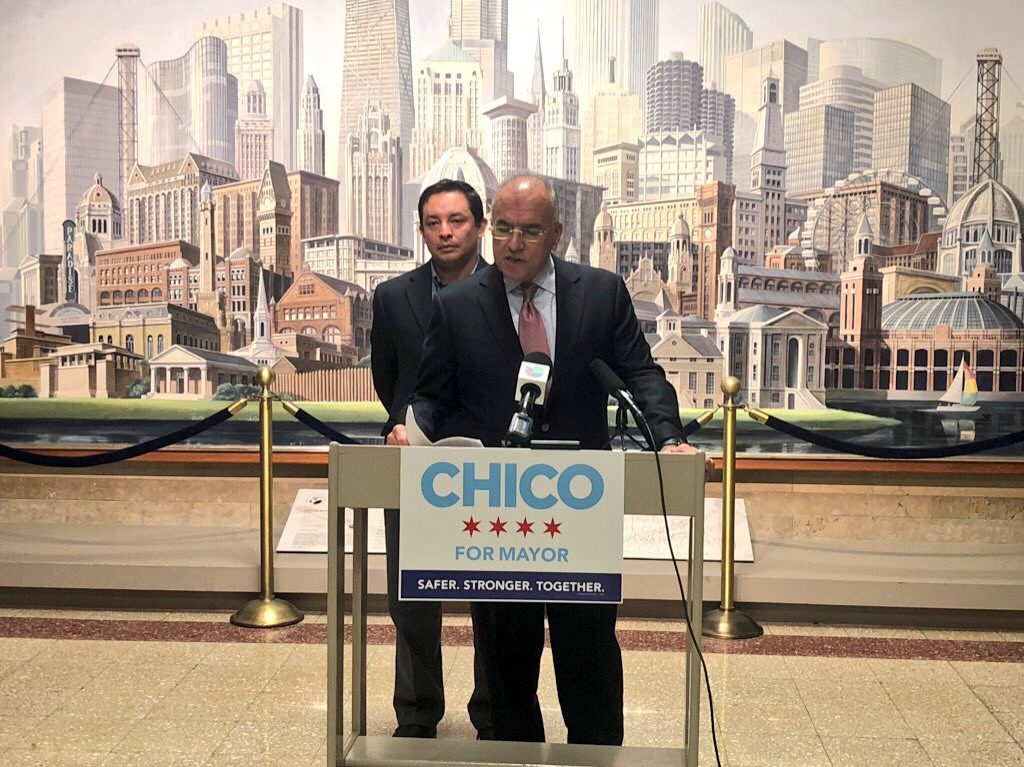 Flanked by Ald. Raymond Lopez (15), mayoral candidate Gary Chico called for Chicago to withdraw from the Gary-Chicago Airport agreement because undocumented immigrants are deported from there. [A.D. Quig/

 A rendering of the proposed redevelopment of the Tribune printing plant from Solomon Cordwell Buenz.

