


Chicago News
-
MAR 15, 2019

 Are you ready for round two? Voters eager to make their pick for mayor and treasurer — and residents of 15 wards with aldermanic runoffs — can head Downtown to cast their ballot. Lori Lightfoot continued her clean-sweep of endorsements from former rivals, while Toni Preckwinkle added another labor organization to her long list of union backers.
-
Lawmakers should raise the state’s gas tax to “raise significant and stable funds for infrastructure,” Mayor Rahm Emanuel’s transportation task force recommended Thursday.
 U.S. Transportation Secretary Ray LaHood shows off a copy of the task force's report as Mayor Rahm Emanuel looks on. [Chicago Mayor's Office]
-
The Chicago Board of Elections has released its proclamation for the April 2 runoff — all Chicago voters will have the opportunity to vote in runoffs for mayor and city treasurer, and 15 wards will have aldermanic runoffs.
-
MAR 14, 2019
After notching two high-profile victories at a tense City Council meeting, Mayor Rahm Emanuel allowed himself a brief victory lap at his penultimate post-Council news conference — but vowed once again to “run through the tape” at the end of his term as mayor.
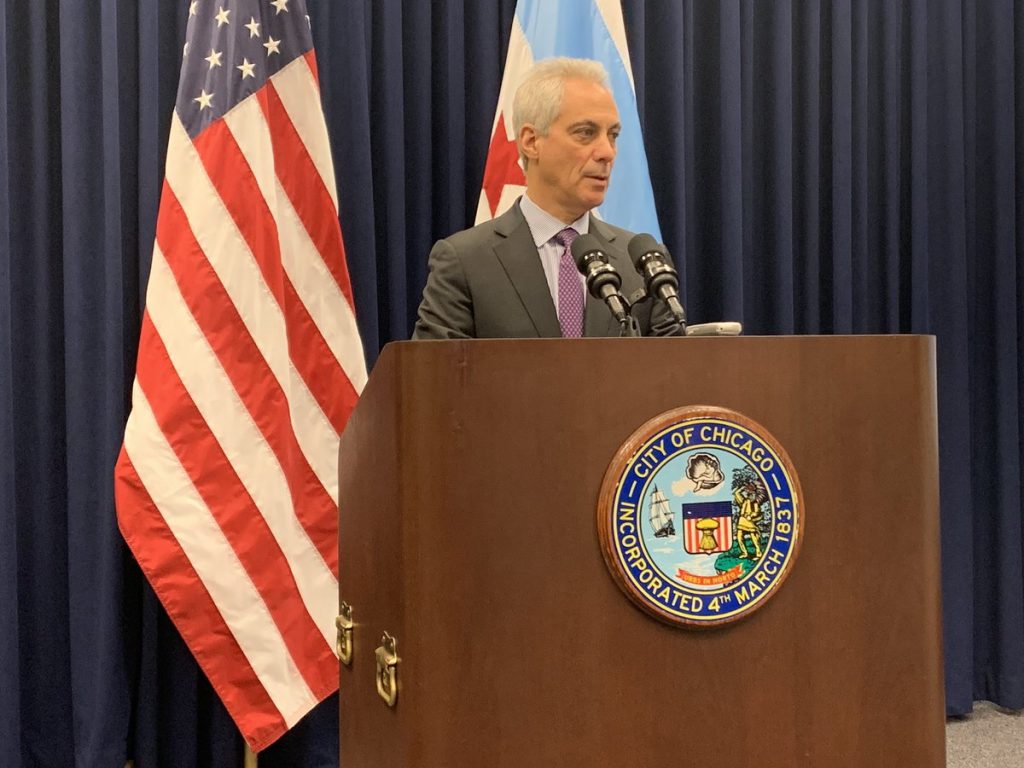 Mayor Rahm Emanuel allowed himself a brief victory lap at his penultimate post-Council news conference — but vowed once again to “run through the tape” at the end of his term as mayor. [Heather Cherone/The Daily Line]
-
A split City Council voted 33-14 to approve a $6 billion project that promises to transform 55 acres along the North Branch of the Chicago River into a new neighborhood.
 The proposed Lincoln Yards development. [Sterling Bay]
Supporters hope it will signal the final transformation of Chicago from an industrial behemoth to a city poised for growth in the 21st Century, while critics contend the project offers only “crumbs” to the rest of the city.
Sterling Bay’s $6 billion Lincoln Yards development calls for 6,000 new homes along with shops, offices and parks to be built between Bucktown and Lincoln Park. It overcame stiff opposition not only from some aldermen, but also from groups that said it would wipe out small entertainment venues like the Hideout while barely putting a dent in Chicago’s affordable housing shortfall or reducing the city’s economic or racial segregation.
Ald. Harry Osterman (48) mocked the project’s 600-foot tall towers and suburban-style shopping centers as “Schaumburg Yards.”
"This is the rich getting richer,” Osterman said. “The North Side getting north-er."
Osterman said the next time someone asks him why the North Side is so much more affluent than the South Side, he will point to this vote as the driving force behind the disparity.
"It happens on days like today, with votes like this,” Osterman said. “This is the tale of two cities."
Osterman’s remarks brought a pointed response from Ald. Jason Ervin, whose 28th Ward is on the West Side.
“It must be nice to sit on Sheridan Road and Northwest Highway and have philosophical conversations about the city,” said Ervin, who said the residents of his ward will be proud to fill the 10,000 construction jobs and the 24,000 permanent jobs city officials project within the next 10 years.
"If this development can help other parts of the city, then let's help," Ervin said.
Ald. Raymond Lopez (15) said the unemployed workers in his ward could not afford to wait for more deliberations to take place.
"It must be nice to look from a point of privilege and say ‘we can wait, don't rush’ ... it is all piles of BS," Lopez said.
In addition to Osterman, the development’s neighboring aldermen – Michele Smith (43) and Scott Waguespack (32) voted no, as did Ald. Sophia King (4); Ald. Leslie Hairston (5); Ald. Susan Sadlowski-Garza (10), Ald. Roberto Maldonado (26), Ald. Ariel Reboyras (30); Ald. Milly Santiago (31); Ald. Deb Mell (33); Ald. Carlos Ramirez-Rosa (35); Ald. John Arena (45); Ald. James Cappleman (46) and Ald. Ameya Pawar (47).
Ald. Ed Burke (14) — who represented Sterling Bay as a private property tax attorney until being charged with attempted extortion — abstained.
Hairston, Reboyras, Santiago, Mell, Cappleman and Smith face runoffs on April 2 to keep their seats on the City Council. Pawar faces a runoff in his race for treasurer.
Even though Ald. Tom Tunney (44), Ald. Proco Joe Moreno (1) and Ald. George Cardenas (12) told The Daily Line before the Feb. 26 election they would vote no on the project, all voted yes.
Tunney and Cardenas were re-elected, while Moreno lost his seat.
Another key vote looms by the City Council’s Finance Committee next month — a $900 million subsidy for the project, set to be generated by the 168-acre Cortland and Chicago River Redevelopment tax increment financing district (F2018-72).
Ald. Brian Hopkins (2) — whose ward includes the project — called Lincoln Yards “a visionary proposal."
"We have to stay focused on progress," Hopkins said.
The proposal was changed at the 11th hour to reduce the size of the mixed-use development to 14.5 million square feet and cap the height of the towers at 600 feet. In addition, the revised plan requires 600 units of affordable housing to be built on site. Originally, the plan called for only 300 units to be built on site, a plan criticized by several alderman as insufficient.
Pawar and Hairston said there should be more affordable housing.
"We have to stop begging for crumbs," Hairston said.
Under aldermanic prerogative — the city’s unwritten policy of giving aldermen the ultimate authority over projects in their own wards — the project only needs the support of the mayor and Hopkins, who has said the new roads, bridges and sidewalks set to be built as part of the Lincoln Yards development are urgently needed.
Mayor Rahm Emanuel said Lincoln Yards is critical to ensure Chicago’s economy remains robust as the city transitions from its industrial past into the future.
“This is going to unlock tremendous opportunity," said Emanuel, who warned aldermen that the alternative to growing Chicago’s tax base is voting to raise taxes — again.
“You use the ability to grow in the city, and the jobs, to become a way to find the resources to address all the issues that, individually, members have asked for to be spoken to,” Emanuel said. “Otherwise, you can just either cut police, fire, garbage services, or you can just tax folks.”
Both Toni Preckwinkle and Lori Lightfoot called to no avail for the vote to be delayed — and whomever wins on April 2 will find her hands tied by Wednesday’s unusually divided vote of the City Council. -
Precisely 539 days after the first City Hall protest against plans to spend $95 million on a new training facility for Chicago police and fire departments, aldermen approved Mayor Rahm Emanuel’s proposal for the new West Garfield Park facility on a 38-8 vote.
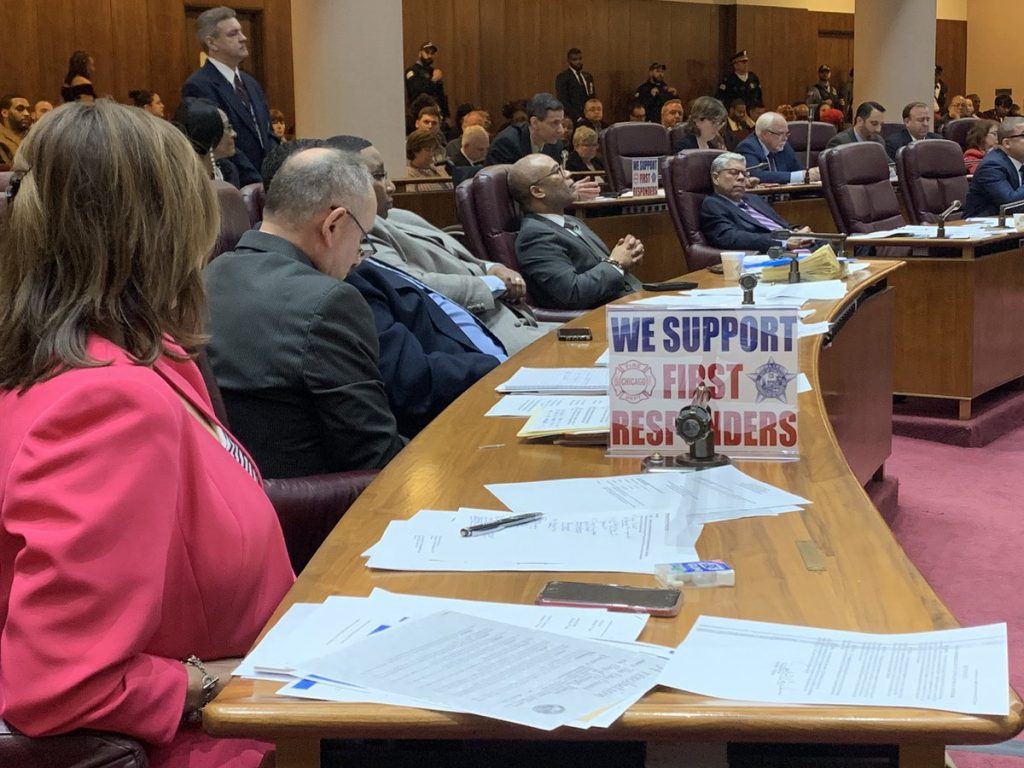 Three aldermen — Ariel Reboyras (30), Anthony Napolitano (41) & Nicholas Sposato (38) — placed these signs on their desks during the City Council meeting. [Heather Cherone/The Daily Line]
The No Cop Academy movement eventually swelled to include hundreds of protestors, and forced Emanuel to expend a significant amount of political capital — and to sweeten the deal by adding two African-American owned restaurants — to get the deal approved two months before he leaves office.
That did not stop hundreds of protestors from converging on City Hall Tuesday and Wednesday, where they were met with a massive show of force by police officers. The coalition protested at City Hall for nearly 10 hours Tuesday and blocked access to the building’s elevators.
Eight aldermen voted against the academy: Ald. Leslie Hairston (5); Ald. Susan Sadlowski-Garza (10), Ald. Roberto Maldonado (26), Ald. Scott Waguespack (32); Ald. Deb Mell (33); Ald. Carlos Ramirez-Rosa (35); Ald. John Arena (45); and Ald. Ameya Pawar (47.)
After the vote, protestors disrupted the meeting, loudly demanding that the $95 million be spent on restoring cuts made to Chicago Public Schools’ budgets or reopening mental health clinics shuttered by Emanuel.
Mayoral candidates Toni Preckwinkle and Lori Lightfoot also called for the project to be halted, although both support new training facilities for officers.
Ramirez-Rosa urged his colleagues not to give 37th Ward Ald. Emma Mitts the final word on the facility by following the City Council’s long-standing tradition of aldermanic prerogative.
That unwritten policy is fine when it comes down to determining where stop signs should go, but not when determining public safety policy, Ramirez-Rosa said.
“This impacts the whole city,” Ramirez-Rosa said.
Before the vote, Ramirez-Rosa warned his colleagues that the protestors would remember how they vote — and that Emanuel is on his way out.
“He’s not going to cut you those $20,000 checks anymore,” Ramirez-Rosa said.Mitts once again delivered an impassioned defense of the project, which will be built by AECOM as part of an $85 million contract (O2019-1154). In a separate vote, aldermen agreed to borrow $65 million to finance the construction of the facility.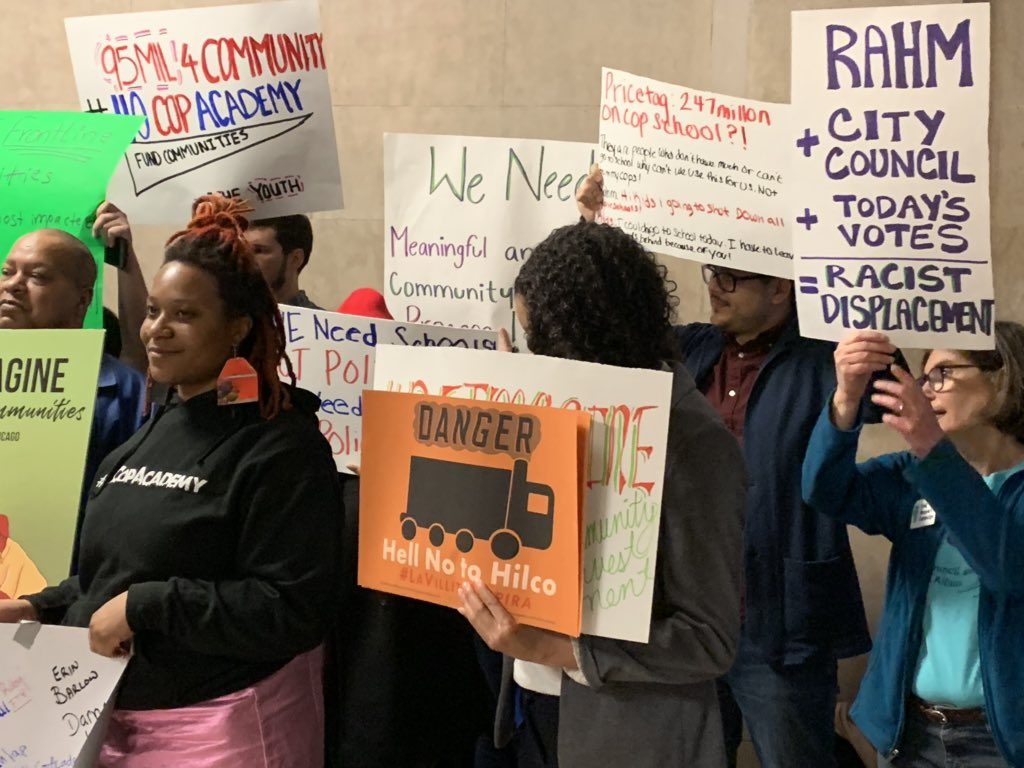 Hundreds of protestors converged on City Hall Wednesday to object to the new training facility and other items. [Heather Cherone/The Daily Line]
In May 2018, the City Council earmarked $20 million from the sale of the city’s largest maintenance garage and yard along the North Branch of the Chicago River — now slated to be part of the Lincoln Yards development — for the construction of the training facility. The city bought the land for the training facility in Mitts’ ward for $9.6 million.
"We have a right to have public safety as a priority!" Mitts said. "Mr. Mayor, we have an opportunity to get something right! I ask you to respect the wishes of not only myself but all the elected officials on the West Side."
Ald. Jason Ervin (28) said the facility is much-needed, and will be embraced by the people who live on the West Side – who voted to re-elect Mitts and others who support the academy. Neighboring West Side aldermen Walter Burnett (27) and Michael Scott Jr. (24) both spoke in support.
"It is interesting that people who don't live on the West Side want to tell us how to live,” Ervin said. “I will not stand by and allow that."
Members of the coalition said the 1,500 police and firefighters that are expected to work and train at the facility every day won’t make the area safer, even as Mitts and Emanuel contend their presence will boost economic growth and reduce crime.
Construction of the facility on land that has been vacant for 30 years will create 300 construction jobs. Half of those jobs must be filled by Chicagoans, the city says. Fifteen percent of those workers must be from the immediate area, which is double the usual requirement, and 40 percent of workers must be Black or Latino, according to city officials.
Twenty-eight percent of the work called for by the contract must be performed by firms owned by Blacks and Latinos; the usual city requirement is 26 percent. Eight percent of the work must be performed by firms owned by women, according to city officials.
The training facility will include two buildings — one for classrooms, labs, simulators, conference rooms, an auditorium and offices, and the other for a shooting range and space for “active scenario training and a dive training pool” for teams to practice rescues from submerged vehicles in daylight or dark.
The campus will also include a driving course, skid pad and and a place for “hands-on practice in real-world situations.”
Plans call for the training facility to include a Culver’s and a Peach’s restaurant, as well as community rooms and computer labs open to members of the public.
Emanuel has said a state-of-the-art facility is needed to address serious concerns outlined by the U.S. Justice Department in its 2016 investigation of the Chicago Police Department that found officers graduate from the five-month academy were “unprepared to police lawfully and effectively.”
The facility would replace the police training academy at 1300 W. Jackson Blvd., built in 1976; the fire prevention training facility at 1010 S. Clinton St., built in 1950; and the Fire Academy South at 1338 S. Clinton St., built in 1965, officials said.
Department of Fleet and Facility Management Commissioner David Reynolds said construction is expected to finish in 2021. -
MAR 13, 2019
-
Aldermen stalled an ethics package over zoning concerns and passed a strings-attached streaming ordinance in the Rules Committee Monday.
Rules Committee Chairwoman Ald. Michelle Harris delayed the ethics changes Mayor Rahm Emanuel proposed in January after aldermen expressed concerns over how soon zoning map amendments would have to be heard by the Zoning Committee.
-
When Mayor Rahm Emanuel announced in September he would not run for another term, the clock started ticking on his agenda — and he has repeatedly vowed to resist becoming a lame duck for as long as possible by “running through the tape.”
 Mayor Rahm Emanuel address the news media. [Heather Cherone/The Daily Line]
As aldermen gather Wednesday for the first City Council meeting after the Feb. 26 election that ensured Chicago’s next mayor will be an African American woman, Emanuel is set to cross off several high-profile items on his final to-do list that will tie his successor’s hands.
Aldermen are set to approve the $6 billion Lincoln Yards development that promises to transform formerly industrial land along the North Branch of the Chicago River into a new neighborhood of 6,000 new apartments, condominiums, shops and offices.
The project relies on a $900 million subsidy, set to be generated by the 168-acre Cortland and Chicago River Redevelopment tax increment financing district (F2018-72).
That measure is set to be introduced to the full City Council Wednesday, setting up a vote on the subsidy in April at one of the last City Council meetings of the 2015-19 term — and Emanuel’s final chances to preside over the City Council chambers.
Related: Zoning Committee advances Lincoln Yards despite Cappleman’s request for delay
Both Lori Lightfoot and Toni Preckwinkle have called on aldermen to delay the project until after a new mayor is sworn in — but Emanuel and his allies have rejected those demands. Instead, they have cast the project as critical to ensure Chicago’s economy remains robust as the city transitions from its industrial past into the future.
Lightfoot and Preckwinkle have also called for aldermen to block final approval of the Emanuel-backed plan to spend another $85 million to build a new training facility for Chicago police and fire departments.
The project has the endorsement of the Zoning and Budget committees, so Tuesday’s action by the Budget and Government Operations Committee means the land-use approval (O2019-374) as well as the contract (O2019-1154) for AECOM are set for final votes by the City Council on Wednesday.
Despite fierce protests from the No Cop Academy coalition, Emanuel has insisted that plans for the facility move forward to address concerns laid out by the U.S. Justice Department in its 2016 investigation of the Chicago Police Department. It found officers that graduate from the five-month academy were “unprepared to police lawfully and effectively.”
Building the training facility on the long vacant 30-acre site at 4301 W. Chicago Ave. will breathe new life and bring “jobs, additional resources and hope” to West Garfield Park, local Ald. Emma Mitts (37) said.
In addition to defending the project on its merits, Mitts was one of three aldermen to defend aldermanic privilege, which gives each alderman the final decision over projects in his or her ward, and insist her colleagues follow her lead.
“You take care of your business, and I’ll take care of mine,” Mitts said.
Ald. Brian Hopkins (2) made much the same argument during the contentious hearings over Lincoln Yards development. The proposed subsidy will build urgently needed new sidewalks, roads, bridges and other infrastructure.
“We can’t wait any longer,” Hopkins said. “We need to act now.”
Ald. Ricardo Muñoz (22) called a plan (R2018-1394) to grant Hilco Development a 12-year, $19.7 million tax break to build a distribution center in Little Village on what was the Crawford coal-burning power plant “a local matter in the 22nd Ward where we’ve taken this debate at heart and decided that the investment and the repurposing of this vacant site to a site that will be creating these jobs is a much better use than just leaving it vacant” in the face of opposition from environmentalists.
But Emanuel was not able to run the table on his bucket list in the days leading up to Wednesday’s City Council meeting, as aldermen balked at the bulk of the mayor’s proposed ethics reform package introduced in the wake of a federal attempted extortion charge filed against Ald. Ed Burke (14) in January. Part of the holdup was over how aldermen can control zoning matters in their own wards.
With two months left in his term, Emanuel still faces some big obstacles in his push to wipe the slate clean, including his push to lay the groundwork for the city to borrow $10 billion to start paying down the city’s pension debt. A $276 million bill will come due in 2020 for the city’s police and fire pensions, while the city is obligated to pay an additional $310 million into the city’s municipal and laborers pension funds in 2022.
Ald. Anthony Beale (9) — an ally of the mayor — declared another of Emanuel’s pet projects dead — the effort to build an express train to the Loop from O’Hare Airport. That project is also opposed by Lightfoot and Preckwinkle.
But Beale said it was stopped in its tracks for another reason — Emanuel’s so far unsuccessful effort to extend the Red Line South to 130th Street.
“There will be no mass transit project city until that happens, I can assure you,” Beale said.
Aldermen will also take a final look at issuing up to $850 million in general obligation bonds next month to finance the city’s 2018 and 2019 Capital Improvement Program, aldermanic menu and equipment purchases.
In addition to helping pay for the new police and fire training academy, the city’s $780 million plans (O2019-1156) include dozens of Americans with Disability Act upgrades, $14 million for the riverwalk streetscape, $168 million for aldermanic menu spending in 2018 and 2019, and $171 million for the city’s SMART Lighting program.
In addition, the city is spending $7.2 million for road engineering around another key Emanuel agenda item — the Obama Presidential Center. The city will not recoup those costs, but the state will cover future costs, budget spokesperson Kristen Cabanban said.
The ordinance provides the authority to issue debt not beyond 30 years.
Emanuel will stay true Wednesday to his oft-quoted mantra handed down by Daniel Burnham and continue making no little plans.
The mayor is set to introduce a measure that will give Lyft, Inc. authority to run the Divvy bike-sharing system. With the approval of the City Council, the system — now operated by Motivate International Inc., which is owned by Lyft — would expand to serve the entire city within three years with a $50 million investment in new bikes, stations and hardware.
In return for $77 million earmarked for transportation improvements over nine years, Lyft would bank the revenues from the program up to $20 million, with the city getting 5 percent of anything over that level, according to the mayor’s office.
Aldermen are also set to approve a number of items:- O2019-626; O2019-1150 — A redevelopment agreement for the Uptown Theater as well as a Class L tax incentive for the $75 million project, which is set to get $3 million in Adopt-A-Landmark funds as well as $13 million from the Lawrence/Broadway Tax Increment Financing District.
- O2019-1050 — A redevelopment agreement for the Congress Theater, which includes $8.85 million in tax-increment financing funds.
- R2018-1151 — A measure from Ald. Brendan Reilly (42) that would require committee meetings be streamed starting Sept. 30.
- Three police misconduct settlements — $248,000 for a woman who said she was beaten by Chicago Police after the planned March 2016 Donald Trump rally at the UIC Pavilion; $275,000 for a man who alleged officers fabricated evidence against him during an August 2011 arrest by planting a gun and cocaine in the car he was in during a traffic stop; and $5.25 million to a man who said he was tortured by disgraced Chicago Police Cmdr. Jon Burge [Our coverage]
- O2019-476 — An agreement to use $1.84 million in TIF funds to renovate Foreman High School at 3235 N. LeClaire Ave.
- O2019-336 — A measure from Ald. Brendan Reilly (42) to crack down on advertising stickers plastered all over light poles, traffic signals, signs and bicycle racks as part of “guerilla-marketing” campaigns designed to go viral. [Our coverage]
- O2018-9323 — A measure to require additional radiation monitoring during construction in Streeterville or at the former Michael Reese Hospital site in Bronzeville, where radioactive elements have been found under the surface.
- O2019-289 — A measure that would require private firms to get a city permit before removing graffiti by sandblasting, grinding or using a chemical wash. [Our coverage]
- O2019-1151 — A Class C tax credit for Tennis Corporation of America and Columbia Equities LLC to redevelop once-polluted land at 2427 N. Elston Ave. and 2480 N. Elston Ave.
- O2018-9438 — A measure to align city and county ethics filing dates and to hold appointed city officials to the same sexual harassment standards as aldermen.
- O2019-286 — New rules for the city’s farmers markets that would require vendors to pay a new $15 permit per day per 10-foot by 10-foot space for booths at markets outside the Central Business District. [Our coverage]
- O2019-287 — New rules for the Maxwell Street Market at 800 S. Des Plaines St. [Our coverage]
- O2019-351 — The sale of 825 S. Kilpatrick Ave. to The Will Group, Inc. for $332,250. The developer plans to build an approximately 60,000 square foot, $5 million manufacturing facility. [Our coverage]
- O2019-1152 — An agreement with UST to lease a hangar at O’Hare Airport. [Our coverage]
- O2019-312, O2019-311, O2019-316, O2018-9334 — Measures to lift bans on packaged liquor sales in the 21st, 28th, 40th, and 47th Wards.
- O2019-9023; O2019-9025 — Two measures from Ald. Marty Quinn (13) that would ban Airbnb or other home-sharing services from setting up shop in 44th and 47th precincts of his ward.
- O2019-292 — A measure to reimburse the Chicago Park District with $32,402 in Open Space Impact Fee Funds for purchasing land at 4658 N. Virginia Ave. for Jacob Park.
- O2019-923 — A measure to allow the Chicago Board of Education to use $100,000 in Open Space Impact Fee funds for playground, multi-sport and parking improvements at A.N. Pritzker School at 2009 W. Schiller St.
- A2019-6 — The appointment of Rich Guidice as the head of the Office of Emergency Management Communications. [Our coverage]
- A2019-5 — The appointment of Christopher Wheat as member of Community Development Commission.
- A2019-7, A2019-11, A2019-12, A2019-13 — The appointment of Christy George as chairwoman of Chicago Emergency Telephone System Board, and Susie Park, Jonathan H. Lewin, Annette Nance-Holt to serve on the board.
- A2019-15 — The appointment of Charles C. Brown to the Low Income Housing Trust Fund Board.


