Chicago News
-
A former prosecutor, investigator and former inspector general often called upon by city and state officials in the wake of scandal will monitor the effort to reform the Chicago Police Department, a federal judge decided Friday.
Maggie Hickey will monitor efforts to reform the Chicago Police Department. [Schiff Harden]
-
The runoff between Lori Lightfoot and Toni Preckwinkle is in full swing, with the rivals already trading rhetorical blows. The man whom both hope to replace — Mayor Rahm Emanuel — released a spot of his own taking aim at President Donald Trump’s promise that Mexico would pay for a border wall.
-
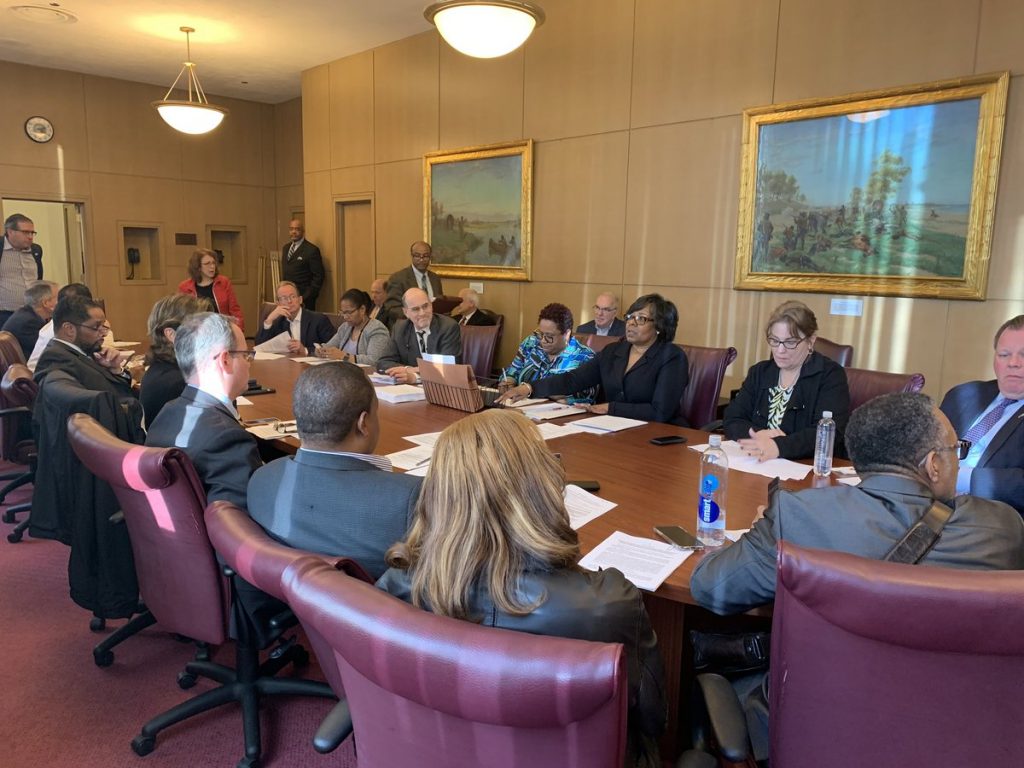
Ald. Ricardo Muñoz (22) returned to City Hall Friday to back a 12-year, $19.7 million tax break for Hilco Development’s planned distribution center in Little Village.
Muñoz had been absent since Dec. 31, when he was arrested and charged with misdemeanor domestic violence after his wife said he struck her while intoxicated. Muñoz declined to answer questions from reporters about the incident.
“I’m not having this conversation in the press,” Muñoz said.
The development would replace the Crawford coal-burning power plant and create hundreds of jobs, but environmental activists told committee members they were allowing one kind of pollution to be replaced with another.
Attendance – Vice Chairman Leslie Hairston (5), Greg Mitchell (7), Patrick D. Thompson (11), Raymond Lopez (15), Willie Cochran (20), Howard Brookins (21), Ricardo Muñoz (22), Jason Ervin (28), Milly Santiago (31), Carlos Ramirez-Rosa (35), Gilbert Villegas (36), John Arena, Ameya Pawar (47)
“Hilco has identified a project that is seeking to invest $300 million in construction, $150 million in demolition,” and add 300-400 jobs to the neighborhood, Muñoz said. “I’d hope that this 6b application (R2018-1394) be considered as a local matter in the 22nd Ward where we’ve taken this debate at heart and decided that the investment and the repurposing of this vacant site to a site that will be creating these jobs is a much better use than just leaving it vacant.”
Once applied, the property would be assessed at 10 percent of its market value for the first 10 years, 15 percent in the 11th year and 20 percent in the 12th year. That could save Hilco $19.7 million over the life of the agreement, officials said
Committee chair Ald. Proco Joe Moreno (1), who lost his bid for another term Tuesday, was not present.
After roughly an hour of questioning from aldermen about the project, Muñoz grew frustrated.
“I don’t mean to cut anybody off, but for crying out loud, people, this is a local matter,” Muñoz said, becoming the second alderman in as many days to deliver a pithy defense of aldermanic privilege, which gives each alderman the final decision over projects in his or her ward.
Activists with the Little Village Environmental Justice Organization, the Sierra Club and others testified Friday and at previous meetings that increased particulate matter from the trucks traveling to and from the 1 million-square-foot facility would exacerbate existing health problems in the neighborhood.
A spokesperson for the Sierra Club said the project is “a step backwards” for Little Village and that City Council should take environmental issues more seriously, not reward potential polluters with tax breaks.
Another compared the Hilco Development to Lincoln Yards or The 78 – two developments that would reshape their respective neighborhoods along the North Branch of the Chicago River and the South Loop.
Hilco Development Partners Director of Development Jeremy Gray has described the project as one designed to fuel economic development throughout Little Village and the entire West Side, bringing both construction and likely e-commerce warehousing jobs to the 100 million square foot facility.
The proposal has the support of the Little Village Chamber of Commerce and construction trade groups, and has already won approval for construction from the City Council.
The project’s community benefit agreement will require Hilco to set aside space on the facilities’ roof for solar panels and provide electric charging stations to reduce the use of diesel trucks.
Hilco will be required to meet city regulations regarding the use of firms owned by black and Latinos and to hire local residents. The company plans to recycle more than 90 percent of the demolition debris and plant 600 trees.
The committee delayed a vote last month after aldermen heard complaints about the community engagement process, in addition to pollution concerns.
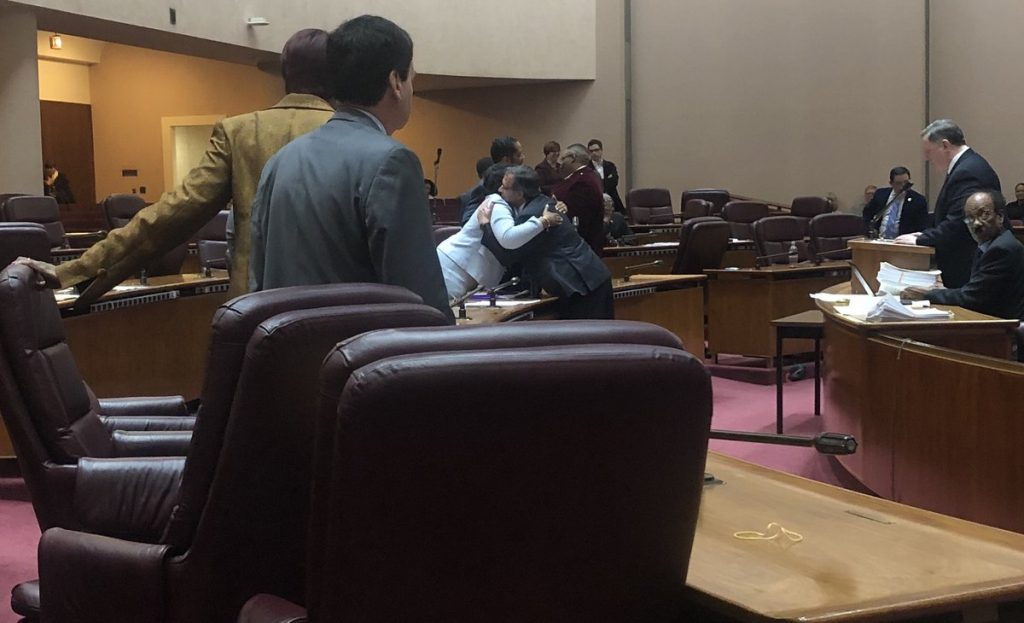
Ald. Carlos Ramirez-Rosa (35) attempted to delay the vote again by making a quorum call. Staff from the mayor’s office nabbed Ald. Jason Ervin (28) from the cloak room and brought the committee's attendance up to the minimum requirement of 10 members, and the meeting continued.
Rosa, Ald. Milly Santiago (31), and Ald. Ameya Pawar (47) voted no.
Pawar has been critical of Amazon’s workplace conditions for warehouse workers and the potential for jobs to be easily automated.
Muñoz dismissed concerns that the already high rates of asthma would rise after the facility is built with a shrug.
“The Stevenson is not but 1,500 feet away from here,” he said. “Diesel is everywhere. It’s not making it worse, it’s just moving it to 35th and Pulaski.”
When reminded of testifier’s comments on asthma rates in the community, Muñoz shrugged.
Muñoz did not run for re-election, and will be replaced by 22nd Ward Democratic Committeeperson Mike Rodriguez, who had been endorsed by Muñoz. Rodriguez called for Muñoz to resign after he was charged.
The committee also approved the appointment of Christopher Wheat as member of Community Development Commission (A2019-5).
In other action, the City Council’s Aviation Committee approved an agreement (O2019-1152) with UST to lease a hangar at O’Hare Airport. The firm, which provides aircraft maintenance and re-positioning services for various airlines at the O'Hare, sub-leased the 126,518-square-foot hangar from Delta Airlines, but will now lease it directly from the city.
Attendance: Chairman Matt O’Shea (19); Raymond Lopez (15); Derrick Curtis (18); Willie Cochran (20); Gilbert Villegas (36); Anthony Napolitano (41); John Arena (45)
The committee also approved a measure introduced on the floor of the committee to revise the 10-year agreement the City Council approved Nov. 14 tapping Hilton to manage the 860-room hotel on the grounds of O’Hare International Airport near Terminal 2.
The deal also calls for Hyde Park Hospitality to provide food and beverages to the hotel, but that part of the agreement needed to be revised because it contained an outdated fee structure. It needed to be revised because it was based on the management of two hotels. Plans for a second hotel to be built near Terminal 5 have been scrapped, officials said. -
Thousands of late arriving ballots cast in Tuesday’s election will be processed Friday, perhaps changing the outcome of four aldermanic races that are teetering on a razor’s edge. Groups hoping to push state lawmakers to end Illinois’ more than two-decade-old ban on rent control will rally Downtown after an advisory referendum on the issue found deep support.
-
Hilco Development Partners plans to invest $100 million to redevelop the Crawford Generating Station into a one million-square-foot warehouse. [Hilco Development Partners]Aldermen set to consider tax break for Little Village warehouse on Crawford coal plant
By A.D. Quig and Mauricio Peña,Block Club ChicagoAldermen are set to vote on a tax break for a massive, controversial distribution center set to replace a former coal-fired power plant in Little Village.
At 11 a.m. Friday, the Economic, Capital and Technology Development Committee will once again consider a tax incentive for Hilco Partners’ one million square foot distribution center dubbed Exchange 55.
If the tax break is approved, the property would be assessed at 10 percent of its market value for the first 10 years, 15 percent in the 11th year and 20 percent in the 12th year.
Preservation Chicago included the Crawford Power Plant at 5th Street and Pulaski Avenue on its list of most endangered buildings released Thursday.
The plant, which has a brick facade with Art Deco and “Gothic Industrial” influences, was built in 1926 by Graham, Anderson, Probst and White, according Preservation Chicago.
Last month, the committee delayed the vote after opponents said the already-approved development would pollute the environment.
Ahead of the meeting, Little Village Environmental Justice Organization Executive Director Kim Wasserman-Nieto said, given the historic respiratory issues in the neighborhood from industrial pollution, and diesel trucks inundating the neighborhood, the development “should not” receive financial incentives.
In September, the City Council approved the $100 million plan despite vehement opposition from residents from nearby residents and environmental groups.
RELATED: Massive Little Village Warehouse On Old Crawford Coal Plant Site Approved By City Council
During January’s committee meeting, Wasserman-Nieto testified that more than four trucks pass 31st Street and Pulaski Road every minute, and said that increased air pollution from diesel-fueled trucks will exacerbate respiratory illnesses, particularly among the 8,000 students attending school within a mile of the planned center.
Colleen Smith, the legislative director for the Illinois Environmental Council, said taxpayers should not be on the hook “to perpetrate more environmental racism,” and said she was “alarmed” at how much the process so far has conflicted with what the Little Village community wants.
Aldermen agreed to hold off on the measure.
“I know that community has been facing serious contamination issues for decades and don’t think it’s fair to approve project that is not so clear,” Ald. Milly Santiago (31st) said, and asked that the item be held in committee. Aldermen agreed unanimously.
Related: Semi-Trucks Are Taking Over Little Village, Neighbors Say — And Giant Warehouse Plan Will Make It Worse
Ald. Ricardo Muñoz (22) signed a letter of support for the tax break, but has not been at City Hall since he was charged with misdemeanor domestic battery, and entered rehab in Indiana for alcohol addiction.
During the meeting, Hilco representatives said the warehouse would strive to protect the environment by recycling 90 percent of demolished materials, exceeding the requirements of the city’s stormwater ordinance, planting 600 trees and installing electric car charging stations.
On Wednesday morning, a fire broke out during the dismantling of an electrical transformer on site as part of the demolition process. The fire was struck out quickly, and one firefighter was transported to a local hospital in good condition.
Developer Hilco Partners purchased the 70-acre site in 2017.
The Crawford Power Plant was shut down in 2012 after community-led efforts raised concerns about the impact coal pollution was having on the health of Little Village residents.
The Hilco plan has sparked anger among residents who fear the distribution center will bring more diesel trucks and increase pollution in the neighborhood.
Last year, Hilco officials told residents they plan on beginning demolition and remediation in 2019. The distribution center is expected to be completed in 2020.
In other action, aldermen will consider Mayor Rahm Emanuel’s appointment (A2019-5) of Christopher Wheat to the Community Development Commission.
Wheat is the director of strategy and city engagement for the American Cities Climate Challenge, and worked in Emanuel’s office for seven years as the chief sustainability officer and Emanuel’s chief of policy.
Mauricio Peña, of Block Club Chicago, contributed to this report. -
Mayor Rahm Emanuel’s plan to build a $95 million training facility for Chicago police and fire departments advanced Thursday, as aldermen disregarded calls from mayoral candidates Toni Preckwinkle and Lori Lightfoot to delay the project.
Ald. Emma Mitts (37) talks to reporters about her refusal to delay a vote on plans for a new training academy. [Heather Cherone/The Daily Line]
With the endorsement of the City Council’s Committee on Zoning, the project heads to a vote by the full City Council March 13. A separate proposal to award AECOM the contract to build the facility (O2019-1154) is awaiting a hearing in the City Council’s Budget Committee, which could consider the matter next week.
Ald. Ameya Pawar (47) and Ald. Deb Mell (33) voted no. In the April 2 runoff for treasurer, Pawar faces state Rep. Melissa Conyears-Ervin, while Mell will take on Rossana Rodríguez-Sánchez to hang on to her North Side City Council seat.
Ald. Emma Mitts (37) said she considered delaying plans (O2019-374) to build a 500,000-square-foot training facility in West Garfield Park because of Preckwinkle and Lightfoot’s opposition.
"I'm not one to back down," Mitts said, adding she decided to move forward because of the project’s significant benefits for her ward. "I'm not willing to wait another second."
Building the training facility on the long vacant 30-acre site at 4301 W. Chicago Ave. will breathe new life and bring “jobs, additional resources and hope” to West Garfield Park, Mitts said.
“I want the mayoral candidates to know long before they decided to run for mayor, I was working on this project and my community doesn’t want to wait,” Mitts said.
Mell attempted to delay the vote on the training facility by forcing a quorum vote to determine whether a majority of aldermen were present at the Zoning Committee meeting, the first to be led by Ald. James Cappleman (46) after 25th Ward Ald. Danny Solis resigned as chair.
Solis has not been seen at City Hall since the Sun-Times reported he received sex acts at massage parlors, the erectile dysfunction drug Viagra and campaign contributions in exchange for ushering deals through City Council.
However, a majority of committee members were present: Mell, Pawar, Cappleman, Michelle Harris (8); Raymond Lopez (15); David Moore (18); Matt O'Shea (19); Margaret Laurino (39) Brendan Reilly (42); and Tom Tunney (44).
Mell said she voted against the training facility because of Lightfoot and Preckwinkle’s opposition.
The “next mayor must have confidence in the process,” Mell tweeted after the vote.
Pawar said he could not vote for the proposal because Emanuel has tapped AECOM to build the facility. The Los Angeles-based firm has built prisons and faced allegations of wrongdoing, as detailed by the Chicago Reporter.
Mitts addressed her colleagues who oppose the training facility directly before the vote.
"You take care of your business, and I'll take care of mine," Mitts said, delivering a succinct defense of aldermanic privilege, which gives each alderman the final decision over projects in his or her ward.
“And I hope that each and every one of you look in your own wards, see what you got,” Mitts said. “And then just take a look in the 37th Ward. Don’t you think we want the same thing? Don’t you think we deserve the same thing?”
Moore said members of the City Council should follow the lead of voters in the 37th Ward, who re-elected Mitts Tuesday with more than 54 percent of the vote, according to early returns.
If residents of the 37th Ward opposed the training facility, Mitts would not have won without facing a runoff.
"The community's vote is their voice," Moore said.
However, one of many opponents of the training facility who were removed from the City Council Chambers during Thursday’s meeting yelled out that Mitts would not have been re-elected had Emanuel not contributed $30,000 to her campaign.
Cappleman said he agreed with Emanuel that the new, state-of-the-art facility is needed to address serious concerns outlined by the U.S. Justice Department in its 2016 investigation of the Chicago Police Department. It found officers that graduate from the five-month academy were “unprepared to police lawfully and effectively.”
Cappleman faces a runoff April 2 against scientist Marianne Lalonde, who opposes the project.
The facility would replace the police training academy at 1300 W. Jackson Blvd., built in 1976; the fire prevention training facility at 1010 S. Clinton St., built in 1950; and the Fire Academy South at 1338 S. Clinton St., built in 1965, officials said.
However, members of the No Cop Academy coalition said the money would be better spent on restoring cuts made to Chicago Public Schools’ budgets or reopening mental health clinics shuttered by Emanuel.
“My wish is that as the police and those in the community they serve have more opportunity to interact with one another, possibly some healing can begin,” Cappleman said, acknowledging the deep distrust between black and Latino Chicagoans and members of the Chicago Police Department.
The training facility will include two buildings, including one for classrooms, labs, simulators, conference rooms, an auditorium and offices.
The other building is slated to include a shooting range and space for “active scenario training and a dive training pool” for teams to practice rescues from submerged vehicles in daylight or dark.
The campus will also include a driving course, skid pad and and a place for “hands-on practice in real-world situations.”
In May 2018, the City Council earmarked $20 million from the sale of the city’s largest maintenance garage and yard along the North Branch of the Chicago River — now slated to be part of the Lincoln Yards development — for the construction of the training facility. The city bought the land for the training facility for $9.6 million.
City officials have not identified how they plan to cover the remaining cost of the training facility. The Chicago Infrastructure Trust is overseeing the project.
Only two aldermen voted to block that move at the time — Ald. Carlos Ramirez Rosa (35) and Ald. Ricardo Muñoz (22).
Plans call for the training facility to include a Culver’s and a Peach’s restaurant.
"These restaurants may not be what you want," Mitts said. "But right now we have nothing. And something is better than nothing."
Harris and Scott said the training facility would have a catalytic effect on the West Side, and spur private development.
"Our communities need this kind of development,” Harris said. “We start with this, and other things will come.”
The Zoning Committee approved the other items outlined in our preview, with the exception of a proposal to build a four-story, 20-unit building (O2019-322) with four parking spaces at 2135 W. Cermak Road in the 25th Ward.
In the 45th Ward, aldermen gave the green light to plans (O2019-333) for a four-story, 31-unit building with nine parking spaces at 4900-08 N. Milwaukee Ave. across the street from the Jefferson Park Transit Center.
The development includes six units set aside for low- and moderate-income residents, which Ald. John Arena (45) said was “much needed” and in a perfect location.
Arena lost his seat on the City Council after drawing fierce criticism for aggressively advocating for affordable housing. -
Lori Lightfoot and Toni Preckwinkle will be able to accept unlimited contributions during the mayoral runoff, after Lightfoot blew the caps in the second round of voting. Mayor Rahm Emanuel said Chicago should be proud two African American women are vying to replace him — but don’t expect him to endorse either candidate.
-
The scene hardly had the look of history being made. On an Election Day with low turnout, the voting booths stood empty. Outside, the surrounding blocks in Chicago’s Rogers Park neighborhood were mostly quiet except for the sound of the bitterly cold wind.
On a nearby corner, Maria Hadden, the challenger for alderman of the city’s 49th Ward, waited to greet voters. Finally, a compact man in a heavy coat approached. He proudly told Hadden he had lived in Rogers Park for 30 years and was going to vote for her. They shook gloved hands.
In Hadden’s view, the race came down to whether residents felt their neighborhood would remain vibrant and affordable.
“Will we keep our economic and racial diversity?” she said. “Is the current leadership able to maintain that, or do we need new leadership?”
That evening, as totals streamed in, it became clear that voters demanded a change. Hadden overwhelmed Joe Moore, a 28-year incumbent, with 64 percent of the vote. She became the first openly queer black woman elected to the City Council, and one of the first black aldermen ever to come from the North Side.
Hadden’s victory was widely seen as one of the biggest upsets in Tuesday’s elections. But it actually reflects broader local and national political trends in the battle over the future of the Democratic Party.
Residents across Chicago worry they can no longer afford to live or invest in the city. As Mayor Rahm Emanuel tries to win approval for several massive new development projects before he leaves office in May, many voters are outraged at the idea of using public money to subsidize them. At the same time, residents in some neighborhoods remain desperate for development. Organizers north and south are campaigning to lift a state ban on rent control and build more affordable housing.
The 14 candidates for mayor all agreed on one point: To confront these challenges, Chicago didn’t need anyone like Emanuel. Most tried to distance themselves from his record of school closings, Wall Street campaign contributions and insider ties, touting themselves as progressives.
Of course, the two top finishers have their own ties to the political establishment. Toni Preckwinkle is the Cook County Board president and chair of the county Democratic Party. She also accepted fundraising help from 50-year Alderman Ed Burke, of the 14th Ward, who’s facing federal extortion charges. Preckwinkle has since repudiated Burke, who was re-elected despite his legal problems. Lightfoot, meanwhile, served in the mayoral administrations of Emanuel and his predecessor, Richard M. Daley.
Still, Preckwinkle and Lightfoot both tout their work on criminal justice reform, and they vow to pay attention to long-neglected parts of the city.
And as black women, they offer an obvious, visible break from the past. Chicago has elected one woman and one black man as mayor, but it has never been led by a woman of color. That 182-year streak is about to end.
Months ago, Moore sensed that his re-election bid in the city’s far northeast corner could be tough. He watched from afar as 28-year-old Alexandria Ocasio-Cortez toppled another Joe, longtime U.S. Rep. Joseph Crowley, in a diverse, liberal New York City district not unlike the 49th Ward. In the age of President Donald Trump, Democrats seen as compromising or shopworn are sometimes viewed as part of the problem.
Moore first won office in a runoff in 1991. For the next 20 years, he was one of the City Council’s leading critics of Daley. From 2007 to 2011, Moore sided with the mayor on just 51 percent of divided roll-call votes, the lowest rate in the council, according to an analysis by Professor Dick Simpson and other researchers at the University of Illinois at Chicago.
But when Daley retired and Emanuel took the reins, Moore became one of his closest council allies and his reputation as an independent withered. From 2017 to 2018, Moore voted with the mayor 98 percent of the time.
As Tuesday’s election neared, Moore reminded constituents of his progressive accomplishments: He helped bring community policing to Chicago; pioneered participatory budgeting, in which residents get to vote on how to spend infrastructure funds; and added affordable and public housing to the ward.
Hadden criticized Moore’s alliance with Emanuel. She targeted him for accepting campaign contributions from developers and landlords while many residents struggled to remain in the gentrifying area.
By Tuesday afternoon, Hadden thought she had a chance.
“But if nothing else, we’ve got new people voting, new people involved in the campaign, and we’re going to keep organizing,” she said. “In some ways, we’ve already won by putting the community’s vision first.”
Within a few hours, she had won the election, too
ProPublica Illinois is an independent, nonprofit newsroom that produces investigative journalism with moral force. Sign up for The ProPublica Illinois newsletter for weekly updates.
-
Once again, the James R. Thompson Center in the heart of the Loop are among the city’s most endangered buildings, according to Preservation Chicago. Cook County commissioners will weigh two bills pending in the General Assembly authored by Assessor Fritz Kaegi, who has proposed changing the way Cook County assesses commercial properties.
The Thompson Center in the Loop. [Heather Cherone/The Daily Line]
-
While the membership of the next City Council will not be set until after the April 2 runoff — and calls to change the way committee chairmen are picked are sure to resound at City Hall soon after, there is no doubt that aldermen will face a significant amount of change once their new terms begin.
-
Voters in Woodlawn and Washington Park overwhelmingly backed a push to require the Obama Presidential Center to ink a community benefits agreement that includes an affordable housing mandate and a property tax freeze for long-time residents.
A rendering of the proposed Obama Presidential Center. [City of Chicago]
More than 88 percent of voters in the 5th precinct of the 5th Ward; the 15th and 18th precincts of the 12th Ward, the 1st, 22nd and 23rd precincts of the 20th Ward; the 15th precinct of the 22nd Ward backed the non-binding question, according to Tuesday’s unofficial results.
The center has been delayed by a lawsuit filed by the group Protect our Parks, which objects to the Obama Foundation’s plan plans to build the center in Jackson Park. The group contends those plans violate state law and Chicago Park District rules. The center must also undergo a federal review.
The CBA would mandate 30 percent of all new and rehabilitated housing to be set aside for low- and moderate-income Chicagoans.
The OPC agreement aldermen already unanimously approved in late October acknowledges that the $500 million project could push long time South Side residents out of their homes. Planning officials said they would “monitor” displacement.
Former President Barack Obama and the Obama Foundation have resisted calls to sign a community benefits agreement that would include independent monitoring and local hiring, support for neighborhood schools and a community trust fund to support the initiatives.
Obama’s presidential museum will be part of a four-building campus that includes an underground parking facility, a plaza, play areas, pedestrian and bicycle paths and landscaped open space, according to the revised measure. Those plans were approved in May by the City Council, and the city will own the center once it is built, according to the agreement.
One of the buildings will include a branch of the Chicago Public Library. The foundation pledged to “strive” to award 50 percent of all contracts to firms owned by blacks, Latinos and women, more than current law requires.
Lift ban on rent control: voters
Voters across the North and Northwest Sides overwhelmingly backed a non-binding referendum designed to pressure state lawmakers into lifting the ban on rent control.
More than 72 percent of voters in six precincts of the 1st Ward and six precincts of the 26th Ward, according to early returns.
More than 67 percent of voters in three precincts of the 45th Ward backed the push to lift the ban, as did approximately 76 percent of voters in two precincts in the 50th Ward.
More than two-thirds of voters in the 35th, 46th, 49th wards backed a measure to overturn the ban on rent control in November.
SB 3512, pending in the General Assembly, would repeal the Rent Control Preemption Act, and would allow county rent control boards to set regulations based on specified income levels, as well as “restrictions on increasing rent-controlled amounts; notice to tenants before increasing rent; [and] creation of a reserve account by property owners for repairs and capital improvements,” according to the bill summary.
Concerns that rising home and rental prices in neighborhoods like Bronzeville, Pilsen, Logan Square and Uptown are driving out working-class families have taken center stage at City Hall.
In parts of nine wards, activists pushing to repeal the statewide ban on rent control won at least 70 percent of the vote during the March election.
Invest revenues from legal marijuana on South, West sides: voters
Nearly 88 percent voters in six South and West Side wards urged city officials to “appropriate tax or other revenues it receives from the sales of marijuana towards neighborhood reinvestment in low-income, disenfranchised communities hit hard by the war on drugs,” according to unofficial returns.
That ballot question was also non-binding.
In three precincts of the 6th Ward, 87 percent of voters backed the measure, as did voters in one 16th Ward precinct, according to unofficial returns.
In the 17th Ward, more than 85 percent of voters backed the push, according to unofficial returns.
In four precincts of the 24th Ward, 90 percent of voters backed the push, according to unofficial returns.
In the 28th Ward, more than 85 percent of voters backed the push, according to unofficial returns.
In five precincts of the 29th Ward, 89 percent of voters backed the push, according to unofficial returns.
In the November election, approximately 88 percent of Chicago voters supported a measure to appropriate funds from the sale of marijuana if legalized for Chicago Public Schools and mental health services.
Correction: An earlier version of this story misidentified the group that filed the lawsuit against the Obama Presidential Center. The lawsuit was filed by Protect Our Parks. -
Lori Lightfoot and Toni Preckwinkle will advance to the April 2 runoff in the fight for Chicago mayor, ensuring that Chicago’s next mayor will be an African American woman who has promised to steer the city along a more progressive path, as voters rejected a bid by Bill Daley to become the third member of his family to be Chicago mayor.
Mayoral candidate Bill Daley greets supporters before conceding the race. [Heather Cherone/The Daily Line]
-
Voter turnout peaked in the 1983 election between Harold Washington and Bernard Epton at 82.07 percent. Its trough was 2007, when Mayor Richard Daley was running for his sixth and final term, at 33.08 percent. Turnout in 2015's general election was 34.03 percent, but rose to 41.10 percent for the runoff between Mayor Rahm Emanuel and Jesus "Chuy" Garcia.
More than 26 percent of voters have cast a ballot in Chicago’s municipal elections as of 4 p.m. Tuesday afternoon, putting the city on track to just miss setting a record for low turnout, Chicago elections officials said.
Without a late surge of voters to the polls after work, the city may break or tie the record for low turnout set in 2007 at 33.08 percent, said Jim Allen, a spokesman for the Chicago Board of Election Commissioners.
Voters 55 and older make up a majority of those who cast a ballot Tuesday, as well as by mail and during early voting, Allen said.
Younger voters that turned out to vote in the November elections have shown no sign of flooding the polls again, Allen said. Nearly 189,000 voters age 25-34 cast a ballot in the November election, with state and federal offices up for grabs.
In this election, only 51,000 voters age 25-34 have cast a ballot — a drop of more than 30 percent, Allen said.
“Hey, millenials, it is time to vote,” Allen said.
Allen encouraged voters to head to the polls, rather than waiting to see which candidates advance to a runoff, which will take place April 2 if necessary.
“Your vote will never count more than it does now in Chicago history,” Allen said.
Voters expecting to cast a ballot for their preferred candidate may be out of luck if he or she does not make the runoff, Allen said.
Officials reported a smooth day of voting, but with several hiccups.
The polling place at Independence Park in the 45th Ward opened approximately two hours late amid problems setting up the equipment. Elections officials will ask a judge to allow that polling place to stay open late to allow the 12 to 20 voters who were turned away to return, Allen said.
Two election judges were removed by officials – one in the 26th Ward was removed after complaints from other poll workers that she was pushing voters to cast their ballot for a specific aldermanic candidate. She made racist remarks before being removed, Allen said.
In the 34th Ward, a judge was removed for “verbally abusing” other poll workers, Allen said.
Near the 12th Ward polling place at Hoyne Park, there was a report of shots fired and police stopped a car suspected of firing the shots toward a person, Allen said that person declined to cooperate with police.
There is no indication that the incident was election-related, according to Allen.


Maria Hadden and former Cook County Clerk David Orr celebrate. [Jonathan Ballew/Block Club Chicago]