


Chicago News
-
When Mayor Rahm Emanuel delivered his first budget address in October 2011, he was peering into a financial abyss.
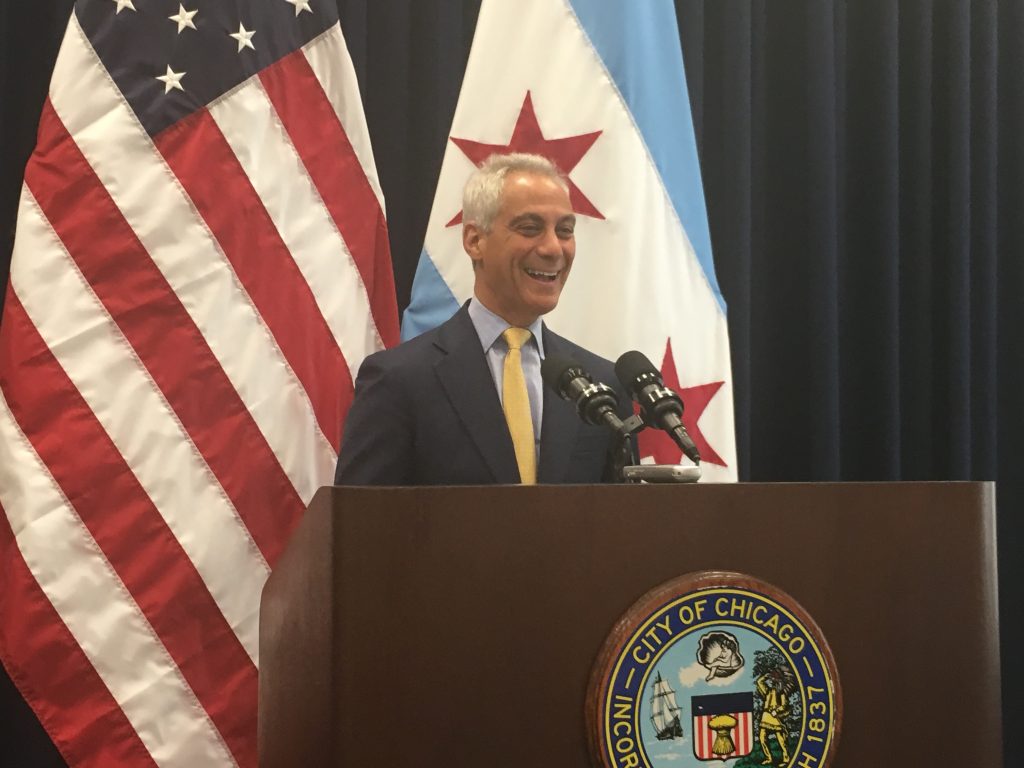 Mayor Rahm Emanuel address the news media. [Heather Cherone/The Daily Line]
The city faced a budget deficit of $635 million, and the new mayor told aldermen they had no choice but to lay off city employees, reduce library hours, close mental health clinics and hike a host of fines and fees for everything from staying overnight in a hotel to parking in a Downtown garage.
“Smoke and mirrors and one-time fixes simply won’t get the job done,” Emanuel said in 2011. “It’s time to provide Chicagoans with an honest city budget – one that focuses on current needs while still investing in our future.”
Emanuel’s first budget proposal cut spending by $417 million.
But when Emanuel takes the podium at 10 a.m. Wednesday to deliver his final budget address, the lame-duck mayor will declare that his policies and programs — many of which were laid out in that 2011 budget address — have pushed Chicago back from the brink of financial peril and onto firmer footing.
While Emanuel frequently claims credit for the drop in the city's structural deficit — expenses minus revenue — to $98 million, the smallest projected budget deficit since 2008, the path he took to right the city’s financial ship also shaped the most enduring criticisms of his tenure — and no doubt played a role in his decision not to seek a third term as Chicago’s mayor.
To the relief of aldermen facing tough re-election fights in February, the approximately $10 billion 2019 budget won’t contain any new tough-to-swallow tax hikes or spending cuts. However, taxpayers will get the bill for the second phase of two already approved increases: the 5 cents per ride increase for ride-hailing services that funds CTA improvements, as well as another installment of a 29.5 percent surcharge on property owners’ water and sewer bills earmarked to pay pension bills.
But the spending plan will likewise not address how the city will foot a $400 million bill starting in 2020 the city must pay to shore up its four pension funds under a change in state law that ties payments to actuarial estimates. Currently, the city’s payments to its four pension funds are fixed by state law.
Whoever wins the 2019 mayoral election will be immediately confronted with how to pay the bill for the city’s pensions, which is set to jump 31 percent.
The financial stability that Emanuel is so proud of is due to several massive tax increases, including the largest property tax increase in Chicago’s history — approved in 2015 — and a 30 percent increase in the water and sewer tax — approved in 2016 — as well as a robust economy.
However, the city’s structural deficit is set to balloon again in 2020 to $251.7 million and then in 2021 to $362.2 million, just as the bill for the city’s employees pensions come due.
Public safety reorganization
In 2011, Emanuel found $82 million in savings by reorganizing the Police and Fire departments, which included a reduction of the number of police districts from 25 to 22. That move has been blamed by some for contributing to the conditions that led to a surge in violence that swept the city in 2016, causing homicides to spike to a level not seen since the 1990s.
In addition, Emanuel eliminated vacant police and fire positions from the city’s budget. That forced officials to cope with the surge in violence by ordering officers to work overtime, rather than hiring.
In September 2016, Emanuel reversed course, and announced he would hire 1,000 new police officers, a process that is set to be completed in 2019.
More debt collection, higher fees, tougher penalties
The budget also relied on $33 million in savings from “more aggressive management of debt collections.”
After negotiations with aldermen, Emanuel’s first budget raised the fee not having a required vehicle sticker from $120 to $200.
Not only did that move fail to generate the $16 million officials expected, it “came at a devastating cost for thousands of Chicago’s poorest residents, particularly those from African-American neighborhoods,” according to an investigation by ProPublica Illinois and WBEZ.
Reduce library hours, lay off staff
Emanuel proposed closing libraries for four hours on Monday and Friday mornings to save $7 million. That plan drew howls of protests, and prompted the resignation of Library Commissioner Mary Dempsey, who backed former Police Board President Lori Lightfoot before Emanuel dropped his bid for a third term.
After negotiations with aldermen, Emanuel agreed to scale back the cuts, but they still amounted to 26 percent of the library’s total workforce and closed the branches all day on Mondays for a period of time before those hours of operation were restored.
An audit by Inspector General Joseph Ferguson released in May found the city’s 80 branches still do not have enough staff to meet the needs of library users and community residents.
Mental health clinics shuttered
Emanuel’s first budget also shuttered six of the city’s 12 mental health clinics, triggering vehement protests and national attention.
While the closures saved the city $3 million, Emanuel said the move was primarily designed to expand the types of treatment available to residents and deliver those services more efficiently.
The closures of clinics in Rogers Park, Logan Square, Woodlawn, Auburn-Gresham, Morgan Park and Back of the Yards remain a source of controversy, with a survey released in June finding that residents of the Southwest Side were still suffering as a result of the closures.
A 2014 report from the Chicago Department of Public Health described the consolidations as a success, which the city still touts. The closures, they say, maintained “capacity to serve clients at the city clinics, while strengthening the overall mental health infrastructure amid historic changes under the (Affordable Care Act).”
Residents of Avondale, Logan Square and Hermosa will vote on a measure Nov. 6 that would hike property taxes by 0.025 percent to offer free mental health services for any resident. The program would have a budget of $825,000, according to the proposal. The push was detailed by Block Club Chicago.
What we know will be included the 2019 budget:- $97 million from the city’s Tax Increment Financing Districts for the Chicago Public Schools, according to WBEZ.
- $10.4 million to “expand and extend” the city’s mentoring programs as part of its violence prevention efforts from an agreement reached with ride-hailing companies Uber, Lyft and Via to settle claims they failed to properly vet drivers.
- $2.07 million to hire formerly incarcerated men and women in three programs. Eighty people would be to clean and beautify vacant lots in high-crime neighborhoods; 34 people would be hire as part of the CTA’s Second Chance Program and another 25 would be hired by the Department of Transportation’s Greencorps programs.
- $27.5 million for police reform, including cost of the monitoring team that will be charged with ensuring the city and Police Department comply with the changes order by the judge, as first reported by the Sun-Times.
- $1.3 million more to buy garbage and recycling bins in an effort to get new trash cans to residents faster, as first reported by the Tribune.$500,000 more for rat abatement that would allow crews to go into yards to search for and close rat holes rather than responding to complaints, as first reported by the Tribune.
- $308,000 more for tree trimming, a line-item sure to be popular with aldermen running for re-election.
- $71.6 million in savings and reforms, “including significant savings in commodities and equipment purchases, department reductions and reducing healthcare costs,” according to the mayor’s office.
- $38 million was carried forward from last year’s budget “through strategic planning from the use of prior year funding,” according to the mayor’s office
What won’t be in the budget:- $10 billion in borrowing to pay down the city’s $28 billion in pension debt — and limit the need for another massive property tax hike. Emanuel has told reporters he has not made a final decision.
- New taxes, fees or tax hikes
-
Chicago mayoral candidate Gery Chico joined a growing group of aldermen calling for an end to the compact creating the Chicago-Gary Airport Authority over the airport’s deportation of undocumented immigrants “on a near weekly basis,” but the mayor of Gary described the move as “political posturing.”
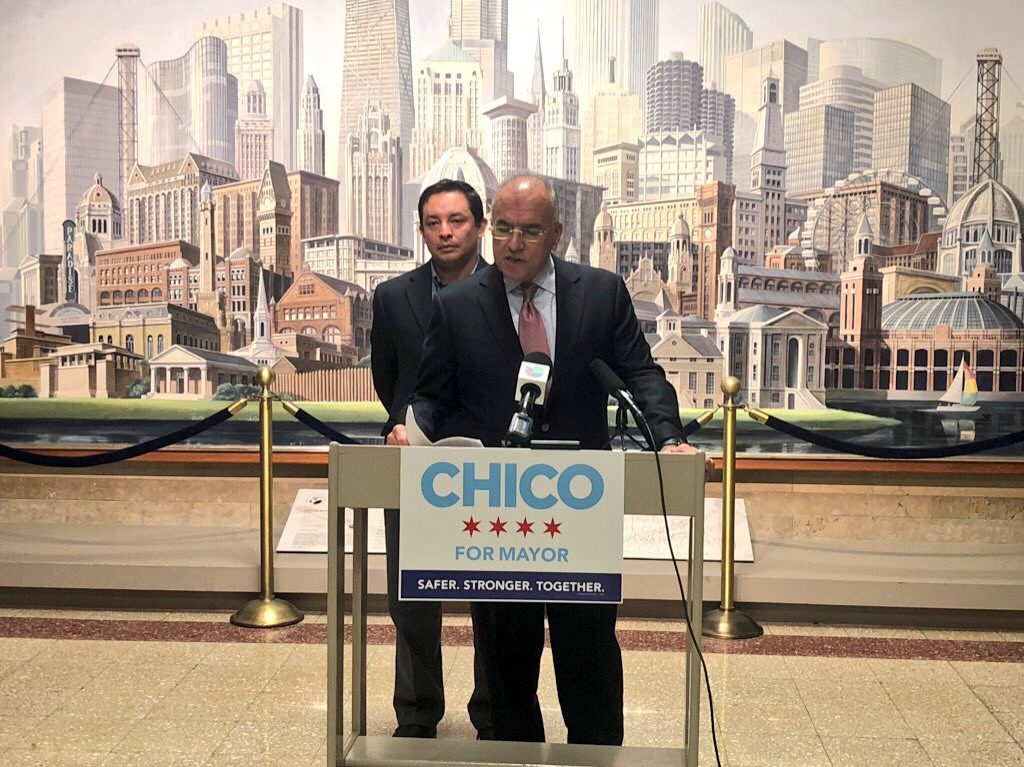 Flanked by Ald. Raymond Lopez (15), mayoral candidate Gary Chico called for Chicago to withdraw from the Gary-Chicago Airport agreement because undocumented immigrants are deported from there. [A.D. Quig/
 -
The national spotlight will focus on City Hall Tuesday, as Chance The Rapper is set to hold a 10 a.m. news conference “regarding the Chicago mayoral election.” The 44th Ward race is now wide open, with state contribution limits lifted after a massive contribution by one of Ald. Tom Tunney’s challengers. The City Council’s Public Safety Committee is set to meet Tuesday to consider re-appointing three members of the Chicago Police Board, less than a week after the board cleared an officer of wrongdoing in a 2012 fatal shooting.
-
-
A new chapter opened this week in the enduring battle between the city of Chicago and the Trump Administration — the fight over whether the city is entitled to funds designed to help the Chicago Police Department reduce crime at the same time it prohibits officers from cooperating with federal immigration agents in most cases.
-
The Obama Presidential Center is poised to take another step forward Thursday as aldermen weigh a revised agreement that will allow the center to be built on land in Jackson Park owned by the city and Chicago Park District.
 A rendering of the proposed Obama Presidential Center. [City of Chicago]
 -
OCT 11, 2018

 Fraternal Order of Police President Kevin Graham welcomed the news that the Trump administration planned to intervene in the city’s effort to impose a consent decree to reform the police department, even though Mayor Rahm Emanuel dismissed the action as not “on the level.” Mayoral candidate Cook County Board President Toni Preckwinkle bristled when asked Wednesday if she had been the source who leaked a confidential Cook County inspector general report that found Democrat JB Pritzker had engaged in a “scheme to defraud” taxpayers when his Gold Coast mansion was reassessed sans toilets in 2015.
-
Heralding this year’s starting budget as closing the lowest gap in eight years, Cook County Board President Toni Preckwinkle unveiled a $5.9 billion budget proposal Wednesday that she says confronts “the county's financial challenges while avoiding new taxes, fines and fees.”
-
As the push to move the Chicago City Council left in the wake of Mayor Rahm Emanuel’s decision not to run for a third term takes shape, the Chicago chapter of the Democratic Socialists of America endorsed three candidates in February’s election.In addition to 35th Ward Ald. Carlos Ramirez-Rosa — the only member of the DSA on the City Council — the group endorsed two challengers trying to unseat aldermen who have allied themselves with Emanuel.
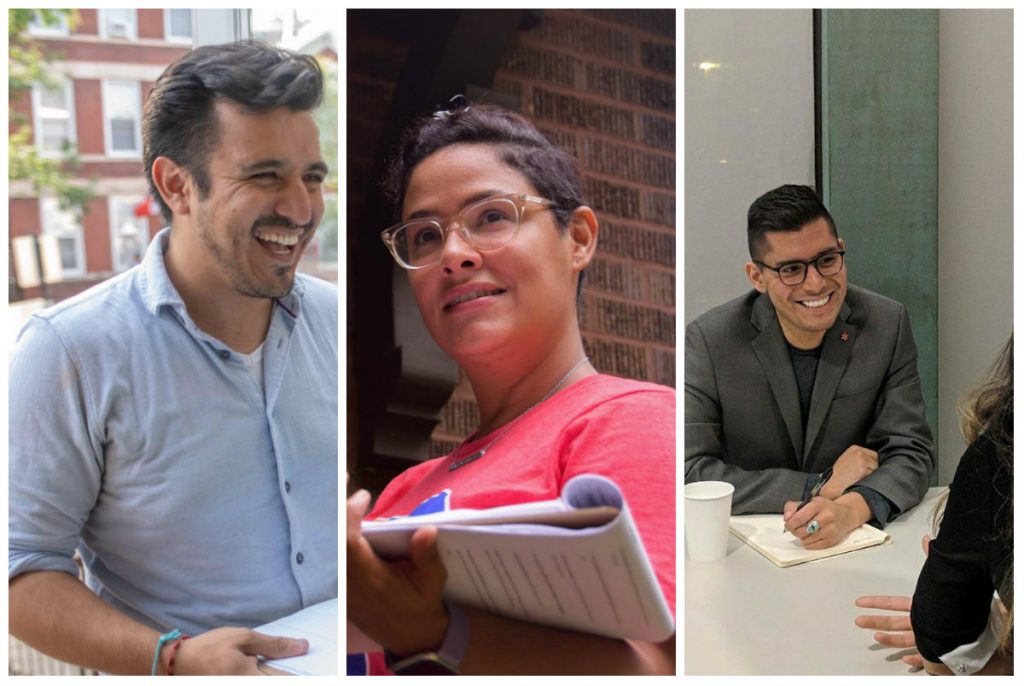 From left, Byron Sigcho-Lopez, Rossana Rodriguez-Sanchez and Ald. Carlos Ramirez-Rosa (35.) [Submitted photos]
The group endorsed Pilsen Alliance founder Byron Sigcho-Lopez in the 25th Ward race against Ald. Danny Solis, the chairman of the powerful Zoning Committee and a 22-year veteran of the City Council. Three other candidates have also filed to challenge Solis.
Related: The TDL aldermanic spreadsheet
Tom Bowen, a spokesman for Solis’ campaign, declined to comment on the DSA’s endorsement of Sigcho-Lopez.
In the 33rd Ward, the Chicago DSA endorsed Rossana Rodriguez-Sanchez, who is attempting to unseat Ald. Deb Mell and end her family’s dynastic hold on the Northwest Side council seat that stretches back to 1975, when her father Ald. Dick Mell was elected to City Council.
Mell declined to comment on DSA’s endorsement of Rodriguez-Sanchez.
Rodriguez-Sanchez is a youth educator and community activist who helped build the 33rd Ward Working Families organization, which has focused on immigrants’ rights.
The Chicago chapter of the DSA is made up of three branches covering the North Side, South Side and West Cook suburban area, and has approximately 1,700 members, said Steve Weishampel, co-chairman of Chicago DSA’s Electoral Working Group.
“We’re thrilled to offer endorsements to three brilliant and committed fighters for the working
people of Chicago,” Weishampel said in a statement. “The DSA group of candidates offers the only real, coherent alternative to the pro-corporate, anti-worker city government we have now. This group believes in the power of working people, and we in turn believe in them and are ready to fight for them.”
Chicago DSA will canvass, phone bank and fundraise for its endorsed candidates before the municipal election Feb. 26. Chicago DSA aims to turn out 1,000 of its members to support
its endorsed candidates, who won the nod after submitting their answers to Chicago DSA’s
candidate questionnaire and answered questions directly from members at in-person interviews, Weishampel said. Candidates who were endorsed won more than two-thirds of the vote of the membership at the meeting, he added.
The working group submitted five candidates for endorsement, Weishampel said and the endorsement meeting featured a “robust debate” about how many candidates DSA had the capacity to support in a meaningful way, Weishampel said in an interview with The Daily Line.
“We are not a rubber stamp,” Weishampel said. “We don’t want to stretch ourselves too far. We want to be a disruptive force in next year’s election.”
Ugo Okere, who is running in the 40th Ward against Ald. Pat O’Connor, Emanuel’s floor leader, won 62 percent of the vote at Sunday’s meeting, falling just short of the threshold necessary to win the group’s endorsement. Both Okere and Andre Vasquez, another 40th Ward candidate, are DSA members, Weishampel said.
Daniel La Spata — who is running against 1st Ward Ald. Proco Joe Moreno — won more than 50 percent of the group’s vote, but not enough for an endorsement, Weishampel said.
The DSA may consider endorsing additional City Council candidates at its next general membership meeting in December, Weishampel said.
In addition, Chicago DSA may consider endorsing in the mayoral election, with candidates Troy LaRaviere and Amara Enyia expressing interest in the group’s support, Weishampel said.
The upset victory of DSA member Alexandria Ocasio-Cortez in the Democratic primary for Congress representing New York City put the socialist group in the nation’s political spotlight and caused its membership to surge.
In an opinion piece published two weeks ago, Ramirez-Rosa and Rodriguez-Sanchez laid out a 10-point progressive platform for candidates that included a tax hike on large corporations, an end to tax-increment financing districts, an elected school board and the end to the Chicago Police Department’s database that is used to track those affiliated with gangs. The group is also organizing around efforts to lift the statewide ban on rent control.
Several other candidates for City Council have made common cause with the DSA, including Pete DeMay, who is running in the 12th Ward.
“We need more members of the DSA on the City Council,” said chapter co-chairwoman Lucie Macias. “For too long aldermen have not listened to their constituents.”
Macias said the endorsement process was “democratic” and conducted in the “right way.”
Even though the municipal election is 140 days away, the endorsements from the DSA are the second from a progressive group determined to reshape the City Council, which often served a rubber stamp for Emanuel and Mayor Richard M. Daley.
United Working Families, a political organization formed by progressive labor and community organizations, claimed credit for pushing Emanuel out of the mayor’s race.
“Now, we’re building a City Hall that will fight back against those who have profited from skyrocketing violence, displacement, and unemployment,” said executive director Emma Tai. “Black and Latinx working families bore the brunt of Emanuel’s racist, pro-corporate economic agenda. Now is the time to win a different future and a city for the many, not the wealthy few.”
UWF endorsed Ramirez-Rosa and Rodriguez-Sanchez in the group’s “early wave” of endorsements as well as:- 10th Ward — Ald. Susan Sadlowski Garza
- 15th Ward — Rafael Yañez
- 20th Ward — Jeanette Taylor
- 22nd Ward — Michael Rodriguez
- 46th Ward — Erika Wozniak
- 49th Ward — Maria Hadden
The UWF said it planned to build on its undefeated record during the March Democratic primary, when it helped Cook County Board candidates Brandon Johnson and Alma Anaya to victory along with Illinois House candidates Delia Ramirez and Aaron Ortiz. -
OCT 10, 2018
The Women’s March Chicago is set to return to Columbus Drive and Jackson Boulevard Saturday — this time in an effort to get first-time voters to turn out for next month’s midterm elections. Three progressive aldermen agreed to lead an exploratory committee for Peter Gariepy, and Cook County Board President Toni Preckwinkle named a permanent chief of staff, and prepared to unveil her 2019 budget proposal.
-
A chapter that has defined Chicago politics for three years came to a close Friday, as a jury found Jason Van Dyke guilty of second degree murder and 16 counts of aggravated battery for the shooting death of 17-year-old Laquan McDonald in October 2014.
Van Dyke still faces sentencing, and three officers accused of covering conspiring to exaggerate the threat McDonald possed from the night of the shooting still face prosecution, but for protestors and politicians, Friday was a milestone.
See how political Chicago reacted in real time on Twitter @TheDailyLineChi.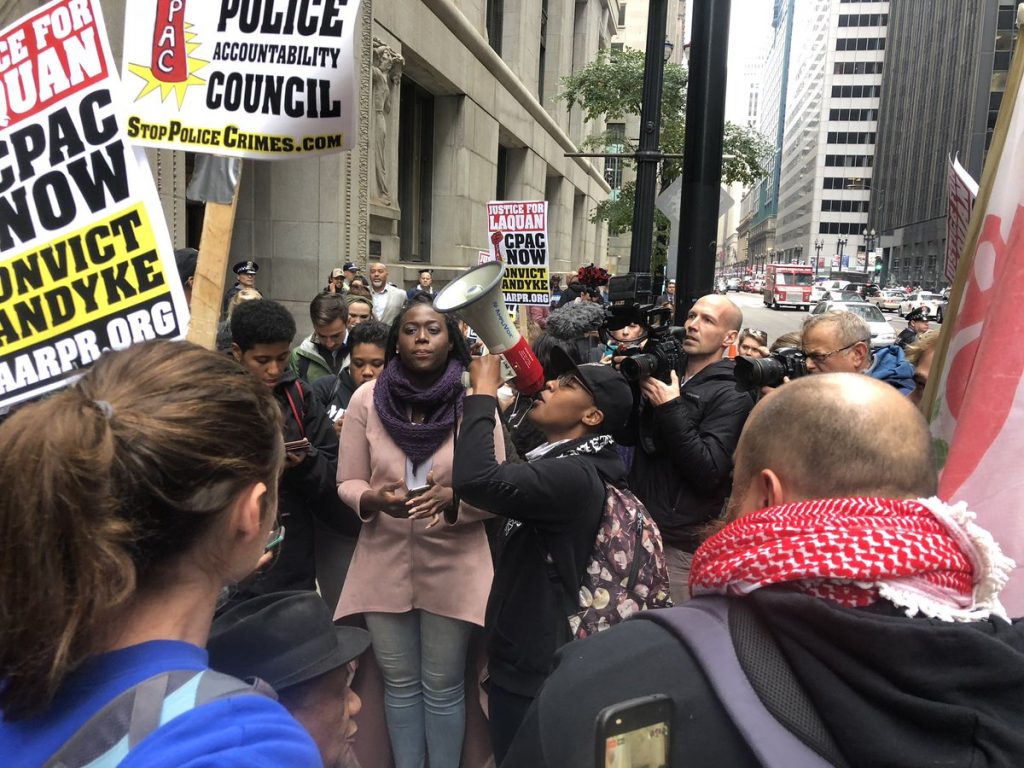 The crowd outside City Hall at the time the verdict in the Van Dyke case was read. [A.D. Quig/The Daily Line]


