Amanda Kass, the associate director of the Government Finance Research Center at UIC’s College of Urban Planning. [Submitted]
Mayor-elect Lori Lightfoot is 10 days away from inauguration day, and has already begun preparing Chicago taxpayers for bad news.
Shortly after she was elected, Lightfoot said the city was facing a more
“dire” budget gap than she expected and warned Thursday that the city faces a
“much more substantial” pension challenge than the public has been led to believe.
Lightfoot’s first budget — generally introduced in October — will arrive on her new desk drenched in red ink: a roughly $250 million structural budget gap and a $276 million bill for the city’s pension funds.
With that in mind,
The Daily Line invited one of Twitter’s most prolific pension watchdogs to come on the Aldercast podcast to discuss why journalists and politicos should not refer to it as a pension “crisis,” or expect Springfield to save the day and spare the city from making tough decisions.
Amanda Kass is the associate director of the Government Finance Research Center at UIC’s College of Urban Planning and Public Affairs. The Columbus, Ohio native with degrees in geography and international studies joined the Center for Tax and Budget Accountability in 2011 to research Illinois public pension systems.
“I actually had no idea what I was getting into at the time and I came in the summer of 2011, so it was kind of peak politics around Illinois’ pension systems,” Kass said. “It was right after the Tier II legislation had been signed into law and I had no clue what I was getting myself into at all.”
Technical difficulties prevented a broadcast-quality recording, so we’ve opted for a Q&A format, edited for length and clarity.
If you could go back to 2011 Amanda and 2011 legislators, what would you tell them?I would tell 2011 Amanda don’t do anything differently, it’s going to be great. I think I would tell the legislators don’t bother passing any of these pension laws, because the Supreme Court’s just going to strike them down. I don’t think anybody would have listened to me. I think a lot of them knew that it was likely that legislation that they passed that cut benefits was going to get struck down by the state Supreme Court, but I think the politics of it was that they had to do something.
We’re just a couple weeks away from Lori Lightfoot’s swearing in — did you get the impression during the campaign that she understood the magnitude of Chicago’s budgetary and pension issues? There was a ton of talk during the campaign about corruption, Ed Burke, but not as much on pensions, not as much on budget. If I take a step back and don’t think about her specifically, I think it would be difficult for any candidate to fully understand the finances of the city of Chicago. I don’t think the finances are that transparent or accessible to people working outside of City Hall. I think the pension issue and the kind of finances of the pension systems was well known. My sense was that her campaign staff and her understood this problem, but I don’t think anybody wanted to talk about it, right? Because they’re going to have to talk about, how are they going to raise revenue to make the pension contributions? Nobody who’s running for mayor is going to sit there and say hey, I’m going to raise your property taxes.
Give us a snapshot of where Chicago is pension-wise and budget-wise.The pension systems, there’s four, one thing that people often don’t understand is that the City of Chicago itself is in charge of just four pension systems. There are other pension systems in Chicago and Cook County that impact Chicago residents, but they’re not in the purview of the city government. Those four systems, collectively, are about 30 percent funded, meaning that for every dollar of a pension liability there’s about $0.30 in the bank to pay that liability. The kind of financial condition of the systems ranges.
 The first budget that Lori Lightfoot has, she’ll have to come up with $270 million to meet the ramp that we’re on.
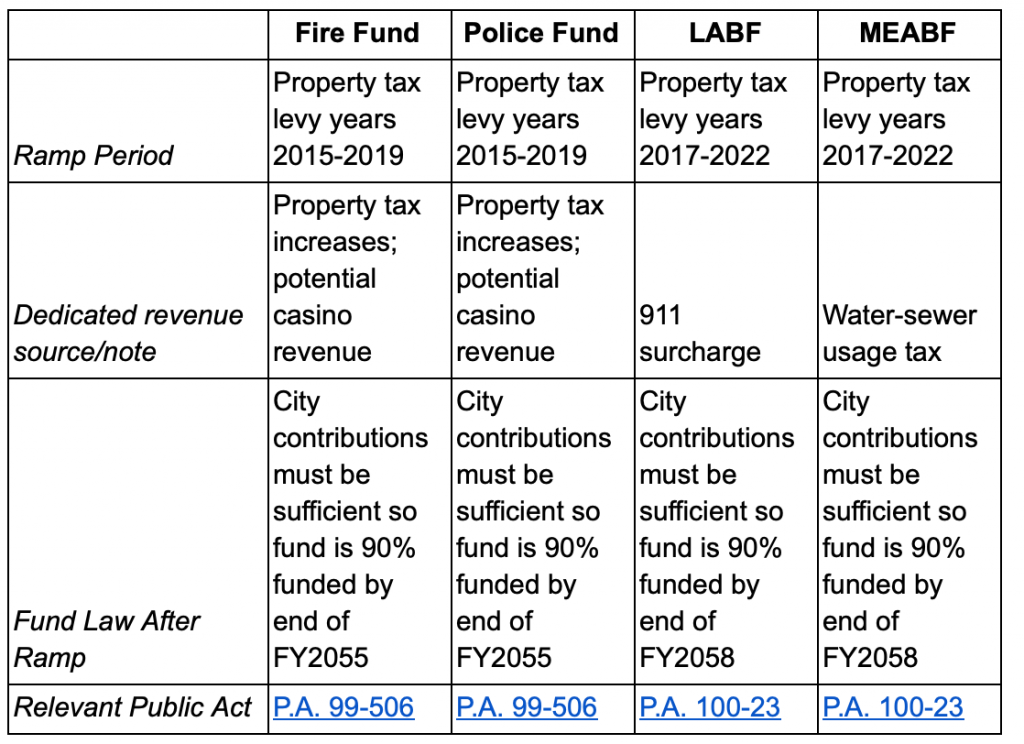
That’s another important component — the four different pension systems, each of them has a five year ramp period. The city’s required contributions to the pension systems is a fixed dollar amount. This is a really bad idea, actually.
Why?Because in theory, the way that you would want to have a government fund its pension systems is that the annual required payment would be a function of the unfunded liabilities, a plan to pay those down and the cost of benefits earned by the current employees in that year. So it would be determined each year by actuaries. Fixed dollar amounts are just that – they’re fixed dollar amounts. So if the unfunded liabilities increase or decrease, those fixed dollar amounts aren’t increasing or decreasing in tandem. So the city has these five year ramp periods, and then after those five year ramp periods is when it goes to funding the pension systems based on that calculation of paying down unfunded liabilities and the cost of benefits. So this means what the required contribution will have to be for the first budget year of Lori Lightfoot’s mayoralty is an estimate right now. Same for the Labor and Municipal.
 So ideally, every year some actuary would be coming back to the city saying, ‘Hey, here’s what you should actually be paying us to get to the level where we need to be.’ And we’re aiming for 90 percent funding?
 Yep, for the four pension systems, the aim is 90 percent funded in different years. I think it’s 2055 for Police and Fire, 2058 for Labor and Municipal. The other important thing is the payment schedule to get to 90 percent is really backloaded. So in dollar amounts the city’s contributions are going to increase every year from now until 2055 or 2058.
Lori Lightfoot’s first budget, which would be prepared in September and passed before the fiscal year begins on January 1, calls for this big, seemingly big push up, this $270 million, and there’s another one in 2022, and it’s more than a billion over the first four years of her term? One, I think the $270 million, we want to put that in context of the city’s budget. The city’s overall budget is about $10 billion. When we’re thinking about the city’s overall budget, $270 milion, even though that’s certainly a lot of money to me, is not insurmountable in a $10 billion budget. It is still something where they’re going to have to come up with the money to make the payment. The pension contributions are a more visible cost than other elements of the city’s budget. I think one question I’d like to get a better handle on is, what other aspects of the city’s budget are going to be increasing from year to year? And what’s the cost of those? And does the city have the revenue to make those payments?
<span data-mce-type="bookmark" style="display: inline-block; width: 0px; overflow: hidden; line-height: 0;" class="mce_SELRES_start">
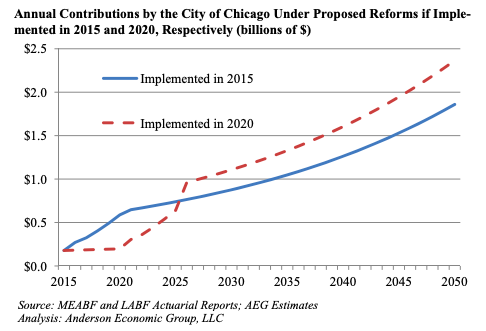
Right. The first year projected gap for Lightfoot is also about $250 million. She said it was more dire than she originally anticipated because we’re going to have all these expected new costs – a new police contract a new fire contract, and because it already expired, there’s going to be some back pay involved. That’s another one of the big costs that she’s going to have to consider. Yes, point at the data — again, these are current estimates — the city in 2017 contributed about $1 billion to its pension systems. Let’s just go out to 2025. The estimate right now is that the city will have to put in about $2.3 billion. So in less than ten years it increases by about a billion and a half.
That is a lot of money. We’re no longer looking at $270 million as a small percent of the city’s budget, we’re looking at more than a billion on top of dramatic, historic property tax hikes in addition to water and sewage fees and a new 911 surcharge.Yes, it is a lot of money. I think we don’t project out revenue in the same way we do the required pension contributions. I think we’d want to say, if we can, project out all the other things that are a part of the city’s budget to get a real sense of what is actually the potential kind of gap that it’s going to be. The other component is the city underfunded its pension systems for decades, and so we weren’t recognizing the full cost of city operations for a really long time. Unfortunately, the taxes people were paying weren’t covering actual costs of the services they were using.
Walk us through a little bit of the history of how the city got away with underfunding its pensions for so long.The city’s required contributions are actually dictated by state law. Until fairly recently, the state law basically said that the city’s contributions were a multiplier of what employees contributed. If a municipal employee put in a dollar to its pension system, the city maybe put in a dollar or $1.50. Those contributions were fixed multipliers, meaning that they didn’t change as unfunded liabilities changed, as the cost of benefits changed at all. So they’re completely divorced from the actual finances of the pension system. As you can imagine, this becomes a problem when unfunded liabilities arise and you have no way to contribute to pay down that unfunded liability. It is a problem that just snowballs and grows and grows and grows and grows. And then we have the recession, and it grows astronomically larger.
What are some misconceptions or 101 things we should review before we talk more about it?I think that the challenge facing the city today is not a pension problem, I think it’s a budget problem. I think we should be talking about the issue in the context of the city’s overall budget and overall finances. Why do I think it’s not a pension problem? I think of a pension crisis as a situation in which the pension system is going to go insolvent, meaning that it is going to run out of assets and checks to retirees are going to get halted. That was the scenario that was facing the city’s pension systems until legislation was passed fairly recently that changed the city’s required contributions. So now there’s a funding plan for all four of the pension systems that will eventually, over many decades, restore the fiscal health of the pension systems. So now the challenge is how is the city going to come up with the revenue to make those required payments?
Isn’t that a crisis though? That the money isn’t readily there?But the money’s not readily there for many other aspects of the city’s budget, right? The money’s not readily there, necessarily, to — pick whatever aspect of the budget is your interest. Is it an economic development initiative? Is it mental health? Is it public safety? Any aspect that is of interest in the city’s budget, the money’s not there. I don’t think it’s a crisis, because a crisis denotes something that’s acute and immediate. I don’t mean to say that they’re not a problem or a challenge, but I don’t think it’s an acute crisis in the same way that it would be if the pension systems had gone insolvent and the checks to retirees were literally halted.
We are moving closer to a couple potential revenue streams Chicago has wanted for a while. Some kind of gambling – maybe sports betting, maybe a casino, maybe video, poker, video gambling like we have in the suburbs – and also recreational marijuana. What are your concerns or your warnings for these new aldermen and this new mayor about either source of revenue?I would really want to scrutinize any revenue estimate attached to any of these proposals. The other thing to know is that the revenue from a Chicago casino would already be dedicated to the police and fire pension systems. That’s not going to be revenue that the City Council and mayor can use for other areas of the budget. Casino money’s already spent.
What about marijuana? The logistics of setting up recreational marijuana and then actually having the tax revenue comes in for it – there can be quite a long lag time between when a law is passed and when revenue actually starts being collected. For example, Cook County Board President Toni Preckwinkle passed the sugary soda tax, and I think from when the commissioners approved that to when revenue started getting collected was somewhere between six and nine months. That’s for a product that was already legal, on the market.
The other question is would the city be able to implement its own tax on recreational marijuana or would it be a state only tax? The state’s already facing its own financial challenges. If recreational marijuana is legalized and taxed at the state level, I think it’s an open question of is any revenue even going to filter down to the local governments.
What are other limitations this new mayor and the new City Council have in terms of raising revenue to pay for pensions? I think the one thing we always look at is property taxes, the one automatic thing the mayor and City Council can do to get revenue. Raising the property tax levy is a political hurdle. Logistically, in terms of implementation, the property tax levy is the easiest target for the city, but I think the politics of it are complicated. We’ve got a new assessor who is implementing a new assessment system. It’s not totally clear yet how that’s going to impact people and businesses. Then you also have some areas of the city that are really hot real estate markets, so the values in those areas have already increased. That’s all still to be shaken out.
The city’s bound by home rule, so the city can only implement taxes that it’s authorized by state law to implement. The city, for example, can’t implement a city income tax because of the state constitutional provision. I’m going to be very unpopular, but I think the easiest thing for the City Council and the new mayor to do is to raise the property tax levy to make the 2020 payment.
We saw Mayor Emanuel attempt to do a rebate program that was not particularly popular. And the other issue is that people are generally okay with their taxes being raised if they feel like they’re getting something in return. These are just going straight to pensions rather than city services.The property tax, there’s no good way around it, unfortunately residents have enjoyed services at a below-cost level for decades, and that kept their property taxes low, and unfortunately now revenue’s having to be raised to pay for unfunded liabilities. These are services people enjoyed and used in the past.
So we’ve been under-taxed for decades and now we’re playing catch up?Yeah. I think if we think about the unfunded pension liability somewhat as a function of the full cost of city services not being realized, then yes.
So if it’s not a pension crisis would you describe it as a budget crisis? I think the crisis word is just generally unhelpful in trying to craft thoughtful, robust public policy. I think labeling something as a budget crisis or a pension crisis creates a kind of frenetic energy of ‘Oh my gosh, we have to do something, we have to do anything, and we have to have done it yesterday, so we just need to do whatever.’ I think it leads to really bad pieces of legislation getting passed. I’d say there are budgetary challenges and problems, but I don’t think they’re insurmountable and I don’t think that they’re an immediate crisis.
I think it’s probably very boring, but to say let’s go steady, let’s be very careful, let’s do robust analysis, and to be honest and figure out what are we trying to fix, and what the scope of the problem is and how long it will be to dig itself out. The city’s financial challenges, underfunded pension systems, are long-term problems. The City Council, the new mayor are not going to be able to pass an ordinance tomorrow that’s going to at the snap of a finger turn everything around.
What role do you think TIF reform should play in this new Lightfoot administration? There’s a lot of attention on it because of the 78 and megadevelopments that might be benefiting from TIF to pay for infrastructure. What would you tell Lori Lightfoot about TIF? Good luck.
Good luck because Chicago has such a massive program?The politics around TIF are fairly heated. I’d say one, kind of good luck in trying to understand all the different TIF districts that are in Chicago. What are all the projects those TIFs are financing? How do some of these newer TIFs differ structurally from the already existing TIFs? And understanding the politics of TIF – why are different groups opposed to TIF? Is it financial reasons? Transparency? Are they just kind of opposed to it to be opposed to it?
You and Daniel Kay Hertz have written about it… if we got rid of a bunch of TIFs would we be able to solve our pension crisis– our budgetary issues? Our short answer is mostly no. You can read our blog for the wonky details, but one of the complications is that TIF projects go to fund projects for Chicago Public Schools and the city’s infrastructure. One complication is some of these projects are for things that absent TIF, the city or Chicago Public Schools would still want or need to do. In that way it benefits CPS or the city.
What deserves a second look from this administration and these aldermen?I think there could be two fronts on this. One could be — how is information on TIFs presented to the public? Are there ways to improve the transparency and clarity? One of the problems with public finance, often, is things are “transparent” because financial documents are put online or anybody can readily get those documents. But not everybody has been trained in public finance to understand what financial terms are. The information has to not just be transparent, meaning readily available, but made accessible to your everyday resident.
Two, looking at the actual projects and saying kind of structurally – is doing it via the TIF program the best way in terms of transparency in city operation? Why are we doing projects that are ostensibly needed infrastructure projects, why are we doing them via TIF? Could we do it a different way that would make it part of the city’s overall budget and give residents a better picture of the city’s overall activities?
What else would you like to see out of the new City Council?To have a robust office to analyze legislation and come up with better fiscal notes for the general public.
You’ve been here for all of Mayor Rahm Emanuel’s tenure. The city is now facing up to the payments that it needs to make, at least Rahm Emanuel would say we’re through the choppiest waters, we’re on the path to sustainability, we’re in much better shape. Do you buy it? And is his legacy one of facing up to the challenges of our pension problem and our budget problem?I think that’s complicated. I think I have the luxury of not having to think about the politics of everything and think about how do I get the majority of City Council to vote on something, how to get state lawmakers to pass something. So I should caveat my answer with that. With the pensions, I think yes and no. One of the problems is that changing the city’s funding laws for its pension systems wasn’t done during the first four years. Mayor Daley had commissioned a pension committee to look at that issue and
they issued reports in 2010 that were pretty clear that look, the longer this issue festers, the more the problem’s going to grow and nothing was done immediately. I don’t put that all on Mayor Emanuel though, because during Daley’s administration they didn’t lobby to change the funding laws either. A problem with what got passed was they had these five year ramp periods. In the long run, the city would have been a lot better off if it had started properly funding the pension systems immediately, and not putting in these five year ramp periods.
So acting in 2012 rather than acting in ‘15 and ‘16?Well even acting in ‘15 and ‘16, if they had just not put in these ramp periods and had said –– the financial hurdle between what the city had been contributing to the pension systems and what the city would have had to put in to the pension systems would have been much higher.
Do we know how much?It would have been substantial.
The Anderson Economic Group did a study on this about the overall impact of if the city hadn’t had these five year ramps. One question is, would it have been better if residents had taken one hit? If, fine, the increase would have been larger than what people have experienced thus far, but it was a one time hit, versus what’s been happening of a steady increase in property taxes, increases in the 9-1-1 charge, increase in the water and sewer rate charge and still a $270 million gap is going to have to be filled somehow.
 His justification is, “I couldn’t have done that so soon after the recession.” Is that fair?
I don’t know. The other component is that the city had kept its property tax levy fairly flat for decades.
So people might have been able to sustain the hit. The question is, maybe it wouldn’t have been feasible for him to come into office right away and do it, so maybe it wasn’t feasible in 2012, but 2015, 2016? Again, my quibble is over having the five year, fixed-dollar amount ramps.
What overall grade would you give him on his pension legacy? That’s confidential.


 Mayor-elect Lori Lightfoot will brief aldermen Tuesday on her plan to curtail aldermanic privilege, a key part of her campaign platform, while several aldermen-elect are set to join Ald. Carlos Ramirez-Rosa (35) to renew a push to give elected civilians oversight of the Chicago Police Department.
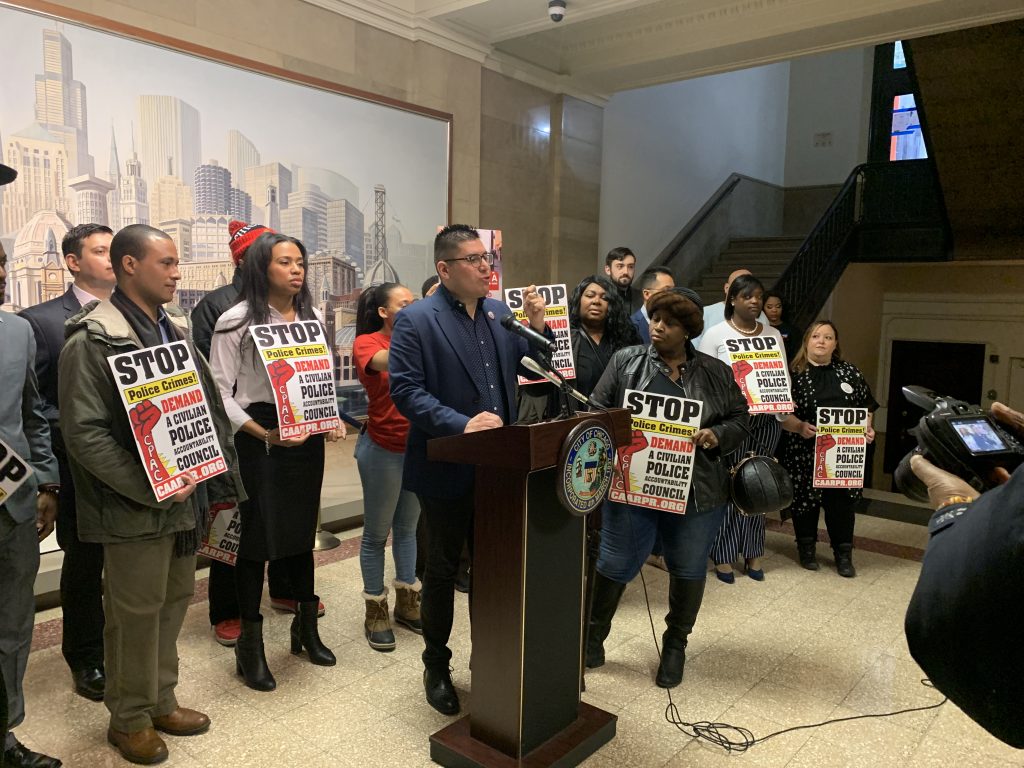 Ald. Carlos Ramirez-Rosa (35) rallied in support of civilian police oversight. [Heather Cherone/The Daily Line]
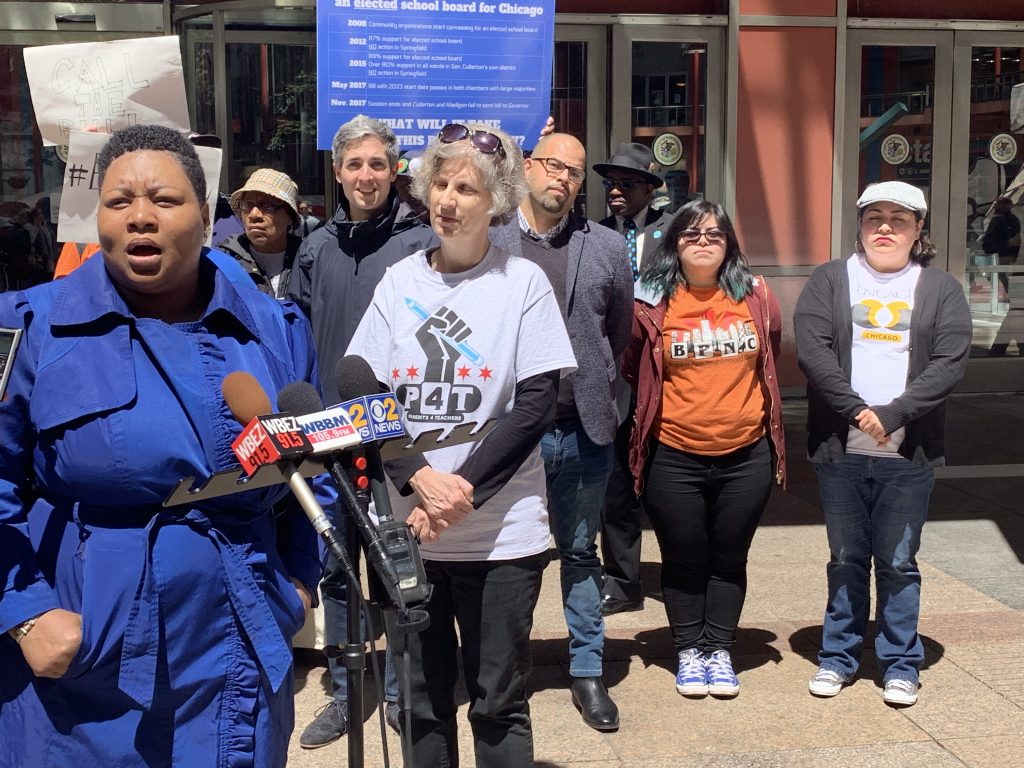 “The people have spoken. And people are tired of not being listened to," Ald.-elect Jeanette Taylor (20) said. [Heather Cherone/The Daily Line]
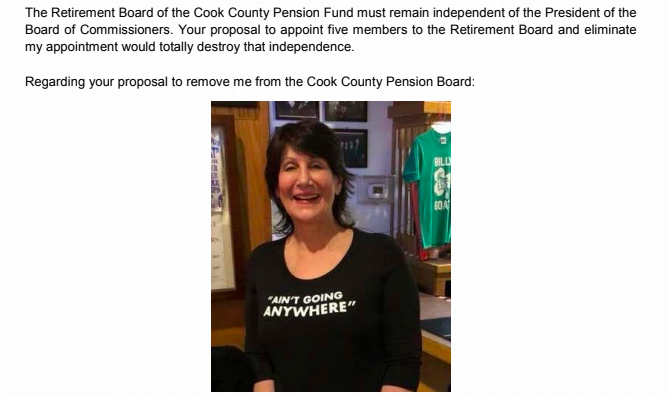 Treasurer Maria Pappas' letter to Cook County Board President Toni Preckwinkle. [Provided]
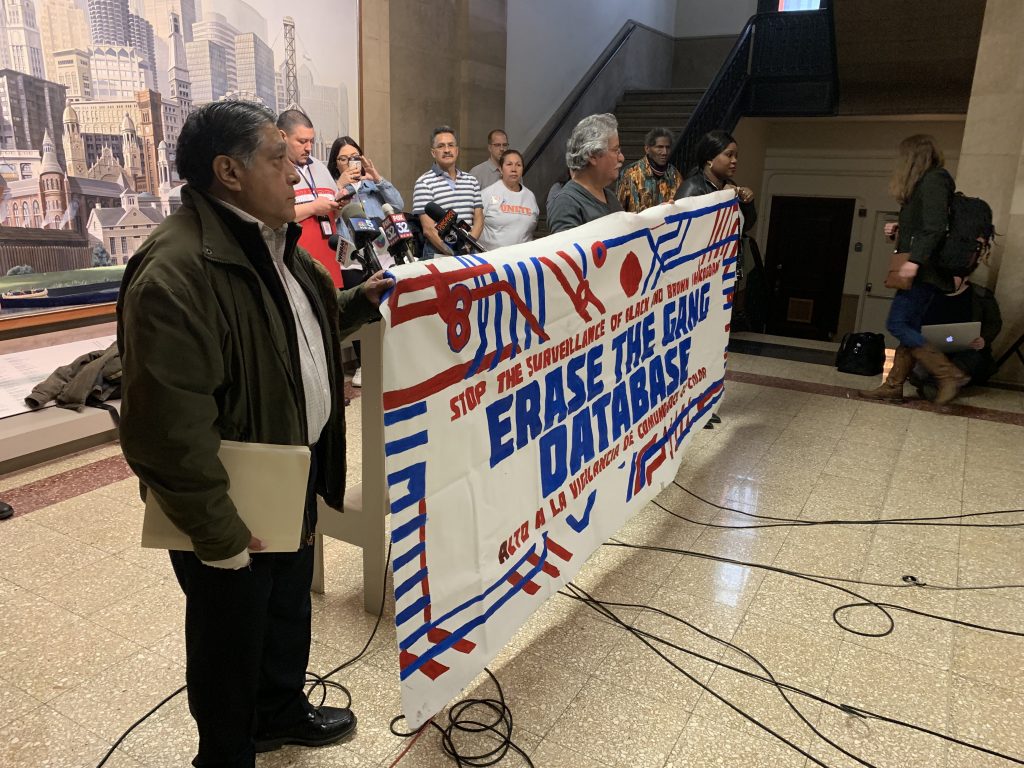 Members of the coalition said the database was "racist." [Heather Cherone/The Daily Line]

