


Chicago News
-
AUG 10, 2018

UNLOCKEDThis story is a collaboration between ProPublica Illinois and WBEZ. The payment center at Chicago City Hall. [Heather Cherone/The Daily Line]
The City of Chicago has a message for drivers who received more than one sticker ticket in a single day: Take us to court. Or, if you’re feeling generous, just pay up.
Seven weeks after ProPublica Illinois/WBEZ revealed that Chicago police officers and parking enforcement aides had, on some 20,000 occasions over the past decade, issued multiple citations for not having a required sticker on the same vehicle, city officials have made no apparent effort to refund the money — even though they said they might.
Asked what was being done, finance department officials deferred to the city’s law department.
Bill McCaffrey, a law department spokesman, said in a statement: “Depending on the circumstances, it is possible for a car to receive multiple tickets in a day. In those cases, motorists have the option to pay the fines for the violations or contest the tickets.”
Officials with the finance department first raised the prospect of offering refunds or canceling debts in June, after they were informed by ProPublica Illinois/WBEZ that, over the past decade, the city had issued close to 20,000 duplicate citations to vehicles without the required city sticker.
The finance department officials said they were “taking this seriously” and working with other departments to “further investigate the issue and determine responsible next steps.”
Many city officials privately acknowledge the city ordinance — a requirement that vehicle owners buy stickers annually and affix them to their windshields — makes clear that a vehicle can be cited only once a day.
The city clerk’s office, which is responsible for administering the sticker program, operates with that understanding. And drivers who contest duplicate tickets nearly always have at least one thrown out, ticket data show.
Sticker tickets cost $200 each and quickly rise to $488 if not paid. ProPublica Illinois has reported on how these tickets, as well as other traffic and parking citations, send thousands of drivers into bankruptcy.
About half the duplicate tickets remain unpaid. That debt will remain on the books — potentially threatening drivers’ licenses and their vehicles — unless the city concludes the tickets were wrongly issued and dismisses them.
Black drivers are affected most by duplicate tickets and, more generally, by all sticker tickets, ProPublica Illinois/WBEZ reported last month. Those tickets disproportionately go to drivers on Chicago’s West and South Sides, neighborhoods where the majority of the residents are low-income and black.
Sticker tickets stand out among the dozens of vehicle-related citations the city issues because they’re among the most expensive and least likely to get paid. They also contribute to the largest amount of ticket debt owed to the City of Chicago, a phenomenon helping to push thousands of low-income, black Chicagoans into bankruptcy.
In recent months, a growing number of organizations have begun calling for change to the city’s ticketing practices, citing the ProPublica Illinois reporting and more recent reports done with WBEZ.
In June, researchers at the Woodstock Institute, a local nonprofit that advocates for progressive financial policies, released a report highlighting disparities in ticketing, including in sticker ticketing.
“Our findings indicate you need to look at this,” said Lauren Nolan, research director for the group. “You need to do a bias study. These are pretty stark findings.”
The Illinois Policy Institute, a conservative public policy research group, believes that Chicago is overly reliant on fines and fees, including fees from city stickers. The group released an analysis in February comparing Chicago’s taxes and fees to those of other major American cities. Adam Schuster, budget and tax research director with the group, called the cost of city stickers and related penalties a death “by a thousand cuts.”
“If [drivers] are not able to pay the original registration fee, the penalty is now that they owe more money, which can be a really hard poverty trap to get out of,” he said.
Last month, Jacie Zolna, a Chicago attorney who had filed a lawsuit against the city over the lack of adequate notice for tickets tied to automated traffic cameras — and obtained a $39 million settlement — sued the city again, saying its steep financial penalties violated state law.
Ticketing is also becoming an issue in Chicago’s mayoral race. The election is next February.
One candidate, Troy LaRaviere, a former Chicago school principal who is one of more than a half-dozen candidates running to unseat Mayor Rahm Emanuel, released an online ad this week attacking Emanuel for, among other things, city ticketing practices that “force thousands of people to lose their cars and force thousands more into bankruptcy.”
Another candidate, Paul Vallas, a former Chicago schools chief, is calling for an overhaul of ticketing policies, including city sticker violations, automated traffic camera citations and driver’s license suspensions tied to debt.
“I honestly believe these fees and fines are counterproductive,” Vallas said. “I think they’re actually hollowing out communities.” -
Chicagoans worried that the massive $5 billion plan to transform now-industrial land along the North Branch of the Chicago River into a new neighborhood will snarl traffic throughout the North Side need to “get off the sidelines” as Sterling Bay’s project enters the next phase, Ald. Brian Hopkins (2) said.
 A rendering of the proposed Lincoln Yards development. [Sterling Bay]
 -
A Chicago hip-hop great prepared to make some noise for a aldermanic challenger in the 40th Ward. Meanwhile, November’s general election must be right around the corner, since voters can now request a mail-in ballot and an LGBT-focused independent expenditure committee filed paperwork with the Illinois State Board of Elections.
 Grammy-winning rapper and former aldermanic candidate Che “Rhymefest” Smith.
-
AUG 09, 2018
UNLOCKED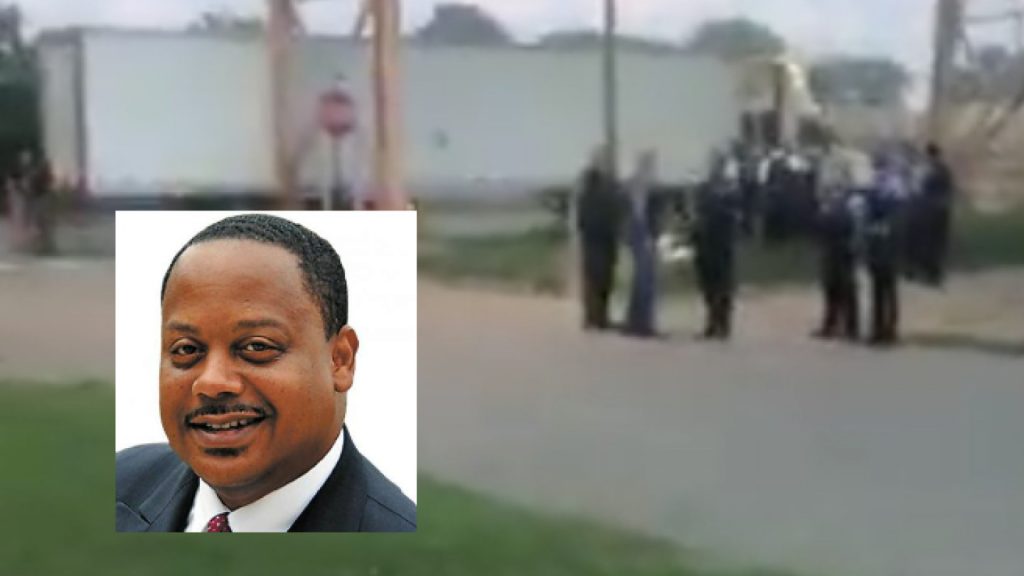
The chairman of the City Council’s Black Caucus denounced a sting operation that used “bait trucks” to try to catch thieves in Englewood, saying it was an “inappropriate use of police resources” and a hearing should be held to get answers.
Ald. Roderick T. Sawyer (6) called Chicago Police and the Norfolk Southern Railroad on the carpet for the joint operation, which was revealed when video shot by activists went viral this week. -
AUG 08, 2018
 Approximately 450 people took 2nd Ward Ald. Brian Hopkins’ survey about the massive proposal that would remake the North Branch of the Chicago River — and the results show deep opposition to the plan — and a strong desire for parkland and open space. Close to two dozen elected, church, and law enforcement leaders met to propose a range of changes — but no quick fixes — to gun violence.
-
Praising Cook County’s current assault weapons ban as a “responsible and meaningful law aimed at protecting our residents and our law enforcement officers,” Board President Toni Preckwinklehailed a recent federal court decision to uphold the law that bans specific types of assault weapons.
-
A neighborhood group fired the opening shots in the battle for the 44th Ward seat on the Chicago City Council, accusing Ald. Tom Tunney of not doing enough to keep property taxes in Lakeview from skyrocketing.
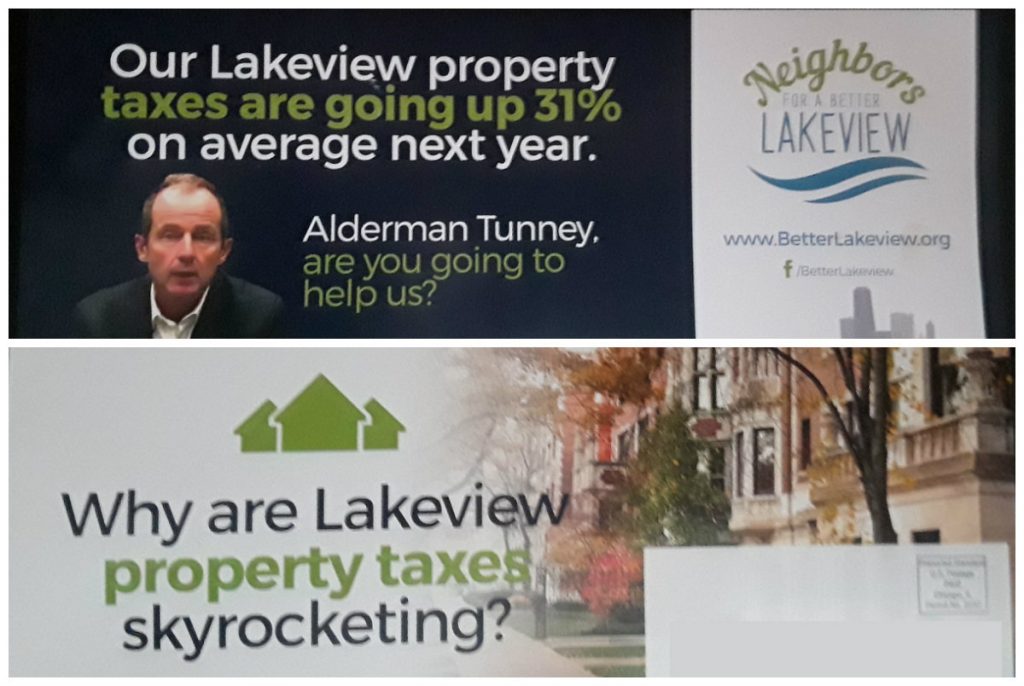 The mailer 8,000 North Side residents got from Neighbors for a Better Lakeview.
-
A group of candidates hoping to unseat a number of long-serving aldermen will ask Chicago voters whether the City Council should hold hearings on the discovery that the water they drink and bathe in might be tainted with lead.
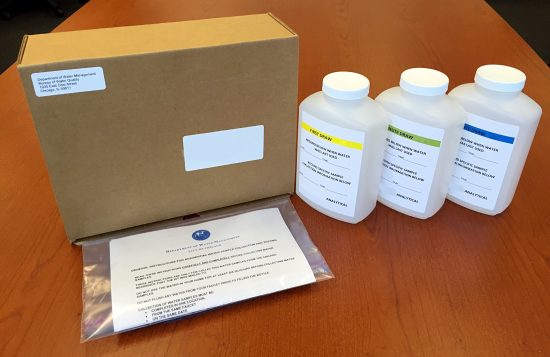 The testing kit Chicago residents can request. [City of Chicago]
 -
Two years of relentless signature gathering by former Illinois Gov. Pat Quinn will come to an end Monday, as he faces a 5 p.m. deadline to turn in at least 52,000 signatures from registered Chicago voters in his effort to limit Chicago mayors to no more than two terms in office.
-
AUG 02, 2018
Another candidate filed the paperwork with state officials to run for the open 47th Ward seat, while challengers emerged in the 15th, 16th and 45th wards. In addition, city officials launched another push on Wednesday to grow the ranks of the Chicago Police Department.
-
Aldermen must be prepared to take “bold action” and spend “millions” more to subsidize and finance affordable housing in Chicago to combat rising inequality and instability, a nonprofit coalition told aldermen Wednesday.
While the city is on track to meet its affordable goals for 2018, Chicago Rehab Network Director of Public Policy Rachel Johnston told a sparsely attended session of the City Council’s Housing and Real Estate Committee that the city should triple the number of affordable rental units subsidized from 2,500 to 7,500.
“We need to start talking about displacement,” Johnston said, urging the aldermen to boost the city’s contribution to the Chicago Low Income Housing Trust Fund.
Attendance: Chairman Joe Moore (49); Walter Burnett (27); Ariel Reboyras (31); Deb Mell (33); James Cappleman (46)
Past coverage:
- With affordable housing in spotlight, city says it has spent $27 million on 3,556 units in 2018
- As mayor focuses on affordable housing, aldermen, housing advocates propose limiting aldermanic prerogative
- Aldercast: The Truth About Chicago Population Loss
In the first three months of 2018, city funds were used to build 71 new rental units, according to the Chicago Rehab Network, a nonprofit coalition of community groups and nonprofit developers. However, just 44 will be reserved for residents earning between 51 and 80 percent of the area median income, or between $42,300 and $67,700.
Of those new apartments, only 29 were built to comply with the Affordable Requirements Ordinance. The ARO applies to any development of 10 or more units that needs special approval by city officials, is on city-owned land or is subsidized by taxpayer funds. Each project must set aside 10 percent of its units for moderate- or low-income residents.
At least 25 percent of those units must be included in the project in most parts of the city. Developers can opt to pay a fee of up to $225,000 per unit instead of building the remaining affordable units on site.
In all, the city expects to build 180 units in 2018 under the affordable housing ordinance.
The city should earmark more of its general fund — which also pays for police and fire protection, tree trimming and public health programs — for affordable housing, Johnston said. Aldermen have almost complete discretion to spend money in the city’s general fund.
Since 2008 — before the passage of the Affordable Requirements Ordinance — general fund dollars spent on affordable housing has fallen from $32 million to $14 million, a drop of more than 56 percent, according to data compiled by the Chicago Rehab Network.
Ald. Deb Mell (33) said she has been “frustrated” to see families who had lived in her ward for many years get pushed out by rent hikes.
Mell said it has been tough to figure out how to keep that from happening, and wished out loud that she had a “magic wand.”
“We can see how it trickles down to everything,” Mell said.
However, Ald. Walter Burnett (27) rejected suggestions that people are being “forced” to move out of the city.
“People are choosing to move out of the city,” Burnett said.
That may be correct, Ald. Joe Moore (49) responded, but Chicagoans who are moving may feel like they have no choice because they can no longer afford their rent or property taxes.
With the city’s five-year housing planset to expire in December, work has already begun on a plan covering 2019-23, said Anthony Simpkins, the managing deputy commissioner of the housing bureau in the Department of Planning and Development.
An advisory committee made up of 150 members, including developers, investors, nonprofit groups and advocates has met three or four times to start crafting the plan, which is set to be approved by the City Council this fall.
While the current housing plan focused on helping Chicago recover from the Great Recession, the next plan will focus on “displacement and gentrification in some neighborhoods” as well as “low property values, depopulation and the legacy of segregation in many other communities,” Simpkins said.
-
Chicago police told fellow officers helping the state craft the federal order that will determine the scope and speed of efforts to reform the Chicago Police Department they want more training, better equipment, better communication with the communities they police — as well as more support from elected officials and the press.
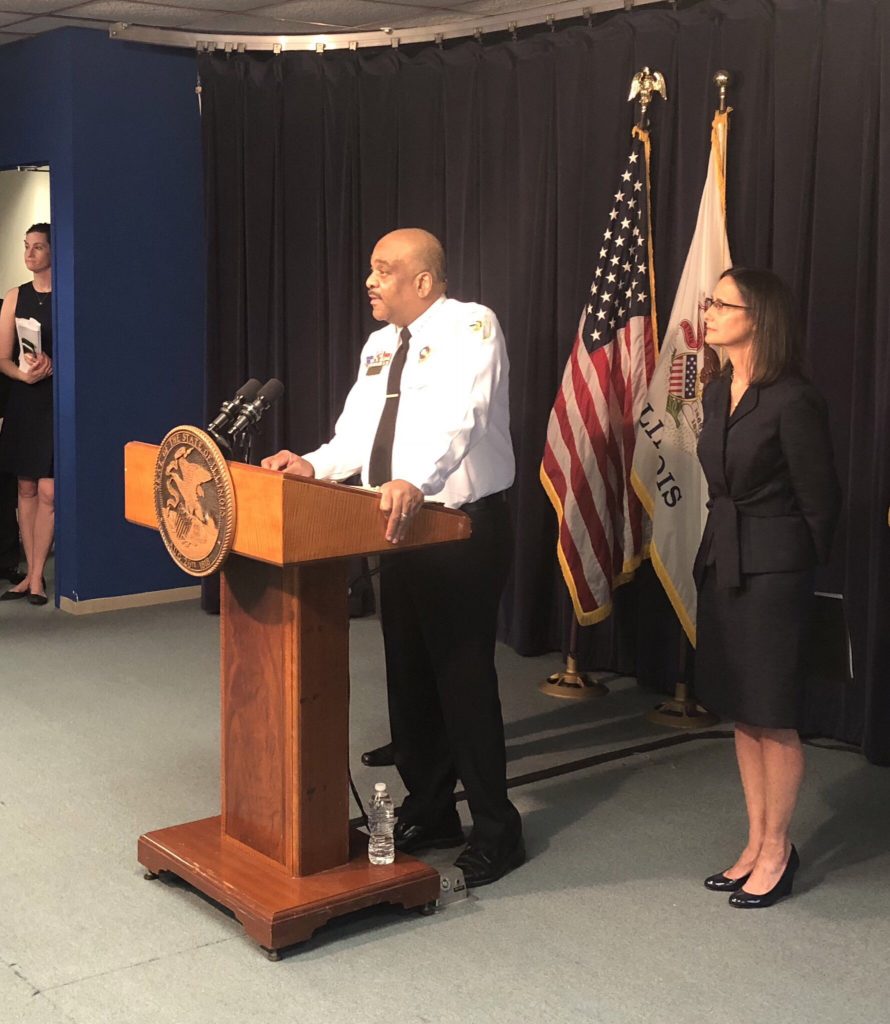 Chicago Police Supt. Eddie Johnson discusses the draft consent decree. [A.D. Quig/The Daily Line]


