


Chicago News
-
Mayoral candidate Bill Daley unveiled a new plan for the Chicago Public Schools, while former Chicago Police Supt. Garry McCarthy will make the February ballot, after rival candidate Paul Vallas dropped his petition challenge, and hearings continued in Toni Preckwinkle's challenge of Lori Lightfoot.
Correction: This story has been changed to correct the name of the candidate who challenged Garry McCarthy's petitions. It was Paul Vallas, not Bill Daley.
-
City officials will roll out a modernized 311 platform — the Chi311 Mobile app — allowing residents to log service requests or complaints with the city — ranging from potholes to paid sick leave violations.
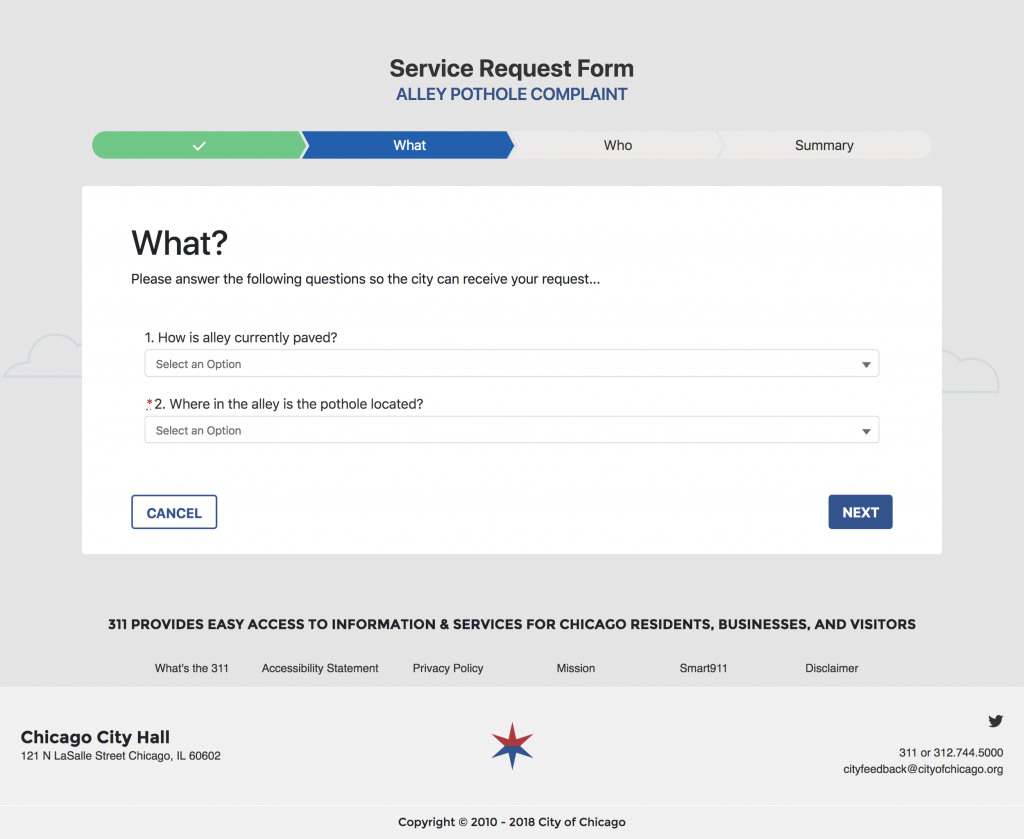 A screen from the new 311 app. [Provided]
Chi311 Mobile will be available via Apple's App Store and Google Play for residents to download, and will allow them to log and track service requests. Users will also be able to view other requests made nearby. Users can opt to keep their complaints anonymous or choose to receive push notifications or email updates. App users can also snap pictures and upload them with complaints and requests.
The official launch of the app, scheduled for Tuesday, was scrapped when two police officers died Monday evening after being struck by a passing train while investigating reports of shots fired.
Chief Information Officer Danielle DuMerer said approximately 100 unique requests and submissions can be made through the app.
Aside from regular city service requests for help with potholes and garbage pickup, users can submit restaurant inspection requests, notify city officials if employers are violating Chicago’s paid sick leave or minimum wage requirements, report hate crimes and airplane noise or ask for a kit to test their water for lead.
Each selection will offer users a brief explanations about which city departments provide services and an estimate of how long a request should take. A paid sick leave investigation might take 90 days, for example, while a request for a lead testing kit should be finished within a week. A complaint about an Uber or Lyft driver might take 45 days to be completed, officials said.While residents could call in to the city’s non-emergency 311 system to log such requests and complaints previously, DuMerer says she hopes the app makes it easier for Chicagoans to learn the scale of what issues they can go to the city to address, and reduce wait times on phone lines. A screen from the new Chi311 app. [Provided]
“Part of the modernization effort is also improving how our departments are delivering services,” DuMerer said. “This will provide them with increased transparency into what’s happening in different areas. They have dashboards for reporting, this will enable more of that kind of analysis.”
The multi-year effort cost $35 million, and was launched after Mayor Rahm Emanuel briefly floated privatizing 311’s call center to save the city “about a million dollars” annually by switching union workers with outside contractors. Aldermen and AFSCME Council 31, which represents most call center workers, almost immediately pushed back.
“It makes no sense to privatize what connects their residents to their government. It makes no sense to privatize 311 and put the nerve center of the city in the hands of a corporation whose number one goal and/or priority is to make a profit,” one 311 operator Louis Shuttlesworth, said during testimony on the 2016 budget. “It makes no sense to privatize and get rid of 311’s biggest asset, which would be experienced, knowledgeable workers who are committed to the City of Chicago.”
Emanuel abandoned privatization plans and instead used part of the proceeds of the sale of city-owned land at Goose Island to pay for the upgrade. As part of the sale, the city moved one of its Fleet and Facilities Management warehouses to Englewood.
Mayor Richard M. Daley created 311 in 1998 for $4 million in an effort to free up the city’s 911 system. “At the time, 911 was handling 3.7 million calls a year, as many as 40 percent of them non-emergencies,” according to the Sun-Times. -
The Chicago Board of Ethics fined a Chicago Police Officer $8,000 to settle charges she violated the city’s Ethics Ordinance by owning a security firm with that earned $1.6 million in city subcontracts from 2011 to 2016.
-
Petition objections continued their slow crawl to completion throughout the weekend.
This election cycle, only a few races are free from objections — an age-old, costly, lengthy tradition in Chicago. Three of the four open races on City Council for the 22nd, 39th and 47th wards are truly open — no candidates filed challenges.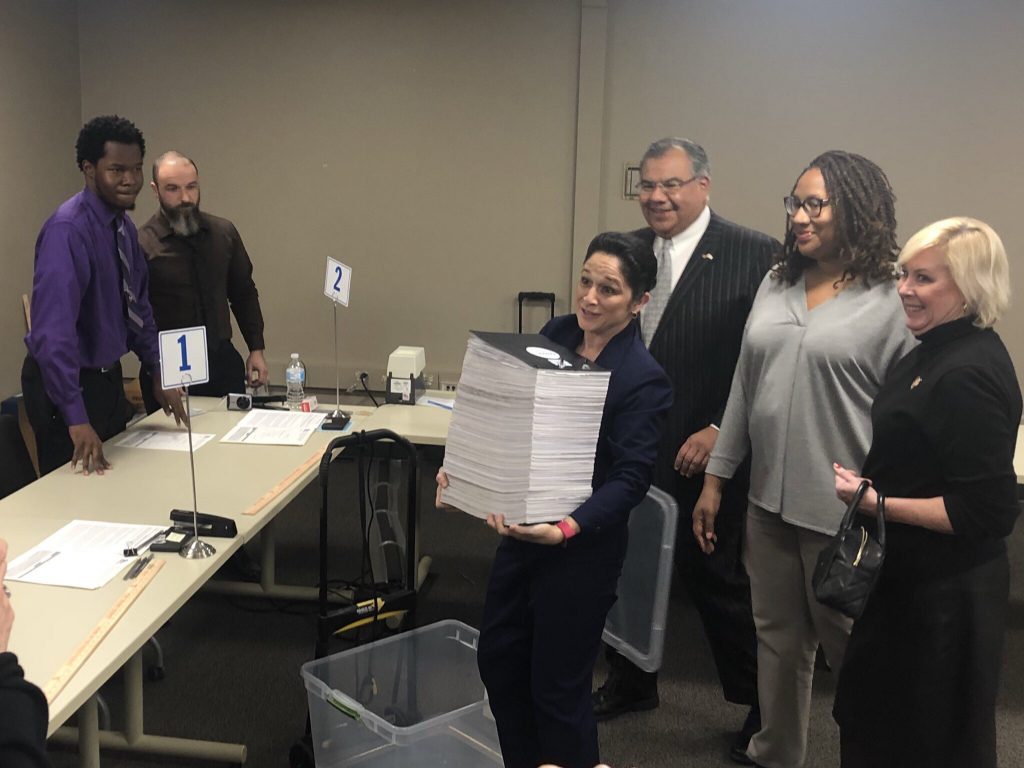 Illinois Comptroller Susana Mendoza delivers approximately 25,000 signatures to Chicago elections officials. [A.D. Quig/The Daily Line]
 -
Mayoral candidate Susana Mendoza found herself in the midst of the firestorm swirling around 14th Ward Ald. Ed Burke, who is under investigation by the FBI, and responded by swiping at rival Toni Preckwinkle’s record on sexual harassment. Two aldermanic hopefuls snagged an endorsement from the One People’s Campaign, while the group “committed to winning racial, gender and economic justice” said defeating Ald. James Cappleman was its “highest priority” in the 46th Ward. In addition, five more city officials reported $20,000 contributions from Mayor Rahm Emanuel, who has vowed to help his allies win re-election, even as he prepares to leave office.
-
South Side Ald. David Moore (17) and North Side Ald. Scott Waguespack (32) voted against policies and projects backed by Mayor Rahm Emanuel more than any other alderman from April 2017 to November 2018, according to the most recent “rubber stamp” report from former Ald. Dick Simpson.
-
Chicago Board of Ethics Executive Director Steve Berlin will lead an international organization devoted to ethics in government, while the Civic Federation honored Aviation Commissioner Jamie Rhee for her “inspirational” career. On the trail, a group dedicated to electing gay men and women to office endorsed Lori Lightfoot for mayor and five aldermanic candidates.
- Berlin to lead COGEL — Chicago Board of Ethics Executive Director Steve Berlin was elected president of the Council on Governmental Ethics Laws at the group’s annual meeting. Berlin will serve as president-elect until December 2019, and become president at the international group’s 2019 meeting, set to be held in Chicago. Berlin has been executive director of the Board of Ethics since 2008, and oversaw the overhaul of the city’s ethics laws in 2012. Ethics Board Chairman William Conlon said he was delighted by Berlin’s appointment. “Steve is a person dedicated to the service of the public; we are very fortunate to have him serving the citizens of Chicago.”
- Rhee honored — The Civic Federation, a nonpartisan budget watchdog group mostly funded by corporate interests, honored Aviation Commissioner Jamie Rhee with the 2018 Motorola Solutions Foundation Excellence in Public Service Award. Rhee replaced Ginger Evans as aviation commissioner earlier this year, after serving as the head of the city’s Department of Procurement Services. “Ms. Rhee’s 25-year career in public service is truly an inspiration,” the federation said in a statement.
- Trail notes — Mayoral candidate Lori Lightfoot trumpeted Thursday the endorsement of the Victory Fund, which is devoted to electing LGBTQ women and men to elected office. Lightfoot, who is the only openly gay candidate in the mayoral race, has a 10-year-old daughter with her wife, Amy Eshleman. “As someone who grew up in a small town and didn’t know any openly LGBTQ+ people, much less role models or elected officials, I know that representation matters,” Lightfoot said. “I hope that as the first LGBTQ+ mayor of Chicago I can expand opportunities for equity and inclusion — and for increased representation in government for decades to come. Victory Fund also endorsed 49th Ward candidate Maria Hadden, who is running to unseat Ald. Joe Moore, as well as 15th Ward Raymond Lopez, 33rd Ward Ald. Deb Mell, 44th Ward Ald. Tom Tunney and 46th Ward Ald. James Cappleman. In the treasurer’s race, Peter Gariepy won the backing of Northside Democracy for Action, his campaign announced in a statement.
-
-
Mayor Rahm Emanuel Wednesday laid out a four-part plan to keep the city’s four pension funds in the black — and avoid another series of tax hikes on Chicagoans.
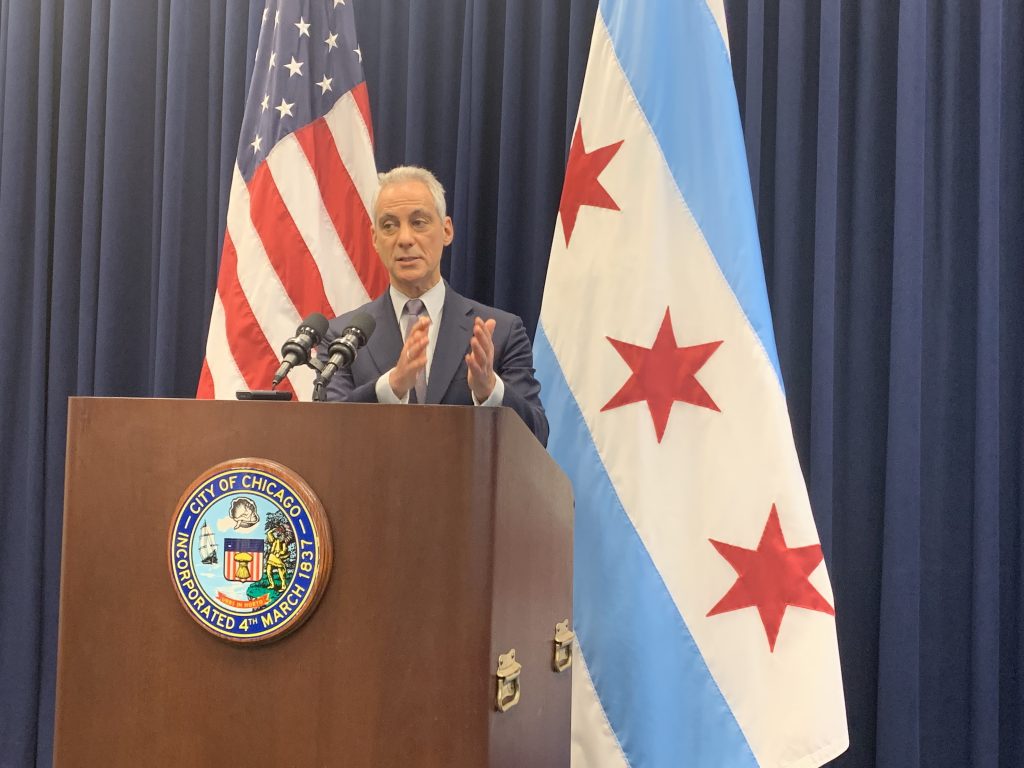 “I’m trying to save the pension system from itself,” Mayor Rahm Emanuel told reporters. [Heather Cherone/The Daily Line]
 -
DEC 12, 2018

UNLOCKED[Remarks as prepared for delivery]
Chairman Austin, Chairman Burke, and Members of the City Council:
I appreciate this opportunity to speak with you once again, and our entire city, about a challenge that affects Chicago’s future.
Today, Chicago’s economy is strong.
Unemployment has reached an all-time low. Last year, we achieved the largest drop in unemployment of the ten largest cities in the country. There are more jobs per capita in our city today than there have been in five decades.
-
DEC 12, 2018
 Blocked by allies of Mayor Rahm Emanuel from pushing through an reform the city’s use of tax-increment financing, members of the Progressive Caucus blinked on Tuesday, agreeing to try to craft a compromise with members of the administration.
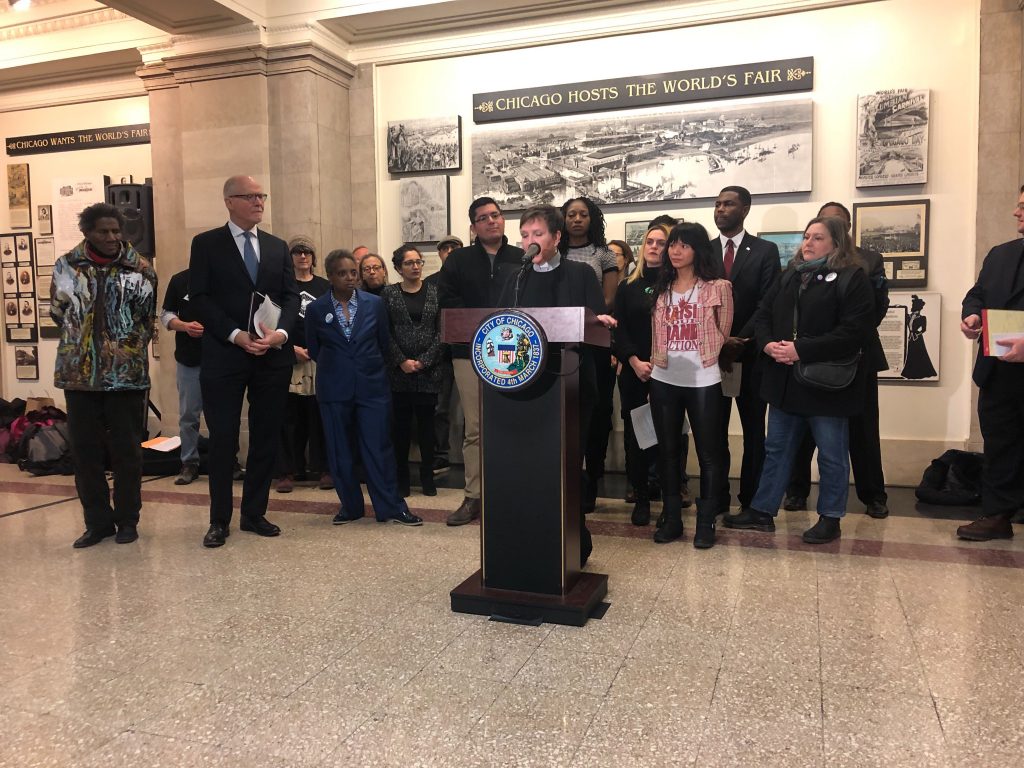 A group of mayoral candidates, aldermen, and community groups call for the city to pump the brakes on two new TIFs until the City Council’s next term. [A.D. Quig/The Daily Line]
 -
Flanked by a bevy of suburban mayors, Mayor Rahm Emanuel called Tuesday for the General Assembly to pass a capital bill — and fund those infrastructure projects with a gas tax hike of at least 20 cents and as much as 30 cents. Former Ald. Dick Simpson is set to unveil his latest report on the City Council’s support of Emanuel’s initiatives. On the campaign trail, mayoral candidate Amara Enyia announced the endorsement of former journalist Charles Thomas.
-
Mayor Rahm Emanuel will propose a number of sweeping proposals Wednesday including a city casino, legalized marijuana and an amendment to the state’s constitution to stanch the flow of red ink from the city’s pensions funds that threatens to swamp the city’s finances.
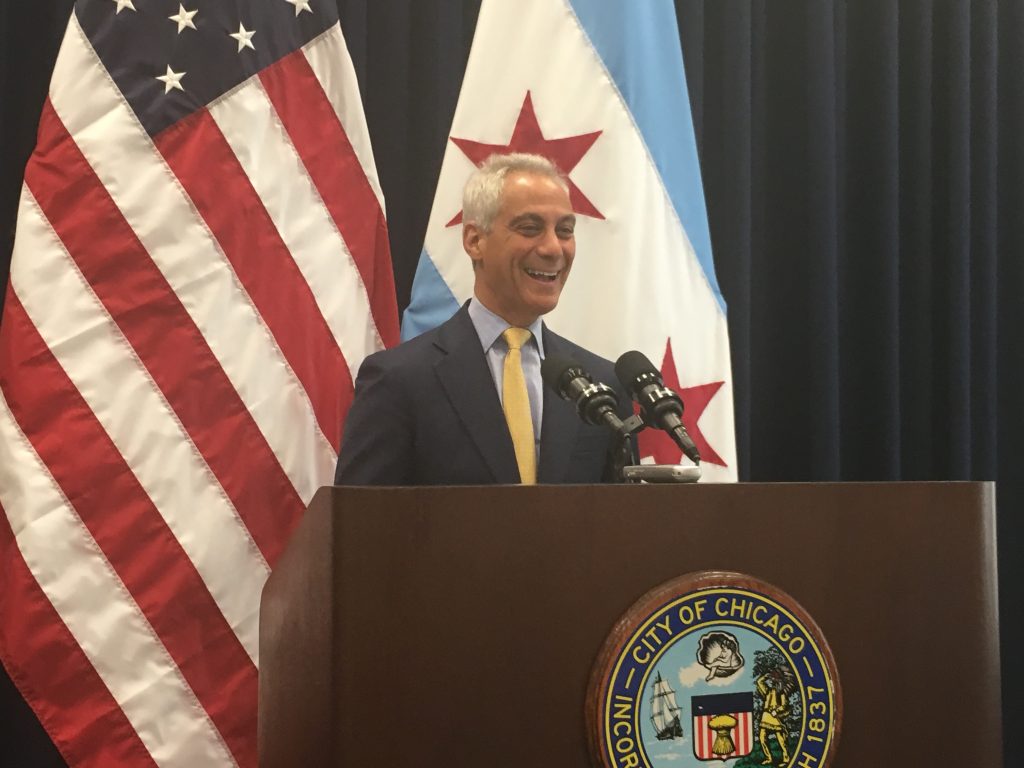 Mayor Rahm Emanuel address the news media. [Heather Cherone/The Daily Line]
Emanuel, who will leave office in May, will have turned over the office on the fifth floor of City Hall by the time the additional $276 million bill comes due in 2020 for the city’s police and fire pensions — and the additional $310 million bill for the city’s municipal and laborers pension funds arrives in 2022.
In all, the shortfall could top $1 billion by 2023, according to the city’s annual financial analysis.
In what could be Emanuel’s last major policy address before the Chicago City Council, the mayor will attempt to not only burnish his legacy but also to lay out a road map for the next mayor and the next City Council. That includes pushing lawmakers to legalize marijuana and create a Chicago casino.
“We can not allow the boulder we pushed up the hill to roll back down,” Emanuel will say, as he attempts to frame the debate with a recipe of equal parts diagnosis and prescription.
The mayor often lists putting the city’s four pension grounds on more solid ground among his top accomplishments.
But with a state law set to go into effect in 2020 that will tie payments to actuarial estimates, rather than fixed amounts, that ground has shifted, even after Emanuel pushed through the largest property tax increase in Chicago history along with dozens of other tax and fee hikes.
“These contributions must be made,” Emanuel will say. “There are no ifs, ands or buts about it.”
Emanuel will call for solutions based on “progressive principles,” according to sources in the mayor’s office. That includes earmarking all revenue from legalized marijuana and a casino for pension payments, sources said.
In addition, Emanuel will breathe new life into to his proposal to borrow as much as $10 billion to pay down the city’s pension debt. The mayor first floated that plan this summer, but then announced he would not run for a third term, scrambling those efforts.
The mayor will also call on the General Assembly to amend state’s constitution to eliminate the provision that prohibits lawmakers from changing pension payments because those contracts “shall not be diminished or impaired.”
Emanuel will take specific aim at the requirement that retirees in the labor fund get 3 percent annual compounded cost of living adjustments.
“The fact is, a 3 percent compounded COLA in an era of low inflation is not progressive
and not sustainable,” Emanuel will say. “It made sense in 1970 when we had more workers than retirees and high inflation, but it does not make sense today.”
Once the City Council meeting begins in earnest, aldermen are set to approve a five-year housing plan (O2018-9199) that calls for Chicago officials to spend $1.4 billion to build or preserve 40,000 homes.
However, that is essentially flat as compared with the previous five-year plan, and has been criticized as insufficient to tackle the city’s growing affordable housing crisis as well as rising concerns about gentrification, displacement, the continuing decline in Chicago’s African American population as well as rising inequality and instability.
Aldermen could also approve a new pilot program for Pilsen and Little Village under the city’s Affordable Requirements Ordinance, even though it was approved by the Housing Committee in an apparent violation of the City Council’s rules of procedure after Ald. Raymond Lopez’ (15) quorum call was ignored.
The proposal (O2018-9030) would increase the city’s affordable housing requirement from 10 percent to 20 percent in a 7.2-mile area in Pilsen and Little Village. It has the support of Mayor Rahm Emanuel and retiring Alds. Ricardo Muñoz (22) and Danny Solis (25).
Critics say it does not address those who have already been displaced by the forces of gentrification in Pilsen and surrounding neighborhoods.
After the quorum call, the committee also approved a measure (O2018-9027) to acquire four miles of abandoned railroad tracks from BNSF Railway to make way for the Paseo Trail from 16th Street in Pilsen to 31st Street in Little Village. Some residents there worry developers will flock to that trail as well and fuel further gentrification. Housing prices have soared near The 606 trail, pushing out some longtime residents.
Aldermen are also set to approve a number of items:- O2018-4455 — The $7 billion mixed-use project from Related Midwest dubbed The 78, which would create a new neighborhood along the Chicago River between the South Loop and Chinatown that could feature 10,000 units and create 24,000 jobs. [Related coverage]
- O2018-4966; O2018-4967 — A proposal for new West Loop towers from developer Tandem Partners featuring 401 apartments and 80 parking spaces, as allowed by the city’s transit-oriented development ordinance. [Related coverage]
- O2018-3797 — A proposal to transform eight acres of long-vacant land in Douglas Park owned by the Chicago Housing Authority into a new complex with a hotel, 384 apartments, 547 parking spaces as well as shops and stores. [Related coverage]
- O2018-8394 — A proposal for a new Green Line stop at Lake and Damen in Ald. Walter Burnett’s 27th Ward. [Related coverage]
- O2018-8400 — An agreement to acquire abandoned railroad tracks near the proposed Lincoln Yards development to allow The 606 trail to be extended and permit a light rail line to be built as part of the massive development along the North Branch of the Chicago River. [Related coverage]
- O2018-8076 — Changes to the city’s Human Rights Ordinance and Fair Housing Ordinance designed to expand protections for individuals who complain about unlawful discrimination and harassment. [Related coverage]
- O2018-9196; O2018-9197 — Two high-dollar grants from the city’s Neighborhood Opportunity Fund. One grant of $720,000 would help build a 6,500 square building to house “18 fully equipped salon suites for independent beauty professionals” at 80 E. Pershing Road. The other project is a $1 million grant to Kehrein Center for the Arts “to rehab and modernize a vacant auditorium into a 1,000 seat performing arts center.” [Related coverage]
- O2018-9200; O2018-9198 —Two proposals to use Open Space Impact Fees to expand the Chicago Park District’s West Ridge Nature Preserve and a new a multi-use artificial turf field and playground at LaSalle Language Academy, at 1734 N. Orleans St. [Related coverage]
- Five measures regarding the sale of packaged liquor. [Related coverage]
- Payments totaling $11.7 million to settle police misconduct lawsuits. [Related coverage]
- O2018-9203 — A measure giving the Chicago Park District a green light to move its headquarters from Streeterville to Brighton Park with $8.65 million in TIF fund. [Related coverage]
- A2018-119 — The appointment of former city Budget Director Alexandra Holt to the Regional Transit Authority Board of Directors. [Related coverage]
- A2018-117 — The appointment of Cory Thames, the deputy director for community engagement at the Obama Foundation, to Metra’s board of directors. [Related coverage]
- A2018-135 — The re-appointment of Michael K. Forde, former Ald. Ray Suarez (31) and Henry Wisniewski to the Illinois International Port District board of directors. [Related coverage]
-
Developer Related Midwest won committee approval to rezone 62 acres along the Chicago River between Chinatown and the South Loop to DX-5, Downtown Mixed Use District. The change allows as many as 10,000 apartments and condominiums to be built in what they anticipate will become Chicago’s 78th neighborhood.
The $7 billion mixed-use project (O2018-4455) is expected to create 24,000 jobs.


