Chicago News
-
Fresh off the bruising fight over the Lincoln Yards and the 78 megadevelopments, the Chicagoland Chamber is throwing its weight behind another proposal that has the potential to reshape a wide swath of the city.
A rendering of the proposed One Central development. [Submitted]
Even before the proposal from Wisconsin-based Landmark Development starts working its way through the approval process, the chamber and AECOM released a study that contends that proposal, One Central, will add $120 billion to the city’s bottom line in added taxes and revenues over the next four decades.
The 34-acre development in the city’s South Loop would include construction of a Millennium Park-like “tabletop” above the existing CTA, Metra, Northern Indiana Commuter Transportation District and Amtrak lines.
Chicagoland Chamber/AECOM study
The second part of the development calls for as much as 20 million square feet of new offices, homes, health and wellness services, and education space atop the table. Backers say the project would serve as “a new front door to the city’s central business district, the Museum Campus, McCormick Place, Wintrust Arena and Soldier Field.”
In all, the $19 billion project will create 40,000 construction jobs and 210,000 permanent jobs, according to the study — and will not request a city subsidy, unlike Lincoln Yards and the 78.
The bottom line from Chicagoland Chamber president Jack Lavin: “We need bold and innovative ideas to position Chicago on a global scale.”Podcast: Play in new window | Download
Subscribe: Apple Podcasts | Android | RSS
[audio mp3="http://thedailyline.net/wp-content/uploads/2019/04/Lavin-Aldercast_mixdown.mp3">[/audio]
The development would also provide what the AECOM study identifies as much-needed improvements to transit systems in the South Loop. Metra and CTA stations and lines serving Downtown “are increasingly at rush hour capacity, effectively limiting transit access,” according to the study.
“While the East Loop has benefited from significant residential and hotel development since 2000, corresponding decreases in office inventory appear connected with a reduction of 20,000 jobs which has eroded ridership on the Metra Electric District, reduced transit access for South Side and South Suburban residents, and increased costs of commuting,” according to the study. “In total, the share of downtown jobs held by all South Side commuters into downtown has eroded at the fastest rate of all suburbs since 2002,” according to the study.
The proposed development just west of Lake Shore Drive between McFetridge Drive and McCormick Place would extend the city’s building boom that has reshaped the Loop, West Loop and Fulton Market.
“This will bust through and send growth to the south,” Lavin said.
One Central could serve as a “gateway” connecting people on the South Side and South Suburbs with jobs, Lavin said.
However, the development will have to win the backing of Ald. Pat Dowell (3) and Mayor-elect Lori Lightfoot, who campaigned on a platform that promised to prioritize neighborhood development and blasted Mayor Rahm Emanuel for focusing on Downtown too much.
After the City Council approved Lincoln Yards and the 78, Lightfoot warned developers she would take a different approach.
“Enjoy this moment in the sun because you’re never going to get a deal like this again out of the city of Chicago as long as I’m mayor,” Lightfoot told reporters.
Lavin said thriving neighborhoods can coincide with a booming downtown.
“I do think that in order for our city to be the best it can be, there has to be an interrelationship with the neighborhoods,” Lavin said. “If the neighborhoods are doing well, the downtown’s gonna do well. If the downtown’s doing well, the neighborhoods will do well.”
Despite increasing activism around megadevelopments in and near the Loop — and the thousands of square feet they’ve added — the $60,000 study found ample demand for projects like One Central.
Roughly 13 acres of developable land have been gobbled up each year for the last 20 years, regardless of recession and growth “without fail,” AECOM’s Chris Brewer said.
“When you take Lincoln Yards, The 78, the Tribune Freedom site, add in acreage, and add up vacant pieces of land downtown, you appreciate there’s less easily developable land downtown,” Brewer said.
The city can absorb the megadevelopments, AECOM’s Bill Abolt said.
“Based on growth rates, based on the urbanization that’s happening, we’re gonna need all these developments,” Abolt said. “Bottom line, it can accommodate the growth. There’s a demand for the space, and as importantly it helps to distribute some of that growth in an area that could benefit from the investment, where infrastructure is not used at its full capacity.”
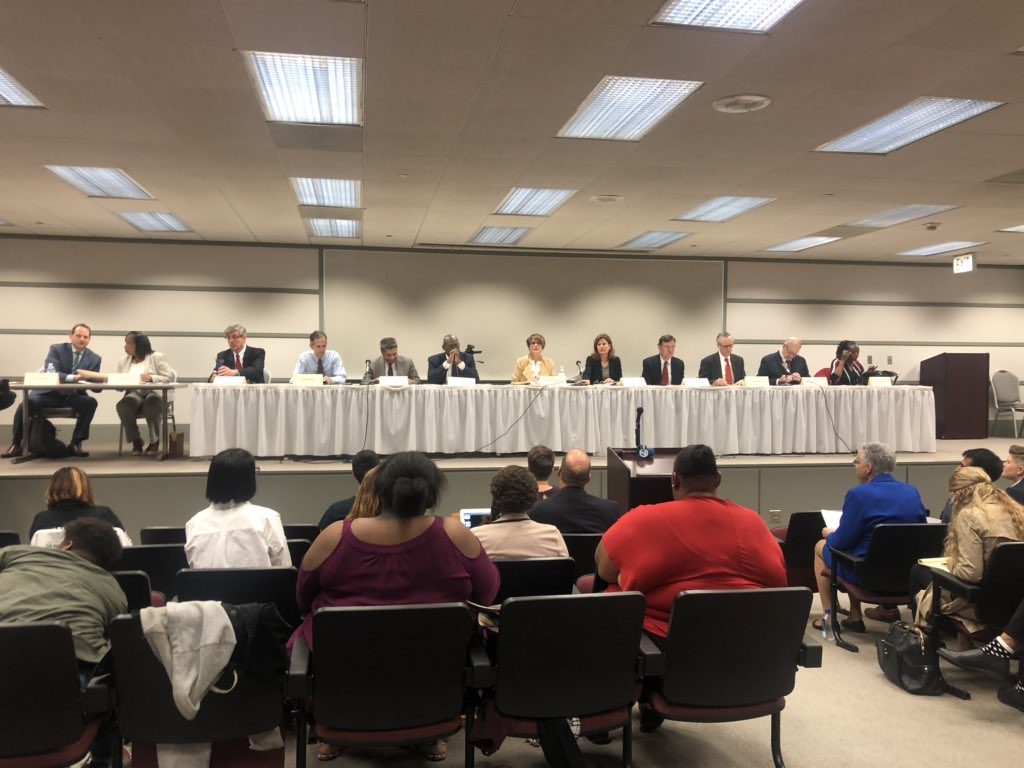
Ald. Pat Dowell (3), whose ward would include the project, told residents ahead of a community meeting that the proposal was far from a done deal.
“No back room deals have been struck,” Dowell said. “There are no handshake agreements on this project. Bob [Dunn, of Landmark Development] knows that I will hold him and his development accountable to the needs of my constituents first and foremost. The size, shape, scope, and design of this project are all open for discussion.”
Town Hall Slides
“Numerous revisions and compromises are needed” before it could win her approval, Dowell said.
“The community improvements like the transit hub, the increased retail and park space and potential space for a neighborhood high school, if done correctly, could be lasting assets for the South Loop,” Dowell wrote to constituents after the meeting, according to the Tribune.
The alderman said she would request shorter and less dense buildings.
“Of course we need to work with the community on how these developments are going,” Lavin said, adding that detailed proposals will “make sure we have open space for parks and make sure we have schools for these new areas.”
As the debate over the latest megadevelopment starts, Lavin will draw on 30 years of experience in state and local politics to shepherd One Chicago through the process.
An Elmhurst native, Lavin cut his political teeth volunteering in 1980 for John Anderson’s unsuccessful presidential bid. Lavin went from passing flyers on the campus of the University of Illinois for the moderate Illinois congressman to a handshake and job with former Gov. Pat Quinn, a friend of his cousin, a fellow graduate of Fenwick High School.
Lavin first worked as the director of development finance when Quinn was state treasurer and climbed in Illinois government off and on with Quinn, eventually becoming his chief operating officer, then chief of staff.
Lavin also worked at Abbott Laboratories, and served for more than six years in Gov. Rod Blagojevich’s administration. After leaving the Quinn administration, he founded his own lobbying and strategic consulting business. He joined the Chicagoland Chamber of Commerce in late 2017.
Lavin first met now Gov. JB Pritzker when Lavin was the state’s director of commerce, where he helped nurture what would become business incubator 1871. Mayor Rahm Emanuel has been one of the tech hub’s biggest cheerleaders.
“Oftentimes I’ve found when projects are done, it’s the people who show up that get a lot of the credit. When I worked for Rod Blagojevich, he didn’t always show up at events, but Mayor [Richard M.] Daley always showed up,” Lavin said.
Other takeaways from Lavin’s interview on The Daily Line’s Aldercast:- On Mayor-elect Lori Lightfoot’s mandate for ethics reform – Former Gov. Bruce Rauner used Lavin as a punching bag for patronage issues at the state’s Department of Transportation. Lavin said Chicago’s reputation as a corruption hub is overstated. “I don’t want to dwell on it, but some of those things you mentioned did not happen and they were not all truthful, what came out in the press, particularly the Department of Transportation, but I will leave that aside for now… I am an optimist and I have always felt that some of the perceptions of Chicago are wrong and I think that’s one of the perceptions that is wrong. I think that most people that work in government, and most people that are working in their jobs want good things to happen and they want to do the right things, and we need to talk about that more. Definitely there are some reforms needed.” Mayor-elect Lori Lightfoot has claimed mandate for City Hall reform.
- On negotiations for a scheduling ordinance — Market forces have essentially forced businesses to accept higher wages and protections like sick leave as necessary changes to attract and retain talent, Lavin said. But a proposed Fair Workweek ordinance, which Lavin describes as “restrictive” goes too far in some respects. Business, labor, and city representatives have haggled over the ordinance for years. While business groups, including the chamber, conceded on several fronts, including an eventual mandate for two weeks notice for employee schedules, he said businesses need to be able to create a “voluntary standby list” and flexibility on how employees are offered extra hours.
- On top priorities for Lightfoot – Lavin said addressing crime and Chicago’s perception as a violent city is one area he’ll be watching closely. “We need to look at what are the causes of violence and what can we do and how can we work with the business community on that,” he said, pointing to AT&T’s “Believe Chicago” initiative. The company recently celebrated hiring its 500th employee from one of 19 targeted neighborhoods “most affected by gun violence and high unemployment.” If he were advising her first 100 days, he’d tell her to go straight to Springfield to secure a new capital bill. “We haven’t had one in ten years,” he said. “We need to invest in our transportation systems. They’ve been under-invested in. We need to do more. In the last capital bill, 20 percent of new transportation capital was spent on transit. We need to make that 30 percent.”
-
An audit of the Cook County Assessor’s office demonstrates the need for state lawmakers to approve a bill backed by Assessor Fritz Kaegi now stalled in Springfield that would give his office the ability to collect operating income and expense data from commercial and industrial properties, Kaegi’s office said.
-
By Cassie Walker Burke and Yana Kunichoff, Chalkbeat Chicago
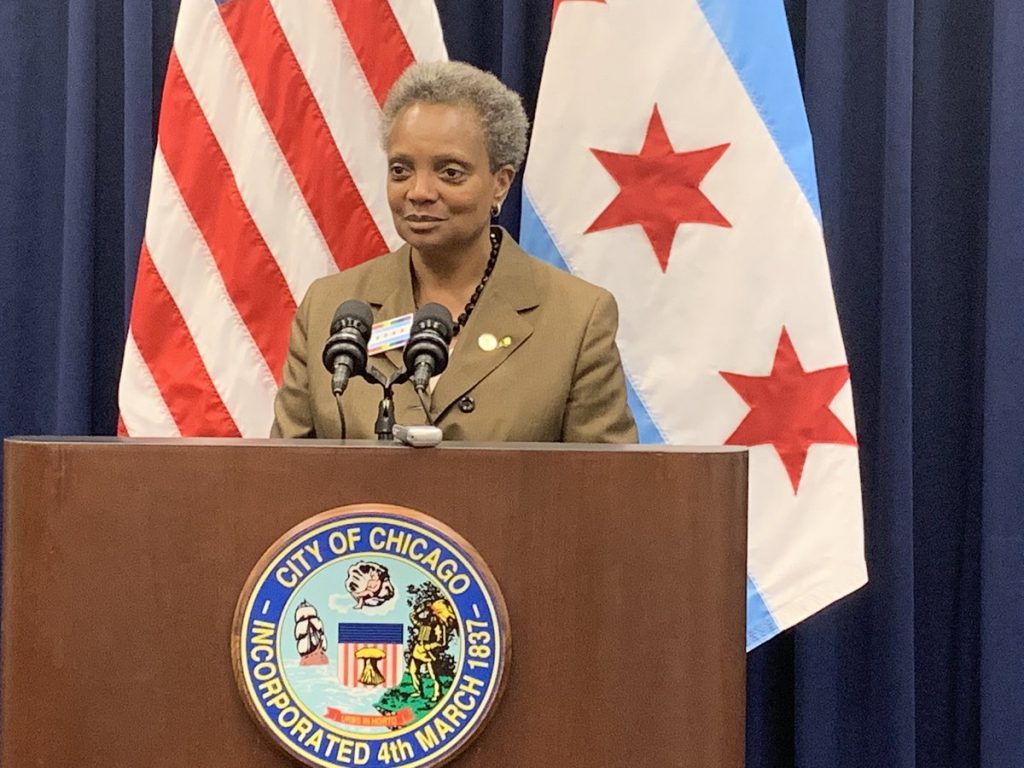
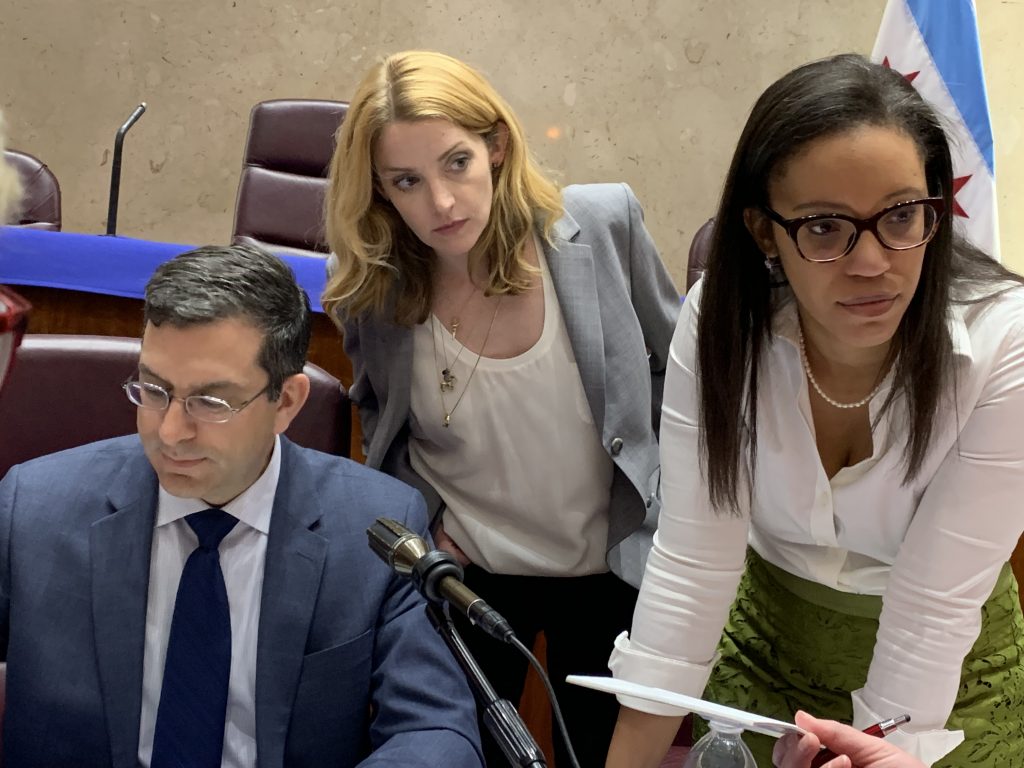
Flanked by a staff member, Mayor Lori Lightfoot tells reporters she has disbanded the Chicago school board. [Heather Cherone/The Daily Line]
Chicago’s new mayor, Lori Lightfoot, said Wednesday she is disbanding the city’s seven-member school board, moving quickly to set up what is likely to be a dramatic transformation of how the 361,000-student school district is governed.
Lightfoot, who was sworn in Monday, campaigned on a promise to support a switch from a school board appointed by the mayor to one selected by the public.
Speaking to reporters at City Hall Wednesday afternoon, she said none of the current board members would remain in place. But since the move to an elected body requires legislative approval, Lightfoot said she would appoint an interim board and would announce the names of those selected soon.
During this period, she said, “we want to make sure we are doing what we could to bring diversity into the process.”
As for selecting interim replacement, Lightfoot said, “My first priority is placing an emphasis on people who have children in the system or have themselves been a part of the CPS system, whether as administrators, teachers or principals.”
News that the school board would be disbanded came just prior, at the end of a four-hour and otherwise pro-forma school board meeting, when the board’s president, Frank Clark, announced: “It’s our last meeting. Really truly thank you, it’s been an honor.”
The seven board members, all appointed at some point over the past eight years by former Mayor Rahm Emanuel, oversaw and, in many cases, supported some of the most landmark changes in Emanuel’s tenure, including a 20-percentage point climb in graduation rates and the nation’s largest single round of school closings.
Schools chief Janice Jackson thanked Clark for his service, and said working alongside the board had made her a better leader. “I have felt both challenged and supported in this role. You all have served with integrity, and pushed us to be better,” she said.
As Clark made his announcement, district staff filed into the room and, at one point, gave a standing ovation to the outgoing board members.
Board member Mahalia Hines, who was chosen by Emanuel in May 2011, thanked Clark for his work, and thanked the former mayor for appointing her to the role. Hines also had a special message for the parents who use the public comment section at each board of education meeting to press the board for more resources and, sometimes, to make the outright case that their children’s schools should stay open.
“I want to say thank you to all of the parents who come and take their time to be here. You have helped me to grow,” said Hines. She also commended Jackson, who will continue in her role as schools chief under Lightfoot. “You’re not just saying you are putting children first, you live it.”
During her mayoral campaign, Lightfoot, a former federal prosecutor, spoke often about how her mother served on the elected school board in her Ohio hometown, and said she supported a move to an elected board in Chicago.
In advance of Wednesday’s meeting, vocal members of a parents’ group that supports a state bill that would establish a 21-person elected school board began posting on Twitter that they were disappointed that Lightfoot had not overhauled the existing board during her first few days in office.
Lightfoot was sworn in Monday. In her inauguration speech, she spoke about education as one of four priority pillars for her incoming administration. On Tuesday, she said she officially planned to retain Jackson.
Meanwhile, a bill that would establish a 21-member elected school board has stalled in the Illinois Senate after passing the House. A coalition of legislators, teachers’ union representatives, and parents groups support the measure. But Lightfoot has described the proposal as a “recipe for chaos and disaster” because of its size and has asked for time to study the issue more.
Heather Cherone of The Daily Line contributed to this report.
Chalkbeat is a nonprofit news site covering educational change in public schools. -
Ald. Susan Sadlowski-Garza (10).
Former Mayor Rahm Emanuel spent most of his two terms in office at loggerheads with Chicago’s biggest unions — and consigned most of their legislative priorities to purgatory.
But Mayor Lori Lightfoot’s selection of Ald. Susan Sadlowski-Garza (10) to chair the City Council’s Workforce Development Committee indicates a seismic shift is underway in Chicago politics. If Lightfoot’s picks are confirmed by the City Council Wednesday, she will replace former Ald. Pat O’Connor (40), Emanuel’s floor leader and one of his closest allies.
-
Mayor Lori Lightfoot spent her first full day as mayor meeting behind closed doors with members of her cabinet, and capped it off by announcing a full slate of picks for her cabinet — some of whom will stay on after serving Emanuel administration.
Samantha Fields, who served as former Mayor Rahm Emanuel’s budget director, will be charged with guiding Lightfoot’s agenda through a City Council put on notice that business as usual — and their veto power over projects in their wards — has come to an end as the mayor’s senior advisor for legislative counsel and government affairs.
Fields sailed through her City Council confirmation hearings in the spring of 2017 and won praise for her handling of Emanuel’s election year budget — one that included no tax hikes or fee increases.
Manuel Perez, who managed Lightfoot’s runoff campaign, will serve as the managing deputy director of legislative counsel and governmental affairs, and focus on shepherding the mayor’s agenda through the final weeks of the legislative session in Springfield. That could include changes to a measure that would end mayoral control of the Chicago Public Schools.
Related: Let Senate vote on elected school board bill, aldermen-elect, supporters urge
Tiffany Sostrin will serve as deputy director of legislative counsel and governmental affairs, charged with overseeing “council relations” and advocating “for legislation on behalf of the mayor’s office. Sostrin will be a familiar face for veteran aldermen, having worked during the Emanuel administration as the chief legislative liaison for the Department of Finance and before that an attorney for the City Council’s Legislative Reference Bureau, led by former Ald. Margaret Laurino (39), where she prepared legislation for aldermen as well as legal guidance.
Lightfoot also filled two newly created positions designed to make good on her promises to prioritize neighborhood — rather than Downtown — development and to tackle the city’s massive shortage of affordable homes.
Marisa Novara, will serve as commissioner of the Department of Housing, which former Mayor Richard M. Daley disbanded in a cost-cutting measure in 2008 and Emanuel resurrected a decade later — before announcing that he would not run for another term as mayor.
While vice president at the Metropolitan Planning Council, Novara helped author a study of the cost of racial segregation and advocated for changes to city law to encourage more affordable housing. Her appointment requires City Council confirmation
Samir Mayekar, will serve as deputy mayor for neighborhood and economic development after working in the Obama White House and at a federal infrastructure finance agency.
Lifghtfoot also moved to replace Brian Bannon as the head of the Chicago Public Library in a repudiation of Emanuel’s leadership of the agency. Lightfoot said she would nominate Andrea Telli to lead the library, which has been under fire from Inspector General Joseph Ferguson for failing to adequately staff its libraries after cuts pushed through in 2011 by Emanuel.
Related: Library staffing still ‘insufficient:’ watchdog
However, six of Emanuel’s highest profile cabinet members will stay in their jobs. They are:- Chicago Police Supt. Eddie Johnson
- Chicago Public Schools CEO Janice Jackson
- City Colleges of Chicago Chancellor Juan Salgado
- Chicago Transit Authority President Dorval Carter
- Chicago Park District CEO Michael Kelly
- Chicago Housing Authority CEO Eugene Jones
In addition, three high-profile commissioners who departed with Emanuel will be replaced on an interim basis by their deputies:- Alison Arwady will replace Department of Public Health Commissioner Dr. Julie Morita when she steps down June 18 on an interim basis while a national search is conducted for Morita’s replacement.
- Thomas R. Carney will replace former Department of Transportation Commissioner Rebekah Scheinfeld while a search is conducted.
- Eleanor Gorski, the deputy commissioner of planning, historic preservation and sustainability, will replace former Department of Planning and Development Commissioner David Reifman while a search is conducted.
-
Commissioners are set to advance plans Wednesday to create three county commissions to tackle some of Cook County’s most pressing issues.
They include proposals to open up the county’s books to outsiders, ensure a full Census count, and to ensure Cook County is a “leader in combating global warming.”
-
City Hall regulars — including reporters — took note when the divider between the fifth floor of the City and County building reopened hours after Mayor Lori Lightfoot’s inauguration after being closed for years.
The now-open doorway between the city and county building on the 5th floor. [A.D. Quig/The Daily Line]
-
Department of Central Management Services officials told lawmakers they have at least partially implemented the recommendations included in an audit released last year — but lawmakers who sit on the Legislative Audit Commission are skeptical of real change within the agency.
-
Despite her lengthy inaugural address, Mayor Lori Lightfoot touched on a just few of her administration’s key priorities — while her campaign website teemed with white papers crafted during the past year.
-
Mayor Lori Lightfoot took office Monday and immediately struck at the heart of aldermen’s ability to veto — or green light — licenses and permits in their wards in an effort to fulfill her promise to root out corruption at City Hall.
Mayor Lori Lightfoot signs an executive order she said "ended" aldermanic prerogative. [Heather Cherone/The Daily Line]
The new mayor's inaugural address built around the words of Chicago poet Gwendolyn Brooks, centering on Lightfoot’s pledge to increase equity in Chicago and govern with the poor, the threatened and scared uppermost in mind.
“‘We are each other’s harvest,’ she said, quoting the former poet laureate. “‘We are each other’s business; we are each other’s magnitude and bond.’”
-
LORI LIGHTFOOT'S INAUGURAL ADDRESS
(Delivered at Wintrust Arena, May 20, 2019)
Thank you.
Thank you so very much.
I stand here as your mayor, humble and hopeful, honored to be the 56th mayor in the history of this great city.
We are a proud city with a proud history.
In this moment, I cannot help but look at all of you and think about what lies ahead and what we can be together. I’m looking ahead to a city of safe streets and strong schools for every child regardless of neighborhood or zip code. A city where people want to grow old and not flee. A city of sanctuary against fear where no one must hide in the shadows. A city that is affordable for families and seniors and where every job pays a living wage. A city of fairness and hope and prosperity for the many, not just for the few, a city that holds equity and inclusion as our guiding principles.


Cupcakes for Courage food truck owner Laura Pekarik sued the city over a 2012 ordinance. [Institute for Justice]