


Chicago News
-
After months of protests, the massive Lincoln Yards development is poised for a decisive vote Thursday that could transform the North Side of Chicago — and solidify Mayor Rahm Emanuel’s legacy as the mayor who guided the final transformation of Chicago from an industrial behemoth to a city poised for growth in the 21st Century.
 A rendering of the proposed Lincoln Yards development. [Sterling Bay]
With a deal in place to double the amount of housing for poor and low-income Chicagoans built as part of the development, the City Council’s Zoning Committee is set to vote Thursday to advance the massive development to the full City Council, which is expected to take a final vote Wednesday.
The revised plan requires 600 units of affordable housing to be built on site. Originally, the plan called for only 300 units to be built on site, a plan criticized by several alderman as insufficient.
Hours before the vote, Chicago planning officials announced the plans would be changed to reduce the height of the tallest building set to be part of the 55-acre development to 600 feet from 800 feet.
In addition, the total size of new buildings will be capped at 14.5 million square feet, said Department of Planning and Development spokesman Peter Strazzabosco.
Zoning Committee Chairman Ald. James Cappleman (46) did not return repeated calls from The Daily Line about whether the proposed changes to the development have secured his support. Cappleman had said proposal should be revised to provide housing those making no more than 30 percent of the area’s median income, or $25,450 for a family of four.
The Uptown alderman replaced disgraced Ald. Danny Solis (25) as chairman of the Zoning Committee in January. Cappleman faces scientist Marianne Lalonde in the April 2 runoff to win a third term on the City Council.
Lalonde said she planned to rally at City Hall Thursday morning before the Zoning Committee meeting with other opponents of the project, including Ald. Carlos Ramirez-Rosa (35), Andre Vasquez, who is running against Ald. Pat O’Connor in the 40th Ward and Rafael Yanez, who is running against Ald. Raymond Lopez in the 15th Ward.
Mayoral candidates Toni Preckwinkle and Lori Lightfoot have called on aldermen to halt consideration of the project, which could be approved by the time the next mayor takes office in May, tying her hands.
Eleven aldermen told The Daily Line in January and February they would vote against the project unless it included more affordable housing than originally proposed.
Although the 55-acre development is in the 2nd Ward, it is sandwiched between the 43rd Ward and 32nd Ward. Ald. Michele Smith (43) and Ald. Scott Waguespack (32) vehemently oppose the project, and have been urging its delay.
However, under aldermanic prerogative — the city’s unwritten policy of giving aldermen the ultimate authority over projects in their own wards — the project only needs the support of the mayor and 2nd Ward Ald. Brian Hopkins.
Hopkins has said the new roads, bridges and sidewalks set to be built as part of the Lincoln Yards development are urgently needed.
Department of Planning and Development Commissioner David Reifman said the approval of Lincoln Yards is critical to ensure Chicago’s economy remains robust as the city transitions from its industrial past into the future.
“This is a tremendous opportunity for jobs and economic growth,” said Reifman, who briefed aldermen Tuesday on the revised proposal. “I don’t know any other way to develop this site and have it come close to its potential.”
The development is expected to create 10,000 construction jobs and 24,000 permanent jobs, according to city officials. Under the city’s rules, $1.9 billion of the project’s cost will be set side for women, African American and Latino owned firms.
The project relies on a $900 million subsidy, set to be generated by the 168-acre Cortland and Chicago River Redevelopment Area (F2018-72), which could also be approved by the City Council on March 13 if it is endorsed by the Finance Committee on March 11.
TIF districts capture all growth in the property tax base in a designated area for a set period of time, usually 20 years or more, and divert it into a special fund for projects designed to spur redevelopment and eradicate blight.
Of the 6,000 apartments, condominiums and townhomes planned for Lincoln Yards, 1,200 must be set aside for low- and moderate-income Chicagoans. The total number of affordable homes will not increase under the revised proposal — only their location will change.
That is an “outstanding commitment” by a private developer, Reifman said.
Sterling Bay also plans to pay $39 million into the city’s housing trust fund. Half of the trust is earmarked to subsidize individuals’ rent in existing buildings, and the other half is set aside to build new homes for the poorest Chicagoans.
Another 300 units would be allowed to be built outside the development, but within three miles, according to the revised plan. Sterling Bay would also have the option to pay into the trust fund instead of building some of those remaining units, or including them as part of Lincoln Yards.
The 600 affordable units built as part of Lincoln Yards would be earmarked for low- and moderate-income Chicagoans making no more than 60 percent of the area’s median income, or $47,400 for a family of four, according to city data. -
Members of the Grassroots Alliance for Police Accountability sat behind Ald. Harry Osterman (48) during a sparsely attended Public Safety Committee meeting Tuesday to introduce an amended ordinance to give elected civilians oversight of the Chicago Police Department.
-
Ald. Willie Cochran (20) has had second thoughts about the second thoughts that prompted him to scuttle a plea deal on corruption charges back in November, court documents show. In the runoff for treasurer, the third-place finisher backed the first-place finisher, and the latest vote totals show some races still teetering on the brink.
-
-
The massive Lincoln Yards development will advance to the City Council’s Zoning Committee on Thursday after aldermen, planning officials and developer Sterling Bay announced an agreement to double the amount of housing for poor and low-income Chicagoans built as part of the development.
 A rendering of the proposed Lincoln Yards. [Department of Planning and Development]
The deal, announced Tuesday, would require 600 units of affordable housing to be built on site, according to the deal announced by 2nd Ward Ald. Brian Hopkins. Originally, the plan called for only 300 units to be built on site, a plan criticized by several alderman as insufficient.
"This is a huge gain," Hopkins said at a City Hall news conference to announce the plan.
Although the $6 billion development has consistently been supported by Mayor Rahm Emanuel and Hopkins, new Zoning Committee Chairman Ald. James Cappleman (46) said he wanted the proposal to be revised to provide housing those making no more than 30 percent of the area’s median income, or $25,450 for a family of four.
The Uptown alderman replaced disgraced Ald. Danny Solis (25) as chairman of the Zoning Committee in January. Cappleman faces scientist Marianne Lalonde in the April 2 runoff to win a third term on the City Council.
Mayoral candidates Toni Preckwinkle and Lori Lightfoot have called on aldermen to halt consideration of the project, which could be approved by the time the next mayor takes office in May, tying her hands.
Eleven aldermen told The Daily Line in January and February they would vote against the project unless it included more affordable housing than originally proposed.
Although the 55-acre development is in the 2nd Ward, it is sandwiched between the 43rd Ward and 32nd Ward. Ald. Michele Smith (43) and Ald. Scott Waguespack (32) vehemently oppose the project, and have been urging its delay.
However, under aldermanic prerogative — the city’s unwritten policy of giving aldermen the ultimate authority over projects in their own wards — the project only needs the support of the mayor and Hopkins.
Hopkins has said the new roads, bridges and sidewalks set to be built as part of the Lincoln Yards development are urgently needed.
Department of Planning and Development Commissioner David Reifman said the approval of Lincoln Yards is critical to ensure Chicago’s economy remains robust as the city transitions from its industrial past into the future.
“This is a tremendous opportunity for jobs and economic growth,” said Reifman, who briefed aldermen Tuesday on the revised proposal. “I don’t know any other way to develop this site and have it come close to its potential.”
Reifman rejected concerns that the project has been rushed — but said time was of the essence.
“If they don’t get out of the box, we might be waiting an inordinately long time to develop this land,” Reifman said.
The development is expected to create 10,000 construction jobs and 24,000 permanent jobs, according to city officials. Under the city’s rules, $1.9 billion of the project’s cost will be set side for women, African American and Latino owned firms.
If approved by the Zoning Committee, the full City Council could act on the proposal March 13.
Cappleman could not immediately be reached for comment. Hopkins said he could not say whether Cappleman supports the revised plan.
The project relies on a $900 million subsidy, set to be generated by the 168-acre Cortland and Chicago River Redevelopment Area (F2018-72), which could also be approved by the City Council on March 13 if it is endorsed by the Finance Committee on March 11.
TIF districts capture all growth in the property tax base in a designated area for a set period of time, usually 20 years or more, and divert it into a special fund for projects designed to spur redevelopment and eradicate blight.
Of the 6,000 apartments, condominiums and townhomes planned for Lincoln Yards, 1,200 must be set aside for low- and moderate-income Chicagoans. The total number of affordable homes will not increase under the revised proposal — only their location will change.
That is an “outstanding commitment” by a private developer, Reifman said.
Sterling Bay also plans to pay $39 million into the city’s housing trust fund. Half of the trust is earmarked to subsidize individuals’ rent in existing buildings, and the other half is set aside to build new homes for the poorest Chicagoans.
Another 300 units would be allowed to be built outside the development, but within three miles, according to the revised plan. Sterling Bay would also have the option to pay into the trust fund instead of building some of those remaining units, or including them as part of Lincoln Yards.
The 600 affordable units built as part of Lincoln Yards would be earmarked for low- and moderate-income Chicagoans making no more than 60 percent of the area’s median income, or $47,400 for a family of four, according to city data.
Ald. Walter Burnett (27) and Ald. Raymond Lopez (15) praised Hopkins for increasing the number of on-site affordable homes.
“This is a great development,” Burnett said. -
A suit brought by a group of producers, suppliers and contractors that challenged Cook County’s compliance with the so-called Illinois lockbox amendment has been tossed out of court.
 A city crew patches a pothole. [Quinn Ford, DNAinfo Chicago]
-
Aldermen will consider Mayor Rahm Emanuel’s pick to lead the Office of Emergency Management and Communications at the meeting of the City Council’s Committee on Public Safety set for 11:30 a.m. Tuesday.
 Mayor Rahm Emanuel announces Rich Guidice as the new executive director of the Office of Emergency Management and Communication. [City of Chicago]
-
A former prosecutor, investigator and former inspector general often called upon by city and state officials in the wake of scandal will monitor the effort to reform the Chicago Police Department, a federal judge decided Friday.
 Maggie Hickey will monitor efforts to reform the Chicago Police Department. [Schiff Harden]
-
The runoff between Lori Lightfoot and Toni Preckwinkle is in full swing, with the rivals already trading rhetorical blows. The man whom both hope to replace — Mayor Rahm Emanuel — released a spot of his own taking aim at President Donald Trump’s promise that Mexico would pay for a border wall.
-
Ald. Ricardo Muñoz (22) returned to City Hall Friday to back a 12-year, $19.7 million tax break for Hilco Development’s planned distribution center in Little Village.
Muñoz had been absent since Dec. 31, when he was arrested and charged with misdemeanor domestic violence after his wife said he struck her while intoxicated. Muñoz declined to answer questions from reporters about the incident.
“I’m not having this conversation in the press,” Muñoz said.
The development would replace the Crawford coal-burning power plant and create hundreds of jobs, but environmental activists told committee members they were allowing one kind of pollution to be replaced with another.
Attendance – Vice Chairman Leslie Hairston (5), Greg Mitchell (7), Patrick D. Thompson (11), Raymond Lopez (15), Willie Cochran (20), Howard Brookins (21), Ricardo Muñoz (22), Jason Ervin (28), Milly Santiago (31), Carlos Ramirez-Rosa (35), Gilbert Villegas (36), John Arena, Ameya Pawar (47)
“Hilco has identified a project that is seeking to invest $300 million in construction, $150 million in demolition,” and add 300-400 jobs to the neighborhood, Muñoz said. “I’d hope that this 6b application (R2018-1394) be considered as a local matter in the 22nd Ward where we’ve taken this debate at heart and decided that the investment and the repurposing of this vacant site to a site that will be creating these jobs is a much better use than just leaving it vacant.”
Once applied, the property would be assessed at 10 percent of its market value for the first 10 years, 15 percent in the 11th year and 20 percent in the 12th year. That could save Hilco $19.7 million over the life of the agreement, officials said
Committee chair Ald. Proco Joe Moreno (1), who lost his bid for another term Tuesday, was not present.
After roughly an hour of questioning from aldermen about the project, Muñoz grew frustrated.
“I don’t mean to cut anybody off, but for crying out loud, people, this is a local matter,” Muñoz said, becoming the second alderman in as many days to deliver a pithy defense of aldermanic privilege, which gives each alderman the final decision over projects in his or her ward.
Activists with the Little Village Environmental Justice Organization, the Sierra Club and others testified Friday and at previous meetings that increased particulate matter from the trucks traveling to and from the 1 million-square-foot facility would exacerbate existing health problems in the neighborhood.
A spokesperson for the Sierra Club said the project is “a step backwards” for Little Village and that City Council should take environmental issues more seriously, not reward potential polluters with tax breaks.
Another compared the Hilco Development to Lincoln Yards or The 78 – two developments that would reshape their respective neighborhoods along the North Branch of the Chicago River and the South Loop.
Hilco Development Partners Director of Development Jeremy Gray has described the project as one designed to fuel economic development throughout Little Village and the entire West Side, bringing both construction and likely e-commerce warehousing jobs to the 100 million square foot facility.
The proposal has the support of the Little Village Chamber of Commerce and construction trade groups, and has already won approval for construction from the City Council.
The project’s community benefit agreement will require Hilco to set aside space on the facilities’ roof for solar panels and provide electric charging stations to reduce the use of diesel trucks.
Hilco will be required to meet city regulations regarding the use of firms owned by black and Latinos and to hire local residents. The company plans to recycle more than 90 percent of the demolition debris and plant 600 trees.
The committee delayed a vote last month after aldermen heard complaints about the community engagement process, in addition to pollution concerns.
Ald. Carlos Ramirez-Rosa (35) attempted to delay the vote again by making a quorum call. Staff from the mayor’s office nabbed Ald. Jason Ervin (28) from the cloak room and brought the committee's attendance up to the minimum requirement of 10 members, and the meeting continued.
Rosa, Ald. Milly Santiago (31), and Ald. Ameya Pawar (47) voted no.
Pawar has been critical of Amazon’s workplace conditions for warehouse workers and the potential for jobs to be easily automated.
Muñoz dismissed concerns that the already high rates of asthma would rise after the facility is built with a shrug.
“The Stevenson is not but 1,500 feet away from here,” he said. “Diesel is everywhere. It’s not making it worse, it’s just moving it to 35th and Pulaski.”
When reminded of testifier’s comments on asthma rates in the community, Muñoz shrugged.
Muñoz did not run for re-election, and will be replaced by 22nd Ward Democratic Committeeperson Mike Rodriguez, who had been endorsed by Muñoz. Rodriguez called for Muñoz to resign after he was charged.
The committee also approved the appointment of Christopher Wheat as member of Community Development Commission (A2019-5).
In other action, the City Council’s Aviation Committee approved an agreement (O2019-1152) with UST to lease a hangar at O’Hare Airport. The firm, which provides aircraft maintenance and re-positioning services for various airlines at the O'Hare, sub-leased the 126,518-square-foot hangar from Delta Airlines, but will now lease it directly from the city.
Attendance: Chairman Matt O’Shea (19); Raymond Lopez (15); Derrick Curtis (18); Willie Cochran (20); Gilbert Villegas (36); Anthony Napolitano (41); John Arena (45)
The committee also approved a measure introduced on the floor of the committee to revise the 10-year agreement the City Council approved Nov. 14 tapping Hilton to manage the 860-room hotel on the grounds of O’Hare International Airport near Terminal 2.
The deal also calls for Hyde Park Hospitality to provide food and beverages to the hotel, but that part of the agreement needed to be revised because it contained an outdated fee structure. It needed to be revised because it was based on the management of two hotels. Plans for a second hotel to be built near Terminal 5 have been scrapped, officials said. -
Thousands of late arriving ballots cast in Tuesday’s election will be processed Friday, perhaps changing the outcome of four aldermanic races that are teetering on a razor’s edge. Groups hoping to push state lawmakers to end Illinois’ more than two-decade-old ban on rent control will rally Downtown after an advisory referendum on the issue found deep support.
-
MAR 01, 2019

UNLOCKED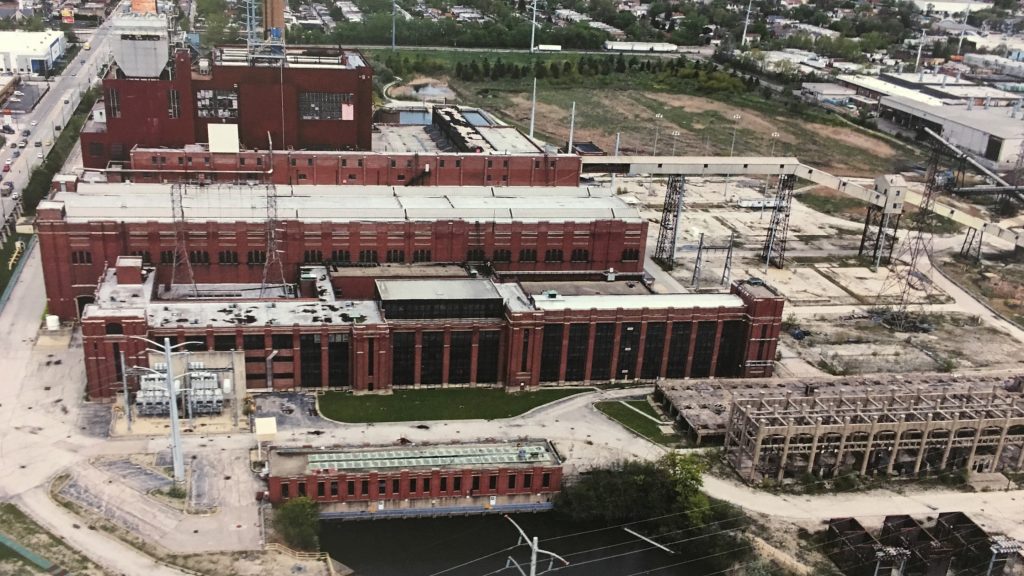 Hilco Development Partners plans to invest $100 million to redevelop the Crawford Generating Station into a one million-square-foot warehouse. [Hilco Development Partners]
Aldermen set to consider tax break for Little Village warehouse on Crawford coal plant
By A.D. Quig and Mauricio Peña,Block Club ChicagoAldermen are set to vote on a tax break for a massive, controversial distribution center set to replace a former coal-fired power plant in Little Village.
At 11 a.m. Friday, the Economic, Capital and Technology Development Committee will once again consider a tax incentive for Hilco Partners’ one million square foot distribution center dubbed Exchange 55.
If the tax break is approved, the property would be assessed at 10 percent of its market value for the first 10 years, 15 percent in the 11th year and 20 percent in the 12th year.
Preservation Chicago included the Crawford Power Plant at 5th Street and Pulaski Avenue on its list of most endangered buildings released Thursday.
The plant, which has a brick facade with Art Deco and “Gothic Industrial” influences, was built in 1926 by Graham, Anderson, Probst and White, according Preservation Chicago.
Last month, the committee delayed the vote after opponents said the already-approved development would pollute the environment.
Ahead of the meeting, Little Village Environmental Justice Organization Executive Director Kim Wasserman-Nieto said, given the historic respiratory issues in the neighborhood from industrial pollution, and diesel trucks inundating the neighborhood, the development “should not” receive financial incentives.
In September, the City Council approved the $100 million plan despite vehement opposition from residents from nearby residents and environmental groups.
RELATED: Massive Little Village Warehouse On Old Crawford Coal Plant Site Approved By City Council
During January’s committee meeting, Wasserman-Nieto testified that more than four trucks pass 31st Street and Pulaski Road every minute, and said that increased air pollution from diesel-fueled trucks will exacerbate respiratory illnesses, particularly among the 8,000 students attending school within a mile of the planned center.
Colleen Smith, the legislative director for the Illinois Environmental Council, said taxpayers should not be on the hook “to perpetrate more environmental racism,” and said she was “alarmed” at how much the process so far has conflicted with what the Little Village community wants.
Aldermen agreed to hold off on the measure.
“I know that community has been facing serious contamination issues for decades and don’t think it’s fair to approve project that is not so clear,” Ald. Milly Santiago (31st) said, and asked that the item be held in committee. Aldermen agreed unanimously.
Related: Semi-Trucks Are Taking Over Little Village, Neighbors Say — And Giant Warehouse Plan Will Make It Worse
Ald. Ricardo Muñoz (22) signed a letter of support for the tax break, but has not been at City Hall since he was charged with misdemeanor domestic battery, and entered rehab in Indiana for alcohol addiction.
During the meeting, Hilco representatives said the warehouse would strive to protect the environment by recycling 90 percent of demolished materials, exceeding the requirements of the city’s stormwater ordinance, planting 600 trees and installing electric car charging stations.
On Wednesday morning, a fire broke out during the dismantling of an electrical transformer on site as part of the demolition process. The fire was struck out quickly, and one firefighter was transported to a local hospital in good condition.
Developer Hilco Partners purchased the 70-acre site in 2017.
The Crawford Power Plant was shut down in 2012 after community-led efforts raised concerns about the impact coal pollution was having on the health of Little Village residents.
The Hilco plan has sparked anger among residents who fear the distribution center will bring more diesel trucks and increase pollution in the neighborhood.
Last year, Hilco officials told residents they plan on beginning demolition and remediation in 2019. The distribution center is expected to be completed in 2020.
In other action, aldermen will consider Mayor Rahm Emanuel’s appointment (A2019-5) of Christopher Wheat to the Community Development Commission.
Wheat is the director of strategy and city engagement for the American Cities Climate Challenge, and worked in Emanuel’s office for seven years as the chief sustainability officer and Emanuel’s chief of policy.
Mauricio Peña, of Block Club Chicago, contributed to this report.


